

issue 133 | 10 nov 2025

The integrity flash

Analysis of Developments in the Space Domain

in this issue

Checking In With Cosmos 2581/2582/2583

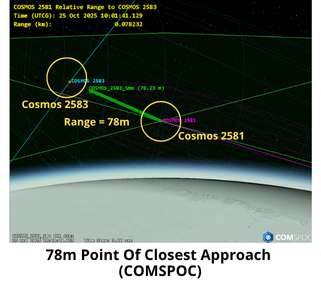
8 Nov 2025: It’s been a while since I checked in on the Russian Cosmos 2581/82/83 (62902/62903/62904) trio. Recall Russia launched these three satellites on 5 Feb 2025 (video) and released no details of the mission other than to say they were for the “Ministry of Defense.” While my reporting regarding these objects ceased in early April, their activities have not…the spacecraft regularly orbit within <1km of one another. My ability to analyze what’s going on is limited due to reliance on two-line element set (TLE) based data which is satisfactory for monitoring the general goings-on on orbit but presents challenges when trying to perform detailed analysis of two objects which are extremely close to one another or frequently maneuvering (or both). With these limitations I turned to the pros over at COMSPOC_OPS to take a look at the trio and compare our results. To limit the scope of the research we focused on on just the interactions from 24-29 October 2025. Watch Video of 25 Oct Activity.

– First a little review:
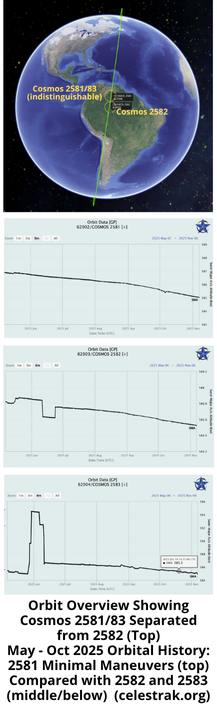
  • Russia has maneuvered Cosmos 2581 the least going back to Feb 2025. It seems Cosmos 2581 plays the role of “target” for both Cosmos 2582 and 2583 which maneuver much more frequently.
  • In Feb Russia maneuvered Cosmos 2581 & 2582 into the same orbital altitude and initiated a long series of proximity maneuvers. They remained in close vicinity from Feb – Apr 2025.
    • During this period, 2581 & 2582 achieved extremely close distances. COMSPOC reported they came as close as 50m from one another while flying in tandem. On 11 Mar one report indicated a close approach to be within 15 meters.
    • During this time Cosmos 2582 was the active satellite performing the maneuvering, with Cosmos 2581 acting as the target.
    • For the details see 9 Mar 2025 & 6 Apr 2025 Flash and associated video.
  • During this time Cosmos 2583 did not participate in proximity operations. However, it did release a sub-satellite (Obj F) on 18 Mar and did conduct proximity operations with it through May 2025.
    • This may have been a test of Cosmos 2583 systems. In late May Russia raised Cosmos 2583’s orbit and in mid-June closely approached Cosmos 2581, coming within a few hundred meters or less. Subsequently, Cosmos 2582 joined them by maneuvering on June 23, resulting in all three satellites orbiting closely together.
  • During the period of our research (24-29 Oct 2025) Cosmos 2583 conducted several close approaches with Cosmos 2581. Cosmos 2582 played no apparent role in the operations as it remained over 250km away and is orbiting at a slightly higher orbit than its sibling satellites.

– TLE Based Analysis 24-29 October 2025
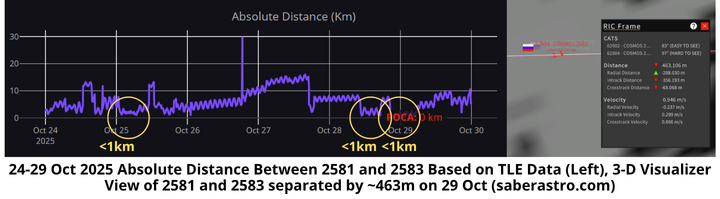
  • Cosmos 2581 and Cosmos 2583 are in RPO conditions with one another. For the majority of the time the two satellites were within 10km of one another. There were 3 distinct periods where the satellites were within 1km of one another. The point of closest approach was ~463m. Both satellites have an average altitude of 585.3 to 585.0km.
  • Cosmos 2582 was not involved with this particular set of close approaches, its point of closest approach with either 2581 or 2583 was over 250km. The average altitude of Cosmos 2582 was 585.3km during this time period.

– COMSPOC Analysis: Cosmos 2581 v 2583 24-29 October 2025

  • TLE analysis provides some indications of interesting activity, but lacks fidelity to gain an understanding of what is actually happening. TLEs consist of average results from multiple observations which is helpful when monitoring/cataloging space objects which are maneuvering infrequently or not operating in close proximity with other satellites. To understand what was happening between Cosmos 2581 and 2583 we needed more accurate information. Thankfully the COMSPOC team has access to highly accurate data.
  • One of the issues when using TLEs to monitor object orbiting in close proximity is called “cross tagging” which occurs when one object is misidentified with another resulting in faulty orbital information. After noticing an increase in cross tags between COSMOS 2581 and 2583, COMSPOC’s ops team scrutinized the behavior between these objects using data from LEOLABS and their COMSPOC’s kalman filter-based solution, produced from one of

their applications called “SSASuite.”

  • Reviewing raw sensor data enabled COMSPOC orbital analysts to resolve several cross tag instances. Use of the superior precision of the High Definition ephemeris, enabled by LeoLabs data, proved crucial to the task and allowed a level of analysis not possible using only TLEs.
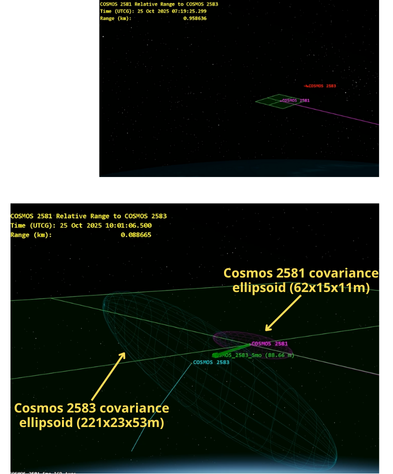
  • Point of Closest Approach: On 25 Oct 2025 10:01:41z COSMOS 2583 approached within 80 meters of COSMOS 2581, passing from below to above the VVLH X-Y plane of COSMOS 2581 (see graphic & video).

ISR University provides courses and pathways for professionals

Checking In With Cosmos 2581/2582/2583

Russian space operators likely set up this point of closest approach with 2 separate Cosmos 2583 maneuvers. The first occurred on between 1710-0744z with a total delta v (fuel usage, “dV”) of 0.242 m/s, and the second just over an hour later between 0851-0903z with a total dV of 0.407 m/s. You can see both maneuvers in this VIDEO, specifically when Cosmos 2583 is highlighted in RED.

  • COMSPOC analysts also produced two other videos (vid1 & vid2) that show the close approach window from different perspectives.

– In some of the videos you’ll notice the satellites are in the center of an (American) football shaped cage. These cages are covariance ellipsoids which indicate COMSPOC’s confidence in the solution. A covariance ellipsoid, such as you see in the video, represents a volume within which COMSPOC’s system has

determined that the object resides, with a 95% certainty. The radii of the covariance volume for COSMOS 2583 are 221.1m by 22.92m by 52.95m. By contrast, the covariance radii for COSMOS 2581 are 61.58m by 14.75m by 10.92m. This volume is considerably smaller than 2583’s, indicating that COMSPOC had better precision about the position of 2581 than 2583. And given that 2583 was maneuvering during this time, it makes clear sense why this would be.
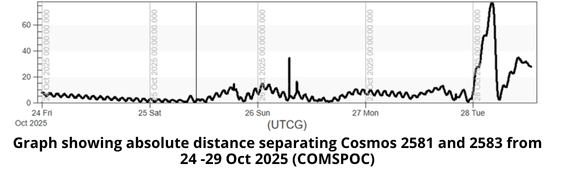
    • Editor’s comment: Russia is clearly testing RPO capabilities and tactics with Cosmos 2581, 2582 and 2583. In our 5-day focus there were examples of 2581 and 2583 coming within <100m of one another. It will be interesting to see if Cosmos 2582 again enters the fray. Special thanks to the COMSPOC team for their support!

Review: Russia Operating Chinese-built satellite

3 November 2025: Space Review journalist Bart Hendrickx reports that Russia is using a Chinese-built satellite—likely the Taijing-3-02 (likely 58822) launched in January 2024—to obtain high-resolution (0.5m) imagery in support of its war in Ukraine, rebranding it as “Stilsat-1” despite never registering it. The satellite was purchased turnkey from a Chinese private firm, MinoSpace, because the Russian industry could not rapidly produce an optical system. Operated by the private Russian company Stilsoft, Stilsat-1 supports security services, including the FSB, by providing optical reconnaissance, identification of Ukrainian infrastructure, targeting support, and monitoring of Russian-occupied territories.

From Bart Hendrickx’s detailed SpaceReview article:
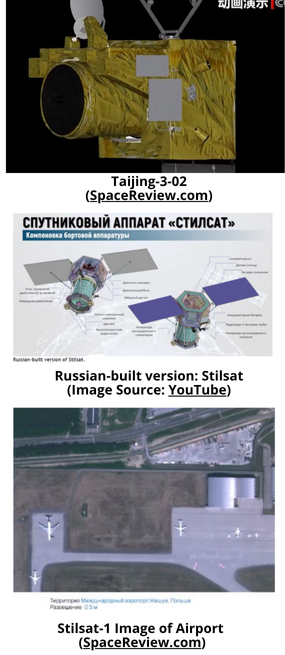
  • Russia secretly acquired a Chinese-built satellite – “No satellite by that name has been officially announced …the reason is that it was built and launched by China”
  • Purchase driven by capability gaps – “One key factor in the decision to purchase a Chinese satellite was the inability of the Russian industry to quickly deliver an advanced optical system with a resolution of 0.5 meters.”
  • Stilsoft, a private Russian firm, operates the satellite – “departure from the standard practice in which the Ministry of Defense assigns projects to prime contractors belonging to the Roscosmos State Corporation and then assumes control of the satellites after they are launched into orbit.”
  • Primary consumers include the FSB – “In his November 2023 presentation, Yuri Stoyanov had singled out the FSB as the main client for Stilsat.”
  • Stilsat-1 imagery supports reconnaissance – “Burmak (Stilspace executive director) went on to show some of the images made by Stilsat-1, including two with a possible connection to the war in Ukraine.”
  • Released images include sites linked to Ukraine logistics, such as Poland’s Rzeszów-Jasionka airport, a major Western transfer hub for “weapons, medical aid, and other supplies.”
  • Evidence indicates Russia may be using imagery from up to three Chinese-built satellites (Taijing-3-01, 3-02, & 3-04) under the “Stilsat umbrella.”
  • “There is no definitive evidence that Taijing-3-02 is the satellite purchased by Russia under the name Stilsat-1. Nevertheless, there are some additional factors supporting this conclusion.”

China Parks TJS-20 in GEO

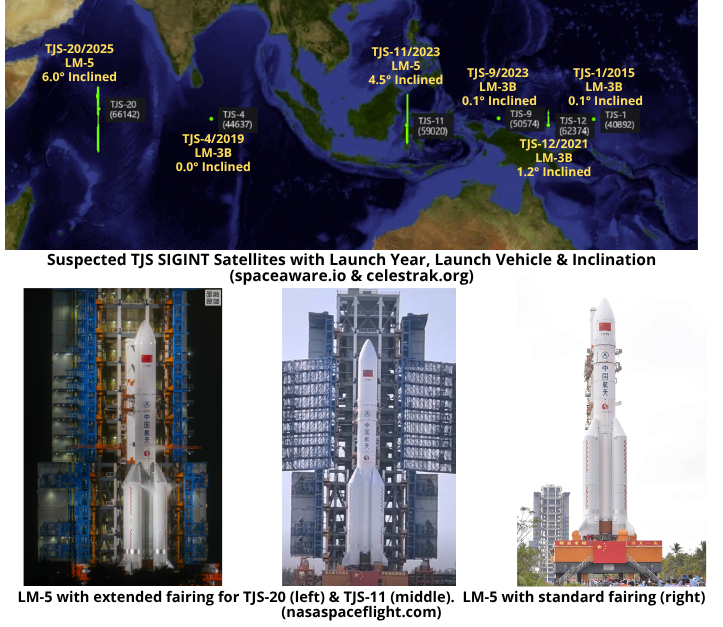
7 Nov 2025: As noted in the 26 October Flash, China launched TJS-20 (66142) on 23 October. After spending a little over a week in Geosynchronous Transfer Orbit (GTO) Chinese space operators circularized TJS-20’s orbit. TJS-20 has now joined the GEO belt and is located at 62.5° E longitude (east of the Arabian Peninsula and west of India). TJS-20’s orbit is inclined 6.0° which is greater than any of the other TJS satellites. China launched TJS-20 using a LM-5 with an extended fairing, the exact same launch configuration used for TJS-11 in February 2024. The China Aerospace Science and Technology (CAST) organization developed TJS-20. Previous TJS satellites also built by CAST include TJS-1 (40892), TJS-4 (44637), TJS-9 (50574), TJS-11 (59020) and TJS-12 (62374) which are assessed to be part of the Qianshao program and SIGINT mission related.

– At 6.0° TJS-20 has a greater inclination than any of the other suspected TJS SIGINT satellites. TJS-11 has the second highest inclination…at the beginning of its life on orbit TJS-11 was inclined 5.5° and is now at 4.5°. TJS-20’s nearest TJS neighbor is TJS-2 (41191) which is at 66.5° E and is a suspected missile warning satellite.
TJS Summary

– TJS-20 is the 6th TJS launch in 2025, 2x greater than any other year. In the past 10 years China has launched 18 TJS satellites, half of which were launched in the past 2 years. For some reason China avoided the TJS-8 and TJS-18 designations…
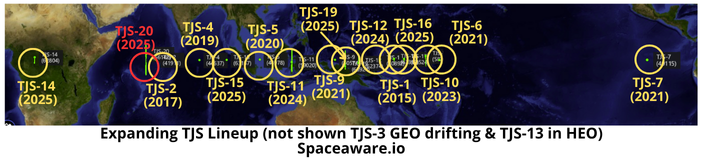
  • 2015 (1): TJS-1 (SIGINT?)
  • 2016 (0): No Launches
  • 2017 (1): TJS-2 (Missile Warning?)
  • 2018 (1): TJS-3 (suspected satellite inspection)
  • 2019 (1): TJS-4 (SIGINT?)
  • 2020 (1): TJS-5 (Missile Warning?)
  • 2021 (3): TJS-6 (Missile Warning?), TJS-7 (Unknown), & TJS-9 (SIGINT?)
  • 2022 (0): No Launches
  • 2023 (1): TJS-10 (unknown)
  • 2024 (3): TJS-11 (unknown), TJS-12 (SIGINT?), TJS-13 (HEO, Missile Warning?)
  • 2025 (6): TJS-14 (unknown), TJS-15 (unknown), TJS-16 (unknown), TJS-17 (unknown), TJS-19 (unknown), & TJS-20 (SIGINT?)

YG-40 03 Maneuvers into Formation

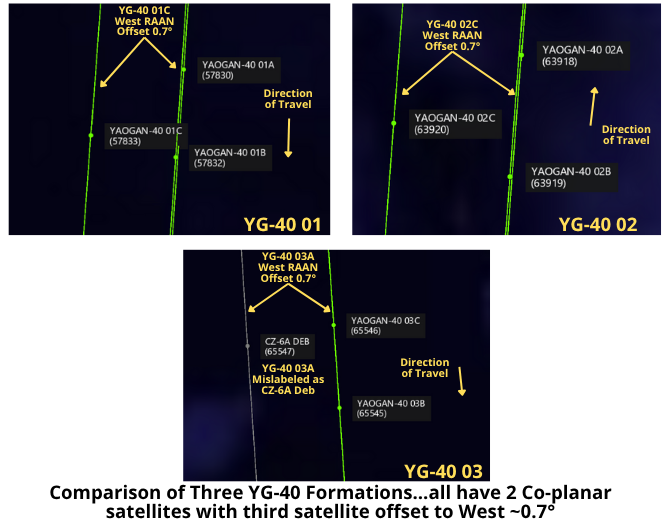
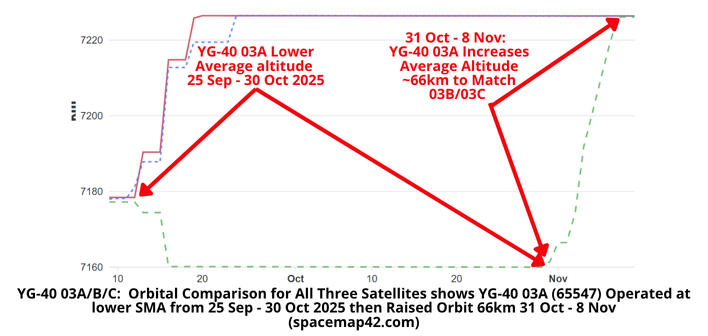
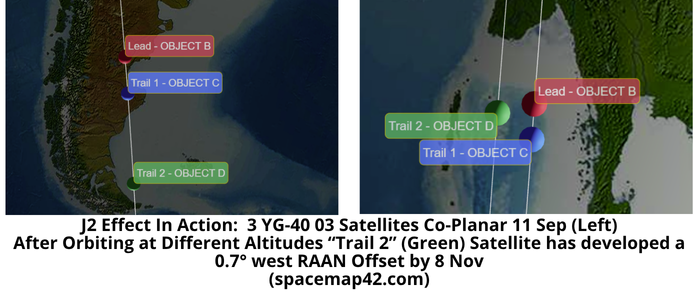
8 Nov 2025: Chinese space operators raised the average altitude of YG-43 03A (65547) to match that of YG-43 03B/C (65545/65546), and the third satellite now has an ~0.7° west RAAN offset from its sibling satellites. Thanks to the J2 effect, the trio are now orbiting in a “triangle” formation and able to perform their radio frequency monitoring and geolocation mission. China has followed a similar deployment pattern for its other RF/Geolocation triplet formations, namely YG-40 02A/B/C (63918, 63919 & 63920), YG-40 01A/B/C (57830, 57831 & 57832) and its 4 sets of YG-31 triplets. YG-40 01 and 02 also have a west RAAN offset of ~0.7°.


China deployed the 3 YG-40 formations into orbital planes separated by ~37°. Unknown how many YG-40 triplets China intends to launch.


Editor’s Note: current catalog (as of 9 Nov 0447UTC) has associated YG-43 03A with SATNO 65544 and not 65547, which is cataloged as “CZ-6A Deb” . I believe this is in error as 65544 has not maneuvered since launch while 65547 has performed several maneuvers since the 6 Sep 2025 launch.
find a job in a flash!

Advertise your jobs in the Integrity Flash

  • Distributed directly to 3,000+ Professionals
  • Reader Base of U.S. Military, Allied Militaries and Industry
  • Highly-Targeted, Internationally-Praised Publication

Do you have a job you would like posted in the FLASH? Contact: [email protected]

integrity flash job Board

hiring

IT Program Manager
Yokota AB, Japan – Full-Time – On-Site | $95,000–$105,000/year Lead critical IT initiatives supporting U.S. Air Force operations. Join Integrity ISR to manage infrastructure projects, acquisitions, and communications systems that keep missions connected and operational across the Pacific.

hiring

Sr. Courseware Developer – Space Cyber
Remote – Contract – $50–$60/hr Help build the future of space cyber training. Join Integrity ISR to design and deliver Initial Skills Training for Cyberspace Guardians, creating curriculum that shapes the next generation of cyber professionals.

hiring

Talent Network
Remote – United States Don’t see the perfect role yet? Join Integrity ISR’s Talent Network to submit your resume, share your ideal roles and locations, and be considered for future openings as they become available.

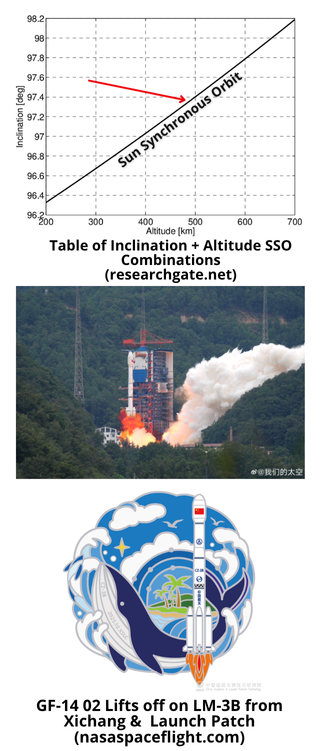
26 Oct 2025: China launched a LM-3B with the Gaofen-14 02 (66175) satellite from Xichang. According to official sources, Gaofen-14 02 entered the planned orbit successfully, it is currently cataloged in a sun synchronous orbit with an average altitude 483.8km and inclined 97.4°. Chinese media noted, “the Gaofen-14 satellite can efficiently acquire high-precision stereo imagery across the globe, produce large-scale digital topographic maps, and generate products such as digital elevation models, digital surface models, and digital orthophotos, providing fundamental geographic information support for national economic and national defense development.” Gaofen-14 02 joins the still operational Gaofen-14 01 (47231) on orbit. Launch Video.

– This was only the second LM-3B to launch into a sun synchronous orbit (SSO), the first was GF-14 01 on 6 Dec 2020.

– Per Jack Congram’s awesome China in Space site, Gaofen-14 02 “will circle basically the entire Earth, creating digital topographical maps, elevation models, and other kinds of geographic maps. It has been reported that digital items created by Gaofen-14-02 will support national plans as well as those for the Belt and Road Initiative.”

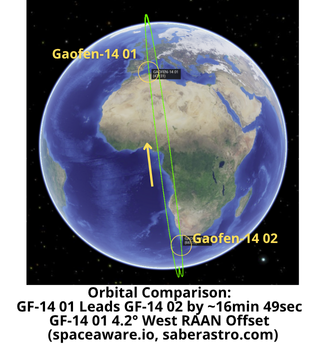
– GF-14 02 is in a similar orbit with that of its older sibling, GF-14 01. The latter has an average altitude of ~488km, about 5km higher than GF-14 02, and is inclined 97.3°, 0.1° greater than GF-14 02.

-Currently GF-14 01 has a 4.2° west RAAN offset from GF-14 02. This may change as GF-14 02 settles into its final orbit. Recall rate of RAAN precession varies with average altitude.
3 Nov 2025: China launched a Long March-7A with the Yaogan-46 (66313) remote sensing satellite from Wenchang. According to official sources, the satellite entered the planned orbit and “will be primarily used in disaster prevention and relief, land resource surveys, hydrology, meteorology, and other related fields”. The 18 SDS has cataloged the satellite in Medium Earth Orbit (MEO) and in a similar orbit as Yaogan-45 (65563) which China launched just 55 days prior (9 Sep 2025). It appears China is establishing a Yaogan remote sensing constellation in MEO. China has not released information regarding any specific sensor types, however the launch patch from YG-45 seemed to indicate an imaging Synthetic Aperture Radar (SAR). Launch Video.

– YG-46 is in a 7,500×7,364km orbit with an inclination of 20.0°. By comparison YG-45 is in a 7,504×7,494km orbit and is also inclined 20.0°.

-The two satellites are NOT co-planar as YG-46’s orbit is offset ~120° from YG-45. This suggests there may be another Yaogan MEO satellite in the future to give the constellation 3 orbital planes separated by 120°.

  • For background, Low Earth Orbit extends to 2,000km, Medium Earth Orbit covers 2,000 – 35,786km, GEO is 35,786km.

– China used a LM-7A to launch both YG-45 and YG-46. YG-46 was the second instance the LM-7A has been used to support a MEO launch.

– China’s use of MEO for Yaogan reconnaissance satellites is unusual in that it is much further from the Earth’s surface than is typical for Earth Observation satellites. Being at higher altitudes increases the potential sensor coverage area, but this comes at the cost of decreased imagery resolution.
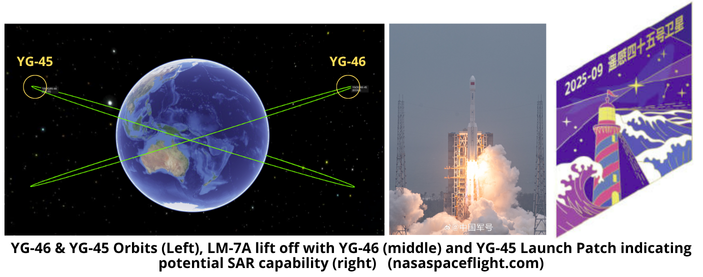
  • YG-45 & 46 are not the first imagery satellites China has placed beyond LEO. While it is the first in MEO, China operates the following imagery satellites in GEO (36,000km above the equator): Gaofen-4 (2015/41194) estimated resolution 50m, Gaofen-13 01 (2020/46610) estimated resolution 15m, Gaofen-13 02 (2023/55912) estimated resolution 15m and Yaogan-41 (2023/58582) estimated resolution 5m.
  • China also operates the Ludi Tance-4 01 (2023/57624), the world’s first and only GEO-based Synthetic Aperture Radar (SAR) imager.
  • China has not released any additional information regarding YG-46 capabilities. The launch patch associated with YG-45 suggests a SAR imager with the collection pattern emanating from either side of the central star. This is pure speculation on my part.

Yaogan-43 Update

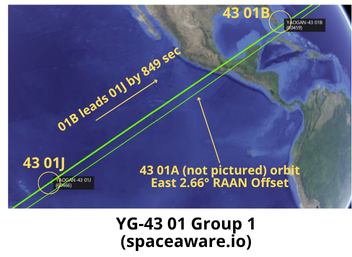
31 Oct 2025: The Yaogan-43 01 formation (60458-60466) continues to change. Back in April I noted that 5 of the 9 satellites had ceased maintaining their average altitudes resulting in a break in formation and increasing RAAN differentials. Revisiting the orbits for all 9 satellites it appears China may be operating them in three separate formations of three satellites. Specifically, Group 1: YG-43 01 B/J/A (60459, 60466, 60458), Group 2: YG-43 01 D/G/F (60461, 60464, 60463), and Group 3: YG-43 01 C/H/E (60460, 60465, 60462). We do not know the specific capabilities of any of the Yaogan-43 satellites, “reportedly these are different satellites from several manufacturers. China may be creating these sub-groups to test tip-cue capabilities from differing sensor types.

– Overview
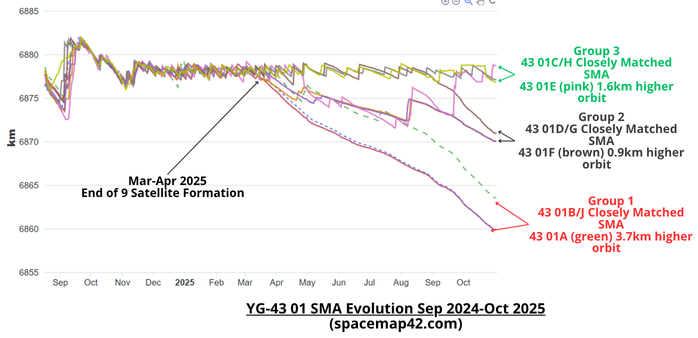
  • The three groups are orbiting at 3 distinct altitudes (SMA) with 2 of the 3 satellites at closely matched altitudes while the third satellite maintains a slightly higher orbit.
  • In all three groups the RAAN difference between the satellites with matched SMA values is ~0.2°. The RAAN difference between the third satellite and the first 2 satellites is >2.2°.

– Group 1: YG-43 01 B/J/A

  • YG-43 01 B and J have an identical SMA of 478.5km (as of 31 October). Neither satellite has maneuvered in the past 7 months (19 Mar for 43 01B and 12 Mar for 43 01J). The satellites maintain a separation of ~849 seconds with 01B in the lead of 01J.
  • YG-43 01A maneuvered more recently than either 01B or J (12 July) in is orbiting 3.7km higher than the 01B/J pair. 01A currently has a east RAAN offset of ~2.66°

– Group 2: YG-43 01 D/G/F

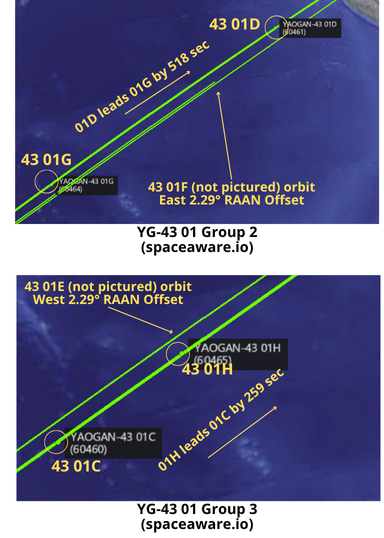
  • Unlike Group 1 all three Group 2 satellites maneuvered recently (Aug 2025). 43-01D maneuvered on 10 Aug, 01G on 9 Aug, and 01F on 12 Aug.
  • YG-43 01 D and G have an identical SMA of 488.7km. The satellites maintain a separation of ~518 seconds with 01D in the lead of 01G.
  • YG-43 01F is orbiting 0.9km higher than the 01D/G pair. 01F currently has a east RAAN offset of ~2.29°.


– Group 3: YG-43 01 C/H/E

  • China has maintained the original YG-43 orbit of ~495km most closely with Group 3. The satellites maneuver frequently: 43-01C maneuvered on 29 Sep, 01H on 10 Oct, and 01E on 30 Oct.
  • YG-43 01 C and H have an identical SMA within 0.3km of one another at ~496km. The satellites maintain a separation of ~259 seconds (curiously this is half of Group 2) with 01C in the lead of 01H.
  • YG-43 01E is orbiting 1.6km higher than the 01C/H pair. 01E currently has a west RAAN offset of ~2.22°.

– While We’re Here: A Quick Look at YG-43 02/03
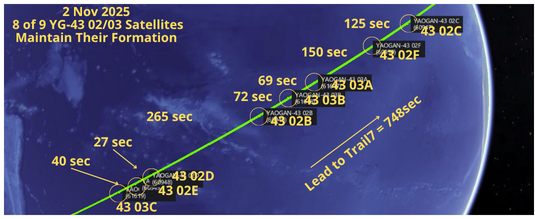
  • The 9 satellites that make up the YG-43 02 (60945-60950) and YG-43 03 (61617-61619) remain largely in formation. The one exception is YG-43 02A (60945) which last maneuvered in late-April 2025 and is now orbiting nearly 25km lower than the other 8 satellites.
  • The remaining 8 satellites are remaining within 0.1km in altitude (SMA). As a result they are closely maintaining their relative positions with one another.

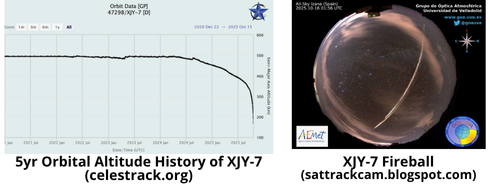
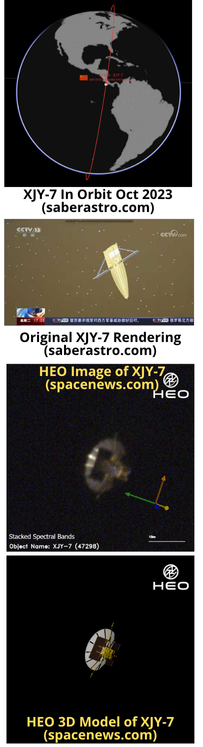
16 October 2025: China’s experimental SAR imaging satellite, XJY-7 (47298) re-entered the Earth’s atmosphere crashing into the Atlantic Ocean near the Canary Islands. After XJS-7 was destroyed, our friends at HEO released both imagery and a 3D model of XJS-7 which confirmed the satellite had a SAR capability and also used fixed solar panels.

– China launched XJY-7 (47298) on 22 Dec 2020 on the maiden LM-8 flight from Wenchang along with 4 other satellites. Launch Video.

– China released a satellite rendering immediately following launch which showed the satellite prior to SAR antenna deployment.

– For nearly 5yrs the XJY-7 operated in a sun-synchronous orbit, at 495km with 97.4° inclination.

– XJY-7 last maneuvered ~16 Aug 2024 and over the next year its orbit slowly decayed until it re-entered on 16 Oct 2025.

  • From Marco Langbroek’s outstanding blog:
    • “In the early local morning of 16 October 2025 around 1:56 UTC, a spectacular phenomena appeared in the sky over Tenerife in the Canary Islands. A bright, slow, fragmenting fireball moved from south to north over the sky. Sonic booms were heard and registered by several seismic stations on Tenerife.”
    • “It is curious that no TIP was issued for this reentry by CSpOC. This was a large heavy object: 3 x 5 x 9 meter and 3 tons in mass. CSpOC apparently overlooked this reentry – a few hours post reentry, they however did add an administrative “decay message” for October 16 to the catalogue for this object, but without any further details.”
    • “We recently have seen a complete lack of TIP’s being issued for any object, for over a month. Only recently, CSpOC resumed issuing TIP’s. CSpOC is currently clearly having some issues with their system. Luckily, we were nevertheless able to identify the object responsible for this spectacular reentry, by some diligent analysis.”

– In addition to confirming XJY-7 was a SAR satellite, HEO imagery also revealed XJY-7 had to rotate its entire body due to its use of fixed solar arrays.
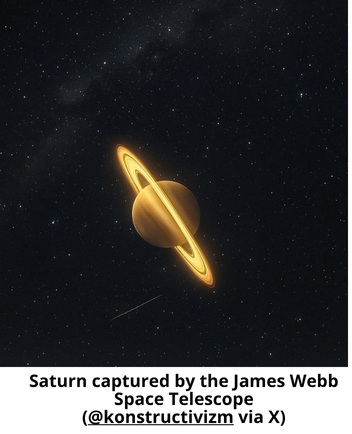
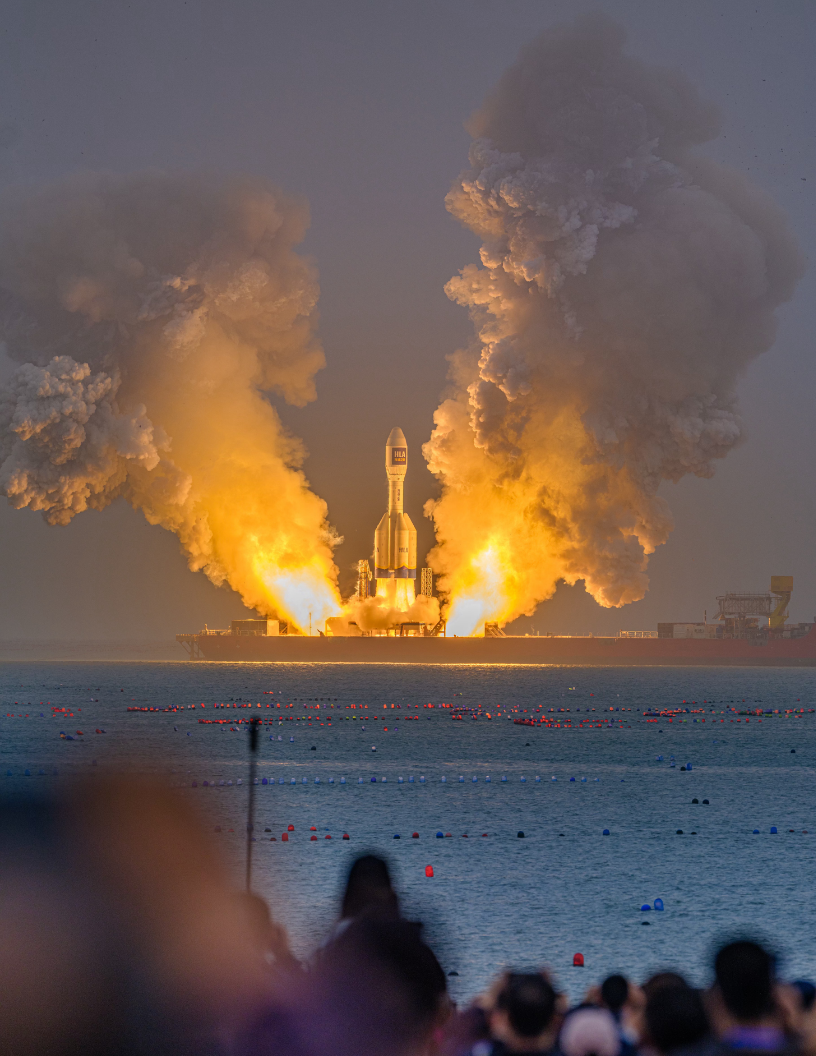
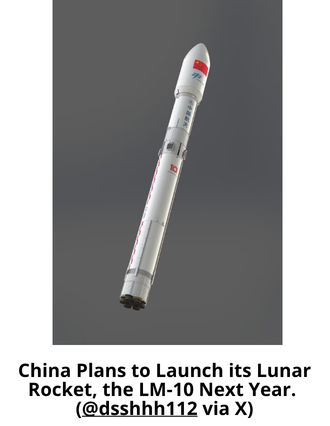
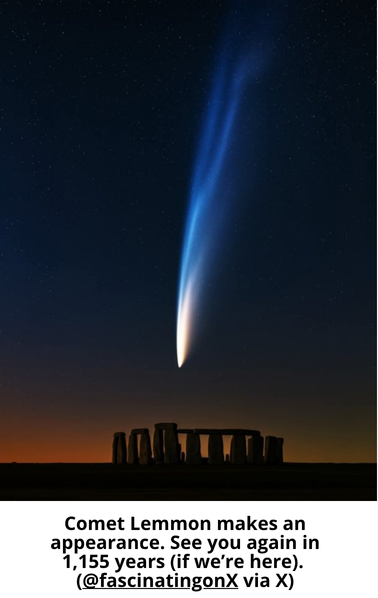
Pics o’ the Fortnight!

All content is considered Integrity ISR Proprietary Information and may not be copied or distributed without written consent from Integrity ISR, LLC.

Days
Hours
Minutes
Seconds

become a member

Subscribe now to unlock full access.

Already a member? Log in