issue 135 | 8 Dec 2025
The integrity flash
Analysis of Developments in the Space Domain
in this issue
Cosmos 2589 Moving to GEO
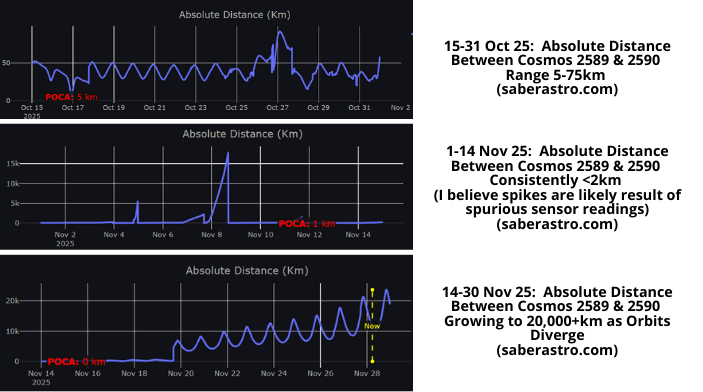
28 Nov 2025: After months of operating in proximity with one another Cosmos 2589 (64467) and Cosmos 2590 (64527) appear to be heading their separate ways. Cosmos 2589 began conducting maneuvers to circularize its orbit on 19 Nov 2025 when it began lowering its apogee and raising its perigee. Since that time Russian space operators have begun to maneuver the satellite every 12 hours. Cosmos 2589’s eccentricity has begun to decrease and has gone from 0.365 on 19 Nov to 0.350 on 28 Nov. I expect the maneuvers will continue over the next several weeks and to eventually get to ~0.0 (nearly a perfect circle). Once 2589’s orbit has been circularized the satellite will have finally joined the Geosynchronous belt and be able to conduct inspection missions of other satellites in that orbital regime. For its part Cosmos 2590 maneuvered between 14-19 November to increase its eccentricity. Prior to the 19 Nov maneuvers Cosmos 2589 and 2590 maintained a separation distance of <10km. As of 28 Nov the satellites are more than 20,000km apart.
Background
- As noted in the 23 June Flash, Russia launched Cosmos 2589 from Plesetsk on an Angara-5 rocket equipped with a Briz-M upper-stage on 19 June 2025. The launch placed Cosmos 2589 into a highly eccentric orbit with an apogee of 51,200km and a perigee of 20,374km. The orbit is oriented to ensure that the spacecraft remains over Russian territory.
- On 26 June Cosmos 2589 released a sub-satellite, Cosmos 2590. As noted in the 8 July Flash, Russia has maneuvered both Cosmos 2589 and 2590. Cosmos 2589 is suspected to be an inspector satellite with links to the same Russian companies responsible for the Nivelir inspection satellites
Recent Maneuvers
- ~2-14 Nov: Cosmos 2590 conducted RPO with Cosmos 2589. As had become the norm over the summer Cosmos 2590 was the maneuvering object with Cosmos 2589 acting as the “target.”
- Based on TLE data the two satellites operated <2km apart for nearly the entire 2 weeks.
- 14 Nov: Cosmos 2589 performed two maneuvers resulting in an exit from its RPO with Cosmos 2590. By 20 Nov, the minimum distance between the objects was over 3000kms.
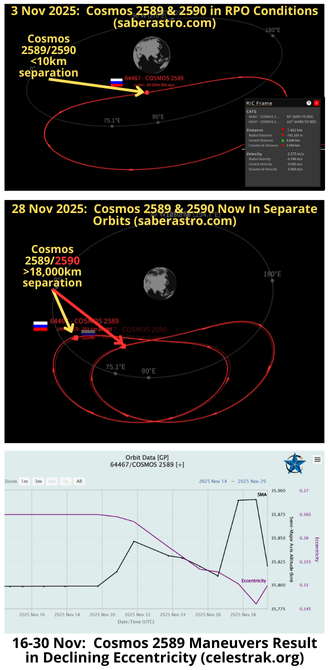
- 28 Nov: The Joint Commercial Operations Cell reported: “Cosmos 2589 maneuvers have followed an ongoing pattern of performing an apogee and perigee maneuver every ~12 hours appearing to circularize its orbit and potentially going to a normal GEO orbit.”
-The question now becomes how long will it take for Russia to maneuver Cosmos 2589 from its Geosynchronous Highly Elliptical Orbit to a more standard Geosynchronous orbit. We don’t know exactly, previous Russian satellites that have followed this flight profile required between 3-6 months.
- Per Bart Hendrickx: “Two earlier Russian missions have followed this particular insertion profile via a supersynchronous transfer orbit, namely Express-80/103 in 2020 and Express-AMU3/AMU7 in 2021. Both pairs of satellites were based on the lighter Express-1000 platform. The first pair needed about six months to reach GEO (using only SPD-100V electric thrusters) and the second pair about three months (using SDP-100V thrusters and an additional SPD-140D thruster). 14F166A, using the heavier Express-2000 platform, has only SPD-100V engines for this purpose.”
Editor’s Comment: It appears Russia conducted a final operations test of Cosmos 2590 from 2-14 Nov 2025 having the satellite remain <2km from Cosmos 2589 for extended periods of time. With testing objectives met (an assumption) Russia has moved to a new phase of operations with Cosmos 2589. I expect Cosmos 2589 to continue to lower its apogee and raise its perigee for the next 3-6 months, eventually circularizing into Geosynchronous Orbit. Several questions remain: 1) how will Cosmos 2589 operate in GEO…will it continuously roam similar to China’s SY-12 inspector satellites or drift to specific target satellites and then remain in proximity for several months, similar to Russia’s Luch/Olymp; 2) Will Cosmos 2589 release additional sub-satellites once in GEO; 3) will Cosmos 2590 release its own sub-satellite/projectile as we’ve noted with Nivelir satellites in LEO; and 4) will Russia maneuver or conduct further testing with Cosmos 2590. I think we have a reasonable chance to answer all of these questions in the coming months. Stay Tuned!


Separation Anxiety: SJ-21 and SJ-25 Part Ways
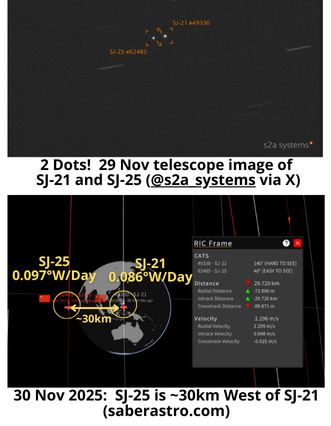
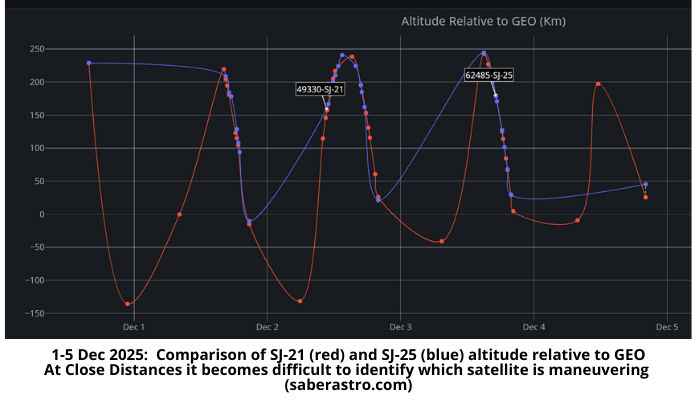
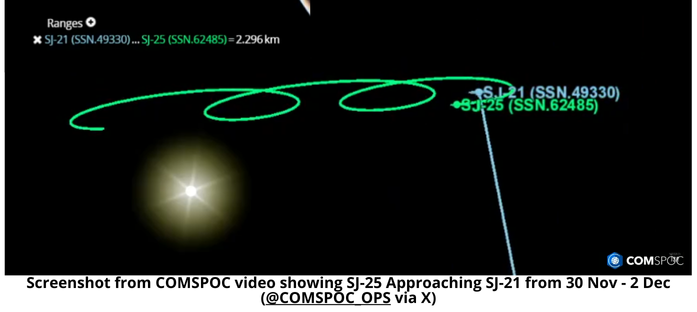
5 Dec 2025: After having docked on 2 July 2025 it appears SJ-21 (49330) and SJ-25 (62485) successfully detached from one another. The Joint Commercial Operations Cell first reported the potential separation on 28 November, then the amazing s2a systems published an image showing two distinct dots confirming separation on 29 November. Based on published TLE data from Spacetrack.org and SBMS from Saberastro, the two satellites were separated by ~30km on 30 November. From 1-5 December both satellites maneuvered to initiate RPO conditions with one another with occasional close approaches of <1km. The situation remains fluid and I expect more maneuvering from both satellites in the coming days/weeks. Watch COMSPOC Video.
Background:
- China launched SJ-25 on 6 Jan 2025 and announced that it would be “used for the verification of satellite fuel replenishment and life extension service technologies.”
- China launched SJ-25 into a co-planar orbit with SJ-21 which had been used to demonstrate “debris mitigation technology” (it captured a defunct Chinese satellite in GEO and dragged it into a graveyard orbit in early 2022.)
- June-July 2025: China maneuvered both SJ-21 & SJ-25 into extremely close proximity with one another and made several docking attempts. The two satellites entered into merge conditions on 2 July.
- August 2025: China conducted significant plane change maneuvers with the docked SJ-21/25 satellites. The pair made minor maneuvers from 2-7 Aug, then from 8 – 15 August, Chinese space operators conducted several plane-changing maneuvers which resulted in a 6° reduction of the spacecraft’s inclination (from 10.4° to 4.4°)and a significant change in RAAN as well. Such maneuvers are highly fuel/energy intensive.
Recent Activity
- Using only TLE data it is impossible to determine maneuvers with any reliable precision.
- On 30 Nov, SJ-25 had an SMA ~1km greater than SJ-21. As a result, SJ-25 was drifting westward at 0.097°/day compared with SJ-21’s westward drift of 0.086°/day.
- From 2-4 Dec Chinese space operators maneuvered both SJ-21 and SJ-25 and the two spacecraft entered into RPO conditions separated by 1-7km. (see graphic next page)
- On 5 Dec the satellites again maneuvered and began to increase their absolute separation distance. The satellites are separated primarily in the In-Track vector.
Editor’s Comment: Now we wait to see what China does next with each of these satellites. Barring any official announcement from China related to refueling success, our only indications will be from subsequent maneuvering. I’ll be watching for indications of SJ-25 maneuvering to get co-planar with other Chinese satellites. I believe the most likely re-fueling targets are SJ-23, SY-12 01 or 02, & TJS-3. Currently SJ-23 is in the closest orbital plane with SJ-25 with a ~1.5° inclination difference & 18.3° RAAN difference. I will also be looking for potential orbital debris test objects for SJ-21 to attempt to capture (this assumes a successful refueling mission).
Orbital Relations? A Look at YG-40 and Guowang
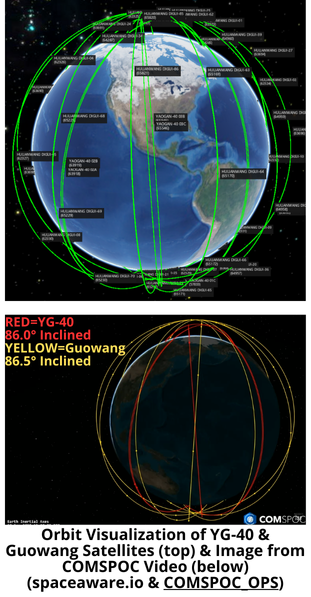
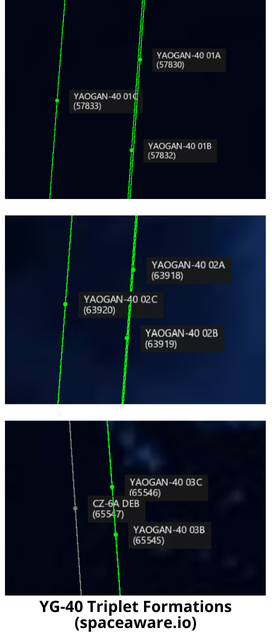
1 Dec 2025: After writing articles related to China’s three YG-40 launches to 86.0° inclination and their 6 launches of Guowang satellites to 86.5° inclined orbits I decided to do a comparison. With some help from the COMSPOC_OPS team the results were interesting. The three sets of YG-40 triplets are orbiting in equilateral triangle formations at an average altitude of 851.2km. They are operating in 3 orbital planes all inclined 86.0° with a RAAN offset of ~37°. China has launched 50 Guowang (China SatNet) satellites into 86.5°inclinations, all of which are now orbiting at an 1,167.9km average altitude. They are spread across 6 orbital planes, each plane with 86.5° inclination and a RAAN offset of ~30°. The orbital comparison reveals the YG-40 satellites gradually drift to the west of the Guowang spacecraft as a result of differing RAAN precession rates. I had previously reported that China had placed its YG-40 satellites into a near polar orbit in order to improve its RF detection/geolocation at the higher latitudes. Now I’m wondering if YG-40’s orbit also allows it to use the Guowang satellite mesh network to quickly relay information to Chinese ground stations. Watch COMSPOC Video.
– As you all know from several of Jack Anthony’s previous articles, objects orbiting at different altitudes will have different orbital periods (10:1 rule) and daily RAAN drifts (J2 effect).
- A look at the numbers
- SMA Difference: YG-40 orbit 316.7km lower than Guowang satellites
- Orbital Period: YG-40 = 1hour 41min 54sec, Guowang = 1hr 48min 41sec
- RAAN Precession: YG-40 = -0.45°/day, Guowang = -0.34°/day
- With their current RAAN drift it will take ~9 months for one plane of YG-40 satellites to twist 30° from one Guowang plane to another plane.
– As evidenced from the COMSPOC video, YG-40 satellites are slowly “twisting” to the west underneath their Guowang counterparts. Such an orbital relationship places YG-40 satellites within line-of-site of the Guowang mesh network which could conceivably relay YG-40 data to Chinese based ground stations in a fraction of the time required to use one of the GEO based Guowang or Tianlian satellites.
– China has released little information regarding its YG-40 satellites. Based on their equilateral triangle formation they are believed to be RF detection/geolocation sensors. China operates other satellites (YG-31 among others) in these formations.
– We cannot confirm YG-40 satellites are equipped with inter-satellite links, however China’s desire to expand its ISR coverage along with investments in the required technologies suggest China would be motivated to include inter-satellite connectivity into satellites such as the YG-40.
– To meet Guowang’s global connectivity requires China to pursue a mesh network architecture.
- In Blaine Curcio’s (friend of the Flash) most excellent China Space Monitor, China’s investment into inter-satellite laser link technology (a requirement for space based high-performance mesh networking) has soared recently. Blaine notes the following:
- “China’s non-geostationary comms constellations (‘Chinese version of Starlink’) have begun to take shape, and this represents a major demand driver for laser comms terminals (LCTs).”
- “China has run into difficulties in setting up overseas ground stations. This makes it more challenging to downlink data from certain regions very quickly, a challenge that can be mitigated with laser inter-satellite links.”
- “China continues to push for the “integration
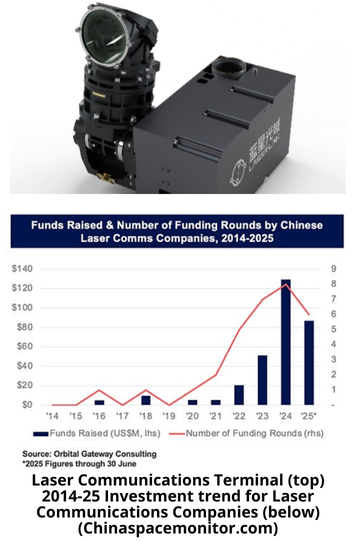
of remote sensing, communications, and navigation satellites” (通导遥一体化), a prospect made somewhat simpler by having a robust LCT industry.”
– Blaine also notes there has been a surge of investment into Chinese laser companies for the past 2-3 years: ”2024 was clearly a banner year with ~US$130M of money thrown at laser companies, 2025 is shaping up to be even bigger, with >US$80M raised in the first half of the year.”
– Additional points from (friend of the Flash) Stephen Clark in his 20 Aug 2025 Ars Technica article:
- “The Guowang network consists of satellites manufactured by multiple companies, and they launch on several types of rockets. On its face, the architecture taking shape in low-Earth orbit appears to be more akin to SpaceX’s military-grade Starshield satellites
- “The constellation described in China’s ITU filings will include one group of Guowang satellites between 500 and 600 kms, around the same altitude of Starlink. Another shell of Guowang satellites will fly roughly 1,145 kms above the Earth. So far, all of the Guowang satellites China has launched since last year appear to be heading for the higher shell.”
- “US officials believe Guowang is a step toward integrating satellites into China’s own kill web. It might be easier for them to dismiss Guowang if it were simply a Chinese version of Starlink, but open source information suggests it’s something more. Perhaps Guowang is more akin to megaconstellations being developed and deployed for the US Space Force and the National Reconnaissance Office.”
- “Chinese media reports suggest the Guowang satellites could accommodate a range of instrumentation, including broadband communications payloads, laser communications terminals, synthetic aperture radars, and optical remote sensing payloads.”
- Gen Saltzman: “The space-enabled targeting that they’ve been able to achieve from space has increased the range and accuracy of their weapon systems to the point where getting anywhere close enough [to China] in the Western Pacific to be able to achieve military objectives is in jeopardy if we can’t deny, disrupt, degrade that… capability,” Saltzman said. “That’s the most pressing challenge, and that means the Space Force needs the space control counter-space capabilities in order to deny that kill web.”
- In a separate article from space.com, US Space Force Gen Michael Guetlein: “China, in particular, is advancing its intelligence, surveillance, and reconnaissance (ISR) technologies. ‘The Chinese ISR capabilities are becoming very capable. They have gone from what we used to call a ‘Kill Chain’ to a ‘Kill Mesh’,’ he said, describing an integrated network that intertwines ISR satellites with weapon systems.”
Editor’s Comment: China has long promoted the idea of a “Space Brain” in which the integration of space-based capabilities results in better and faster actionable information. YG-40’s orbital relationship with the Guowang architecture suggests China is developing the capability to rapidly relay RF detection & Geolocation to Chinese based ground stations (and we assume Chinese weapon systems such as the DF-21 and DF-26). In doing so China can expand its ISR coverage while improving latency and data security…in other words, China is able to improve its “kill web.”

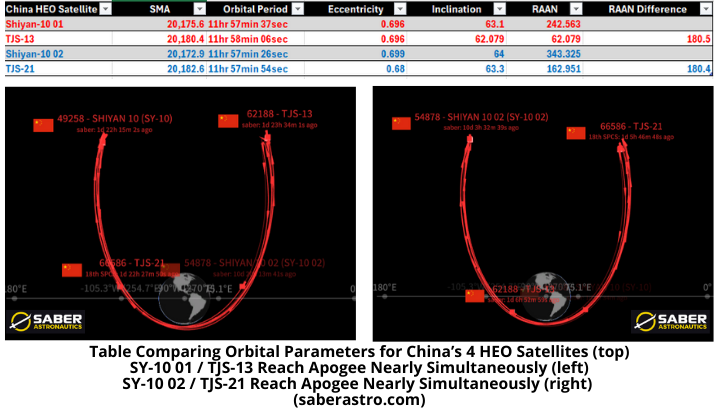
TJS-21 Reaches HEO Orbit: Synchronized with SY-10 02
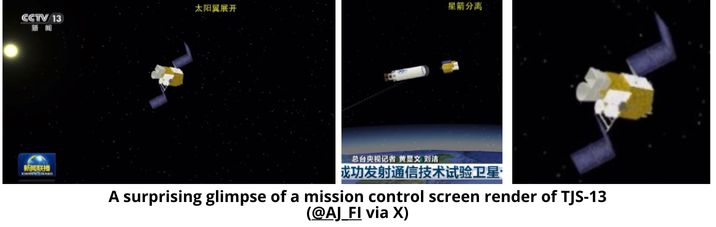
5 Dec 2025: As predicted in the 23 November 2025 Flash, China has placed its newly launched TJS-21 (66586) into a Highly Elliptical Orbit (HEO) and synchronized its orbit phase with Shiyan-10 02 (54878). The two satellites have a RAAN difference of ~180°, resulting in both satellites reaching their apogees at nearly the same time. This configuration matches what China has done with TJS-13 (62188) and Shiyan-10 01 (49258). As a result China now has 24/7 dual satellite coverage of the northern high latitudes. Furthermore, screen captures from Chinese mission control during the TJS-13 launch (thank you Andrew Jones!) seem to show a missile warning satellite. Having two missile tracking satellites permanently perched over the northern hemisphere provides China with greater missile tracking accuracy and confidence levels. Combining with other open source information it now appears China has at least 3 GEO based missile warning satellites, TJS-2 (41911), TJS-5 (44978), and TJS-6 (47613) to go along with its 4 HEO satellites. By comparison the US Space Based Infrared System (SBIRS) consists of 6 GEO and 4 HEO satellites.
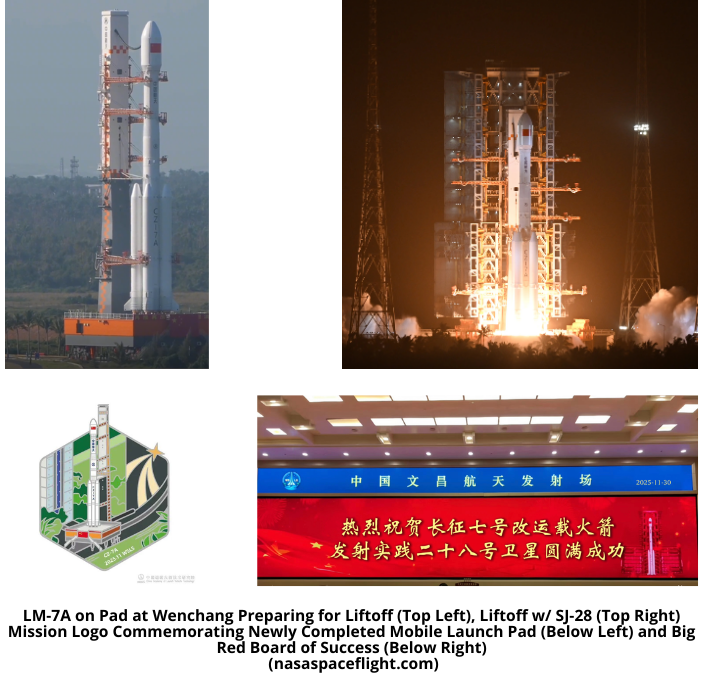
30 Nov 2025: China launched a Long March-7A with Shijian-28 (66549) satellite from Wenchang. According to official sources, the satellite “has entered its preset orbit successfully”. The satellite has not been entered into the space-track.org catalog as of 5 Dec 2025. We’ll report more on this launch as more orbital information is collected/released. For now we’ll have to make do with launch images and mission patches. Launch Video.
find a job in a flash!
Advertise your jobs in the Integrity Flash
- Distributed directly to 3,000+ Professionals
- Reader Base of U.S. Military, Allied Militaries and Industry
- Highly-Targeted, Internationally-Praised Publication
Do you have a job you would like posted in the FLASH? Contact: Rhonda.Sheya@IntegrityISR.com
by Larissa Beavers
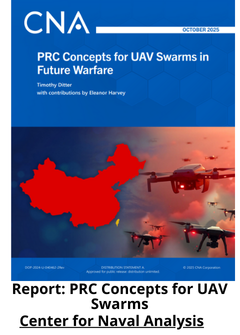
26 November 2025: Newsweek’s reporter Micah McCartney states Chinese researchers are actively studying how to conduct large-scale electronic warfare against SpaceX’s Starlink constellation, running simulations that model how high-altitude jammers could disrupt the network. Their tests indicate that nearly 1,000 drones or balloons equipped with jamming payloads could create an electromagnetic shield capable of degrading Starlink coverage over an area the size of Taiwan. Beijing views Starlink as a national security concern due to its global footprint and its demonstrated wartime value in Ukraine. These findings highlight China’s growing investment in counter-space electronic warfare and its interest in neutralizing Western commercial space assets during a regional conflict.
Key findings from the Chinese article “The US Starlink Project and Its Implications from the Perspective of International and National Security” – Translated by CSIS
- Chinese researchers are studying methods to conduct electronic warfare against SpaceX’s Starlink satellite network.
- A simulation with high-altitude jammers showed that nearly 1,000 drones would be required to disrupt Starlink over an area the size of Taiwan.
- The study modeled a “cloud” of jammers—drones or balloons spaced 5–9 km apart—each generating interference across its coverage area.
- Each jammer in the simulation could block Starlink signals over up to 38.5 square kilometers.
- To disrupt Starlink coverage across all of Taiwan (≈36,000 sq km), the model required 935 high-power jammers or up to 2,000 lower-power ones.
- Researchers conducted a 12-hour small-scale simulation at a site in eastern China to test elements of the concept.
- China views Starlink as a national security threat due to its global coverage and battlefield utility demonstrated in Ukraine.
- Beijing is expanding investments in electronic warfare, cyber capabilities, and conventional forces as part of pressure on Taiwan.
- The study reflects China’s broader effort to devise non-kinetic countermeasures against Western space infrastructure.
- The research highlights China’s interest in degrading LEO satellite networks without resorting to direct kinetic attacks.

- Signals that future conflicts may involve large-scale, distributed jamming campaigns targeting LEO constellations, requiring the U.S. to prepare for contested communications and degraded space support.
Assassin’s Mace in the EM Spectrum: China’s Pursuit of High-Power Microwave and HEMP Superiority
by Larissa Beavers
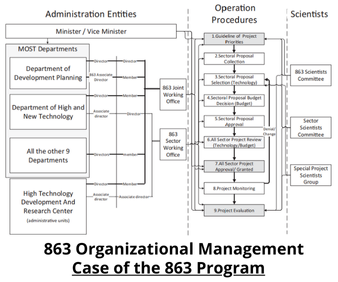
China has rapidly advanced its high-power microwave (HPM) weapons programs through decades of state-funded research, including major investments under the 863 Program. Early PLA assessments in the mid-2000s concluded that effective HPM countermeasures were technically feasible, driving sustained development that has since produced miniaturized, ship-mounted HPM systems and multiple operational anti-drone weapons debuting in 2024. China has also improved synchronization technologies to support precision HPM strikes while simultaneously expanding Electro-Magnetic Pulse (EMP) shielding and hardening of warships, aircraft, and critical infrastructure. Together, these efforts reflect a maturing offensive and defensive HPM/EMP ecosystem designed to operate effectively in contested electromagnetic environments.
- State funding under the 863 Program has long supported China’s research into HPM technologies.
- 2005 PLA analyses concluded that HPM countermeasures to defeat anti-radiation missile seekers were technically achievable with further development.
- Subsequent engineering advances enabled size and power-source reductions, allowing HPM systems to be mounted on mobile and naval platforms.
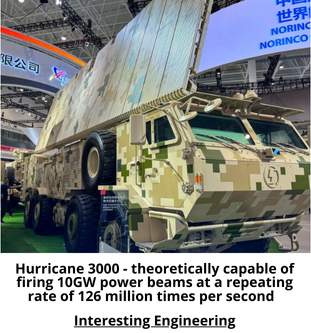
- In 2024, China fielded three new HPM anti-drone systems—Hurricane-2000, Hurricane-3000, and FK-4000—indicating major progress in operationalizing HPM weapons.
- In 2017, HPM scientist Huang Wenhua received China’s highest scientific award, signaling national prioritization of HPM programs.
- China is improving precision HPM strike capability through advanced timing, synchronization, and mobile deployment technologies.
- A RAND study estimates that 90% of global HPM-related patents originate from PRC-affiliated institutions, underscoring China’s research dominance.
- The PLA is heavily investing in EMP shielding, aiming to harden warships, aircraft, command centers, and critical civilian infrastructure.
- These efforts reflect a long-term ambition to maintain operational resilience and superiority in contested electromagnetic environments.

At the strategic level, China views high-altitude electro-magnetic pulse (HEMP) weapons as an asymmetric “assassin’s mace” capable of crippling technologically advanced adversaries and shaping the battlespace before kinetic conflict begins. With delivery systems such as the DF-17 and plans to expand its nuclear arsenal, the PRC integrates HEMP into its broader cyber-electro-magnetic-space warfare doctrine as a means to paralyze satellite networks, command-and-control systems, and ISR architectures essential to modern military operations. These investments signal China’s ambition to dominate high-intensity electronic warfare, leveraging coordinated HPM/HEMP attacks to disrupt, degrade, and potentially neutralize adversary capabilities in the opening moments of conflict.
- The PLA incorporates EMP and HPM into an integrated cyber-electromagnetic-space warfare doctrine, framing EMP use as non-kinetic and non-nuclear despite its origin.
- A coordinated cyber + HEMP first-strike could paralyze both ground-based and space-based systems, enabling follow-on kinetic operations with reduced risk of detection.
- China is rapidly expanding EMP/HPM R&D because informatized warfare depends on disabling adversary electronics at speed and scale.
- The PRC’s doctrine and investment trajectory indicate a willingness to employ EMP/HPM weapons, even without historical precedent and despite widespread underestimation of the threat.
- China views HEMP as an asymmetric “assassin’s mace” capable of crippling technologically advanced adversaries.
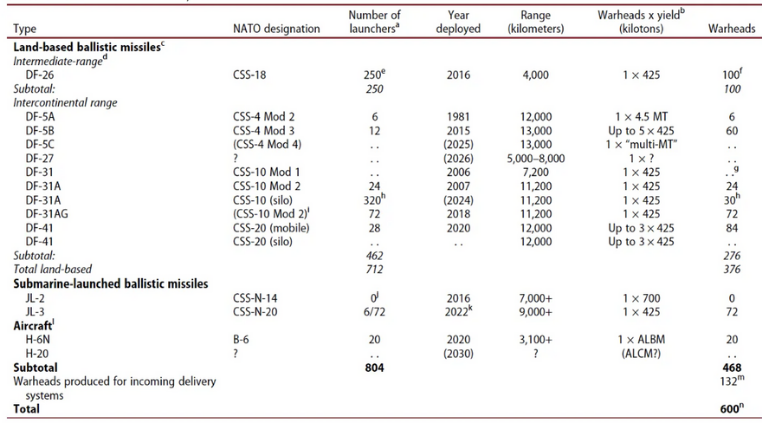
- With 600 nuclear warheads today and plans for ~1,000 by 2035, each could serve as a potential HEMP device.
- Delivery systems such as the DF-17 hypersonic glide vehicle and DF-26 IRBM enhance China’s ability to generate rapid, wide-area EMP effects.
- HEMP weapons threaten satellite systems, TT&C links, ISR sensors, and early-warning architectures, directly impacting space operations.
- In 2024, the PRC unveiled three new HPM systems—Hurricane 2000, Hurricane 3000, and the FK 4000—marking significant advances in anti-drone weapon development.

- China views nuclear-delivered high-altitude EMP (HEMP) as an extension of its asymmetric strategy, with HPM seen as a conventional complement that provides similar electromagnetic effects at tactical scales.
- Expansion of the nuclear arsenal—especially missile systems like the DF-17—also provides reliable delivery platforms capable of lofting HEMP warheads for large-area electromagnetic effects.
- HPM development is influenced by decades of EMP-hardening research within China’s nuclear weapons program, which has given engineers deep expertise in pulse generation, shielding, and electromagnetic coupling.
- Nuclear testing and simulation programs have established a scientific foundation for pulse physics, enabling China to miniaturize HPM sources and synchronize pulses with greater precision.
- The PLA sees HPM and HEMP as layered tools in “cyber-electromagnetic-space” warfare—HPM for targeted disruption, HEMP for theater-wide collapse of electronics.
- China’s leadership considers an expanded nuclear force essential for credible deterrence, enabling more freedom to experiment with non-kinetic electromagnetic weapons without risking strategic imbalance.
- Both nuclear modernization and HPM development support Beijing’s goal to neutralize U.S. and allied C2, ISR, and space systems early in a conflict through rapid, high-impact electromagnetic effects.