< Back to Archive
< Back to Archive

Issue 142 | April 6

The integrity flash

Analysis of Developments in the Space Domain

29 Mar 2026: On ~15 Mar 2026 USA 324 (51280), a US GSSAP inspector satellite, arrived in vicinity of SJ-29A & 29B (67302 & 67303) at ~73.0°E longitude. Recall that the US had stationed USA 325 (51281) in an orbit to observe both SJ-29A/B shortly after the Chinese satellites arrived in GEO (see 9 Feb and 9 Mar Flash articles). TLE data from 16 Mar 2026 shows USA 324 positioned slightly to the west of SJ-29A/B and USA 325 positioned slightly to the east. (see graphic). From its position to the west of SJ-29A/B, USA 324 had favorable solar conditions to to observe both SJ-29A (POCA ~58km) and 29B (POCA ~106km) as the pair travelled from South to North. By 19 Mar 2026, USA 325 had decreased its average altitude and headed east at ~0.7°/day and was no longer in position to observe SJ-29A/B. From 19-29 Mar USA 324 gradually moved to the east, eventually settling into USA 325’s previous orbit.


As of 4 Apr the SJ-29-A and B continue to maintain ~50-70km absolute separation, most of this is due to in-track differences as the two satellites are nearly perfectly plane-matched. Both satellites remain IVO of 73.0° E longitude.


Thankfully the COMSPOC Ops team put together a brief video showing the changing of the Guard.

30 Mar: USA 324 Has Optimal Lighting Conditions for Observing SJ-29A/B @ ~0110Z During North to South Transit

Forget Something? TJS-10 Reverses Course IVO SJ-29

4 Apr 2026: From 30 Mar – 1 Apr Chinese space operators decreased the SMA for TJS-10 (58204) nearly 200km. The maneuver reversed TJS-10’s ~1.9°/day westward drift and the satellite is now travelling eastbound at ~0.7°/day. China conducted the maneuver as TJS-10 was over 73°E longitude. From the previous article you’ll notice that the SJ-29A/B pair (and their new USA 324 minder) are also orbiting 73.0°E longitude. Per the COMSPOC_OPS team, TJS-10 had a 41.2km point of closest approach (POCA) with USA 324 on 31 Mar @ 2352Z, a 65.2km POCA with SJ-29A on 1 Apr @ 0314Z, and an 84.5km POCA wit SJ-29B on 1 Apr @ 0315Z (see graphics next page). Lighting conditions were unfavorable for TJS-10 to observe any of the satellites at the time of closest approach.

After passing USA 324 and SJ-29A/B, TJS-10 made no subsequent maneuvers and continued to move eastward at ~0.7°/day.

TJS-10 had been orbiting over 173°E longitude from Nov 2024 through Feb 2026 when Chinese space operators raised the satellite’s SMA to initiate a westward drift. Originally it looked as if TJS-10 would have some interaction with its old friend, TJS-3, but those satellites passed one another on 20 Mar. Although the timing of its most recent maneuver is curious, it does not seem that TJS-10 is supporting whatever testing China is conducting with SJ-29A/B. China has released little information regarding TJS-10, only stating that it’s mission is to “conduct multi-band, high-speed satellite communication technology experiments.” We’ll need to wait to see what comes next, it is apparent TJS-10 has deviated from its previous pattern of life and entered a more active phase of its mission.

30 Mar – 5 Apr 2026 Ground Track for TJS-10 (green), USA 324 & SJ-29A/B.
(saberastro.com)

Jan – Apr 2026: TJS-10 Maneuver History (celestrak.org)

Points of Closest Approach (POCAs) for TJS-10 v SJ-29A (top left), TJS-10 v SJ-29B (top right) & TJS-10 v USA 324 (below)(COMSPOC_OPS)

16 Mar 2026: China launched an ExSpace Kuaizhou-11 from Jiuquan carrying 8 experimental satellites. The Yuxing-3 06 (HUST-2) (68199) was able to test its on-orbit refueling capabilities, however it appears the test did not include docking with another satellite. Launch Video.

Watch Video of Yuxing-3 06 testing!

– Yuxing-3 06 was developed at the Hunan University of Science and Technology and is in a sun-synchronous orbit with an average altitude of 536km and inclination of 97.5°.

– On 26 Mar Yuxing-3 06 conducted in-orbit experiments involving simulated refueling tasks using a flexible robotic arm.

– At the end of its testing & operations, Yuxing-3 06 will experiment with a drag-enhancing sphere to accelerate its de-orbit.

– Excerpts from Ling Xin article in the South China Morning Post Article:

  • “A Chinese commercial satellite has completed a refuelling test in low Earth orbit using a flexible “octopus tentacle” robotic arm.”
  • “Yuxing-3 06…used its flexible arm to carry out compliance control and refuelling tests”
  • “The arm can curl, twist and wrap around objects to work in tight, complex spaces, with a nozzle-like tip at one end designed to line up and connect with a target port.”
  • “It is made of a series of linked spring-like tubes with motors that pull on cables, bending its joints to guide the tip into place, according to the Tsinghua Shenzhen International Graduate School, which led the arm’s design and development.”
  • “Jointly developed by Hunan University of Science and Technology and Suzhou Sanyuan Aerospace Technology, the satellite is the first of its kind built outside a state-owned enterprise…In-orbit refuelling of satellites is an emerging technology aimed at prolonging the life of high-cost space infrastructure.”
Big Red Board announces Successful Launch (nasaspaceflight.com)
Yuxing-3 06 Prepares for Launch (nasaspaceflight.com)
Rendering of Yuxing -3 06 On-Orbit (nasaspaceflight.com)
Helpful Minion (nasaspaceflight.com)

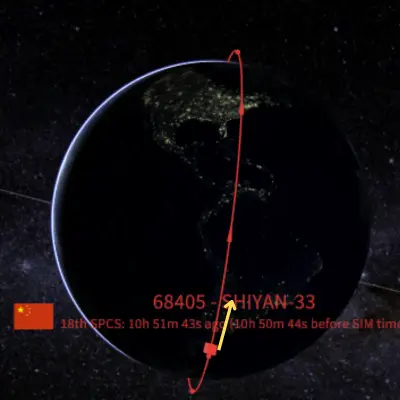
27 Mar 2026: China launched a Long March-2C with the Yuanzheng-1S upper stage with the Shiyan-33 satellite (SY-33) (68405) from the Jiuquan. According to official sources, the satellite has successfully reached its preset orbit and will be “primarily used for scientific experiments exploring the space environment.” Launch Video.

– Shiyan-33 launched into a sun-synchronous (RAAN precession =1°/day) 485 x 505 km orbit with 97.5° inclination.

– The brief mission description was a close match with SY-23, SY-28B01 & 02 and SY-29. However, the orbits provide no additional clues to determine if SY-33 is related with any of them.

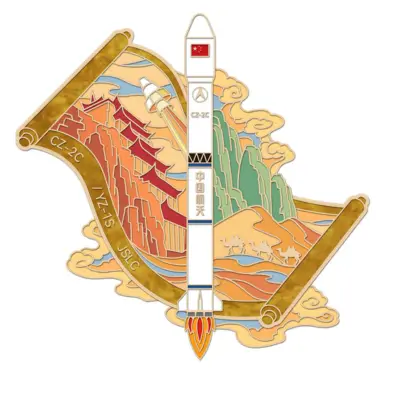
– The use of the LM-2C with the YZ-1S upper stage suggests SY-33 may be a large satellite. The LM-2C/YZ-1S is capable of lifting ~2,600kg to 500km SSO.

LM-2C/YZ-1S Liftoff From Jiuquan with SY-33
(nasaspaceflight.com)

SY-33 Orbit Visualization (left) & Launch Patch (right) (nasaspaceflight.com)

Graphic Showing Mass to Orbit Capacity of LM-2C with YZ-1S Upper Stage
(@TAbusnardo via X)

China Launches Two Superview NEO Satellites

25 Mar 2026: China launched a Long March-2D launch vehicle launched the SuperView Neo-2 05 and SuperView Neo-2 06 (68377 & 68378) remote sensing satellites from Taiyuan. According to official sources, the satellites were developed by the Shanghai Academy of Spaceflight Technology (SAST), a subsidiary of CASC, and “mainly serve fields such as natural resources, urban safety, emergency management and marine supervision, providing users with rich data products and diverse application services”. Launch Video.

– SuperView Neo-2 05 & 06 are in co-planar orbits and have an average altitude of ~506km and an inclination of 97.4°.

– SuperviewNeo-2 05 and 06 are both Synthetic Aperture Radar imaging satellites and will operate together to collect <1m resolution imagery. Per China in Space article, the satellites will generate “twenty-five-thousandth-scale digital models of image areas, developing three-dimensional topographical maps, and supporting the creation of other mapping products.”

  • As of 30 Mar 2026 the two satellites are separated by ~115km.
  • Superview Neo-2 05/06 are co-planar with Superview Neo-2 03/04 (62079 & 62080). All are inclined at 97.4° and have RAAN values within 0.02° of one another.
    • Superview Neo-2 03/04 are currently orbiting at an average altitude of 506km and maintain 4-6km separation from one another.
    • The 05/06 pair is currently orbiting on the opposite side of the Earth (180° separation) compared with 03/04. Such a separation minimizes revisit rates.
    • Chinese media reported, “the ‘four-satellite, two-group’ coordinated imaging capability will significantly enhance imaging capabilities, double data acquisition capacity, halve the revisit cycle, and form faster and denser global observation coverage…After entering orbit, they (05 & 06) will network with the 03 and 04 satellites to form a leading high-precision commercial microwave mapping satellite system in China.”
    • The Superview Neo-2 01/02 satellites (53128 & 53130) are not co-planar with 03/04 or 05/06 (they are co-planar with one another). They have a 1.2° east RAAN offset with 03/04 & 05/06. 01/02 also do not orbit in proximity of one another.

– The China In Space post also noted that China paired a 4.2m fairing with the LM-2D for the first time to support the launch of Superview Neo-2 05/06.

LM-2D w/ 4.2m Fairing Launch Preparations and Mission Patch (nasaspaceflight.com)

– The Superview Neo constallation is operated by China Sewei Surveying and Mapping Technology Co Ltd (aka China Sewei).

– China Sewei plans call for a Superview NEO constellation of at least 28 total satellites.

– Current Constellation Status: 12 Satellites

  • SuperView Neo-1 (20 to 30 cm optical): 4 of planned 16 on orbit.
  • SuperView Neo-2 (50 cm SAR): 6 of 8 on orbit.
  • SuperView Neo-3 (wide-width with 0.7m resolution + 100km swath width): 2 of 4 on orbit. Superview NEO 3-01 launched in April 2024, Superview Neo 3-02 launched 15 Mar 2025.

Orbit Comparisons: Superview Neo-2 05/06 v 01/02 (left); 05/06 v 03/04 (right) (saberastro.com)

Superview Neo Constellation (Polar View): 6 SAR, 4 EO & 2 Wideview EO Satellites (saberastro.com)

23 Mar 2026: Russia launched a Soyuz 2.1b from Plesetsk carrying 16 Rassvet 3 satellites (68360-68376) to Low Earth Orbit. Russia did release NOTAMs for the launch, however for this launch the NOTAMS had an unusually long 9-day NOTAM window and 10-hour daily launch window. Per Bart Hendrickx: “The reason for that could be the ever present danger of Ukrainian drone attacks on the cosmodrome. According to local press reports, a drone attack on Plesetsk was repelled on the day of the Obzor-R launch on December 25, 2025. Local authorities later released a picture of one of the downed drones, thanking local residents for having timely warned them of the attack.” As for the satellites themselves, the Rassvet (meaning “dawn”) satellites are part of a new Russian Low Earth Orbit (LEO) broadband internet constellation developed by Bureau 1440, designed as a sovereign alternative to SpaceX’s Starlink. There have been two previous Rassvet launches, one in 2023 and the second in 2024 (I believe these are 59779-59781 but can’t confirm…these also accompanied the Nivelir satellite Cosmos 2576). Launch Video. Watch Buro 1440 Satellite Separation Video! Watch video describing Rassvet constellation development and deployment goals.

– The satellites have a low initial orbit, with an average altitude of ~306km. All are inclined 82.3°. Expect the satellites to gradually raise their orbits over the coming weeks (note: none of the satellites had maneuvered as of 5 Apr 2026). Publicly available information notes target altitudes for Rassvet as 500-800km.

– The suspected Rassvet-2 prototype satellites have an average altitude of ~786km and an inclination of 98.7°.

-Per Anatoly Zak, “The first 16 Rassvet-3 satellites, with a mass of around 370-kilograms each, followed trios of Rassvet-1 and -2 experimental spacecraft, launched in 2023 and 2024, respectively, as hitchhiker payloads. The first operational launch came just weeks after Starlink deactivated numerous unauthorized terminals used by the Russian occupation forces in Ukraine, further exacerbating the years-long quagmire for the Kremlin. However, at the time of the Rassvet-3 launch, it was unknown how long it would take for Buro-1440 to manufacture and deploy enough satellites and ground infrastructure to make a meaningful impact on the market at home or abroad.”

– Rassvet launch goals for 2026 are 156 satellites. The project plans to have over 250 satellites in orbit by 2027, with a target of 900 by 2035. We’ll see!


 

Rassvet-1, -2 & -3 Comparison
(russianspaceweb.com)

Soyuz 2.1b Lights the Night Sky
(Nasaspaceflight.com)

Rassvet-3 & Rassvet-2 Orbits
(saberastro.com)

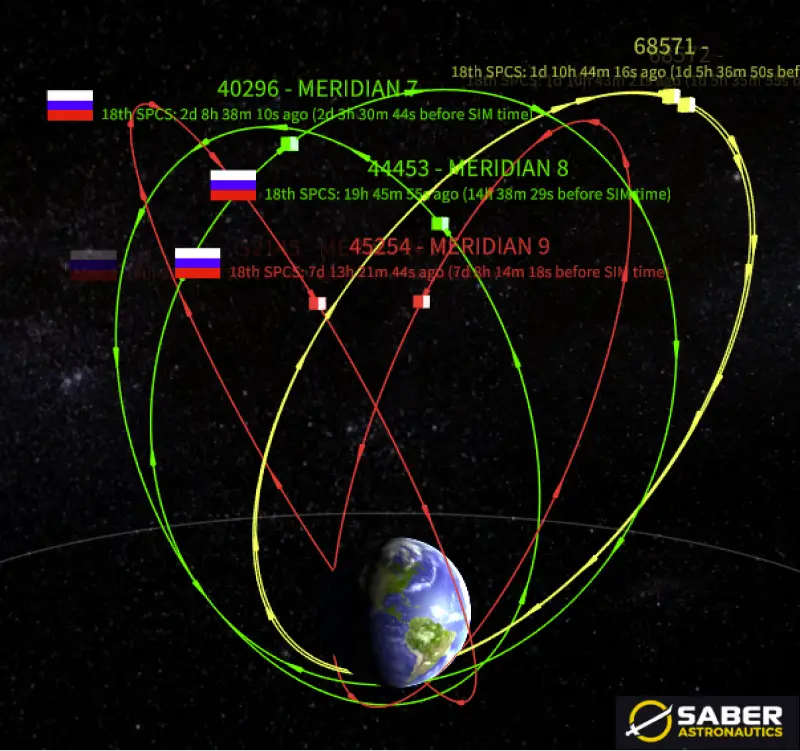
3 Apr 2026: Russia launched a Soyuz 2.1a with Fregat-M upperstage with the Meridian 11 satellite (either 68571 or 68572, not certain which yet) from Plesetsk. This is the first Meridian-M launch since 22 Mar 2022. The satellite is likely heading to a Molniya orbit. Orbital parameters suggest Russia intends to pair Meridian 11 with Meridian 8, perhaps replacing Meridian 7 which was launched in 2014. Launch Video.

– Meridian 11 is currently in a 1,000×39,700km orbit with an inclination of ~63°. Expect Russia to raise the satellite’s perigee several hundred kilometers; the perigee values of the other Meridian-M satellites ranges from ~1,466-2,219km.

– Meridian 11 joins 4 other currently active Meridian satellites:

  • Meridian 7 (40296) (unimproved version launched in 2014);
  • Meridian-M 8 (44453, launched 2019);
  • Meridian-M 9 (45254, launched 2020)
  • Meridian-M 10 (52145, launched 2022).

Soyuz 2.1a Lift Off With Meridian 11
(russianspaceweb.com)

All of the satellites are in highly elliptical Molniya orbits (HEO) inclinations varying from 63-65°. Please review Jack’s previous article on the unique characteristics of this particular inclination!

Meridian Constellation Overview

  • Meridian 7, 8, 9 & 10 have orbital periods of ~11hrs 57min. As of 5 Apr 2026 Meridian 11 has an orbital period of ~12hrs 04min, but as noted above this will likely change in the coming days as Russia maneuvers the satellite into its final orbit.
  • Pairings:
    • Russia has synchronized the orbits of Meridian 9 & 10 with both arriving at their apogee points at nearly the same time. Meridian 9 has a 178° west RAAN offset from Meridian 10.
    • Meridian 7 and Meridian 8 arrive at their apogees about 1 hour apart (and 5-6 hours after Meridian-M 9 & 10). Meridian 7 has a 163° west RAAN offset from Meridian 8.
    • In its current orbit Meridian 11 arrives at its apogee 2-3 hours before 7 & 8. Meridian 11 has a 178° west RAAN offset from Meridian 8…matching the RAAN offset between Meridian 9 & 10. I suspect after Russia settles Meridian 11 into its final orbit it will be paired with Meridian 8. Unknown what the future holds for Meridian 7, the satellite is now 12 years old and may be ready for retirement.
  • Due to their elliptical orbits, Meridian satellites link Russian ground forces, aircraft, ships, and command centers in the Arctic, Siberia and North Sea – outside the reach of stable communications coverage unattainable from geostationary satellites over the equator.
  • The Russian Defense Ministry said the satellites relay signals between coastal stations and vessels and ice reconnaissance airplanes traveling along the Northern Sea Route in the Arctic Ocean. The Meridian satellites also serve users in northern Siberia and Russia’s Far East.

Meridian 7
Apogee ~0300/1500Z
RAAN 222.6°

Meridian 8
Apogee ~0400/1600Z
RAAN 60.1°

Meridian 9
Apogee ~1000/2200Z
RAAN 327°

Meridian 10
Apogee ~1000/2200Z
RAAN 149°

Meridian 11
Apogee ~0100/1300Z
RAAN 238.6°

Meridian Constellation Overview (4 Apr 2026)

  • Meridian 7 & 8 (Red) Arrive at Apogee ~1hr apart and have RAAN offset of 163°
  • Meridian 9 & 10 (Green) Arrive at Apogee simultaneouly (or nearly so) and have a RAAN offset of 178°
  • Meridian 11 (Yellow) has a 178° RAAN offset with Meridian 8 (matching 9 & 10 offset) suggesting Russia will pair the 2 satellites

(saberastro.com)

Nearly There: Cosmos 2589 Circularization Update

5 Apr 2026: Russian space operators continue to circularize Cosmos 2589’s (64467). Recall that Russia launched Cosmos 2589 into an unusual Geosynchronous Highly Elliptical Orbit in Jun 2025. At that time the satellite’s eccentricity was 0.366 with an apogee of 51,110km and perigee of 20,269km (difference of 30,841km). In Nov 2025 Russia began maneuvers to decrease Cosmos 2589’s apogee and increase its perigee. As of 5 Apr Cosmos 2589’s eccentricity was down to 0.044 with an apogee of 37,659km and perigee of 33,907km (difference of 3,752km). Cosmos 2589 has ties to the same Russian company which developed its LEO-based Nivelir counterspace satellites. Similar to Nivelir satellites, Cosmos 2589 released a sub-satellite, Cosmos 2590, shortly after arriving on orbit in late-June 2025. Russia conducted several RPO tests with the two satellites from Jul-Nov 2025.


We’ll be keeping an eye on Cosmos 2589 as it joins the GEO belt. It is likely (at least) a GEO inspector satellite, a first for Russia (I don’t categorize the Luch/Olymp satellites as inspectors).

Ready to Crash the Party: Russia has nearly completed orbit circularization for Cosmos 2589…Expect New Pattern of Life to Evolve

(saberastro.com & celestrak.org)

Pics o’ the Fortnight!

Successful Kinetica 2 Maiden flight from Jiuquan

(@SpaceIntel101 via X)

Space Pioneer Failed Tianlong-3 Launch Failed (payload, if any, unknown)

(spacenews.com
Debris falling from aft end of rocket ~38sec after launch (@WLR_2678 via X)

Russia Preparing for Test Launch (sub-orbital) of Soyuz-5.
(
@TheSpacePirateX via X)

Kerbal Space Program Blowing Up in 2026 (left)…
Bodes well for Aerospace Future (right)
(@wxcory & @BobbyBorkIII via X)

2.1cm Resolution Image of Chinese synthetic aperture radar (SAR) satellite with its large deployable antenna extended from the spacecraft

(Susanne Hake via Linked In)

“You will never look as cool as Neil Armstrong chilling in the Gemini capsule that just tried to spin him to death.”
(
@peterrhague via X)

Tough Week for Flat Earthers…

“Aurora being visible on both poles in a single shot here also is a nice demonstration of the magnetic poles of the earth being off axis from the rotational ‘true’ north-south axis.”

(@neel_kolhe via X)

< Back to Archive
< Back to Archive
< Back to Archive
< Back to Archive
< Back to Archive

All content is considered Integrity ISR Proprietary Information and may not be copied or distributed without written consent from Integrity ISR, LLC.