
ISSUE 151.1 | August 17, 2026
the integrity flash-Lite
A Special Analysis of Developments in the Space Domain
Ukraine Strikes Critical Russian Space Facility
Ukraine Strikes Russia’s Progress Rocket and Space Centre
by Alison Sayer
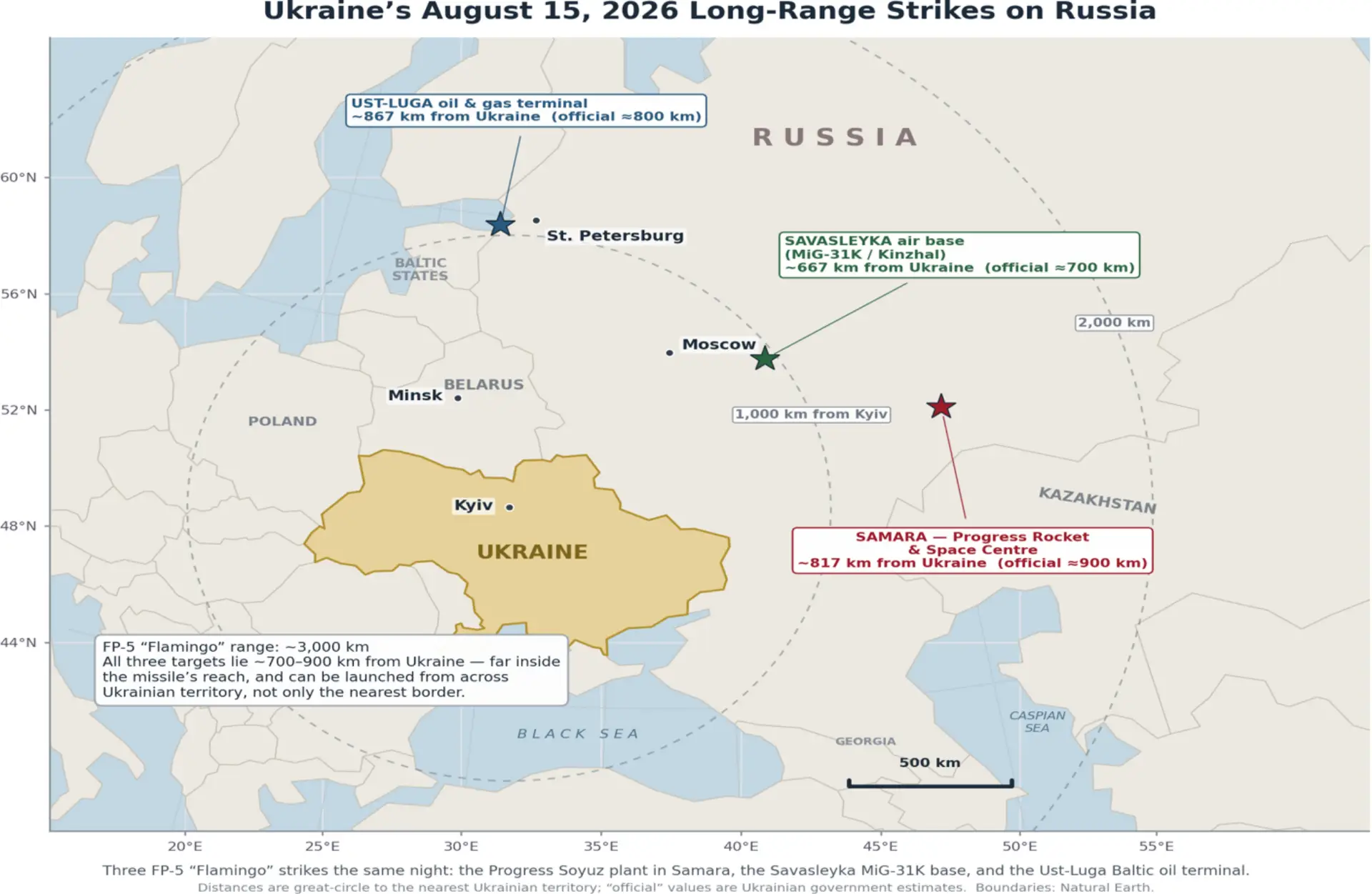
On August 15, Ukraine used domestically produced FP-5 Flamingo cruise missiles to strike the Progress Rocket and Space Centre in Samara, one of Russia’s primary rocket and spacecraft development and manufacturing facilities (see video).
Progress is responsible for the design and production of launch vehicles and spacecraft supporting both Russia’s civilian and military space programs.
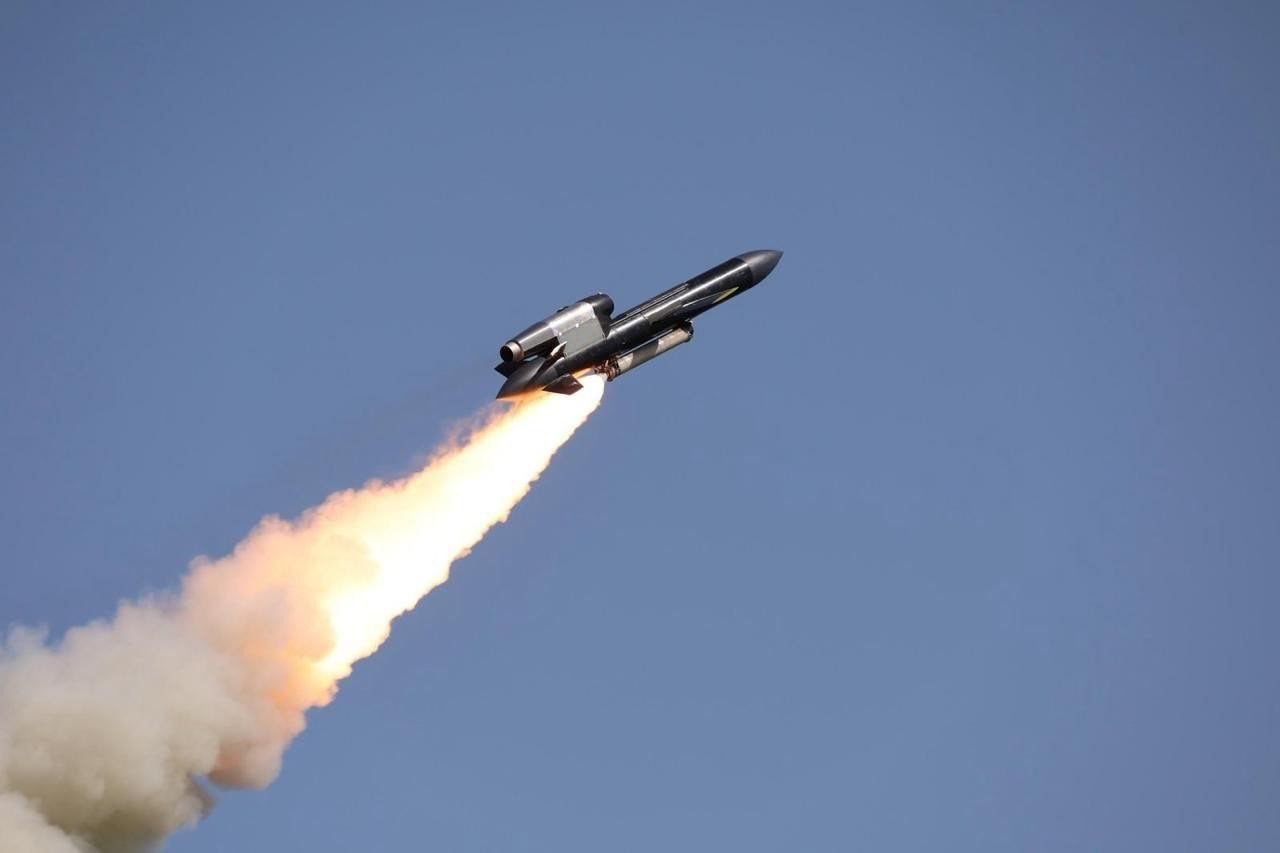
| WEAPON PROFILE FP-5 “Flamingo” Fire Point (Ukraine) — ground-launched cruise missile | |
|---|---|
| Type | Ground-launched, subsonic cruise |
| Range | ~3,000 km (1,900 mi) |
| Warhead | ~1,150 kg (2,540 lb) HE |
| Launch weight | ~6,000 kg (6 t) |
| Length / span | 12–14 m / ~6 m |
| Engine | AI-25TL turbofan + solid booster |
| Speed | Cruise 850–900; max ~950 km/h |
| Guidance | GNSS + INS, jam-resistant |
| Accuracy | ~14 m CEP |
| In service | 2025–present; serial production |
Among its most important programs is the Soyuz launch vehicle family, which remains the workhorse of the Russian space program (see graph). Soyuz supports missions ranging from crewed and cargo flights to military reconnaissance, communications, and other national security launches. Progress-built Soyuz vehicles are also being used to deploy Rassvet, Russia’s developing proliferated low-Earth orbit communications constellation and intended Starlink alternative.
The importance of Progress lies not only in what it produces, but in how concentrated that production is. The Samara facility is the core manufacturing center for Russia’s active Soyuz launch vehicle family, making it a difficult-to-replace node in the country’s ability to maintain and replenish capabilities in orbit. Unlike a launch pad or individual spacecraft, disruption to a specialized production line can potentially affect multiple missions and programs moving through the same industrial pipeline.
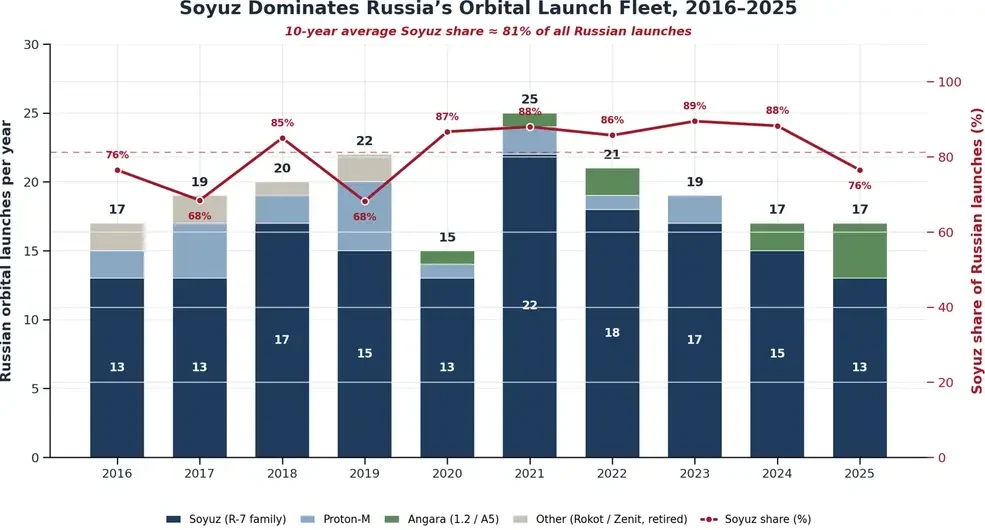
Soyuz Space Launch Vehicles (SLVs) Have Played a Critical Role in Providing Russia Access to Space (graph based on data from Gunther’s Space Page)
So far in 2026, Progress-built Soyuz rockets have supported several Russian military and dual-use launches from Plesetsk. These include multiple classified military satellites on February 5, the first group of Rassvet satellites on March 24, a likely Meridian military communications satellite on April 3, eight military spacecraft on April 17, and a second group of Rassvet satellites on July 19. The launch activity highlights the continued importance of Progress to Russia’s military space program.
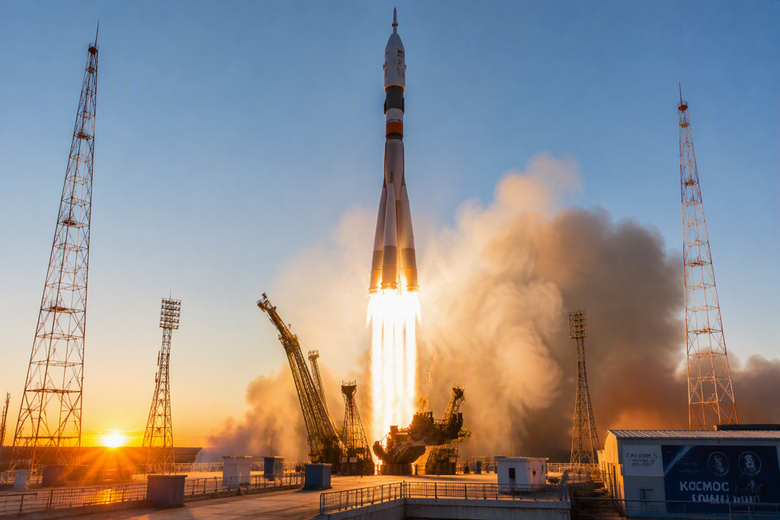
A Progress-built Soyuz lifts off. NASA “Expedition 73 Launch” (NASA/Joel Kowsky)
Just days before the strike on Progress, senior Ukrainian intelligence officials publicly discussed and brainstormed ways to counter Rassvet. Ukraine then struck the facility producing the Soyuz launch vehicles that have been used to put Rassvet satellites into orbit. There is no public evidence that the two events are directly linked, but the timing and choice of target are notable.
Before the strike, Russia planned to rapidly expand Rassvet, reportedly reaching 292 satellites by 2027 (18-20 launches) and 924 by 2035 (58-60 launches). Ukrainian officials have warned that a fully developed system could provide Russia with a Starlink-like communications capability, while Ukrainian presidential adviser Serhii “Flash” Beskrestnov has specifically raised the possibility of Russia using the network to control drones during attacks on Ukraine.
It is not yet clear how Russia planned to meet the launch requirements for Rassvet’s rapid expansion, or whether Soyuz would continue to play the same role as the constellation grew. It is also too early to determine the full extent of the damage at Progress or whether the strike will affect future Soyuz production or Rassvet launches. However, the attack introduces additional uncertainty into Russia’s plans to rapidly field a space capability Ukraine has publicly identified as a growing military threat.
Initial open-source analysis suggests the location of the strike may be significant. Ukrainian OSINT group CyberBoroshno assessed that the attack likely hit Building 106A, an area associated with the installation of onboard electrical equipment, instrumentation, cabling, and control systems on Soyuz launch vehicles. Building 106B, reportedly used for final assembly and integration, sits immediately adjacent. As of late 16 Aug 2026 there was no publicly available imagery to assess the extent of damage to either building.
The potential impact goes beyond damage to the building itself. CyberBoroshno assesses that Building 106A operates to high clean-room standards, meaning damage from fire, soot, or firefighting could require the space and its manufacturing processes to be requalified before operations resume. Specialized equipment, tooling, components, or launch vehicles already moving through production could also take longer to replace than the physical structure. For now, there is not enough publicly available information to determine whether the strike will affect upcoming Soyuz launches.
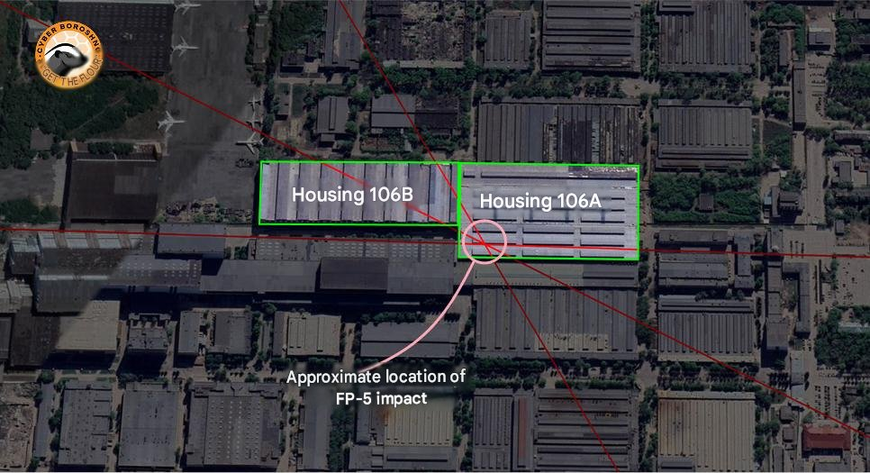
Image of the Progress Rocket and Space Centre. (@cyber_boroshno via X)
Any disruption also comes at a time when projected demand for Soyuz was already expected to exceed Progress’s annual production capacity. In January 2026, former Progress director Dmitry Baranov said orders for Soyuz launch vehicles for the 2027–2030 launch campaign were approximately 30 to 50 percent higher than the facility could produce during that period. Baranov said meeting those requirements would require Progress to draw down its existing stock of rockets before replenishing it, which he characterized as normal practice.
Those existing launch vehicles could give Russia some near-term cushion if new production is disrupted. The precise size and composition of the current Soyuz inventory, particularly the number available for military launches, cannot be confirmed from public information. An on-time Soyuz launch in the weeks or months after the strike would therefore not necessarily mean Progress escaped meaningful damage. Russia could continue launching vehicles completed before the attack while effects on new production appear later.
That distinction becomes more important if disruption at Progress is prolonged. Russia was already expecting to use existing stocks while meeting higher demand later in the decade. Continued military launches, civilian requirements, and plans to rapidly expand Rassvet could place additional pressure on that inventory. The effects of the strike may therefore show up less as an immediate halt to launches and more through inventory drawdown, slower replenishment, or changes to future launch schedules.
The strike against JSC Rocket and Space Centre Progress was also part of a much broader Ukrainian campaign against Russian military and military-supporting infrastructure. During the same overnight operation, Ukrainian forces struck Savasleyka Air Base in Nizhny Novgorod Oblast, which hosts MiG-31K aircraft used to launch Kinzhal missiles against Ukraine. Fires were reported at both Progress and Savasleyka.
The attacks came amid a wider series of Ukrainian strikes against Russian military, logistics, and industrial targets. During August 14 and overnight into August 15, Ukrainian forces reported striking a Strela-10 air-defense system in Kreminna, a drone storage facility in Vuhledar, a logistics and materiel depot in Lysychansk, and command posts in Selydove and Mykhailivka. Earlier in the week, Ukraine also struck the Russian naval base at Novorossiysk, reportedly damaging multiple warships. Ukraine has continued strikes against logistics and energy infrastructure deeper inside Russia as well.
That broader campaign makes it difficult to identify any Russian action as retaliation specifically for the strike on Progress. Russia has continued its own large-scale missile and drone campaign against Ukraine, but those attacks are occurring within an already intense exchange of long-range strikes. Russia’s response may instead be visible in how it protects and operates its space infrastructure. Additional air defenses around Progress and other space-industrial facilities, tighter operational security, changes in production activity, or changes to military launch schedules will all be worth watching.
The extent of the damage at Progress and its impact on future Soyuz launches will likely become clearer over time. Even a temporary disruption could complicate a production schedule already expected to rely on existing rocket stocks to meet growing demand. More importantly, Ukraine placed at risk a concentrated part of the industrial base Russia relies on to maintain existing military space capabilities and field new ones. Changes in Soyuz inventory, production at Progress, and military launch activity will provide some of the earliest indications of whether the August 15 strike had effects beyond the immediate damage in Samara.

ISR University’s Space 480 (SP480) course is designed for professionals who want to move from a consumer of analysis to a producer of it. If you’re reading this, we want to give you 20% off registration for SP480. Use code FLASH480 at checkout to redeem.
In this course, you’ll learn how to:
- Apply structured analytical thinking to complex space developments
- Build practical space domain awareness
- Interpret emerging ISR and space capabilities
- Communicate insights that decision-makers can act on
If you want to think like an analyst, not just read one, ISR University’s SP480 was built for you.

thanks for reading this issue of the integrity flash
The Integrity Flash is the bi-weekly publication from Integrity ISR’s team of SME’s, delivering expert analysis and clear commentary on the trends, technologies, and challenges that impact the space domain.
The Integrity Flash has over 2,000 subscribers and a secondary readership of over 5,000+ industry professionals.
Please continue to help our community grow. Subscribe to our distribution list, share the latest issue, and invite others to subscribe as well.