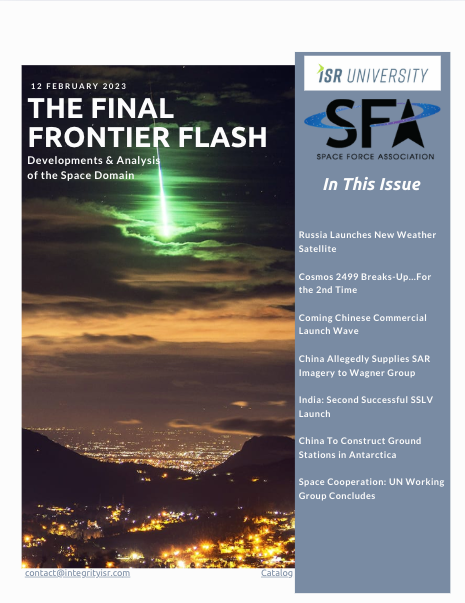
In this issue of Integrity Flash (Edition 66), international developments in weather monitoring, defense imagery, and global cooperation dominate the headlines:
Russia launches a new weather satellite, maintaining its capabilities in orbital meteorological data collection.
Cosmos 2499 suffers a second breakup, raising debris concerns and highlighting the challenges of satellite aging or design flaws.
China prepares for a wave of commercial launches, signaling a push to expand its private sector space activity.
Allegations surface that China supplied SAR imagery to the Wagner Group, fueling geopolitical tensions.
India achieves its second successful SSLV launch, solidifying its progress in small satellite delivery systems.
China announces plans to construct ground stations in Antarctica, expanding its global space infrastructure reach.
Meanwhile, the UN Working Group on Space Cooperation concludes its latest round of discussions, offering cautious optimism for multilateral alignment.
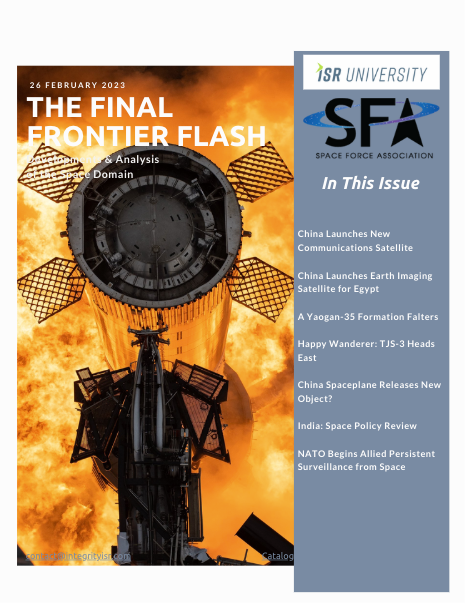
In this issue of Integrity Flash (Edition 67), global surveillance and satellite maneuvers drive headlines:
China launches a new communications satellite and an Earth imaging satellite for Egypt, strengthening bilateral space ties.
One of the Yaogan-35 formations falters, raising questions about orbital stability or mission setbacks.
TJS-3, nicknamed the “Happy Wanderer,” makes a notable eastward maneuver.
Uncertainty surrounds the Chinese spaceplane as it appears to release a new object into orbit.
India reviews its national space policy, outlining future goals and potential reforms.
Meanwhile, NATO initiates Allied Persistent Surveillance from space, marking a major step in multilateral orbital intelligence efforts.
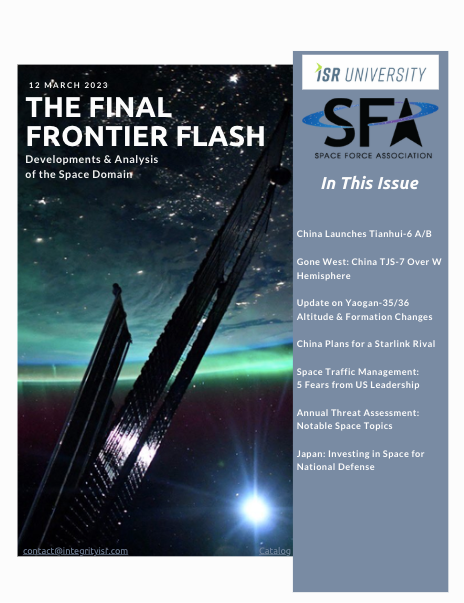
In this issue of Integrity Flash (Edition 68), strategic shifts and new developments in space infrastructure take center stage:
China launches Tianhui-6 A/B, reinforcing its Earth observation and mapping capabilities.
In a bold orbital move, TJS-7 shifts westward over the Western Hemisphere, raising tracking and intent questions.
Yaogan-35/36 satellites undergo altitude and formation adjustments, indicating potential mission evolution.
Beijing unveils plans to develop a Starlink competitor, signaling ambitions for global satellite internet dominance.
U.S. leaders express growing concerns in “Space Traffic Management: 5 Fears,” spotlighting regulatory and operational vulnerabilities.
The Annual Threat Assessment outlines pressing space-related topics shaping the global security landscape.
Japan boosts its orbital presence by investing in space for national defense, aligning space strategy with regional security priorities.
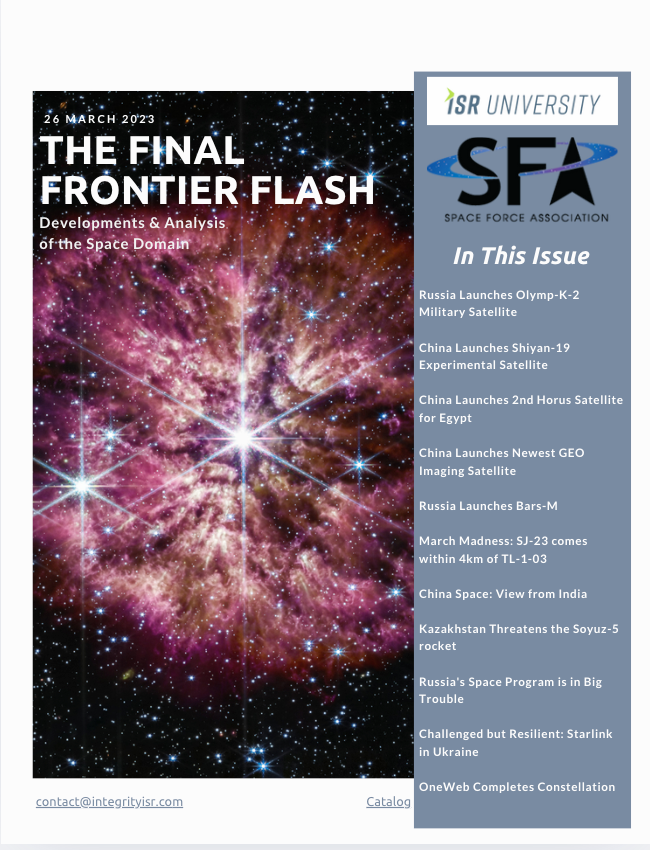
In this issue of Integrity Flash (Edition 69), space power dynamics continue to shift:
Russia launches the Olymp-K-2 military satellite, reinforcing its orbital intelligence presence.
China tests its Shiyan-19 experimental satellite, pushing technological boundaries.
The 2nd Horus satellite for Egypt launches successfully, deepening Egypt-China collaboration.
A new GEO imaging satellite enters China’s orbital roster, expanding persistent surveillance.
Russia boosts its capabilities with the Bars-M satellite.
March Madness in orbit: SJ-23 closes in within 4km of TL-1-03, raising collision concerns.
India offers perspective on China’s space agenda in “China Space: View from India.”
Kazakhstan threatens to withhold the Soyuz-5 rocket, stirring intra-regional tensions.
A report reveals Russia’s space program faces serious trouble amid geopolitical stress.
Despite adversity, Starlink remains operational in Ukraine.
Finally, OneWeb completes its global broadband constellation.
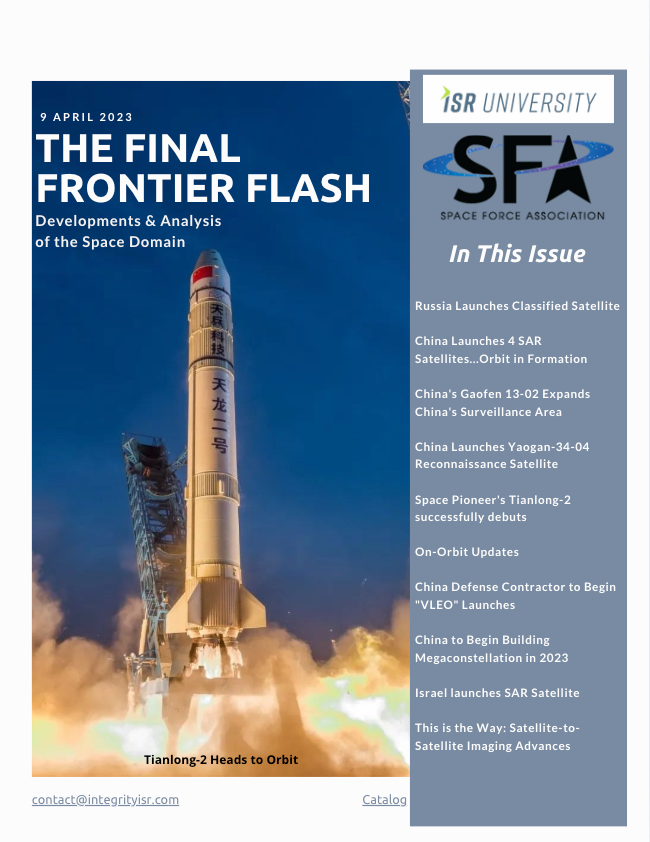
In this issue of Integrity Flash (Edition 70), space capabilities advance through key launches and innovation:
Russia sends a classified satellite into orbit, adding mystery to its orbital activities.
China deploys 4 SAR satellites in formation, enhancing Earth observation coverage.
Gaofen 13-02 expands China’s surveillance reach with upgraded imaging.
Yaogan-34-04 joins China’s reconnaissance network, strengthening national security assets.
Space Pioneer’s Tianlong-2 makes its successful debut, boosting China’s commercial launch sector.
On-orbit updates track satellite positioning and maneuvering.
A Chinese defense contractor prepares for “VLEO” launches, targeting ultra-low altitudes.
China plans to construct a megaconstellation starting in 2023.
Israel launches a new SAR satellite, expanding its strategic footprint.
Finally, satellite-to-satellite imaging takes a leap forward in “This is the Way.”
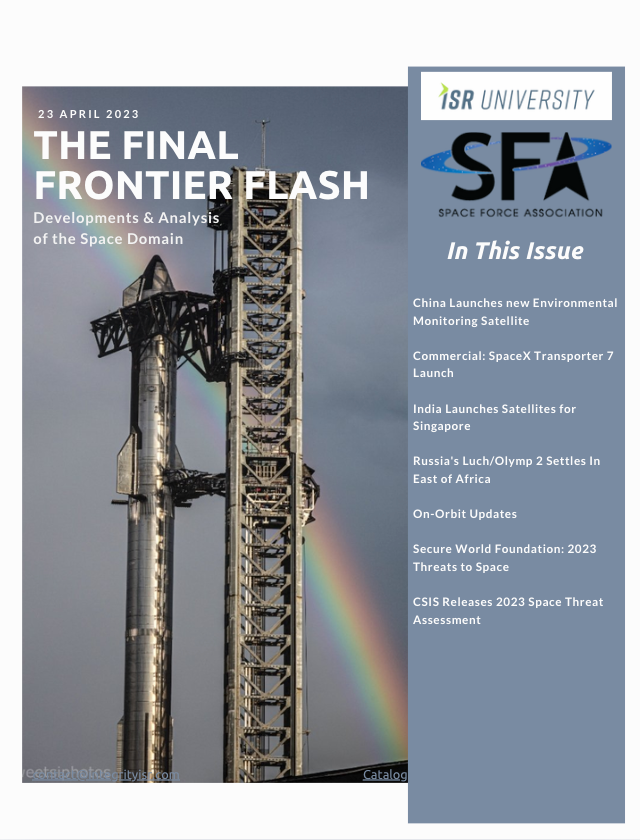
In this issue of Integrity Flash (Edition 71), global space activity and assessments continue to intensify:
China deploys a new environmental monitoring satellite, expanding its civil EO capabilities.
SpaceX’s Transporter-7 mission lifts off, showcasing commercial rideshare success.
India launches satellites for Singapore, deepening international collaboration.
Russia’s Luch/Olymp-2 satellite settles into position over East Africa, raising surveillance concerns.
Comprehensive on-orbit updates reveal ongoing maneuvering and satellite activity.
SWF outlines 2023’s top threats to space security in its annual report.
CSIS adds to the urgency with its own 2023 space threat assessment.
In this issue of Integrity Flash (Edition 72), strategic developments unfold across the global space theater:
Russian GPS jamming disrupts Ukrainian HIMARS effectiveness, illustrating the real-time impact of space warfare.
China’s Korla Facility draws scrutiny amid ASAT development activity.
Commercial ambitions rise as China prepares for sea-based launches in 2023.
A Long March 9 development update provides a glimpse into China’s heavy-lift future.
We compare space race trajectories: is China closing in on U.S. capabilities?
India releases a new national space policy, signaling a more assertive stance in global space affairs.
Plus, detailed on-orbit updates round out this edition.
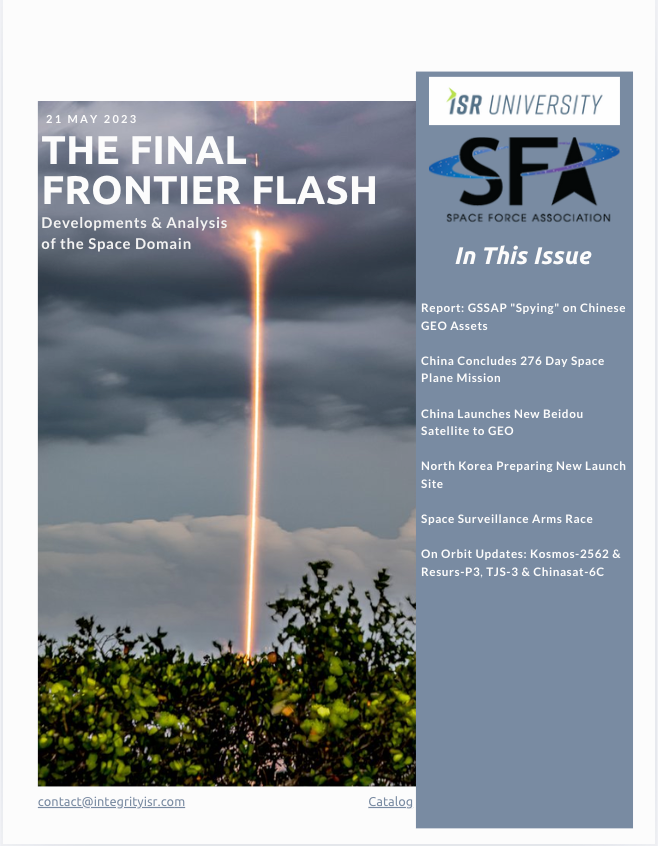
In this issue of Integrity Flash (Edition 73), geopolitical space surveillance ramps up:
A new report alleges GSSAP is “spying” on Chinese GEO assets, intensifying orbital tensions.
China concludes a 276-day space plane mission, reinforcing its capabilities in reusable space tech.
The Beidou constellation expands with the launch of a new GEO satellite.
North Korea is reportedly preparing a new satellite launch site, signaling future provocations.
The broader implications of a growing space surveillance arms race are explored.
On-orbit updates highlight activity from Kosmos-2562, Resurs-P3, TJS-3, and Chinasat-6C.
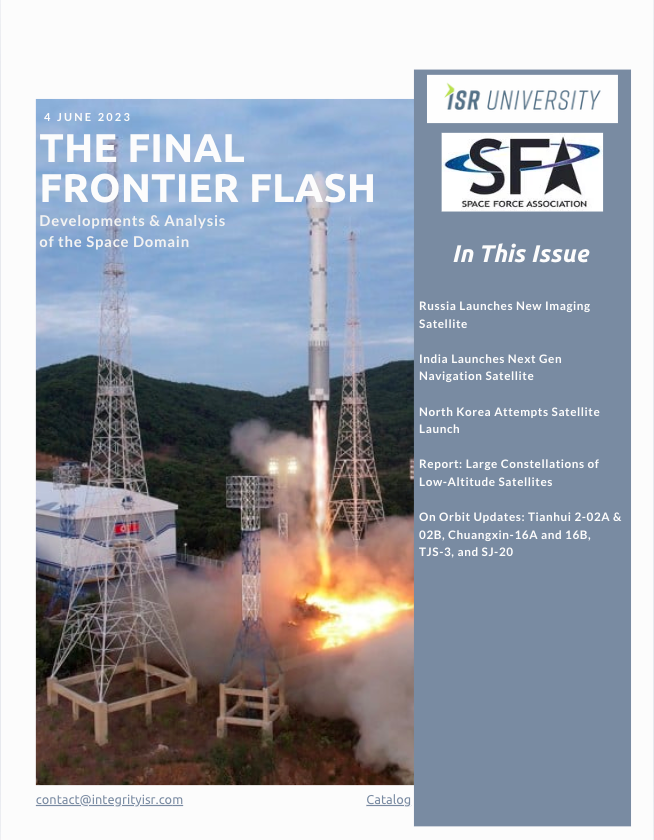
In this issue of Integrity Flash (Edition 74), new satellite initiatives span continents:
Russia launches a new imaging satellite, advancing its reconnaissance capabilities.
India successfully places its next-gen navigation satellite into orbit, reinforcing regional GNSS efforts.
North Korea makes another satellite launch attempt, drawing international attention.
A featured report investigates the growing risks and implications of large constellations of low-altitude satellites.
In orbit updates cover a broad set of missions: Tianhui 2-02A & 02B, Chuangxin-16A and 16B, TJS-3, and SJ-20.