In this issue of Integrity Flash (Edition 129), China and its orbital allies continue pushing boundaries across weather, communications, and strategic positioning:
• China adds 4 satellites to its Guowang Test Network, advancing its planned broadband megaconstellation.
• Yaogan-45 receives an update, providing further clarity on this classified remote sensing satellite’s role and orbital behavior.
• A new update on SY-29 indicates shifts in its mission profile and positioning within GEO.
• China launches a new Fengyun weather satellite, reinforcing its Earth observation infrastructure and global meteorological coverage.
• SY-12 02 executes a maneuver ahead of a flyby near commercial satellite JCSAT, raising questions about intentions and tracking capabilities.
• GeeSat boosts its constellation with 11 additional satellites, solidifying its commercial presence in orbit.
• And of course, don’t miss this edition’s “Pics o’ the Fortnight”, capturing the latest movement and maneuvers from orbit.
In this issue of Integrity Flash (Edition 129), China and its orbital allies continue pushing boundaries across weather, communications, and strategic positioning:
• China adds 4 satellites to its Guowang Test Network, advancing its planned broadband megaconstellation.
• Yaogan-45 receives an update, providing further clarity on this classified remote sensing satellite’s role and orbital behavior.
• A new update on SY-29 indicates shifts in its mission profile and positioning within GEO.
• China launches a new Fengyun weather satellite, reinforcing its Earth observation infrastructure and global meteorological coverage.
• SY-12 02 executes a maneuver ahead of a flyby near commercial satellite JCSAT, raising questions about intentions and tracking capabilities.
• GeeSat boosts its constellation with 11 additional satellites, solidifying its commercial presence in orbit.
• And of course, don’t miss this edition’s “Pics o’ the Fortnight”, capturing the latest movement and maneuvers from orbit.
In this issue of Integrity Flash (Edition 129), maneuvering satellites and Chinese launch momentum continue to shape the orbital narrative:
China’s satellites SJ-21/SJ-25 conduct a coordinated plane change maneuver, showcasing impressive orbital agility.
A deeper dive into the fuel math behind these movements is featured in “Doing the Math,” estimating the complex requirements for SJ-21/25 maneuvering.
China maintains launch tempo with 2 new Guowang deployments, adding 19 satellites to the expanding constellation.
SatNet ambitions enter the spotlight in “Higher Level Support?”, exploring China’s growing GEO infrastructure.
GEESAT adds another 11 satellites, intensifying its presence in orbit.
Russia resurfaces with a detailed Cosmos 2589 and Object C update, keeping tabs on proximity dynamics.
In Jack’s Astro Corner, rendezvous operations get technical with XSS-11 and its daring proximity ops—Part 3 of 3 in this RPO deep dive.
And of course, Pics o’ the Fortnight rounds it out with visuals from across LEO, MEO, and GEO.
In this issue of Integrity Flash (Edition 128), satellite dynamics and international maneuvers take the spotlight:
China’s “Kings on the Move” initiative captures attention with a notable step in strategic mobility.
Two Chinese launches boost the Guowang satellite network by 14, expanding national coverage.
China’s SY-28B 02 enters an unusual orbit, raising curiosity among analysts.
Russia adds 4 new imagery satellites, sharpening its Earth observation capabilities.
Luch Olymp repositions to a new orbital slot, extending its influence.
Cosmos 2589 welcomes back Object C, renewing RPO activity.
“Pics o’ the Fortnight” wraps the issue with curated visual highlights.
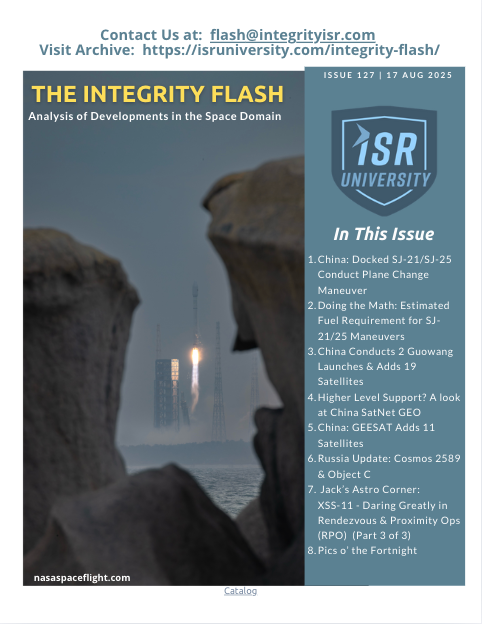
In this issue of Integrity Flash (Edition 127), satellite maneuvering and international space activity dominate the spotlight:
China’s docked SJ-21 and SJ-25 satellites perform a coordinated plane change maneuver, showcasing growing orbital precision.
In a follow-up, fuel requirements for these complex maneuvers are crunched in “Doing the Math,” shedding light on mission planning.
China conducts two major Guowang launches, boosting its broadband constellation with 19 new satellites.
A deeper look at China SatNet’s GEO assets suggests potential for higher-tier global coverage.
Elsewhere, China’s GEESAT constellation adds 11 more satellites to its expanding commercial fleet.
Russia resurfaces with Cosmos 2589 and mysterious Object C, adding intrigue to orbital tracking.
Jack’s Astro Corner concludes its XSS-11 series with a daring deep dive into rendezvous and proximity ops.
And finally, “Pics o’ the Fortnight” captures the celestial moments you don’t want to miss.

In this issue of Integrity Flash (Edition 126), orbital maneuvers and proximity ops dominate the headlines:
China advances in-orbit servicing with new GEO refueling updates, marking a step toward long-term satellite sustainability.
Cosmos 2558 and Cosmos 2589 raise eyebrows as they maneuver near Object C, prompting legal and strategic scrutiny.
Yaogan-40 02 satellite locks into formation, bolstering China’s space-based surveillance capabilities.
China ramps up pace with two Guowang launches in just three days, signaling urgency in its broadband megaconstellation.
A focused analysis of “Guowang Atmospherics” unpacks the constellation’s role in shaping global internet infrastructure.
In “Shadows in Orbit,” experts explore legal uncertainty around Cosmos 2588’s proximity behavior.
Jack’s Astro Corner (Part 2 of 3) dives deeper into XSS-11 and the complexities of RPO (Rendezvous & Proximity Operations).
To round out the edition, “Pics o’ the Fortnight” delivers striking visuals from recent orbital activity.
In this issue of Integrity Flash (Edition 123), we examine a wave of high-stakes satellite activity, spotlighting a potential first in space operations:
China’s GEO refueling mission – SJ‑21 and SJ‑25 performed coordinated close-proximity maneuvers over geostationary orbit from June 8—16, possibly achieving docking and on-orbit refueling-while U.S. GSSAP satellite USA 270 repositioned itself to monitor the activity.
Zhongxing‑9C launch – China deployed a new 5.5-ton communications satellite to replace Chinasat‑9 and enhance its geostationary communications infrastructure.
Yaogan‑35/36/39/42 formation updates – Chinese surveillance triplets continue lead‑trail formation maintenance, but Trail‑2 satellites are now drifting free of original clusters.
Russia’s Cosmos 2589 launch – A suspected geostationary inspector satellite was deployed into a supersynchronous transfer orbit; analysis suggests it may release mini-inspector subsatellites akin to past Nivelir-equipped platforms.
Retrospective: Cosmos 2542 mission – Revisiting Russia’s 2019—2020 inspector test where Cosmos 2543 shadowed U.S. intelligence satellite USA 245 and released subsatellites and debris-prompting international alarm.
In this issue of Integrity Flash (Edition 123), we examine a wave of high-stakes satellite activity, spotlighting a potential first in space operations:
China’s GEO refueling mission – SJ‑21 and SJ‑25 performed coordinated close-proximity maneuvers over geostationary orbit from June 8—16, possibly achieving docking and on-orbit refueling-while U.S. GSSAP satellite USA 270 repositioned itself to monitor the activity.
Zhongxing‑9C launch – China deployed a new 5.5-ton communications satellite to replace Chinasat‑9 and enhance its geostationary communications infrastructure.
Yaogan‑35/36/39/42 formation updates – Chinese surveillance triplets continue lead‑trail formation maintenance, but Trail‑2 satellites are now drifting free of original clusters.
Russia’s Cosmos 2589 launch – A suspected geostationary inspector satellite was deployed into a supersynchronous transfer orbit; analysis suggests it may release mini-inspector subsatellites akin to past Nivelir-equipped platforms.
Retrospective: Cosmos 2542 mission – Revisiting Russia’s 2019—2020 inspector test where Cosmos 2543 shadowed U.S. intelligence satellite USA 245 and released subsatellites and debris-prompting international alarm.
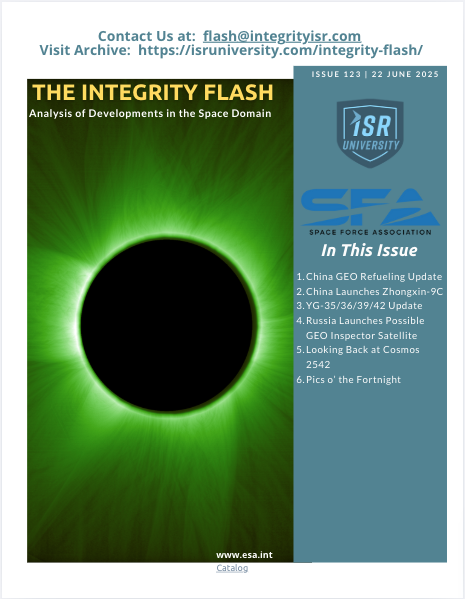
In this issue of Integrity Flash (Edition 123), we track a series of major developments in global space operations, including China’s first attempt at a GEO satellite refueling mission:
China’s GEO refueling maneuver – SJ-21 and SJ-25 performed close-proximity operations, possibly docking in what could be the world’s first on-orbit refueling demonstration at geostationary orbit.
Zhongxing-9C launch – China launched a new 5.5-ton communications satellite intended to replace Chinasat-9, continuing its expansion of state-operated GEO platforms.
Yaogan-35/36/39/42 formation shifts – China continues maintaining Lead-Trail1 formations among multiple satellite triplets while allowing Trail2 members to drift, disrupting their original configurations.
Russia’s Cosmos 2589 launch – A potentially inspector- or counterspace-capable satellite was launched to a supersynchronous orbit; analysis suggests it may deploy smaller subsatellites similar to the Nivelir program.
A retrospective on Cosmos 2542 – Revisiting Russia’s 2019—2020 ASAT-adjacent mission where Cosmos 2543 shadowed and approached U.S. intelligence satellite USA 245, sparking international concern.