issue 118
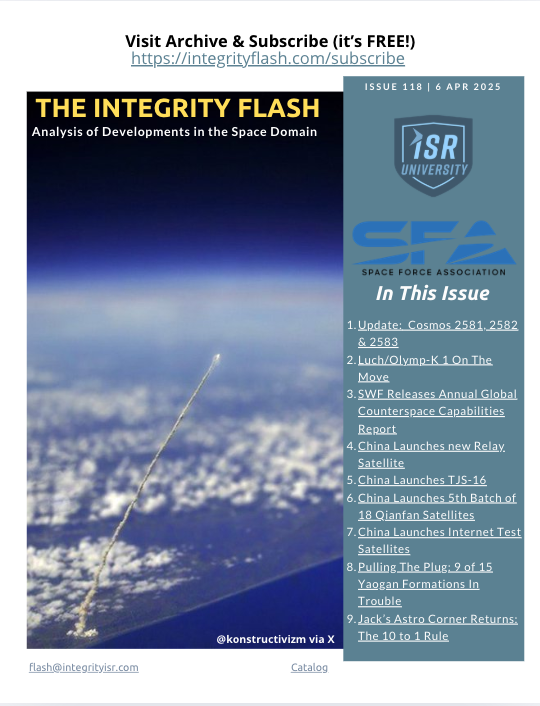
issue 118 | 8 april 2025 The integrity flash Analysis of Developments in the Space Domain SUBSCRIBE NOW Linkedin Facebook Instagram @konstructivizm via X in this issue Update: Cosmos 2581, […]

issue 118 | 8 april 2025 The integrity flash Analysis of Developments in the Space Domain SUBSCRIBE NOW Linkedin Facebook Instagram @konstructivizm via X in this issue Update: Cosmos 2581, […]
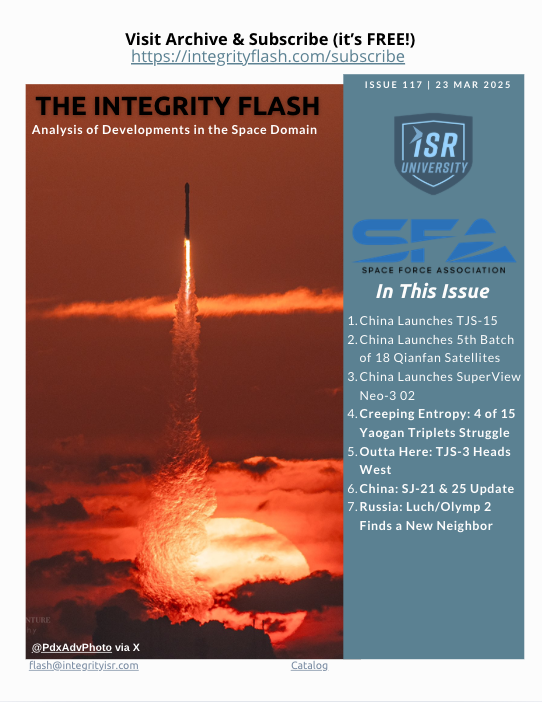
issue 117 | 26 mar 2025 The integrity flash Analysis of Developments in the Space Domain SUBSCRIBE NOW Linkedin Facebook Instagram @PdxAdvPhoto via X in this issue China Launches TJS-15 […]
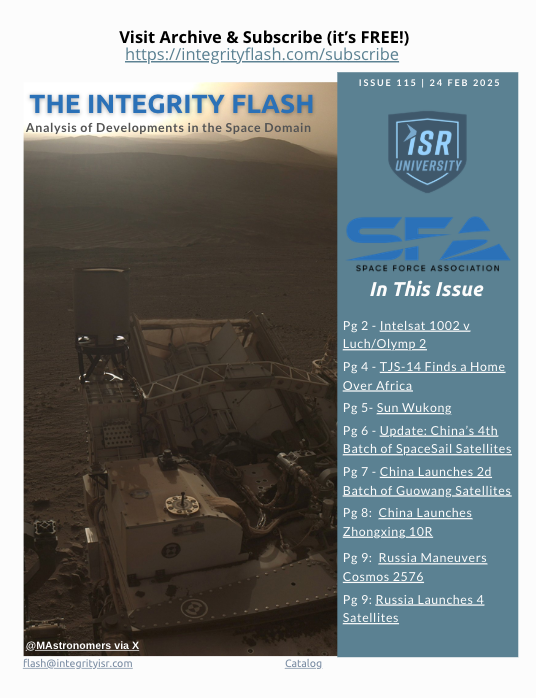
In this issue of Integrity Flash (Edition 115), we delve into the intricate dynamics of space-based surveillance and counterspace activities. The edition provides a comprehensive analysis of China’s advancements in geostationary orbit maneuvering, highlighting the implications for global space security. Additionally, we explore the collaborative efforts between China and Iran in developing high-resolution ISR satellites, examining the strategic motivations and potential outcomes of this partnership. The issue also features an in-depth discussion on rendezvous and proximity operations (RPO), offering insights into the technical challenges and strategic considerations of satellite servicing and inspection missions. 
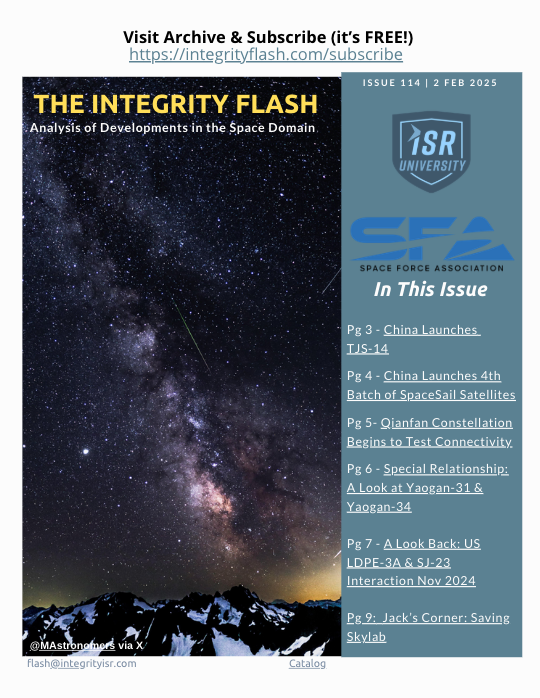
In this issue (Issue 114), we delve into the evolving landscape of In-Situ Resource Utilization (ISRU) and its pivotal role in future space exploration. Highlighting recent advancements and collaborative efforts, the article explores how ISRU technologies are shaping missions to the Moon, Mars, and beyond. From extracting vital resources like water and oxygen to constructing habitats using local materials, the piece underscores the significance of ISRU in achieving sustainable and cost-effective space missions.
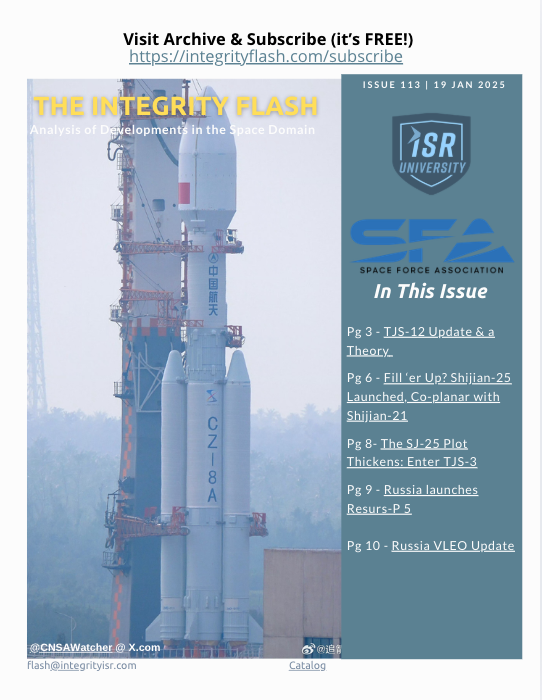
In this issue (113), we explore the latest developments in In-Situ Resource Utilization (ISRU) technologies and their transformative impact on space exploration. The article delves into innovative methods for harnessing extraterrestrial resources, highlighting recent breakthroughs and collaborative efforts that are paving the way for sustainable missions to the Moon, Mars, and beyond. By examining the challenges and opportunities associated with ISRU, this piece offers insights into how these advancements are shaping the future of off-world colonization and long-duration space travel.
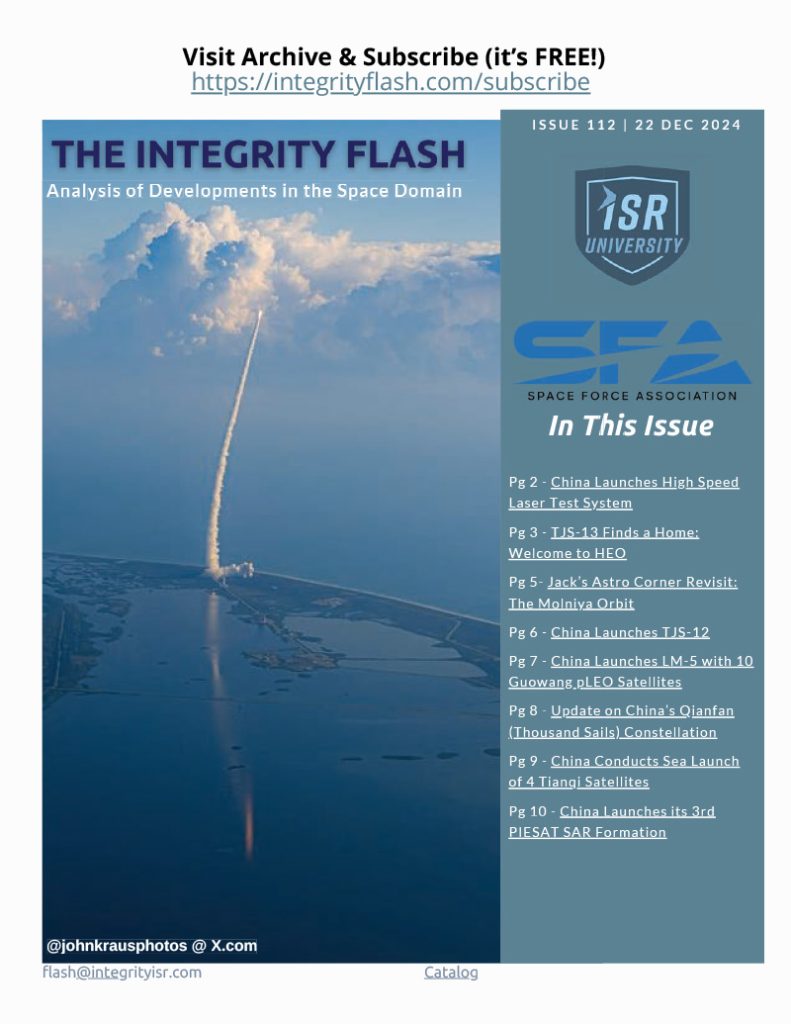
In this issue of Integrity Flash (Edition 112), we explore China’s rapidly evolving space capabilities, with a detailed profile of the Shijian‑17 (SJ‑17) satellite entering the Western Hemisphere and the nation’s groundbreaking strides in multi-domain ISR and precision warfare.
Highlights include:
SJ‑17’s GEO repositioning-a look at its unexpected drift into the Western Hemisphere and its role testing green propellants, composite batteries, and GNSS systems
linkedin.com
+2
linkedin.com
+2
isruniversity.com
+2
.
China’s “multi-domain kill web” strategy-how PLA’s expanding constellations of EO, SAR, ELINT, and commercial satellites are converging to deliver near‑real‑time targeting and strike capabilities
linkedin.com
+1
linkedin.com
+1
.
Commercial and civil-military fusion-insights into constellations like Yaogan, SuperView, Qianfan/Thousand Sail, and Guowang, showcasing China’s leap toward global ISR dominance
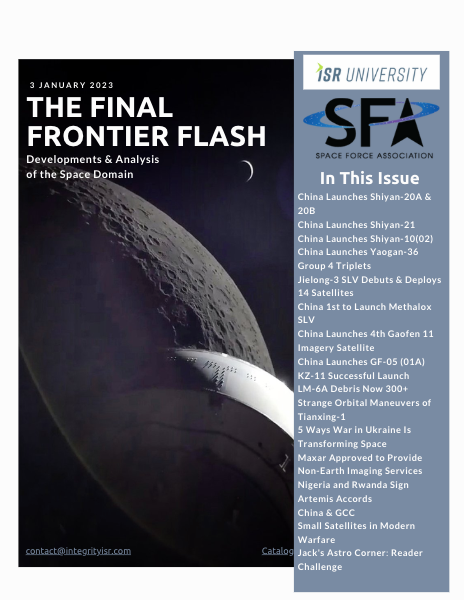
In this issue of Integrity Flash (Edition 63), China’s space ambitions surge forward:
China launches Shiyan-20A & 20B, Shiyan-21, and Shiyan-10(02), bolstering its array of scientific and experimental payloads.
Yaogan-36 Group 4 Triplets continue China’s rapid expansion of remote sensing assets.
Jielong-3 SLV makes its debut, successfully deploying 14 satellites in one go.
China becomes the first nation to launch a Methalox SLV, showcasing next-gen propulsion.
A series of Gaofen launches, including GF-05 (01A) and GF-11, enhance Earth observation capabilities.
KZ-11 achieves a successful mission, while LM-6A debris count rises beyond 300-raising questions about space safety.
Tianxing-1 exhibits strange orbital behavior, stirring speculation.
On the geopolitical front, Maxar gains approval for non-Earth imaging services, and Nigeria and Rwanda join the Artemis Accords.
China continues to deepen space ties with the GCC, while the role of small satellites in modern warfare is explored.
Finally, Jack issues a reader challenge in his Astro Corner.
In this issue of Integrity Flash (Edition 63), China’s space ambitions surge forward:
China launches Shiyan-20A & 20B, Shiyan-21, and Shiyan-10(02), bolstering its array of scientific and experimental payloads.
Yaogan-36 Group 4 Triplets continue China’s rapid expansion of remote sensing assets.
Jielong-3 SLV makes its debut, successfully deploying 14 satellites in one go.
China becomes the first nation to launch a Methalox SLV, showcasing next-gen propulsion.
A series of Gaofen launches, including GF-05 (01A) and GF-11, enhance Earth observation capabilities.
KZ-11 achieves a successful mission, while LM-6A debris count rises beyond 300-raising questions about space safety.
Tianxing-1 exhibits strange orbital behavior, stirring speculation.
On the geopolitical front, Maxar gains approval for non-Earth imaging services, and Nigeria and Rwanda join the Artemis Accords.
China continues to deepen space ties with the GCC, while the role of small satellites in modern warfare is explored.
Finally, Jack issues a reader challenge in his Astro Corner.
In this issue of Integrity Flash (Edition 63), China’s space ambitions surge forward:
China launches Shiyan-20A & 20B, Shiyan-21, and Shiyan-10(02), bolstering its array of scientific and experimental payloads.
Yaogan-36 Group 4 Triplets continue China’s rapid expansion of remote sensing assets.
Jielong-3 SLV makes its debut, successfully deploying 14 satellites in one go.
China becomes the first nation to launch a Methalox SLV, showcasing next-gen propulsion.
A series of Gaofen launches, including GF-05 (01A) and GF-11, enhance Earth observation capabilities.
KZ-11 achieves a successful mission, while LM-6A debris count rises beyond 300-raising questions about space safety.
Tianxing-1 exhibits strange orbital behavior, stirring speculation.
On the geopolitical front, Maxar gains approval for non-Earth imaging services, and Nigeria and Rwanda join the Artemis Accords.
China continues to deepen space ties with the GCC, while the role of small satellites in modern warfare is explored.
Finally, Jack issues a reader challenge in his Astro Corner.