issue 115 | 24 Feb 2025
The integrity flash
Analysis of Developments in the Space Domain
in this issue
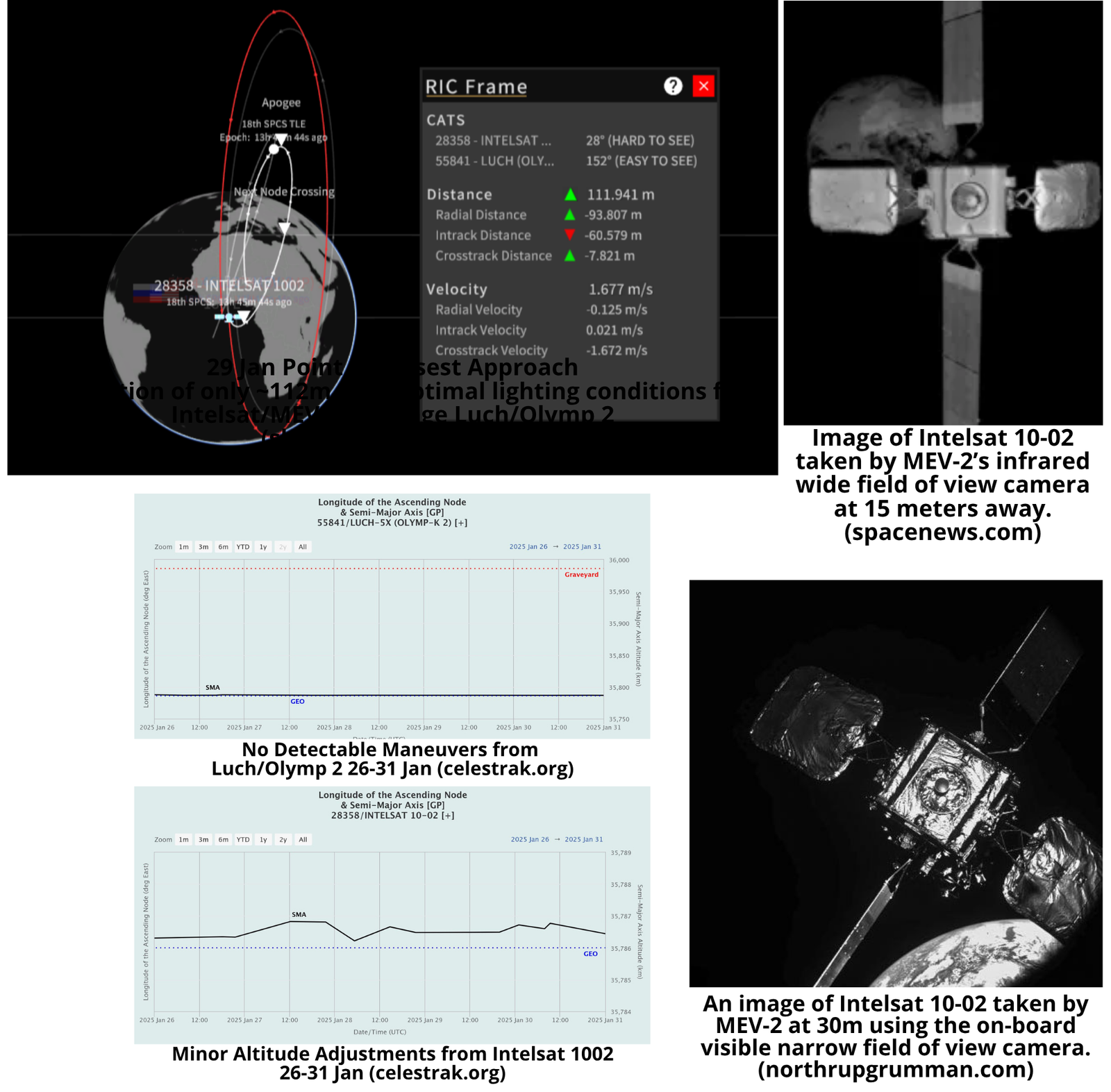
27 Jan – 5 Feb: Per reporting from the Joint Capabilities Office (JCO), between 27 Jan – 5 Feb, Russia’s Luch/Olymp 2 (55841) and Intelsat 1002 (28358) were operating in close proximity. At first glance I assumed this was just another case of Luch doing typical Luch things. I was wrong. From 27-31 January, Luch/Olymp 2 does not appear to maneuver, while Intelsat 1002 did conduct several minor altitude adjustments. According to TLE data on 29 Jan the two satellites were <1km apart. Interestingly, Intelsat 1002 (which is docked with the Mission Extension Vehicle-2 <46113>) had highly favorable lighting conditions for imaging Luch/Olymp 2. MEV-2 is known to have imaging capabilities. Other points of closest approach (POCAs) during this time were between 3-10kms with lighting conditions favorable for Luch/Olymp 2 to image Intelsat 1002. On 6 Feb Luch/Olymp 2 began a series of altitude increases and as of 21 Feb, it was orbiting ~261km below the GEO belt and drifting eastward 3.25° per day and the two satellites were over 30,000km apart.

- During this time period Luch/Olymp 2 conducted no detectable maneuvers. For its part Intelsat 1002 did conduct several minor altitude maneuvers, all less than 1km. Maneuvers on 28 January placed Intelsat 1002 onto a trajectory which resulted in the <1km POCA with Luch/Olymp 2 on 29 January. Per Spacecockpit data the distance between the two objects at point of closest approach (POCA) was ~100-200m.
- Examining the Solar Phase Angle (SPA) values during each POCA provided interesting results. The 29 Jan <1km POCA occurred with optimal SPA for Intelsat 1002 to image Luch/Olymp 2 (SPA 152° placing the sun behind Intelsat 1002 and illuminating Luch/Olymp 2.)
- For all other POCAs during this time period, the SPA was favorable for Luch/Olymp 2 to image Intelsat 1002. It is unknown if Luch/Olymp 2 has any imaging capability.
- Intelsat 1002 does have an imaging capability as it has been connected to the Northrup Grumman Mission Extension Vehicle (MEV)-2 since April 2021. MEV-2 is currently clamped to the back of Intelsat 1002, serving as the satellite’s life support by providing renewed power and navigation control. The two will operate as a “combined stack” until at least 2026.
- MEV-2 is equipped with two imaging sensors, an infrared wide field of view camera and a visible narrow field of view camera. MEV-2 was able to image Intelsat 1002 as the two satellites docked in 2021. Unknown if the cameras remain operational when the MEV-2 is docked with another satellite.
Based on circumstantial evidence it appears that Intelsat 1002/MEV-2 maneuvered to create a <1km POCA with Luch/Olymp 2 with optimal lighting conditions for imaging the Russian satellite. There is also a chance that both satellites were operating without regard to one another and the <1km POCA was unintentional (which is a little unnerving).
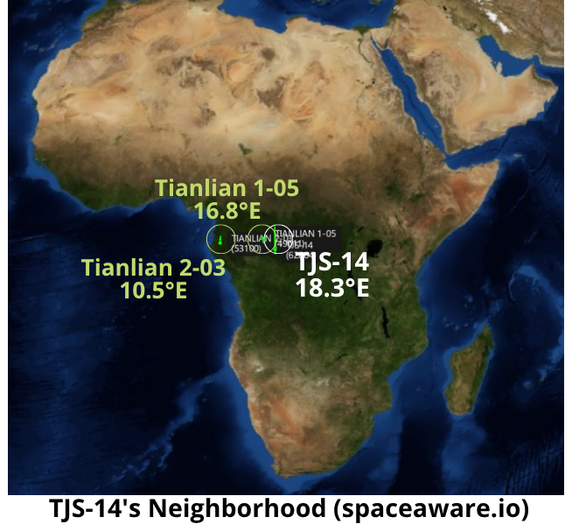
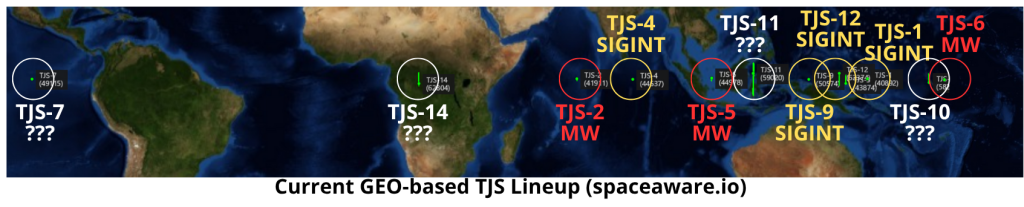
4 Feb 2025: Chinese space operators circularized TJS-14’s (62804) orbit placing the satellite into Geosynchronous orbit over 18.3°E. At this location TJS-14 is the furthest west from China of any of the TJS satellites (TJS-7 notwithstanding which is over the western hemisphere…making it east of China.) As with TJS-12 (62374), TJS-14 has an inclination of 2.0°. The mission of TJS-14 remains unknown, however other TJS satellites are believed to perform SIGINT collection, Missile Warning or some form of satellite inspection mission.
– TJS-14’s 2.0° inclination is similar to that of TJS-12 (62374) which was originally 2.0° and is currently 1.8°. TJS-12 is located over 146.5°E.
– The nearest Chinese GEO satellites are two relay satellites, Tianlian 1-05 (49011) at 16.8°E and Tianlian 2-03 at 10.5°E. (see graphic).
– Open source reporting indicates that TJS-1, 4, 9 & 12 are performing signals collection (SIGINT), while TJS-2, 5, 6 & 13 (HEO) are missile warning (MW) satellites.
-Examining the spacing between the satellites does not yield any conclusive evidence as to the mission of TJS-14.
– Photometric analysis could yield clues as to the
size/shape of TJS-14. This data could then be compared with the TJS satellites believed to be SIGINT and MW.
-The nearest US satellite of interest is DSP-23 (32287). DSP-23 (32287) was the last of the DSP satellites to be launched (2007) and failed within its first year on orbit.
TJS-14 brings the total number of active TJS satellites to 13 (there is no TJS-8). China launched 5 total TJS satellites from 2015 to 2020. In 2021 launches surged to 3 with no launches in 2022. In just the past 14 months China has launched 5 TJS satellites.
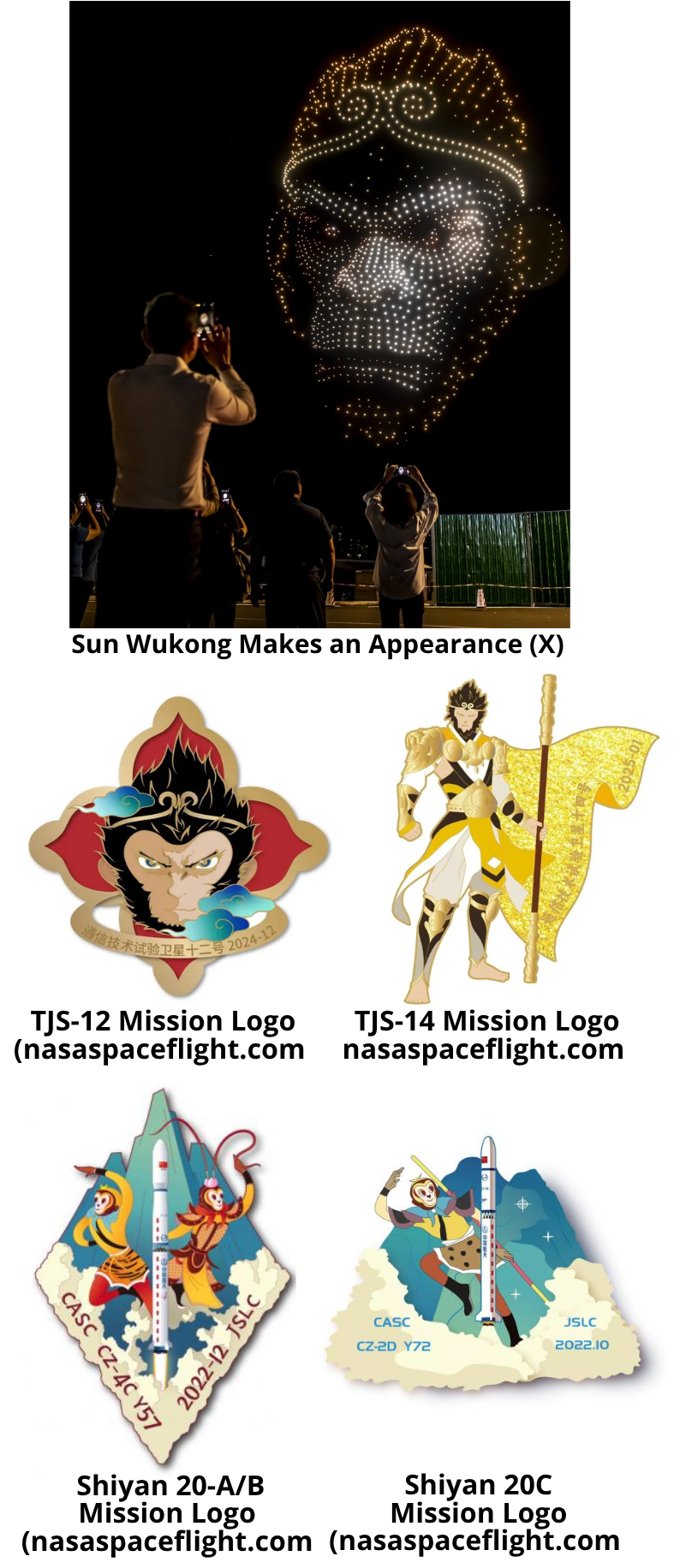
11 Feb 2025: Sun Wukong is a frequent character in Chinese space logos and featured prominently in TJS-14’s logo. While relatively unknown outside of China, this mythical figure is one of the most iconic and beloved figures in Chinese mythology. His story, full of magic, rebellion, and redemption, has captivated generations of readers and continues to resonate worldwide. One of my colleagues, Dee Zimmerman, provided the following analysis.
Sun Wukong, the Monkey King from Journey to the West, is a fitting mascot for China’s space missions due to his legendary traits and symbolism in Chinese culture. Here’s why:
1. Symbol of Exploration and Adventure: Sun Wukong is known for his fearless spirit and insatiable curiosity, much like space exploration itself. His journey to the heavens parallels humanity’s quest to explore space.
2. Power and Speed: The Monkey King’s ability to travel vast distances in a single leap (the Jindouyun, or somersault cloud) symbolizes rapid advancements in space technology and the ambition to reach new frontiers quickly.
3. Immortality and Endurance: Space missions require resilience, adaptability, and longevity. Sun Wukong’s near-indestructible nature reflects the durability of spacecraft and the perseverance needed for long-term space exploration.
4. Wisdom and Strategy: Though mischievous, Sun Wukong is also highly intelligent and resourceful, traits essential for problem-solving in space travel.
5. Cultural and National Pride: As one of the most iconic figures in Chinese mythology, using Sun Wukong as a mascot reinforces national pride and connects modern achievements to China’s rich heritage.
China’s space agency has referenced Sun Wukong in various ways, such as naming its Dark Matter Particle Explorer (DAMPE) “Wukong”, symbolizing its mission to seek the unseen, much like the Monkey King’s ability to see beyond illusions.
Update: China’s 4th Batch of SpaceSail Satellites
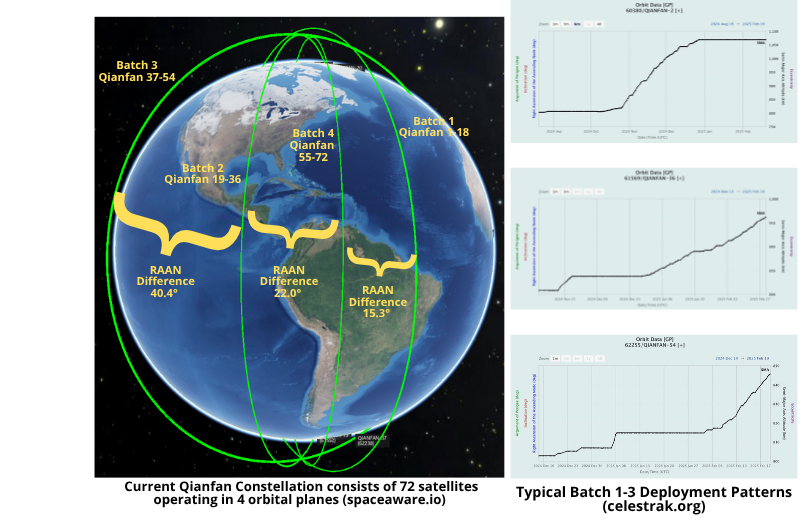
10 Feb: As noted in the 2 February Flash, China launched its 4th batch of 18 Qianfan (SpaceSail) low earth orbit communications satellites on 23 January. After a few weeks those satellites, Qianfan 55-72 (62785-62802) are now in the catalog. All of the Qianfan satellites are inclined 89° but their orbiting altitude differs, possibly due to satellite anomalies. Each launch has been to a unique orbital plan.
– Qianfan 55-72 are also known as, Polar Orbit Group 6, and are orbiting at an average altitude of ~804-808km.
– All 18 of the satellites appear to have conducted initial orbit raising maneuvers.
-Batch Updates:
- Batch 1: 17 of 18 satellites have raised their average altitude to 1,068.9km. Qianfan 7 (60385) has not maneuvered and may be inoperable.
- Batch 2: 15 of 18 satellites have raised their average altitudes. There is a wide variance between the operational satellites, lowest being 814km and highest at 861km. Three of the satellites, Qianfan 27 (61560), Qianfan 28 (61561) and Qianfan 35 (61568) have not maneuvered.
- Batch 3: After over a month with minimal orbit raising maneuvers, 16 of 18 satellites began to raise their average altitudes significantly in early February. The active satellites are all now approaching ~900km average altitude. Qianfan 39 (62240) and Qianfan 42 (62243) did not follow this pattern and remain at ~810km.
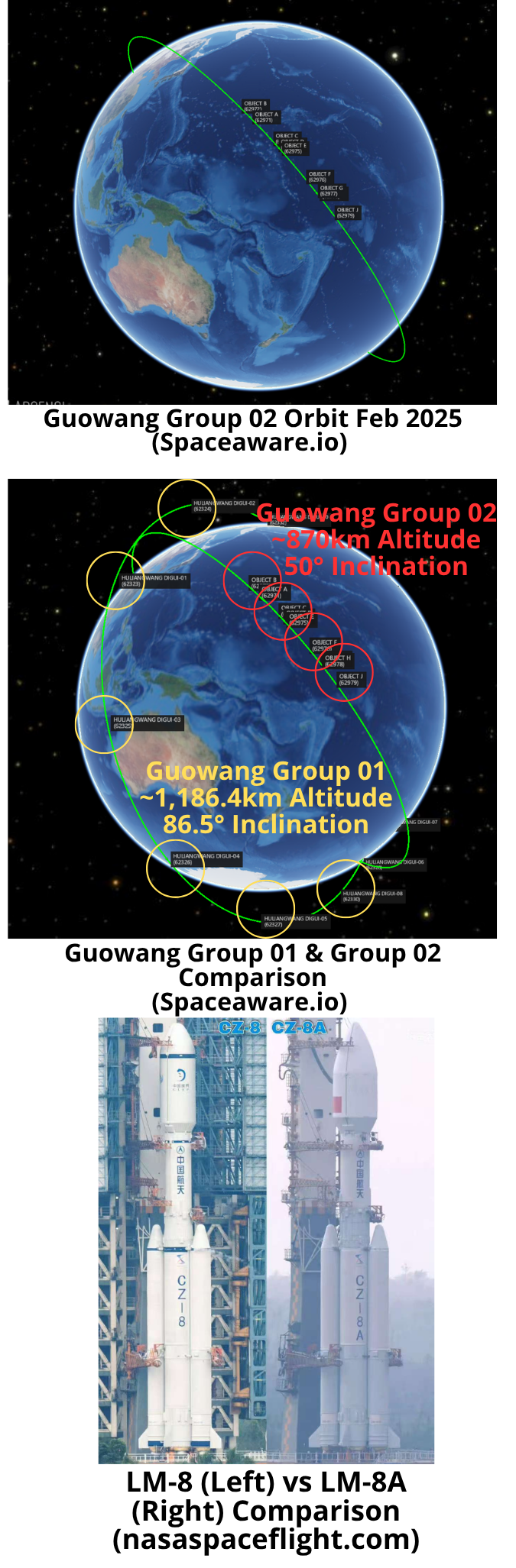
11 Feb: China conducted the first Long March-8A launch vehicle with 9 Guowang Group 02 (SatNet) (62971-62979) low earth orbit satellites from Wenchang. According to CASC, the Long March-8A is designed to launch groups of satellites for satellite constellations. China has released little information regarding Guowang satellite capabilities or mass/size. Launch Video.
– Over 2 launches, China has launched 19 of the Guowang satellites.
- China used a LM-5B to launch the first 10 satellites (Guowang 01) (62323-62332) on 16 Dec 2024. These satellites have an average altitude of 1,186.4km and are inclined 86.5°.
- China launched the Guowang 01 satellites to an average altitude of ~1,100km and all 10 spacecraft maneuvered to reached their operating average altitude ~10 days after launch.
- The 9 Guowang 02 satellites are operating at significantly different operating altitudes and inclinations. Average altitudes range from 866-870kms and all are inclined at 50.0°.
- All of the Guowang 02 satellites have conducted orbit raising maneuvers, but it remains unknown if they have reached their planned operating average altitudes.
- Per Chinese news sources: Guowang plans to launch a total of 12,992 satellites. 6,080 will be in an extremely low orbit of 500 to 600km; the other 6,912 satellites will orbit at 1,145km.
- Guowang 02 satellites do not currently match either, either they will maneuver to new altitudes or the plan has changed since the previous news report.
– Per Andrew Jones:
- CASC’s China Academy of Space Technology (CAST) produced the Guowang 02 satellites. The state-owned China Satellite Network Group Co., Ltd. (China SatNet) oversees the Guowang/SatNet project, which envisions a constellation of around 13,000 satellites in low Earth orbit.
- The Long March 8A is an upgraded variant of the standard Long March 8, which debuted in December 2020. It features the same first stage and side boosters as the original but includes a newly designed 3.35-meter-diameter hydrogen-oxygen second stage, allowing a wider, 5.2-meter-diameter payload fairing.
A domestically controlled satellite network ensures China’s strategic independence from foreign providers like Starlink. The Chinese military also noted the value of that system from the early days of Ukraine’s response to the Russian invasion of the country in 2022.
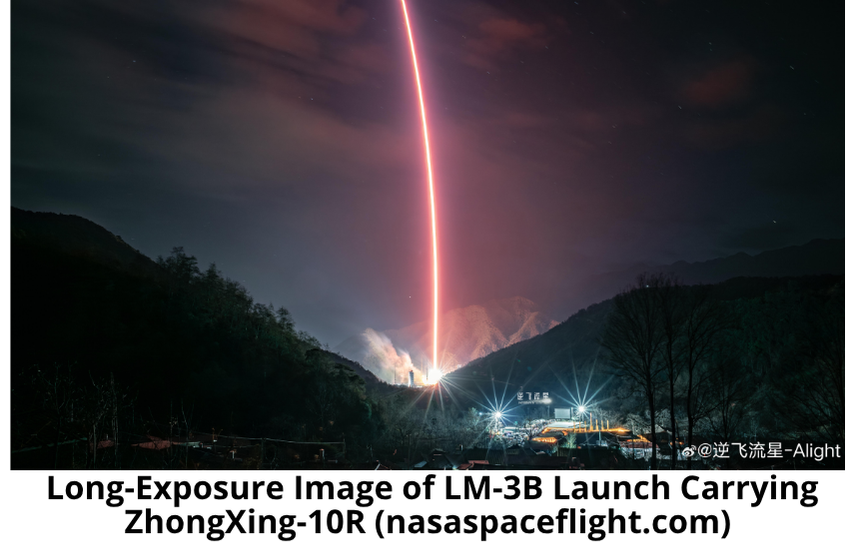
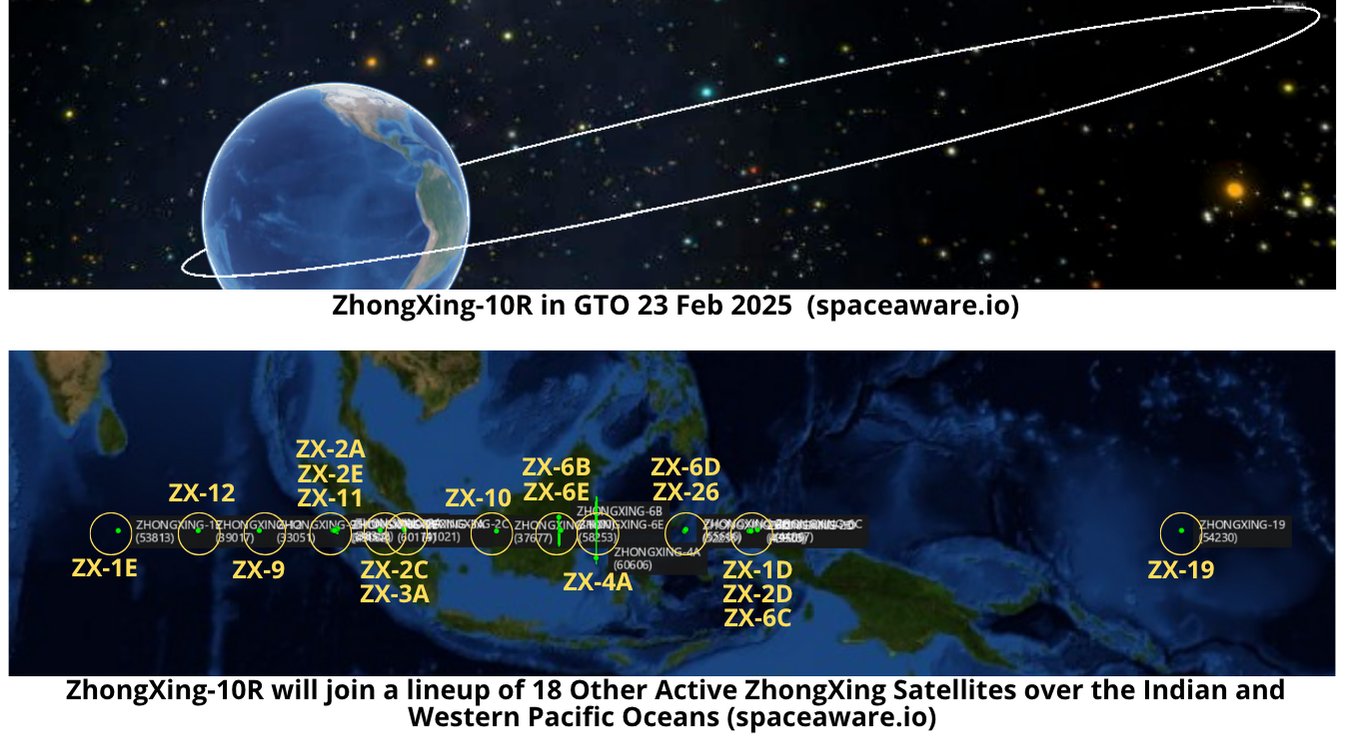
22 Feb 2025: China launched a Long March-3B with the ZhongXing (ChinaSat)-10R satellite (2025-036) from the Xichang. ZhongXing-10R is a communications satellite designed to “provide reliable, stable and safe radio and television transmission and communication services”. As of 23 Feb, ZhongXing-10R was in Geosynchronous Transfer Orbit (GTO) and its ultimate location on the Geostationary belt is unknown. Launch Video.
– Per Andrew Jones:
- ZhongXing (ChinaSat), is a series of communications satellites operated by China Satellite Communications Co., Ltd. (China Satcom), a CASC subsidiary. The satellite series provides a range of communications services, including television broadcasting, internet connectivity, radio transmission, secure military communications, VSAT (Very Small Aperture Terminal) networks, and mobile communications.
- CASC did not immediately provide information on which DFH satellite bus the satellite is based on, nor details regarding transponders and bands used, which would help clarify its exact capabilities.
- The original ChinaSat-10 was launched in 2011 and positioned at 110.5 degrees East on the geostationary belt (over Western Borneo).
The launch was China’s eighth orbital launch attempt of the year…CASC has yet to publish an overview of China’s plans for the year, but is expected to do so later this month. The country may once again attempt to reach around 100 launches—as targeted for 2024—or more. Commercial launch companies headquartered in Beijing are aiming for a collective total of around 40 launches, according to officials at a recent commercial space conference.
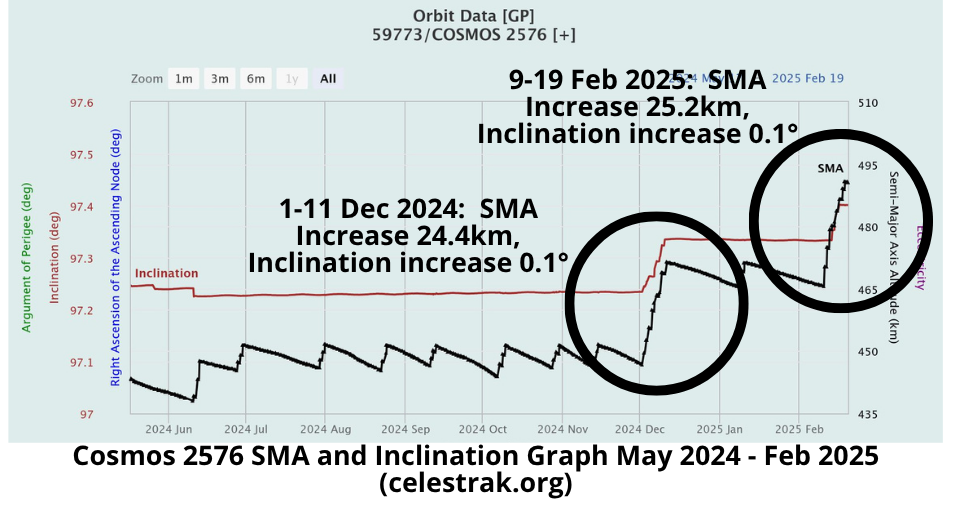
20 Feb: Cosmos 2576 (59773), a Russian satellite suspected of having anti-satellite capabilities, began a series of maneuvers in late November 2024 which included changes in average altitude (common) as well as changes in inclination (uncommon). From 9-19 Feb, Cosmos 2576 raised its altitude ~35km to 490.6km and increased its inclination 0.1°. Inclination changes are rare due to their large fuel expenditures. Cosmos 2576 had been co-planar with a US high-value satellite, USA 314. It is unknown if Russia altered Cosmos 2576 as a result of changes with USA 314 or other satellites of interest. Per the Joint Capabilities Office (JCO) reporting, the recent maneuvers placed COSMOS 2576 closer to two well-tracked objects. JCO provided no further specifics regarding the objects.
– Russia launched Cosmos 2576 on 16 May 2024 from Plesetsk using a Soyuz 2.1b. There were 9 other payloads on-board.
– Russia launched Cosmos 2576 into a co-planar orbit with USA 314, prompting a rapid response from the US Department of Defense.
– From mid-June until 30 November 2024 Cosmos 2576 maintained an average altitude
between 445-451km with an inclination of 97.2°.
– On 30 Nov – 11 Dec, Russia raised Cosmos 2576 average altitude 24.4km to 471.5km. Simultaneously, Cosmos 2576 changed its inclination 0.1° to 97.3°.
– Cosmos 2576 maintained this average altitude and inclination until 9 Feb 2025.
– From 9 – 19 Feb, Russia raised Cosmos 2576 average altitude 25.2km to 490.9km. It also changed its inclination another 0.1° to 97.4°.
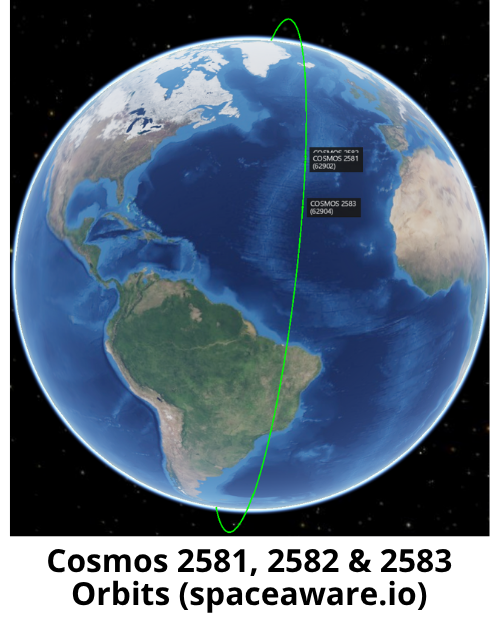
5 Feb: Russia launched a Soyuz 2.1v with a Volga upper (3rd) stage from Plesetsk. On board were three satellites which US Space Command has labeled Cosmos 2581, 2582 and 2583 (62902-62904). Russia has released no information regarding the mission of these satellites other than to say they were launched for the Ministry of Defense.
Launch Video.
-The satellites are all co-planar with an inclination of 82.0°. Initial average altitude for all three satellites was ~587km.
- Two of the three satellites have increased their average altitude. Cosmos 2581 raised its orbit 2.3km to 588.7km and Cosmos 2582 raised its orbit 2.8km to 589.4km. Cosmos 2583 has not maneuvered thus far and its average altitude remains 588km as of 22 Feb.
-Per Bart Hendrycx:
- The amount of information released by the Russians has moved one more level down. All we got was a terse announcement from the Ministry of Defense on the fact that the launch had taken place and a note on the Roscosmos website that they had been successfully placed into orbit.
- The Volga (upper stage) has so far not demonstrated the capability of deploying multiple satellites into different orbits. It usually performs a single burn to place the payload into its final orbit (within about 1 to 2 hours after launch) and then coasts for several hours until its orbit takes it over the disposal zone in the Pacific.
Pics o' the week!