issue 111 | 8 DEC 2024
The integrity flash
Analysis of Developments in the Space Domain
in this issue
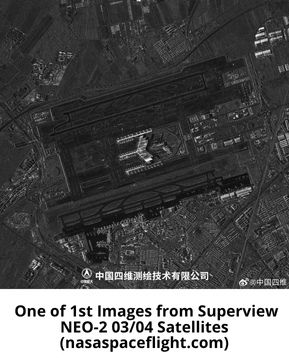
24 Nov: China launched a Long March-2C with the SuperView Neo 2-03 and SuperView Neo 2-04 (62079 & 62080) remote sensing satellites from Jiuquan. It appears the two satellites will work cooperatively to collect high-resolution synthetic aperture radar (SAR) imagery of the Earth. Launch Video.
– The satellite catalog is currently showing 3 objects on orbit from this launch (2024-218). The satellites themselves have not been individually identified by name.
- 62079 and 62080 seem to be the Superview NEO 2 satellites and are orbiting at ~515.5×491.5km with an inclination of 97.5° (sun synchronous orbit).
- 62078 is likely the LM-2C upperstage.
– China described the pair as high-resolution synthetic aperture radar (SAR) satellites equipped with phased-array radar payloads and providing a resolution of 0.5 m.
– Superview Neo-2 03 and 04 will fly in formation and are part of China Siwei’s planned 28-satellite SuperView Neo remote sensing constellation. (see following article for more constellation details).
– According to Shanghai Academy of Spaceflight Technology’s (SAST) public launch announcement the Superview NEO satellites “will be the first time in the world that a commercial satellite can achieve a 100-meter-level autonomous strict return orbit and sub-meter-level fly-around formation coordinated control.”
– Superview NEO-2 03/04 are co-planar with one satellite leading the other by ~5 seconds.
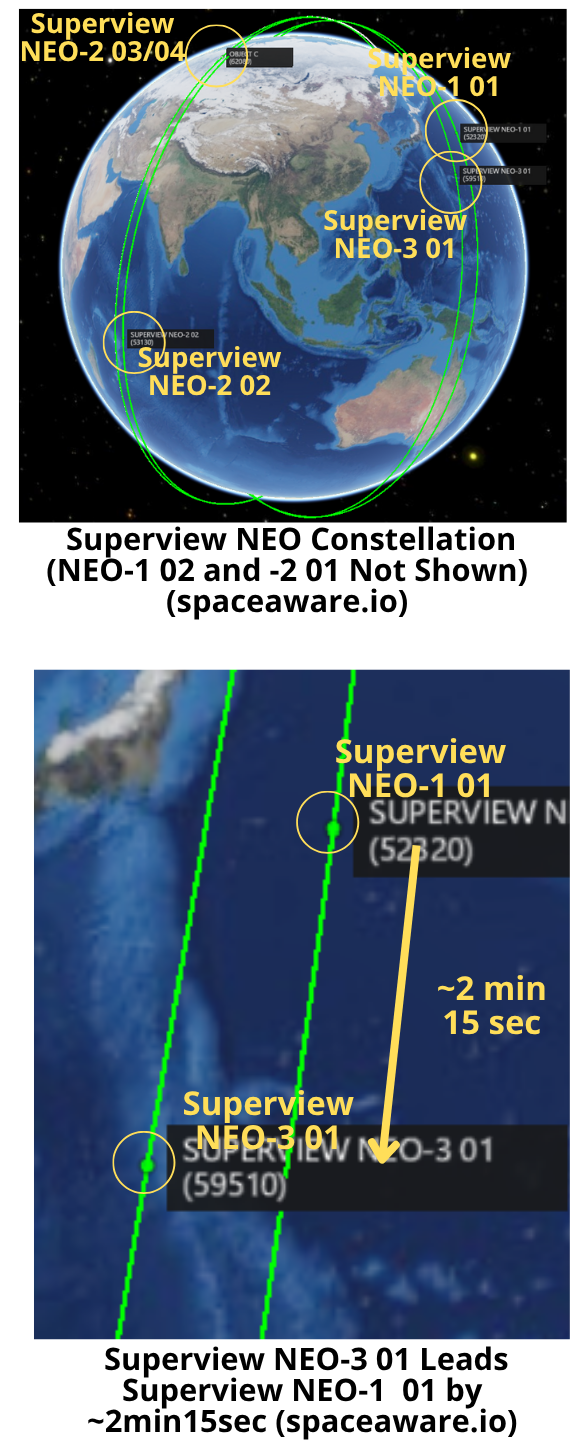
– China launched the first 2 Superview NEO-2 satellites (53128 & 53130) in 2022. Those two satellites remain co-planar but are not operating within proximity of one another. In fact they operate on opposite sides of the Earth (as one passes the North Pole the other is over the South Pole). See graphic right.

30 Nov: I found one particular paragraph from the 8th Academy’s (Shanghai Academy of Spaceflight Technology’s (SAST) public release very interesting.
“The 4D Gaojing-2 03 and 04 (these are the Superview NEO-2 03 & 04 mentioned in the previous article) are two high-resolution radar satellites of China’s 4D new generation commercial remote sensing satellite system. After being networked with the high-resolution optical and wide-band optical satellites launched previously, they will further enhance the country’s leading integrated optical SAR service capabilities, and the satellite system will enter a stage of efficient collaboration “.
– The Superview NEO constellation is operated by a Chinese commercial company, China Sewei Surveying and Mapping Technology Co Ltd (aka China Sewei). China Sewei currently operates 40 earth observation satellites and offers “diversified products in resolution, accuracy and spectral bands.”
– The SuperView Neo commercial constellation will include 16 high resolution optical (20-30cm), 4 wide-swath optical (1m resolution coverage of a 100km swath) and 8 0.5m high-resolution SAR images. Combined Super NEO will contain at least 28 total satellites.
– Current Status
- SuperView Neo-1 (20 to 30 cm optical): 2 of planned 16 on orbit. Both launched in 2022 (52320/52322).
- SuperView Neo-2 (50 cm SAR): 4 of planned 8 currently on orbit. Superview NEO-2 01 & 02 (53128 & 53130) launched in 2022 and most recent launch of NEO-2 03 & 04 (62079 & 62080). Interestingly the 2 sets of SAR satellites are nearly co-planar.
- SuperView Neo-3 (wide-width with 0.7m resolution + 100km swath width): 1 of 4 on orbit. Superview NEO 3-01 (59510) launched in April 2024.
– Networking earth observation satellites with different collection capabilities allows the ability for the satellites to “tip and cue” one another.
– China Sewei is likely experimenting with cross-cueing satellites for optimal collection with the high resolution Superview NEO-1 01 (52320) and the wide swath Superview NEO-3 01 (59510). The wide swath satellite leads the high resolution satellite by ~2min13sec. In this “formation” the wide swath (lower resolution) satellite can identify possible objects of interest which could then be confirmed by an image from the high resolution satellite.
-Currently the Superview NEO-2 SAR satellites are not in position to coordinate with the NEO-1 or NEO-3 satellites. This may change as China Sewei completes the constellation.
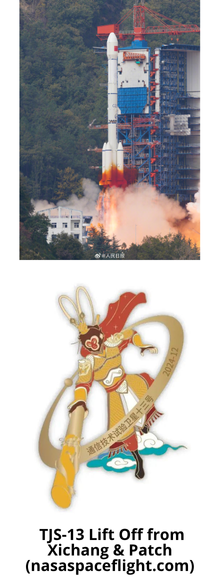
3 Dec: China launched a Long March-3B launch vehicle with the Tongxin Jishu Shiyan-13 (TJS-13/62188) (Communication Technology Test Satellite 13) from Xichang. According to official sources, the satellite has entered the planned orbit and will be used for satellite communication, radio and television, data transmission and other related technology tests. As of 4 Dec 2024 the satellite remained in Geostationary Transfer Orbit (GTO). Launch Video.
– As is the norm for TJS satellites, China released very few details regarding the satellite’s mission.
-Per Andrew Jones article:
- The TJS-13 satellite will be used for satellite communication, radio and television, data transmission and other services, and will also carry out related technology tests, according to Chinese state media. However, the lack of specific details surrounding the TJS-13 satellite, consistent with earlier TJS missions, suggests potential dual-use or military-related capabilities.
- TJS spacecraft are geostationary satellites, potentially carrying out classified missions including signals intelligence, early warning missions and satellite inspection activities.
- TJS-3, launched in 2018, released a subsatellite which carried out subsequent maneuvers indicating it was a subsatellite capable of coordinated movements with TJS-3. The main satellite later made close approaches to U.S. satellites.
- TJS-10 and TJS-11 launched on a Long March 7A rocket in November 2023 and a Long March 7 in February 2024 respectively. These satellites were likewise described as being used to carry out multi-band, high-speed satellite communication technology verification.
– For some reason China has launched TJS-13 prior to TJS-12.
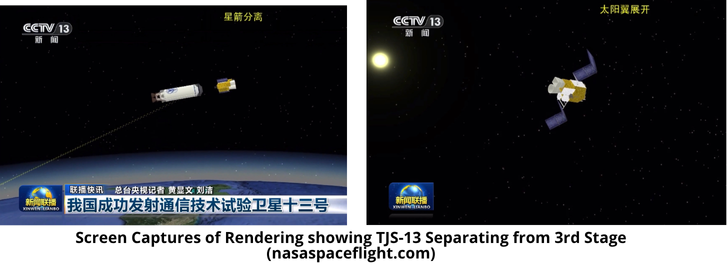
– A 3-4 year old rumor noted that TJS-13 would be one of the Early warning satellites of the TJS series. China included a rendering of the satellite during its launch feed which may support this theory.
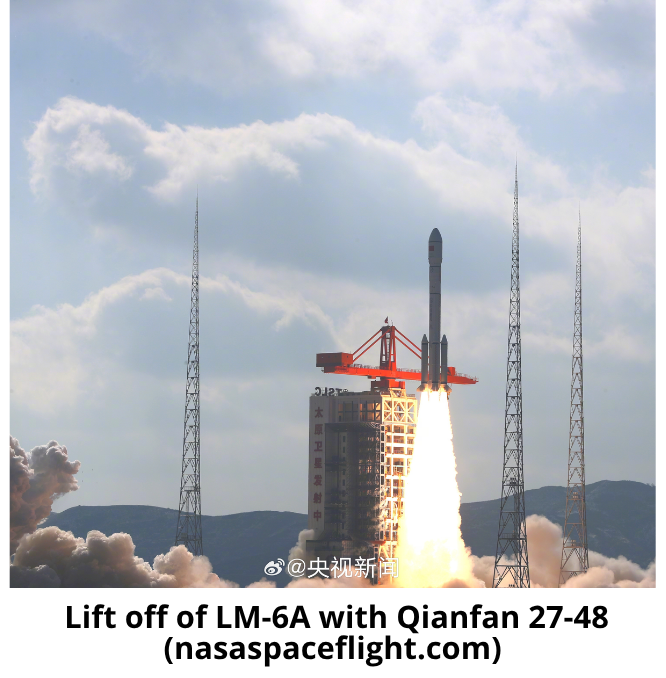
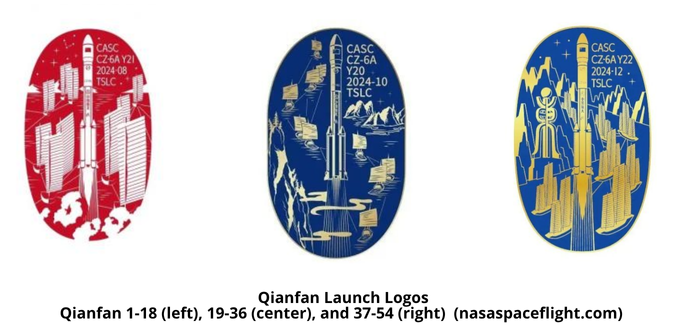
5 Dec: China launched a Long March 6A from Taiyuan with the third batch of 18 Qianfan inernet satellites (Qianfan-37 – 48). There has been very little information released regarding the launch and orbital data was not available as of 6 Dec 2024. Assuming a nominal launch and satellite deployment, this will bring the total number of Qianfan satellites on orbit to 48. Launch Video.
Lorem ipsum dolor sit amet, consectetur adipiscing elit. Ut elit tellus, luctus nec ullamcorper mattis, pulvinar dapibus leo.
16 Dec: China used its most powerful rocket, the Long March-5B Y6 with a Yuanzheng-2 upper stage to launch the first group of 10 SatNet LEO (Guowang) satellites from Wenchang. Official sources noted “the satellites successfully entered the predetermined orbit and the launch mission was a complete success.” Launch Video.
– Shanghai SpaceSail Technologies (SSST) Co., Ltd. is launching the Qianfan constellation to “provide global users with low-latency, high-speed and ultra-reliable satellite broadband internet services.” SSST plans for the constellation’s first stage to consist of 1,296 satellites. 648 of these are to be launched by the end of 2025 to provide regional network coverage. The completed network will consist of more than 14,000 low Earth orbit broadband multimedia satellites.
– All of the Qianfan launches used the LM-6A, you might recall the first launch resulted in considerable debris as it appears the LM-6A upperstage suffered some sort of anomaly.
-There may be a 4th Qianfan launch before the end of 2024.
22 Nov: During its nearly 2 weeks in orbit, China’s Shijian-19 retrievable satellite conducted an experiment involving an inflatable module. This is China’s first such test and, per Andrew Jones, “fills a technological gap in China’s capabilities and potentially opens the door to future applications in deep space exploration and orbital habitats.” More excerpts from Andrew Jones’ SpaceWeek article below.
– China launched SJ-19 a Long March 2D rocket from Jiuquan Sept. 27 and landed late Eastern Oct. 10 at the nearby Dongfeng landing site in the Gobi Desert.
– The China Academy of Space Technology (CAST) manufactured both Shijian-19 and the test module. CAST revealed that the “inflatable flexible sealed module” completed an on-orbit test in a Nov. 21 statement.
– CAST stated that the multifunctional sealed structure was made from flexible composite materials and declared the mission a complete success.
– The module was in a compressed, folded state during launch and inflated upon reaching orbit. This design offers advantages such as lightweight construction and high folding efficiency. CAST described the technology as a promising approach for constructing large-scale space-sealed modules and represents an important new direction in sealed module technology.
– China has earlier stated its interest in expandable or inflatable modules, but the Nov. 21 release appears to be the first public unveiling of related hardware.
– China also revealed plans to begin expanding the Tiangong space station…an inflatable habitat could play a role in this planned expansion.
– The Shijian-19 mission was described as the first test of a new generation of high-performance reusable retrievable space test platform by the China National Space Administration (CNSA).
– SJ-19 was ~3,500-kilograms and carried payloads and experiments including staple and industrial crops for irradiation experiments aimed at fostering beneficial mutations, microbial specimens, and space technology experiments.
– SJ-19 was a short-duration version of the retrievable spacecraft, designed for missions lasting about two weeks. A long-term configuration, equipped with solar arrays on its propulsion and power module, is capable of remaining in orbit longer, supporting extended experiments.

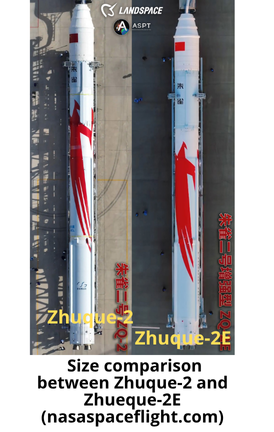
27 Nov: Chinese commercial space company, LandSpace, launched its first ZhuQue-2E launch vehicle with two satellites from Jiuquan. The payloads were the Guangchuan 01 and 02 satellites, the mission of these satellites remains unconfirmed. The ZhuQue-2E is powered by four 80-tons thrust TQ-12 liquid oxygen and liquid methane (LOX+LCH4) rocket engines on the first stage and a single 85-tons thrust TQ-15A liquid oxygen methane rocket engine on the second stage. Launch Video & 9-min technical description video.
– From Andrew Jones article:
- Zhuque-2E is 47.3-meter-long has a diameter of 3.35 meters and can carry 4,000 kg to a 500-kilometer sun-synchronous orbit.
- The second stage engine is an upgrade over the earlier engine, with vernier thrusters replaced by a vector control system, saving 400 kgs in mass.
– The new single TQ-15A vacuum-optimized second-stage engine is the largest difference between the ZQ-2 and ZQ-2E.
– Readers may recall that the first launch of the ZQ-2 on 14 Dec 2022 failed as a result of the vernier engines. The ZQ-2E no longer relies on these engines.
– LandSpace is developing the Zhuque-3 which is a re-usable stainless steel rocket.
– While little is known regarding the capabilities of the Guangchuan 01 and 02, there was one report the satellites are for “key technology demonstration for LEO internet communication constellation development”. The Chinese name “Guangchuan” roughly translates to “light-transfer” so maybe it’s for inter-satellite laser communications links demonstration.
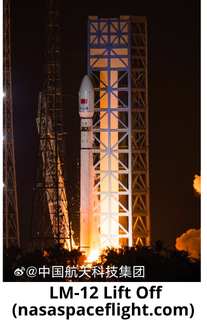
30 Nov: China launched its first Long March-12 launch vehicle with two satellites from Wenchang (Hainan Island). According to China’s National Space Agency, the Long March-12 is China’s first 3.8-meter-diameter single-core liquid-propellant launch vehicle, with a two-stage configuration. The first stage uses four 1250 kN thrust YF-100K liquid oxygen/kerosene engines, and the second stage uses two 180-kN thrust YF-115 liquid oxygen/kerosene engines. CNSA also noted the 2 YF-115 2nd stage engines are able to reignite for the first time and the LM-12 is capable of delivering 12 tons to LEO and 6 tons to sun synchronous orbit. SAST announced the previously undisclosed payloads on the flight to be the experimental “Satellite Internet Technology Test Satellite” and “Technology Test Satellite-3”. No details of the spacecraft were provided.
Launch Video. CNSA LM-12 promotional video.
Yaogan-43 02/03 Continued Evolution
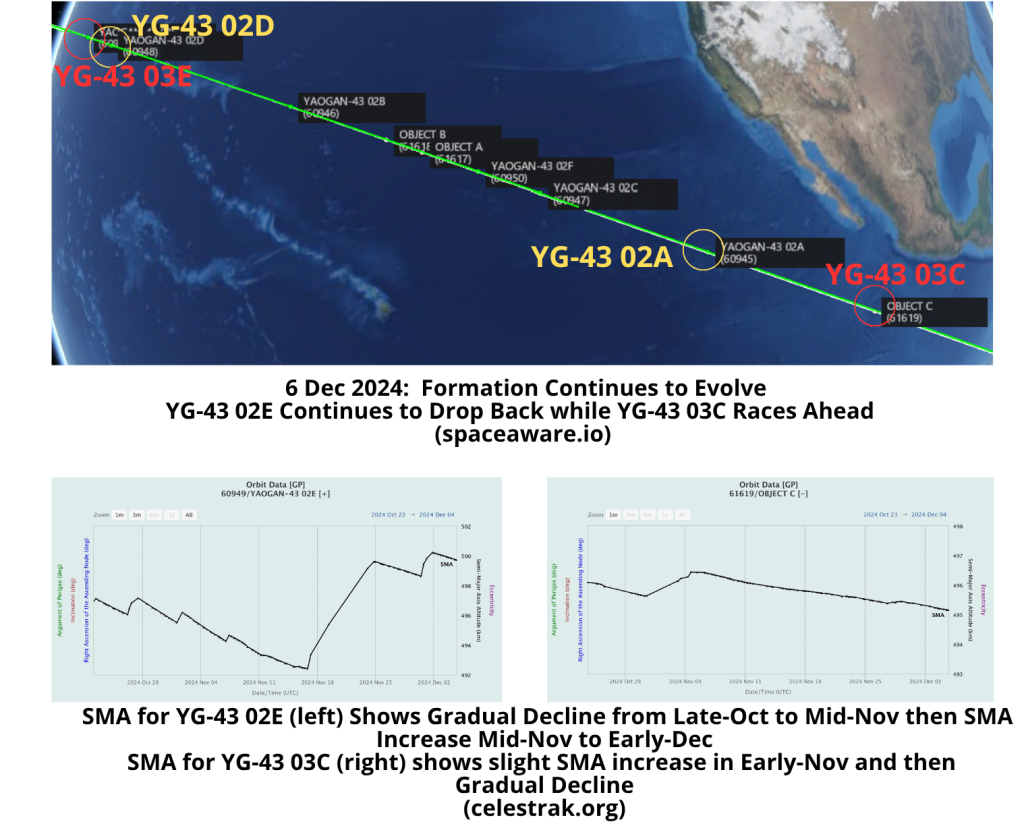
6 Dec: The 9 co-planar satellites that make up the YG-43 02 and 03 “formation” continues to change. You may recall that YG-43 02E (60949) decreased its altitude (SMA) in late-October and as a result went from being the final (Trail8) satellite at the end of the formation to briefly being in the second position just behind what was then the lead satellite YG-43 02A (60945). As we noted in the last Flash, YG-43 02E then raised its SMA nearly 7km bringing it to a higher orbit relative to the other 8 YG-43 02 and 43 03 spacecraft. YG-43 02E remains at a slightly higher orbit and has resumed its Trail8 position at the end of the YG-43 02 & 03 formation. Another change has also occurred at the front of the formation, with YG-43 03C (61619) replacing YG-43 02A as the lead satellite. YG-43 03C is currently orbiting with an SMA of 495.2km which is 1.6km lower than the YG-43 02A satellite.
After the loss of Space Shuttle Columbia (1 Feb 2003), a pre-docking with ISS maneuver was designed and implemented to give the ISS crew a close up look at the condition of the Shuttle before it docked. It was called the R-bar pitch maneuver (RPM), some folks called it the rendezvous pitch maneuver or backflip. The RPM was a maneuver performed by the Space Shuttle as it rendezvoused with the ISS prior to docking. After loss of Columbia, 21 Shuttle missions went to ISS and did the RPM before docking. The Shuttle performed a backflip to show the ISS crewmembers all surfaces of the Shuttle after it achieved orbit. They wanted to ensure there was no damage while ascending to orbit. The key thing they were looking for was the condition of the underside and leading edge where extreme heat is experienced during re-entry. Based on the insight and information gained during the rendezvous pitch maneuver, NASA could decide if the Shuttle was not safe for entry at the end of its mission with ISS. They may have then decided either to wait on the ISS for a rescue mission or do a spacewalk to attempt to repair the damage. Here’s a short video of the Shuttle (STS-120) doing the RPM:
https://youtu.be/2vzqnQ5F7H4?si=xy68VcDtDhdKZY4u
The RPM gives me a chance to use the Ten One Rule of Thumb that gives us some simple rule of thumb rendezvous and proximity operations insight. Basically, the Shuttle arrives just below the ISS, about 200 meters below (on the R-bar, the NASA coordinate frame used has Radial down, and in a circular orbit). Before it drifts forward due to being below ISS, the Shuttle then does the RPM or backflip as the ISS crew photos and inspects the condition of the Shuttle. ISS is in about a 400 KM circular orbit and the Shuttle is coplanar with it, but arrives at 200 meters below. The RPM talks a few minutes and then the Shuttle then maneuvers up to a position in front of the ISS, on the V-bar…the ISS Velocity Vector.
Well, here’s a scenario that they didn’t do, but it enables me to do a refresher on the Ten One Rule of Thumb. So, what if the Shuttle didn’t move to the “in front on the V-bar position?” It would move ahead of ISS per the Ten One rule of thumb, which says per orbit (ISS orbital period in this case is 92.4 minutes) the distance moved in-track will be TEN TIMES the radial offset. So, that means after 92.4 minutes the Shuttle will have advanced ahead 2000 meters (or 2 Km) … which is 10 x the 200 meter radial offset. Hooray for the TenOne rule of thumb.
Let’s see if you got this Ten One rule of thumb down. Here’s another “they didn’t do it that way” scenario, but, it’s a “do you know your TenOne rule of thumb?” What if the Shuttle was 1 Km below the ISS orbit and 30 Km behind right now. It’s in a circular orbit that was matched in orbit plane. When would it move to a position below ISS? Using the Ten One rule of thumb we see the Shuttle will advance 10 Km per orbit (why? Because it’s 1 Km below, so 10 X 1 Km, gives us the 10 Km per orbit (92 minutes or so). How long until the Shuttle is below ISS and can execute the RPM? It takes 3 orbits and using the ISS orbit period of 92.4 minutes we see that’s 277 minutes (4:37). This enables the Shuttle to close the 30 Km behind the “just below the ISS” position. Now, like I said, this is not how they did it, but you see how we apply the TenOne rule of thumb. Actually, the Shuttle would be too far away for a effective RPM inspection. I bet you are all saying “well, let’s do a Hohmann Transfer and raise our altitude to the 200 m below altitude. Yup, we could do that and hooray for you remembering Walter Hohmann’s transfer.
Your Ten One Rule of Thumb Refresher is complete and you also learned one of the key flight safety things done by the Shuttle late in its life supporting the ISS operations.
SY-12 02 Reverses Course Begins Eastward Journey
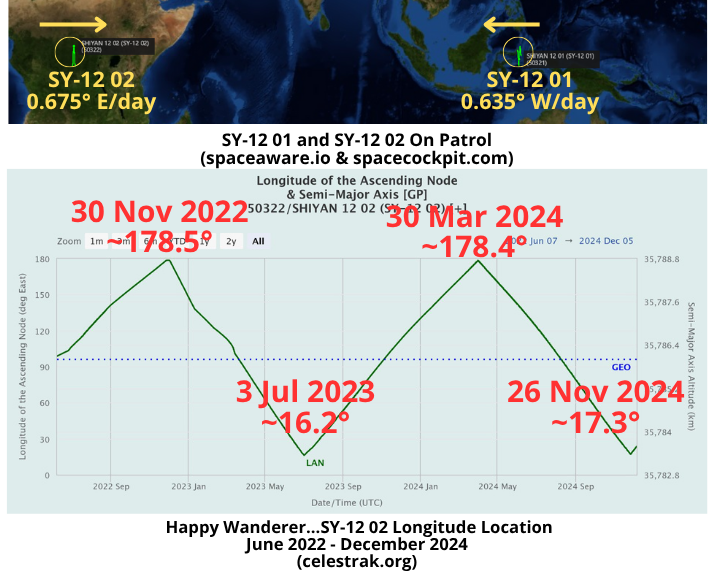
26 Nov: Shiyan-12 02 (SY-12 01/50322), which has been rumored to be the Chinese version of GSSAP, lowered its altitude (SMA) on ~26 Nov 2024 as it approached its historic western turnaround point of 17.3°E (over central Africa). On 28 Nov the satellite was at 19.0°E and drifting further east at a rate of 0.675° per day. From 26-27 Nov the satellite decreased its altitude a total of 102.3kms and is now 50.6kms below GEO.
– A Historical Look at the Journey of SY-12 02
- China launched both SY-12 02 and SY-12 01 (50321) on 23 Dec 2021 on a LM-7A from Wenchang.
- Shortly after arriving on orbit there were some interesting interactions between USA270 (a GSSAP satellite) and both SY-12 satellites (watch Video).
- Both satellites seem to have an average westward limit of ~17.275°E and an average eastward limit of ~177.725°E. On average it takes each satellite ~246 days to complete one leg of their route (either East to West or West to East).
- With this latest maneuver, SY-12 02 is beginning its second eastward journey since June 2022. If it follows previous orbit profiles it should reach its Eastern limit on ~ 30 July 2025.
– For its part SY-12 01 continues to drift west after raising its orbit on 15 Sep 2024. It is drifting East at a rate of 0.635° per day. If it follows the previous orbit profile it should reach its Western limit on ~ 19 May 2025.
Russia Launches 2d Kondor-FKA Radar Imaging Satellite
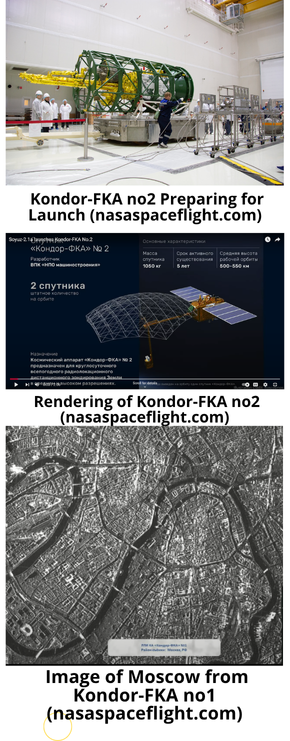
29 Nov: Russia launched a Soyuz-2.1a with the Kondor-FKA No.2 satellite (62138) from the Vostochny Cosmodrome. According to Roscosmos, Kondor-FKA No.2 is a civilian synthetic aperture radar (SAR) Earth observation satellite. The Kondor-FKA space system is designed to obtain high- and medium-resolution radar imagery for the Russian Federation and provides round-the-clock all-weather probing of the earth’s surface. Launch Video.
-Kondor-FKA no2 is currently in a 509x505km orbit with an inclination of 97.4°. Kondor-FKA no1 (56756) is in a similar orbit of 505x503km and an identical 97.4° inclination. The two orbits have a RAAN offset with Kondor-FKA no1 orbiting ~9° West of Kondor-FKA no2.
– Their orbital planes will be close to one another to make possible interferometric imaging. However, it does not appear that the two Kondor-FKA satellites are operating cooperatively as they are orbiting on separate sides of the earth. (see graphic below).
– The follow-on satellites called Kondor-FKA-M are still said to be in the design phase and will have a maximum resolution of 0.4 m.
– The Kondor satellites feature an S-band synthetic aperture radar (SAR), conducting both continuous swath surveys and detailed spot surveys of Earth’s surface. The width of the SAR’s swath is 10km with a ground resolution of 1-2m in spotlight mode, 1-3m in strip-map mode, and 5-30m while in ScanSAR mode.
– Kondor-FKA will assist Russia in its war against Ukraine. It makes two passes over Ukraine each day and can make radar images of “Ukrainian military objects” with a resolution of 1m.
– Officially, Kondor-FKA is a civilian satellite ordered by Roskosmos, but in the current circumstances it may well become a dual-purpose satellite.

5 Dec: Russia launched a A Soyuz 2.1b with the LOTOS-S1 no8 (Cosmos 2580/62216) satellite from Plesetsk. The Lotos reconnaissance satellites form part of a wider, classified, orbital electronic intelligence system known as Liana. This Electronic Signals Intelligence, or ELINT, system intercepts radar and electromagnetic radiation. Launch Video.
-Cosmos 2580 launched into a 899×239 km orbit with an inclination of 67.14°. On 6 Dec Russia circularized the orbit and Cosmos 2580 is now at 912x893km.
-Previous Lotos-S1 launches have included a small passenger satellite and Ministry of Defense announcements noted the presence of “satellites.”
– For Cosmos 2580, the Ministry of Defense reported the launch of a single satellite. Per Bart Hendrickx, “This means that either there is no subsatellite on board or that it was decided not to reveal its presence this time. If there is one on board, it should separate from Lotos after the latter circularizes its orbit at around 900 km (this is what happened after the two previous Lotos launches).”
– As of 8 Dec there has been no reporting of additional satellites/objects associated with this launch.
– The Lotos-S constellation now consists of five operational satellites. All are in separate orbital planes.
- Cosmos 2549 (2021-008A/47546)
- Cosmos 2554 (2022-036A/52202)
- Cosmos 2565 (2022-163A/54381)
- Released sub-satellite + object
- Cosmos 2570 (2023-165A/58148)
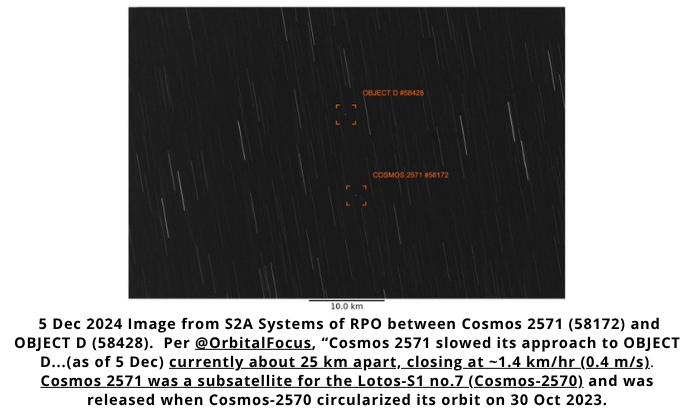
- Released sub-satellite + object: currently engaged in RPO activity (see pg 14)
- Cosmos 2580 (2024-230A/62216)
– Lotos-S is capable of intercepting radio signals helping
to locate, identify, and target various military vehicles
and installations.
– Special terminals installed on Russian war ships were
reported to be capable of downlinking real-time data
directly from the Liana network for the purpose of
weapon guidance.
-More from Bart Hedrickx: Cosmos 2580 “should be the last of a batch of four (serial numbers 806-809) ordered in 2017. As far as is known, the next batch was ordered in 2022…it may be a couple more years before we see these launched into orbit. The fact that a new batch was ordered raises more questions about the status of the next-generation low-orbiting ELINT satellites called Akvarel. These were approved back in 2014.”

Pics o' the week!