issue 96 | 5 may 2024
The integrity flash
Analysis of Developments in the Space Domain
in this issue
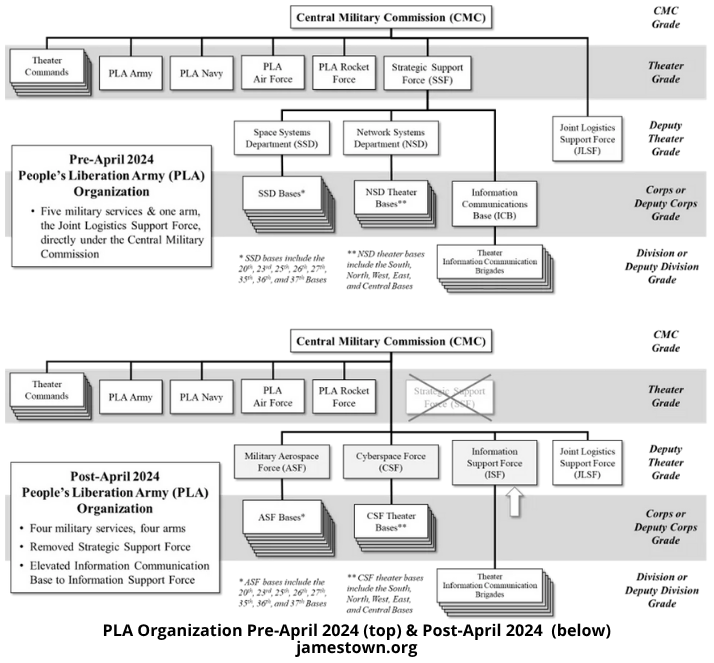
19 Apr 2024: Xi Xinping announced a major restructuring of the Chinese military with the creation of a new Information Support Force (ISF) and the disbandment of the Strategic Support Force (SSF). The re-organization represents the largest since 2015 when China established the SSF. During his remarks Xi declared the ISF was “a brand-new strategic arm of the PLA and a key underpinning of coordinated development and application of the network information system.” The new ISF commander is Lt Gen Bi Yi who was previously the SSF Deputy Commander. How the re-organization will effect China’s space forces
remains unclear.
– In the official announcement, PLA spokesman Wu Qian announced that there are now “four services, namely the Army, the Navy, the Air Force and the Rocket Force, and four arms, including the Aerospace Force, the Cyberspace Force, the Information Support Force and the Joint Logistics Support Force.”
– The roles, responsibilities, forces, and capabilities of the new ISF are still to be determined. Some experts noted the reorganization enhances Xi’s direct control over the PLA’s strategic capabilities and underscores China’s ambitions in better mastering AI and other new technologies to prepare for what it calls the “intelligentized warfare” of the future.
– The ISF is directly under the Central Military Commission (CMC) underscoring the importance of information dominance in modern warfare.
– Per CASI’s Kristin Burke: “The change will allow China’s Space System Division (SSD) to focus on using their systems…while the ISF will be responsible for keeping them functioning & secure.” – Ms Burke also noted: “One important change in the SSD already happened: the separation of functions between Base 26 (Xian TTC) and Base 37 (foreign space object tracking and early warning).”
– The ISF’s Commanding General is Lt Gen Bi Yi who was the SSF’s Deputy Commander beginning in Jul 2023.
– There was no mention of any new appointment for SSF commander Ju Qiansheng. Ju disappeared from public view amid a series of military purges in 2023.

– Per J. Michael Dahm: “The move by CMC Chairman Xi Jinping may be related to factors ranging from ongoing corruption scandals within PLA ranks to bureaucratic infighting to organizational efforts to increase operational effectiveness...Monitoring future development related to PLA information organizations will provide much needed insights into the PRC’s military capabilities, strategy, and intent.”
Executive Summary from J Michael Dahm’s Jamestown Foundation Publication:
- Consolidation and refinement of military information power capabilities within the new Information Support Force (ISF) continues to reflect the PLA’s outsized emphasis on battlespace information control in multi-domain integrated joint operations.
- The April 2024 reorganization eliminated the Strategic Support Force and subordinated the Space Systems Department and Network Systems Department—now designated the Military Aerospace Force and Cyberspace Force, respectively—to the Central Military Commission.
- Additional changes to PLA organization and a clarification of roles and responsibilities in the new structure may be forthcoming.
- The ISF could be the PLA’s answer to information network competition as the US military advances network capabilities associated with Joint All-Domain Command and Control (JADC2).
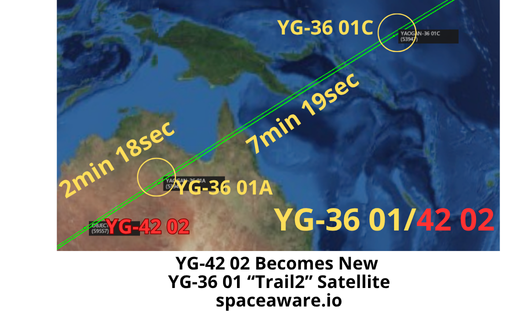
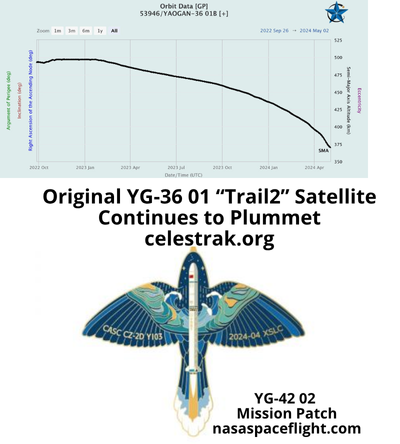
22 Apr: China launched a Long March 2D from Xichang carrying the second Yaogan-42 satellite (YG-42 02) into low earth orbit. This was the second YG-42 launch in less than three weeks as YG-42 01 launched on 2 Apr. China placed YG-42 02 into nearly the same orbital plane as an existing YG-36 01 formation and it appears YG-42 02 will become the new “Trail2” satellite in this formation. The previous YG-36 01 “Trail2” satellite has not maneuvered in over a year and is slowly spiraling towards Earth. Launch Video.
– As with nearly all Yaogan (translates to “remote sensing”) launches, China did not disclose any mission details.
– China launched YG-42 02 into a 502 x 491km orbit with a 35° inclination. These figures are similar to all of the operational YG-35, YG-36 and YG-39 satellites China launched from late 2021-2023.
– China placed YG-42 in the same orbital plane as YG-35 01, YG-36
01 and YG-39 03. The satellite increased its orbit during its first 10 days and appears to have joined YG-36 01C (Lead) and YG-36 01A (Trail1) as the new Trail2 satellite.
-YG-36 01’s original Trail2 satellite, YG-36 01B, has not maneuvered since 21 Jan 2023 and has now lost over 126km in altitude. It is most likely dead.
– YG-36 01C, YG-36 01A and YG-42 02 are all inclined 35°. Their SMAs are within 2km of one another and their eccentricity values
are also nearly identical. However, the RAAN for YG-42 02 is ~9° greater than the RAAN for YG-36 01C or 01A (116.5° vs 107.6/107.7°)
– The RAAN offset for the “Trail2” satellite is also present in the newly formed YG-35 02B (Lead), YG-35 02A (Trail1) and YG-42 01 (Trail2) triplet.
-China may be experimenting with these formations in attempts to improve whatever mission each triplet is attempting to conduct. We may observe similar evolution of other formations in the near future (see next article).
1 May: For the first time since ~29 Jan 2024, China has increased the altitude for 6 of its 7 YG-35 & YG-36 Trail2 satellites. The maneuvers may be an indication that the satellites are going to rejoin their Lead & Trail1 satellites in the near future. As noted in the previous article, China appears to be replacing two failed Trail2 satellites with the newly launched YG-42 01 & 42 02 satellites. These new formations may forecast changes to other YG-35/36/39 formations with the Trail2 satellites having a slightly offset RAAN from their Lead and Trail1 counterparts. Creating this offset may have been the reason China decreased Trail2 altitudes.
– The Facts: Here are the most recent altitude changes for the 7 Trail 2 satellites from mid-Apr through 3 May :
- YG-35 01C: UP .5km
- YG-35 03A: NO CHANGE, continues to lose SMA
- YG-35 04A: UP 2.1km
- YG-35 05A UP 1.6km
- YG-36 02A UP 2.9km
- YG-36 03C UP 1.3km
- YG-36 04B UP 2.6km
– The Theory: As we saw with YG-31 and YG-40 triplets, China may be altering SMA for its formation constellations in order to generate RAAN offsets.
-Per Robert Christy of Orbital Focus: “The plane of a posigrade satellite orbit moves slowly westwards with time, manifested as a decreasing value for the Right Ascension of the orbit’s Ascending Node as seen in the Space-Track data. The effect of being at two slightly different orbit heights is that the two orbit planes move at different rates with the lower orbit moving faster. <In the case of YG-31> by the time the three satellites of this mission come together, the orbit of the singleton will lie about 110 kilometres to the east of the pair.”
– The Evidence: On 30 April 2024 YG-35 05 temporarily returned to its Lead-Trail1-Trail2 formation, only now the Trail2 satellite (YG-35 05A) was slightly offset from the Lead and Trail2 satellites. The formation closely resembled those of the newly formed YG-35 02 and YG-36 01 formations with their new YG-42 Trail2 satellites. (See graphics on right and next page)
– The formation was temporary as YG-35 05A is still operating at a lower SMA and thus passed both Lead and Trail1 satellites over the next 2 days.
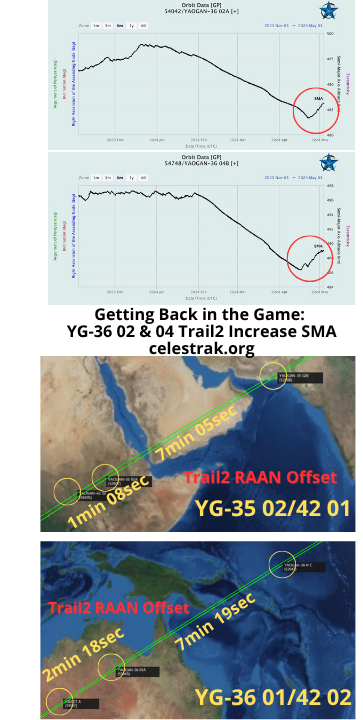
– What To Look For: It remains to be seen if China will continue to increase the SMA for its Trail2 satellites. The natural decline occurred over nearly 4 months and SMA increasing maneuvers just began 2-3 weeks ago. There’s also the matter of YG-35 03A which has NOT increased its SMA as the other 6 Trail2 satellites have. It is potentially dead which would make YG-35 03 a good candidate for a new YG-42 03 Trail2 satellite. China has not announced a new YG-42 launch, but they provided very little notification (like none) of the YG-42 01 and 02 launches. Recall that there are 6 other YG-36/39 triplets which have not broken formation. China may be using these as a “control” group to test the trade-offs between the “in-line” formation and the “Trail2 offset” formation.

The next two articles examine Russian and Chinese space operations in what is called Very Low Earth Orbit (VLEO). VLEO describes the orbit of any spacecraft with a semi-major axis (SMA) or altitude of 300km or less. I asked Jack Anthony to take a look at VLEO operations and he (as always) was nice enough to oblige!
How Low Can You Go?
by Jack Anthony
Operating at lower altitudes, especially those lower than 300km, gives operators a big focus item—atmospheric drag. Check out my “It’s a Drag” article in last issue for a good review. Attentiveness to orbit state and just how fast the atmosphere is reeling in a satellite is the norm of operators who must activate propulsive capability to raise perigee via delta V’s at apogee. There are benefits to being a lot closer to the Earth, distance reduced and thus maximum imagery resolution. In the 1960’s when the US began space-based reconnaissance the Corona satellite program operated by military and contractor crews at Sunnyvale California mastered VLEO operating as their spacecraft swooped as low as 90 miles (145 Km) altitude in a
slightly non-circular 90 x 120 mi orbit. Corona satellites would
send 2 “buckets” of film to earth to be caught by C-119 and
then C-130 aircraft and then scurried off to be examined in
mostly time critical situations. Around 1963 the Corona’s added a
propulsive capability that would help operators beat the tug of
atmospheric drag and keep perigee from perilous demise. If you want
to learn more about Corona and other early satellite reconnaissance programs, check out the NRO History Corona web page.
While operating satellites at <300kms doesn’t happen often, it isn’t
completely novel. There have been several space missions in the
past 10-15 years that operated in VLEO. The European Space Agency’s
Gravity Field and Steady-State Ocean Circulation Explorer was
operational from March 2009 to November 2013. It needed to be
close to the Earth to achieve its gravity mapping endeavor and
orbited the Earth at 255km. In 2017, the Japan Space Agency flew its
Super Low Altitude Test satellite for 2 years starting at 271km and
then working their way down to 167km. They used an ion thruster and
some traditional propulsion to manage their darn low orbit! They even
got a Guiness Book of Records accolade for the 167km orbit, lowest
ever. Way to go Japan…Guiness record! I will share that the
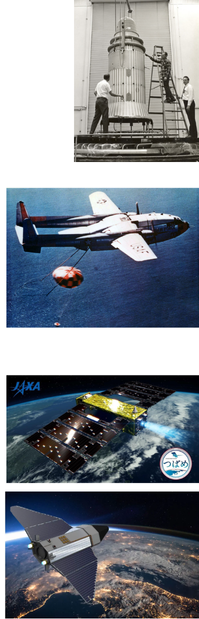
90 x 120-mile orbit I mentioned (145 X 195km) orbit had a mean altitude of 170km. Currently underway is an ESA sponsored mission called Skimsat, how bout that cool name? Skimsat is being built by Thales Athena Space and Redwire and will have a high-specific impulse thruster capability as well as use the aerodynamic forces presented by the upper atmosphere to “skim” and fight off decay. Now that’s going to be a cool mission to watch in operation as it “skims” and “puffs with Xenon” in VLEO.
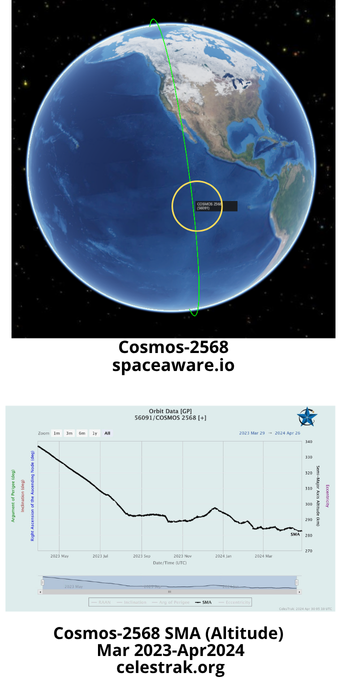
29 Apr 2024: Russia has been operating one of its suspected imagery satellites, Cosmos-2568, below an altitude of 300km since 27 July 2023. For the past 2+ months Cosmos-2568 has maintained a Semi Major Axis (SMA) between 284.3 and 282.8kms. Space operators often refer to any orbit between 150-300km as Very Low Earth Orbit (VLEO). Operating at these altitudes subjects the spacecraft to increased interaction with the Earth’s atmosphere and requires increased propulsion to prevent rapid orbital decay. Operating at these lower altitudes does have its benefits…primarily reducing the distance to the Earth’s surface for maximum imagery resolution from Cosmos-2568’s suspected sensor.
– From 2021-23 Russia launched four classified satellites believed to be EO MKA experimental spacecraft.
– The first three, Cosmos-2551, 2555 and 2560 re-entered the Earth’s atmosphere after 19, 41, and 56 days, respectively.
– Cosmos-2568 launched on 29 March 2023 and for the first 5 months seemed to be on a similar journey. However, the satellite appeared to maintain its altitude from mid-August until early-October. It then decreased its altitude for a few days before stabilizing.
– Cosmos-2568 initial orbit was 340.7 x 325.8 km orbit with an inclination of 96.5°. Its inclination has not changed significantly – it is currently 96.4°.
– At first the semi-major axis was in a natural slope down due to atmospheric drag. But in mid-August 2023, the Russian operators kicked in their VLEO mode and started to manage or keep at acceptable levels the mean orbit altitude.
- From 30 Mar – 11 Aug 2023 the satellite’s SMA decreased ~43.5 km to 293.6 km.
- Then from 12 Aug – 5 Oct Cosmos-2568 SMA decreased only 0.5 km to 293.1 km.
- From 5 Oct – 19 Dec 2023 Cosmos-2568 raised its orbit to 297.4km.
– Cosmos-2568 then began an uneven descent, and has been operating between 282-285kms for the past 2 months.
-Special thanks to TS Kelso for bringing Cosmos-2568 operations to my attention!
China: VLEO Testing?
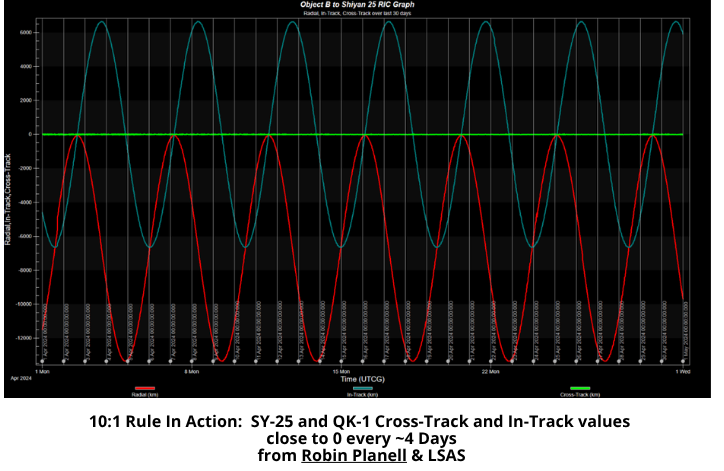
29 Apr: China appears to be conducting some coordinated testing in VLEO with its Shiyan-25 (SY-25) and QianKun-1 (QK-1) satellites. Both were launched within a month of one another and are operating in the same orbital plane with nearly identical RAAN and inclination. SY-25’s orbit is ~65km lower than that of QK-1 which, as we know from Jack’s 10:1 article, means that SY-25 “gains” 650km on QK-1 every orbit. So every 4 days the two satellites pass one another on orbit with SY-25 being directly beneath QK-1.
– China launched SY-25 on 20 Jun 2023 from Taiyuan using a LM-6. Initially it was in a 307 x 321 km x 96.6° sun-synchronous orbit (SSO).
– As is typical with SY satellites, China released very little information regarding the satellite’s mission. Official sources noted the satellite will mainly be used to carry out new Earth-observation technology experiments.
– SY-25 naturally lost altitude for its first week on orbit, then operators used propulsion to maintain altitude at ~302km from 14 Jul – 3 Aug.
– Shortly after 3 Aug operators appear to have used propulsion to rapidly decrease altitude until ~9 Sep when SY-25 leveled out at ~271km where it has remained to the current day.
– Less than 1 month after launching SY-25, China launched QK-1 on a CERES-1 rocket from Jiuquan. QK-1 was developed by a Chinese commercial company, CSPACE.
– QK-1 is CSPACE’s first very low earth orbit satellite. It weighs ~200kg and is equipped with electric thrusters.
– QK-1’s initial orbit was 486 km x 502 km with 96.6° inclination. The satellite maintained this SMA for the first month and then appears to have initiated a series of step-down maneuvers gradually reducing altitude to ~333km in late March 2024, where it remains today. SSO for 96.6° inclination is ~285km, so it remains to be seen if QK-1 will lower its orbit further.
-SY-25 and QK-1 orbits are co-planar with equal inclination and RAAN…which we all remember from Jack’s Orbital Element articles it is the RAAN and inclination that define the orbit plane.
– The two satellites also share similar Eccentricity.
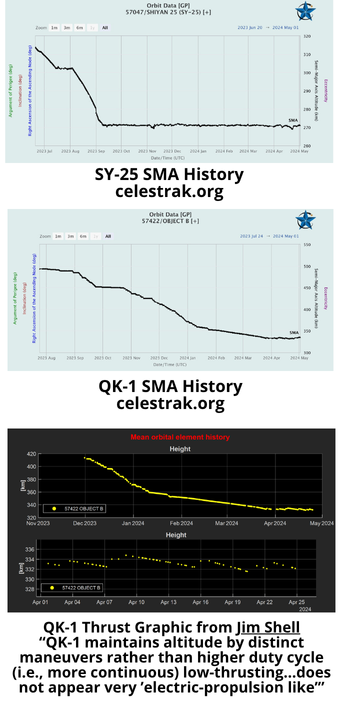
-Checking the SMA we find SY-25’s orbit is ~65km lower than that of QK-1 which, as we know from the 10:1 article and rule means that SY-25 “gains” 650 Km on QK-1 every orbit.
– If you do a little math, we find that every 4 days the two satellites pass one another on orbit with SY-25 being directly beneath QK-1. See the Robin Planell’s relative distance plot provided and the green zero line. As time marches on, you can see the distance gets close (SY-25 zips underneath QK-1) every 4 days or so.
China is poised to add VLEO spacecraft in the near term. CASIC plans to complete the launch of a nine-satellite cluster in 2024, and complete an orbital network of 192 satellites by 2027. By 2030, CASIC expects 300 operational satellites, providing diversified and real-time remote sensing services, and realizing global 15-minute response capabilities.
<Editor’s Note: Thank You to Jack Anthony, Robin Planell and Jim Shell for contributing to this article>