ISSUE 143 | 20 apr 2026
The integrity flash
Analysis of Developments in the Space Domain
In This Issue
Iran Using Chinese Satellites to Target US
China Launches 8 Gaofen-7 Imagery Satellites
China Launches 7th Group of 18 Qianfan Satellites
China Launches Guowang Group 21
China Launches Guowang Test Satellite
Review: The Age Of Space Maneuver Warfare Is Imminent
China’s SY-12 02 Flyby of Iran’s Jam e Jam
Cool Kids Club? USA 325 & TJS-10 Head Toward Cosmos 2589
What’s Up with Cosmos 2576
Russia Launches Military Satellites to Multiple Orbit Planes
SWF Counterspace Report
Pics o’ the Fortnight

15 Apr 2026: The Financial Times reported that the Iranian military has tasking authority of a Chinese commercial imaging satellite, TEE-01B (60012), and has leveraged this capability to target US forces in the Middle East. CGSTL (see next article) manufactured TEE-01B and sold the satellite to the Chinese commercial company Earth Eye. The Financial Times article reported Iran’s IRGC then purchased TEE-01B from Earth Eye for ~$36.6M in late 2024. The satellite is capable of collecting ~0.5m resolution imagery. Based on TEE-01B’s sun-synchronous orbit, the satellite is over the Middle East Region in Mar/Apr at ~0830Z. Watch video.
- TEE-01B is in a sun-synchronous orbit (SSO) which is a specialized, near-polar orbit that passes over any given point on Earth’s surface at the same local solar time each day.
- TEE-01B is in a circular orbit and has an SMA ranging between 528-538km and an inclination of 97.6°.
- TEE-01B conducts orbit maintenance maneuvers every 8 months.
- China launched TEE-01B on a CERES-1 on 6 June 2024 from Jiuquan. Also on board were Naxing-3A and 3B (60013/60014) satellites. The only satellite currently maintaining its orbit is 60012 which I assume is TEE-01B.
- TEE-01B’s daylight pass over the Middle East region is occurs every day from ~0830-0840Z. The satellite also passes over the region in the evening ~12hrs later.

TEE-01B On Display
(China in Space)

TEE-01B Has 2 Passes/Day over Middle East Region. In April Daytime pass (left) occurs between 0830-0840Z (1130-1140L). Nighttime pass (right) occurs ~12hrs later.
(saberastro.com)
14 Apr 2026: China launched a Lijian-1 with 8 Jilin-1 (Gaofen-7) satellites (68691-68698) from Jiuquan. According to CAS Space all satellites were successfully placed into the desired orbits. The satellites are owned and operated by Changguang Satellite Technology Co Ltd (CGSTL). A report published by the China Space Monitor alleged CGSTL sold two of its on-orbit Jilin-1 GF03D series satellites to the Russian paramilitary Wagner Group back in 2022. In 2025 The U.S. State Department accused Chinese firm CGSTL of directly supporting Iran-backed Houthi terrorist attacks on U.S. interests. According to the State Department the company supplied high-resolution satellite imagery, enabling Houthi rebels to target U.S. warships and international shipping in the Red Sea. Adding imagery capacity to the Jilin constellation will improve revisit rates and coverage areas should CGSTL assist Iran in the current conflict with the US/Israel. Launch Video.
– All 8 satellites are in sun-synchronous orbit with an average altitude (SMA) of 540km and inclination of 97.7°. Expect CGSTL to gradually space the 8 spacecraft across the orbit plane in the coming weeks.
– CGSTL launched 3 Jilin Gaofen 07 satellites in December 2025. The April 2026 launch appears to be into a 10km lower orbit and a nearly identical inclination. There is a RAAN offset of only 0.8° between the 2 sets of satellites.
– Per China in Space:
- the satellites “have a resolution of about 0.5 meters alongside onboard AI-assisted processing. That enables them to provide a wide variety of images to customers…including non-Earth target imaging.”
- “CGSTL’s Jilin-1 constellation had non-Earth imaging tested in September 2025…before beginning development of relevant hardware a month later.”
– CGSTL launched the Jilin Gaofen 07 satellites into an orbital plane near Jilin Kuanfu 01 (45016) (2020.)
- Per Gunther’s: “Jilin-1 Kuanfu-01…features a high resolution and wide-field-of-view (WFOV) telephoto range imager. The push-broom imager with a multi-spectral resolution better than 4 m and a swath width greater than 136 km features high-speed storage and high-speed digital transmission systems.”
Editor’s Comment: This orbital relationship enables tip-cue from the WFOV satellite and the higher resolution Jilin Gaofen 07 satellites. Using a Wide-Field-of-View (WFOV) sensor to cue higher resolution sensors is useful for positively identifying potential targets. We do not know if CGSTL is actively providing imagery support to Iran, however they have assisted other anti-US forces in the past.

Lijian-1 Heading To Orbit with 8x Jilin Goafen 07 Satellites
(nasaspaceflight.com)

Visualization of Jilin Constellation with Jilin Gaofen 07 (Green)(saberastro.com)

CGSTL Has Placed Jilin Goafen-07 Satellites into Orbital Planes within 1° of Its Wide Field of View Jilin Kuanfu 01 Satellite. Orbital relationship would support tip/cue from WFOV imager to higher resolution sensors. Useful arrangement for targeting support.
(saberastro.com)


Jilin Gaofen 07 Satellites Preparing for Launch
(nasaspaceflight.com)


7 Apr 2026: China launched a Long March-8 with the seventh group of 18 SpaceSail satellites from Wenchang. According to official sources, the SpaceSail (Qianfan) Constellation, is developed by Shanghai SpaceSail Technologies Co., Ltd. to “provide global users with low-latency, high-speed and ultra-reliable satellite broadband internet services.” With this launch there are now 126 satellites in orbit. This is the first Qianfan launch in 193 days (there were 220 days between Groups 5 & 6). SpaceSail had started with a much higher launch cadence, launching Groups 1-5 on an average 54 days apart. A significant number of Qianfan satellites appear to have experienced issues in reaching their operational orbits. Launch Video.
– SpaceSail launched its 7th group Qianfan satellites into the orbital plane between groups 5 & 3 (see graphic). All planes are inclined 89° with a 20° of RAAN offset between each plane. With this launch, 7 of the 9 planes are in use. SpaceSail may want to augment batch 2 due to 15 of 18 satellites failing to reach their operational SMA of 1,069km.
Constellation Summary:
– Of 126 Qianfan satellites on orbit, 87 have reached their operational altitudes of 1,069kms.
- Group 1 (60379-60396) (launched 6 Aug 2024) : 17 of 18 satellites reached operational SMA. Qianfan 7 (60385) has not maneuvered and may be inoperable.
- Group 2 (61552-61569) (launched 15 Oct 2024): Only 3 of 18 satellites (Qianfan 29, 30 & 32) reached their operational SMA.
- Group 3 (62238-62255) (launched 5 Dec 2024): 16 of 18 satellites reached their operational SMA. Qianfan 39 & 42 appear to be struggling.
- Group 4 (62785-62802)(launched 23 Jan 2025) : 18 of 18 satellites reached their operational SMA.
- Group 5 (63159-63176) (launched 11 Mar 2025): 16 of 18 satellites reached their operational SMA. Qianfan 77 & 83 appear to be struggling.
- Group 6 (66033-66050) (launched 17 Oct 2025): 17 of 18 satellites reached their operational SMA. Qianfan 101 (66043) remains at 800km.
- Group 7: (launched 7 Apr 2026): satellites have not been added to the catalog yet.

LM-8 with Qianfan Group 7
(nasaspaceflight.com)


Qianfan Group 7 Launch Preparations, Mission Patch and Red Board Celebration
(nasaspaceflight.com)


Current Qianfan Constellation consists of 126 satellites operating in 7 orbital planes. Planes are inclined 89° & separated by ~20° RAAN. (saberastro.com)
8 Apr 2026: China launched a Long March-6A with the 21st group of Guowang (China SatNet LEO) satellites from Taiyuan. According to official sources, the 5 satellites (68656-68660) entered the preset orbit successfully. As with other Taiyuan launches, China placed the satellites into an 86.5° inclined orbit. Group 21 is co-planar with Group 11, bringing the total number of satellites in that plane to 10 and matching the other five 86.5° planes. As of 9 Apr, 19 of 21 Guowang groups have reached their operational altitudes (only Groups 20 & 21 remain). Unlike the Qianfan constellation, all Guowang satellites have thus far reached their desired SMA. We will need to wait to see how China focuses its launch capacity for the remainder of the year. With a stated goal of reaching 310 satellites on orbit by 2027, I suspect we won’t have long to wait! Launch Video.
– With Group 21 there are now 168 satellites in the operational LEO Guowang constellation. Additionally, there are 3 Guowang satellites in GEO and China has launched 19 Guowang test satellites (see next article.)
– China is building out the Guowang constellation with orbits inclined either 50.0° or 86.5°. Currently there are 108 satellites in 12x 50.0° orbital planes (9 satellites/plane) and 60 satellites in 6x 86.5° orbital planes (10 satellites/plane).
– Launch Summary + number of days to target SMA…1,167.9km for 86.5° or 1,149.3km for 50.0°
- Group 1 (16 Dec 2024): 10 sats on LM-5B. 86.5° inclination (110 days)
- Group 2 (11 Feb 2025): 9 sats on LM-8A. 50.0° inclination (77 days)
- Group 3 (28 Apr 2025): 10 sats on LM-5B. 86.5° inclination (34 days)
- Group 4 (5 Jun 2025): 5 sats on LM-6A. 86.5° inclination (with Gp 9) (106 days)
- Group 5 (27 Jul 2025): 5 sats on LM-6A. 86.5° inclination (with Gp 15) (58 days)
- Group 6 (30 Jul 2025): 9 sats on LM-8A. 50.0° inclination (103 days)
- Group 7 (4 Aug 2025): 9 sats on LM-12. 50.0° inclination. (117 days)
- Group 8 (13 Aug 2025): 10 sats on LM-5B. 86.5° inclination (32 days)
- Group 9 (17 Aug 2025): 5 sats on LM-6A. 86.5° inclination (with Gp 4) (52 days)
- Group 10 (25 Aug 2025): 9 sats on LM-8A. 50.0° inclination. (86 days)
- Group 11 (27 Sep 2025): 5 sats on LM-6A. 86.5° inclination. (with Gp 21) (54 days)
- Group 12 (16 Oct 2025): 9 sats on a LM-8A. 50.0° inclination (85 days)
- Group 13 (10 Nov 2025): 9 sats on a LM-12. 50.0° inclination (95 days)
- Group 14 (6 Dec 2025): 9 sats on a LM-8A. 50.0° inclination. (86 days)
- Group 15 (8 Dec 2025): 5 sats on a LM-6A. 86.5° inclination (with Gp 5) (58 days)
- Group 16 (11 Dec 2025): 9 sats on a LM-12. 50.0° inclination. (102 days)
- Group 17 (25 Dec 2025): 9 sats on LM-8A. 50.0° inclination. (74 days)
- Group 18 (13 Jan 2026): 9 sats on LM-8A. 50.0° inclination (63 days)
- Group 19 (19 Jan 2026): 9 sats on LM-12. 50.0° inclination (64 days)
- Group 20 (12 Mar 2026): 9 sats on LM-8A. 50.0° inclination (TBD)
- Group 21 (8 Apr 2026): 5 sats on LM-6A. 86.5° inclination (with Gp 11) (TBD)

6x 86.5° Inclined Planes
10x Satellites / Plane (Gp 11 only 5 sats)
30° Offset for Satellites at Operational SMA
(saberastro.com)

16 Mar 2026: 12x 50° Inclined Planes
9 Satellites / Plane
30° Offset for Satellites at Operational SMA
Red Groups Not at Final SMA
(saberastro.com)

Current Guowang LEO Constellation: Gp21 (yellow) will eventually be co-planar with Gp11 (green)
(saberastro.com)

Visualization of Guowangs 86.5° inclined orbits. China Launched Group 21 into near Co-planar Orbit with Group 11. Due to Group 20’s lower SMA its RAAN will shift west at a faster rate than Group 11. China will time SMA increases to result in Group 21 being co-planar with Group 11. Group 21’s RAAN is 30° east of Groups 4&9 and 30° west of Group 8 (well technically it is 330° west).
(saberastro.com)
China Launches Guowang Test Satellite
11 Apr 2026: China launched a Smart Dragon-3 (Jielong-3) with one Weixing Hulianwang Jishu Shiyan Weixing (Satellite Internet Technology Test Satellite, Guowang Test Object A) (68687) satellite from a sea-based platform off the coast of Yangjiang, Guangdong Province. By my count 68687 is the 19th test satellite for the Guowang constellation, and is the second to be sea-launched using a Jielong-3 (the other was 58505). Launch Video.
– 68687 orbit is in a circular orbit with an SMA of 1,004km and inclination of 86.5°
- China will likely raise 68687’s SMA to 1,111km and match that of the 3 other Guowang Test satellites (57288, 57289, & 58505) with 86.5° inclinations (for comparison 58505 required ~6 months on orbit to reach 1,111km).
- 58505 was also launched from the Yellow Sea on a Jielong-3.
- 68687 has a 49° west RAAN offset from 58505.
- 58505 has a 33° west RAAN offset from 57288 & 57289
- 58505 is nearly equal distance from 57288 & 57289 (4,810km & 4,653km respectively)
– Guowang Test Launch Summary: China has conducted 8 test launches. 3 launches to 86.5° Inclination, 4 launches to 50.0° inclination, and 1 launch to 55.0° inclination.
- Test Launch 1* (9 Jul 2023): 2 sats (57288 & 57289) on LM-2C from Jiquan.
- 86.5° inclination, 1,111km SMA
- Test Launch 2* (23 Nov 2023): 3 sats (58425, 58426, 58427) on LM-2D from Xichang
- 50.0° inclination, 1,104km SMA
- Test Launch 3* (5 Dec 2023): 1 sat (58505) on Jielong-3 from Yellow Sea.
- 86.5° inclination, 1,111km SMA
- Test Launch 4* (30 Dec 2023): 3 sats (58691, 58692, 58693) on LM-2C from Jiuquan
- 50.0° inclination, 1,104km SMA
- Test Launch 5 (30 Nov 2024) 1 sat (62186) on LM-2C from Wenchang
- 50.0° inclination, 1,104km SMA
- Test Launch 6 (1 Apr 2024): 4 sats (63428-63431) on LM-2D from Jiuquan
- 55.0° inclination, 450-470km SMA
- 63428 de-orbited 16 Oct 2025
- 63429, 63430, 63431 have recently increased SMA from ~450km to 470km
- Test Launch 7 (16 Sep 2025): 4 sats (65617-65620) on LM-2C from Jiuquan
- 50.0° inclination, 1,104km SMA
- Test Launch 8 (11 Apr 2026): 1 sat (68687) on Jielong-3 from Yellow Sea
- 86.5° inclination, 1,004km SMA (will likely raise to 1,111km over time…
* Denotes launches occurring prior to first operational LEO Guowang launch 16 Dec 2024
– Relationship with Operational Guowang Satellites with 86.5° inclination
- Guowang Test satellites are maintaining an SMA 57km less than operational Guowang satellites (1,111km vs 1,168km)
- None of the Test Satellites are Co-planar with their operational counterparts
- 58505 has a <1° east RAAN offset with Guowang Groups 5 & 15
- 58505 has a 10° west RAAN offset with Guowang Group 1
- 57288/57289 have a ~10° west RAAN offset with Guowang Gp 3


Sea Dragon-3 (Jielong-3) Launch Preparations (top) & Sea-Launch (below)
(nasaspaceflight.com)


Guowang Test Satellites with 86.5° Inclination. 68687 (Green) has 49° west RAAN offset from 58505
(saberastro.com)

Orbit Comparison: Test (Green & Yellow) v Operational (Red
(saberastro.com)

3 Guowang Test Satellites Appear to be Orbiting in Formation
(saberastro.com)
8 Apr 2026: LtGen (R) John Shaw (and Friend of the Flash) authored an article on the coming Age of Space Maneuver in Forbes. Excerpts below and you can read the entire article here!
– “For the last few decades, the ‘first duty’ of military space professionals has been to deliver space effects down to the terrestrial domains in the form of space support.”
– “As adversary threats in and from space proliferate, the first duty of the U.S. Space Force and U.S. Space Command will shift…from space support to space superiority, with a primary focus of deterring and defeating adversaries within that domain.”
– “Here are at least five ways that imminent paradigm shift will play out in the days ahead”
- The U.S. Space Force and U.S. Space Command will pursue space superiority for purposes beyond purely military objectives.
- U.S. national interests will quickly extend across the Earth-Moon system, requiring a similarly expansive space superiority focus.
- The U.S. Space Force and U.S. Space Command will pivot hard into space maneuver warfare and away from its focus on positional space operations.
- “a space-superiority first duty, coupled with a need to range across the vast Earth-Moon system (over a quarter of a million times larger in volume than the low-earth orbit region where the International Space Station operates today), will drive a more aggressive approach that embraces frequent maneuver and an operational need to change orbital energy at a tempo and magnitude far different from near-earth static operations.”
- “Across the spectrum of conflict, space commanders must be able to test, train, develop tactics, patrol, inspect, posture and withdraw for messaging purposes, conduct prolonged dynamic station-keeping, pursue and evade, and much more.”
- “If Space Command could operate those (GSSAP) platforms today in an unconstrained fashion to meet all its current mission needs, each RG-1 would likely exhaust its fuel at 20 times the current rate…space maneuver warfare will, in turn, accelerate space superiority in military space professional cultural identity.”
- The pivot to space maneuver warfare will drive the broader growth of in-space logistics infrastructure, and faster interoperability across system architectures.
- “To properly support space maneuver warfare, space logistics will need to grow beyond the traditional one-dimensional space support paradigm.”
- “We must not mistakenly expect that commercial business cases or civil-space requirements by themselves can drive and solve the logistics needs of space maneuver warfare. This would be tantamount to expecting United Airlines’ or Delta Airlines’ fuel economy business cases to drive and solve the aerial refueling needs of the U.S. Air Force.”
- Every added component, then, to in-space logistics contributes to a virtuous cycle of value for all U.S. national space interests.
- Artificial intelligence will be applied across space missions to enable space maneuver warfare and in-space logistics ahead of other domains.
”In military terms and practice, domain superiority and maneuver go hand in hand. Military forces that limit themselves to positional, defensive postures usually find themselves lacking the ability to seize the initiative, destined for wars of attrition. Even worse, such forces that encounter an adversary engaging in maneuver warfare against them find themselves at a severe disadvantage.”
China’s SY-12 02 Flyby of Iran’s Jam e Jam
5 Apr 2026: Suspected Chinese inspector satellite Shiyan-12 02 (50322) passed ~71km of Iran’s new GEO satellite Jam e Jam 1 (67757). The fly-by opportunity occurred at ~34°E longitude and solar conditions were ideal for SY-12 02 to observe the Iranian satellite.
SY-12 02 decreased its SMA to initiate an eastward drift on 14 Mar 2026 when the satellite was over 19.6°E. This maneuver was consistent with SY-12 02’s pattern of life. It does not appear that SY-12 02 made any maneuvers in preparation for its 71km fly-by of Jam e Jam 1.
The Joint Commercial Operations cell (JCO) noted a photometric change with SY-12 02 at the time of closest approach with Jam e Jam 1. The photometric change is not consistent with SY-12 02’s pattern of life.

5 Apr 2026 0225Z: China’s GEO Inspector Satellite Shiyan-12 02 was ~71km from Iran’s First GEO Satellite, Jam e Jam 1.
SY-12 02 had Ideal Lighting Conditions to Observe Jam e Jam.
(saberastro.com)
Cool Kids Club? USA 325 & TJS-10 Head Toward Cosmos 2589
17 Apr 2026: Over the next 2-3 weeks both USA 325 and TJS-10 will pass through Cosmos 2589’s orbit. As we began reporting in November 2025, Cosmos 2589 (64467) has been slowly circularizing its orbit and now has an eccentricity of only .019 (it was .367 6 months ago). We also noted USA 325’s (51281) observation of China’s SJ-29A/B satellites which ended in late-March 2026 as USA 325 decreased its SMA and began heading East at 0.63°/day (please note latest orbit information is from 20 Mar 2026). At about the same time, TJS-10 (58204) also decreased its SMA and reversed its westward drift and is also heading East at 0.68°/day.
Satellite locations as of 17 Apr 2026:
- Cosmos 2589: 96.3-100.5°E longitude
- USA 325: 93.4°E with 0.63°/day eastward drift
- TJS-10: 85.2°E with 0.68°/day eastward drift
Propagating their current orbits forward (assumes NO maneuvers) USA 325 will pass through Cosmos 2589’s orbit from 24-30 April. TJS-10 will follow from 5-11 May.

18 Apr 2026: USA 325 and TJS-10 Heading toward Cosmos 2589 Current Orbit
(saberastro.com)
What’s Up with Cosmos 2576
17 Apr 2026: Cosmos 2576 (59773), a suspected Nivelir co-orbital weapon system, raised its SMA nearly 30km from 28 Mar – 11 Apr. Russian space operators conducted a series of maneuvers to raise Cosmos 2576’s SMA from 481km to 509km. Until now, Cosmos 2576’s typical operating SMA was 480-490km. The satellite has maintained its new SMA from 11-16 April. Russia launched Cosmos 2576 into a nearly co-planar orbit with a high-value US reconnaissance satellite, USA 314, on 16 May 2024. Graphic below shows the last known orbits for both Cosmos 2576 and USA 314. Please note USA 314 orbit information is nearly 8 months old.


28 Mar - 11 April: Cosmos 2576 Increased SMA 27.7km (left) Inconsistent with Pattern of Life (right) (celestrak.org)

Cosmos 2576 Maintaining Near Co-Planar Orbit with USA 314 Inclination Difference = 0.7° RAAN Difference = 0.4° NOTE: USA 314 Orbit Data last Update 16 Aug 2025 (saberastro.com)
17 April 2026: Russia launched a Soyuz-2-1b rocket lifted off from Plesetsk with multiple spacecraft for the Ministry of Defense. Announcement of the pending launch was delayed due to the threat of Ukrainian drone strikes. The exact number of payloads has yet to be confirmed, US Space Force has added 10 objects to the catalog (68753-68759 & 68762-68764). Russia used the Volga space tug to place objects in multiple orbital planes. This was the first time the Volga has been used with the Soyuz-2-1b.
Per Bart Hendrickx this was a rather complicated launch profile. “The Volga then seems to have performed several burns to deploy objects E, A and B (in that order). Subsequently, object D ended up in an orbit at roughly the same altitude as object B, but with a different inclination. Object D could be the Volga itself…I’m not sure if the Volga has ever performed as many burns as it seems to have done on this mission. That may explain why not enough propellant was left for a deorbit burn. The only other mission where the Volga was not deorbited was the Kosmos-2535/2536/2537/2538 mission launched in 2019 (using the Soyuz-2.1v). That deployed the satellites in higher orbits above 600 km.”
Per Anatoly Zak: “By April 18, 2026, the US Space Force published tracking data for a total of 10 objects associated with the April 17 launch. The latest objects (F, G, H, J and K) were tracked in a 550-kilometer near-circular orbit with an inclination 96.95 degrees, indicating that they were released from the upper stage after it had completed the inclination-change maneuver. By that time, Object D was tracked in a 463 by 481-kilometer orbit indicating a orbit-lowering maneuver likely designed to accelerate the atmospheric reentry of the spent booster.”
Launch Video.

Soyuz 2.1b Lights the Night Sky (@RussianSpaceWeb via X)

Rendering of Volga Space Tug (w/ Payloads) Separating from Upper Stage
(@RussianSpaceWeb via X)

Soyuz-2-1b Deployed Satellites to Multiple Orbital Planes
(saberastro.com)
2026 SWF: Global Counterspace Capabilities Report Summary
By Dr. Larissa Beavers
8 April 2026: The 2026 Secure World Foundation Global Counterspace Capabilities Report assesses the continued expansion of counterspace capabilities across 13 countries and highlights the increasing integration of space into military operations. While many nations are advancing a wide range of counterspace technologies—including co-orbital, cyber, and electronic warfare—only non-destructive capabilities are currently being employed in active conflicts. The report emphasizes a shift toward persistent, on-orbit capabilities and dynamic space operations, particularly among major powers such as the United States, China, and Russia. It also underscores growing risks to space security, including cyber vulnerabilities, increased electronic warfare activity, and the long-term impact of space debris.
Summary of Major Highlights from the SWF 2026 Global Counterspace Capabilities Report:
- Expansion to 13 countries actively developing counterspace capabilities, with most operational use in conflicts limited to non-destructive methods (EW, cyber)
- Increased global interest in co-orbital systems, including “bodyguard” satellites and spaceplanes, alongside continued RPO activity (U.S., UK, France, Russia)
- China’s advancements include a possible new DA-ASAT interceptor and a sustained on-orbit refueling experiment in 2025, indicating longer-duration space operations
- Russia demonstrated continued RPO operations and GEO maneuver activity, highlighted by the conclusion of the Luch satellite mission across the GEO belt
- Significant rise in electronic warfare activity, including extensive jamming in Iran and reported spoofing of Starlink signals
- Cyber counterspace threats expanded, including breaches of ESA systems, unencrypted GEO satellite comms, and cyber operations observed in the Russia–Ukraine conflict
- Growing interest in non-destructive directed energy (laser) capabilities by France and Germany as alternatives to kinetic ASAT systems
- Policy and doctrinal shifts, including Japan releasing space defense guidelines and North Korea formally enabling military use of space
- Updated debris tracking shows 6,904 cataloged debris pieces from ASAT testing (U.S., Russia, China, India), with 2,773 still on-orbit, reinforcing long-term sustainability concerns

China: HQ-29 Space Defense System

Kim Jong Un gives a speech at the Ninth Party Congress, February 2026

Space Debris as of April 2025
Pics o’ the Fortnight!

Epic Artemis 2 Image Looking Back from Far Side of the Moon
(NASA.gov)

Crew Perspective: Moon fully eclipsing the Sun
(NASA.gov)

Artemis 2 Heads towards its RPO with the Moon
(NASA.gov)

“Some interesting ongoings in low-earth orbit recently, with the Xinzhengcheng-1 satellite demonstrating capabilities resembling RPO with the Qingzhou cargo spacecraft”
(@ChinaSpaceGuy via X)

“There’s now a NOTAM suggesting the first Long March 10B launch and first stage recovery attempt is scheduled for April 28, with a window extending through April 30.”
(@AJ_FI via Linked In)


Future Family of Long March Boosters
(@CNSpaceflight via X)

(@CuriosityonX via X)
Space Symposium 2026 - US and Allies Developing Joint Orbital Warfare Strategy
By Rhonda Sheya
At the Space Symposium held at The Broadmoor this past week, the global space community gathered at a pivotal moment for the industry—where national security priorities, commercial innovation, and human space exploration are increasingly intertwined.
The message from this year’s Symposium was consistent across keynote sessions and panels: space is now an operational domain, not a future one. Leaders emphasized the need for resilient architectures, enhanced space domain awareness, and deeper collaboration between government and commercial partners. The pace of advancement—particularly in low Earth orbit and lunar exploration—continues to accelerate, bringing new urgency to workforce readiness and mission integration.
That forward momentum was especially evident on the exhibit floor, where organizations showcased capabilities spanning intelligence, cyber, training, and human spaceflight systems.
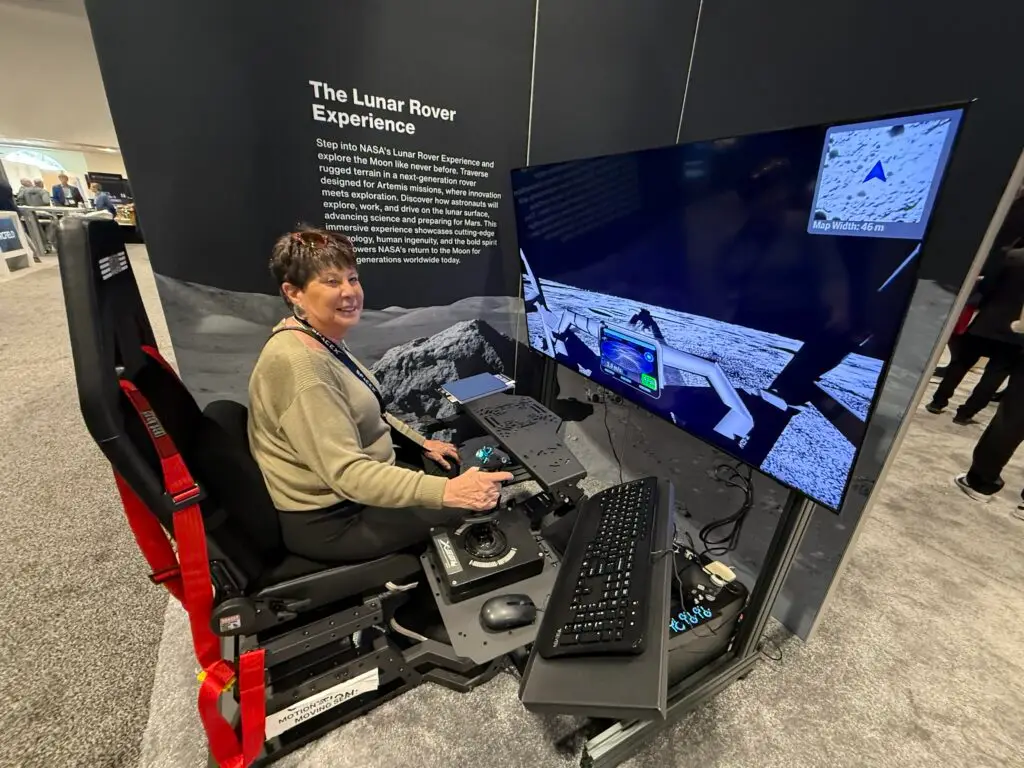
In the Space Zone, NASA offered a hands-on look at the future of lunar operations. Victoria Ugalde, a communication strategist for the EVA and Human Surface Mobility Program at Johnson Space Center, described the agency’s focus on technologies supporting Artemis-era missions, including lunar spacesuits and surface mobility systems.
A key feature was a lunar rover simulator designed to give attendees a realistic sense of navigating the Moon’s surface. According to Ugalde, the simulator uses the same software currently employed to train astronauts at Johnson Space Center. The experience is built on real terrain data captured by the Lunar Reconnaissance Orbiter, allowing users to traverse the Moon’s south pole region—complete with detailed topography, craters, and landmarks such as the Shackleton rim.
“It gives people a feel for what it would actually be like to drive on the Moon,” she explained, underscoring NASA’s effort to make complex mission concepts more accessible while highlighting the realism of current astronaut training tools.
Beyond the exhibits, the Symposium’s influence was just as apparent in the steady cadence of meetings and informal exchanges that define the week.
From behind the booth, conversations reflected a wide spectrum of priorities—from workforce development and training pipelines to emerging operational challenges in space and intelligence domains. For many organizations, these interactions serve as both a validation of capabilities and an opportunity to refine messaging in real time.
Networking extended well beyond the exhibit hall. Evening receptions and industry-hosted events created space for more candid dialogue, often strengthening connections first made during the day. At the same time, a full schedule of prearranged meetings enabled focused discussions on partnerships, program alignment, and long-term strategy.
As is often the case at the Symposium, some of the most meaningful moments were unplanned. Chance encounters in hallways or between sessions frequently led to deeper conversations. One such moment was reconnecting with Eric Sundby of TerraSpace, reflecting the industry’s highly networked, collaborative nature.
Taken together, this year’s Symposium reinforced a central reality: while technology is advancing rapidly, it is the relationships—built across formal sessions, exhibit floors, and informal gatherings—that will ultimately shape the future of the space economy.
Thank you to Space Foundation and all their hard work for producing such a great event with fantastic networking opportunities.