
ISSUE 146 | 1 jun 2026
The integrity flash
Analysis of Developments in the Space Domain
@AJamesMcCarthy via X

Is Russia Maneuvering to Threaten ICEYE Satellites?
29 May 2026: Russia conducted significant plane change maneuvers with 5 Cosmos satellites. Plane change maneuvers are rare in space operations, especially in Low Earth Orbit (LEO) due to the required energy–which equates to a significant fuel investment. In this case, the fuel required to conduct such a maneuver is ~105-106m/sec. The maneuvers brought the 5 satellites into nearly co-planar orbits with ICEYE-X36 (59103) which is also inclined 97.8° and is a Synthetic Aperture Radar (SAR) imaging satellite. ICEYE is a Finnish-American aerospace and data company that designs, builds, and operates the world’s largest constellation of SAR satellites. ICEYE has been supporting Ukrainian military operations against Russia since the beginning of the conflict in 2022. We do not know Russia’s intentions or the capabilities of these particular satellites, however maneuvering into a co-planar orbit is alarming. Plane matching is the first (and most fuel expensive) step to conducting Rendezvous Proximity Operations (RPO) likely necessary for the Russian satellites to target (kinetically or non-kinetically) ICEYE-X36. We also do not know the satellites’ total fuel capacity, however the expenditure of ~106 m/sec is evidence the satellites are capable of conducting high-energy maneuvers. This capability is not common for satellites conducting typical earth observation, signal collection or communications missions.
Details:
The following Russian satellites increased their inclinations 0.8° (from 97.0° to 97.8°):
1) Cosmos 2610 (68758) (15-16 May)
2) Cosmos 2611 (68759) (20-21 May)
3) Cosmos 2612 (68762) (15-16 May)
4) Cosmos 2613 (68763) (13-15 May)
5) Cosmos 2614 (68764) (20-22 May)
In addition to changing its inclination, Cosmos 2614 also increased its average altitude ~6km. Three of the Russian satellites (2610/11/14) have an SMA slightly greater than X36, while two (2612/2613) have SMA slightly less than X36. The Cosmos satellites have eccentricity values between .001-.002 (ICEYE-X36 eccentricity is .002).
Plane matching requires objects to have nearly equal inclination (orbit tilt) and Right Ascension of the Ascending Node (RAAN) (orbit twist). The 14-22 May maneuvers seem to have only impacted the inclination, however Russia launched Cosmos 2610/11/12/13/14 into orbits with <0.5° RAAN offset from ICEYE-X36. With the inclination changing maneuvers the five satellites are now effectively plane matched with ICEYE-X36. Russian space operators are now in position to conduct RPO with ICEYE-X36 with minor adjustments in satellite eccentricity (radial track) and average altitudes (in track).
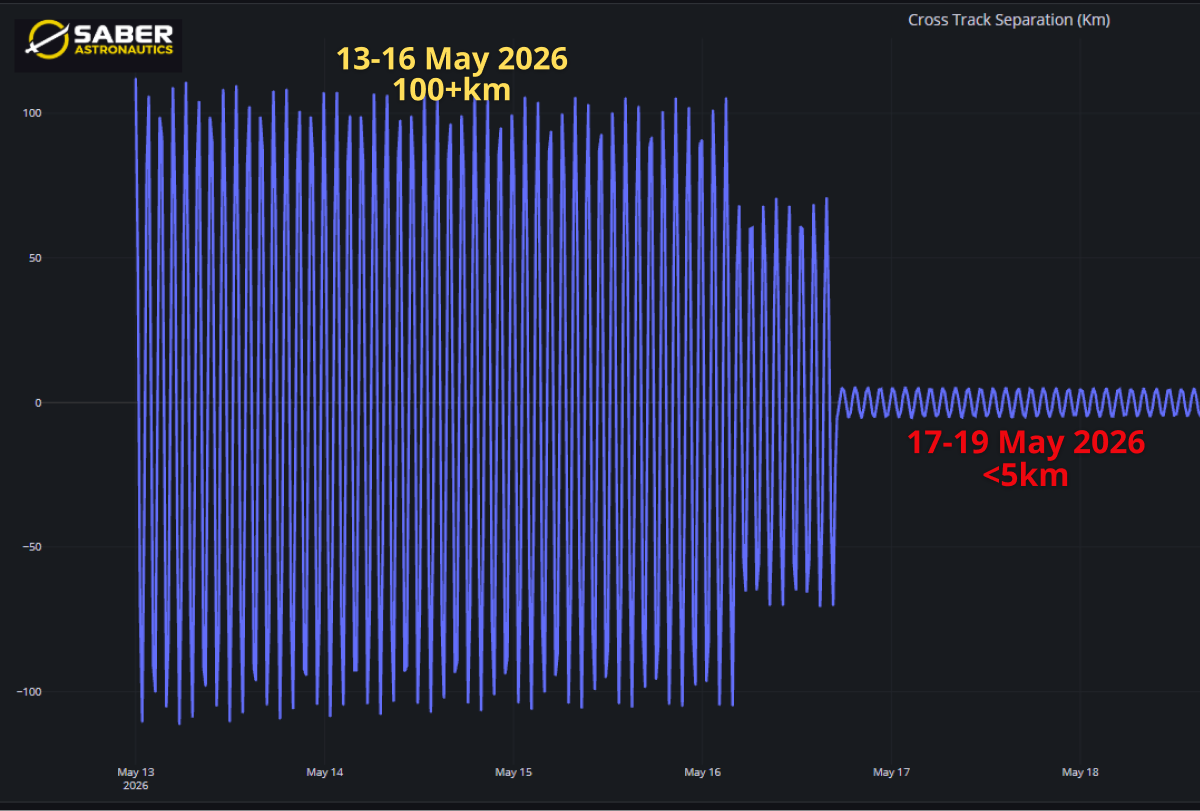
13-19 May 2026: Cosmos 2612 to ICEYE-X36 Cross Track Ranges Decrease from ~100km to <5km (saberastro.com)
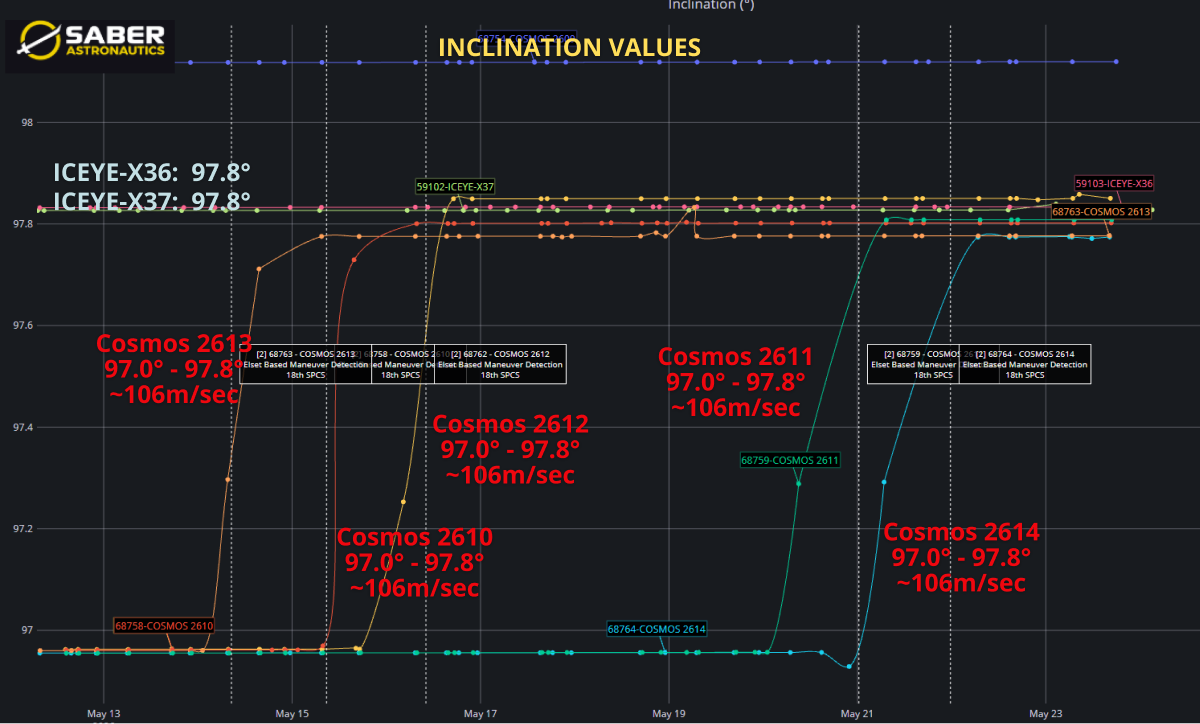
13-21 May 2026: Russia Increases Inclination 0.8°E For 5 Satellites
1) Cosmos 2613 (14-15 May); 2) Cosmos 2610 (15-16 May); 3) Cosmos 2612 (15-16 May); 4) Cosmos 2611 (19-20 May); & 5) Cosmos 2614 (20-21 May)
(saberastro.com)
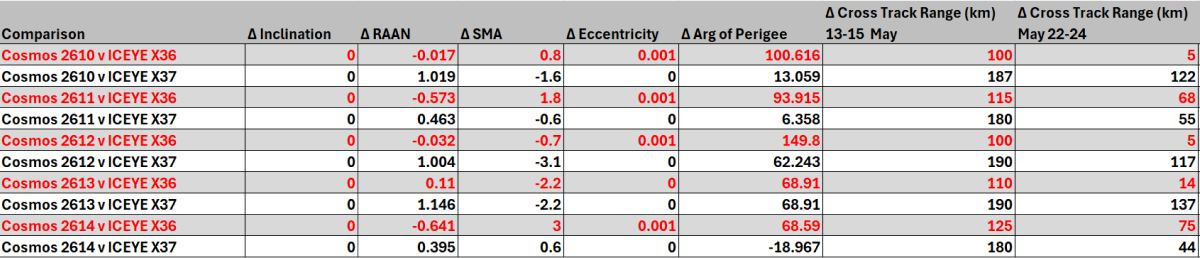
24 May 2026 1842Z: Comparing Orbital Element Values
Cosmos 2610-14 v ICEYE-X36/X37 (saberastro.com & celestrak.org)
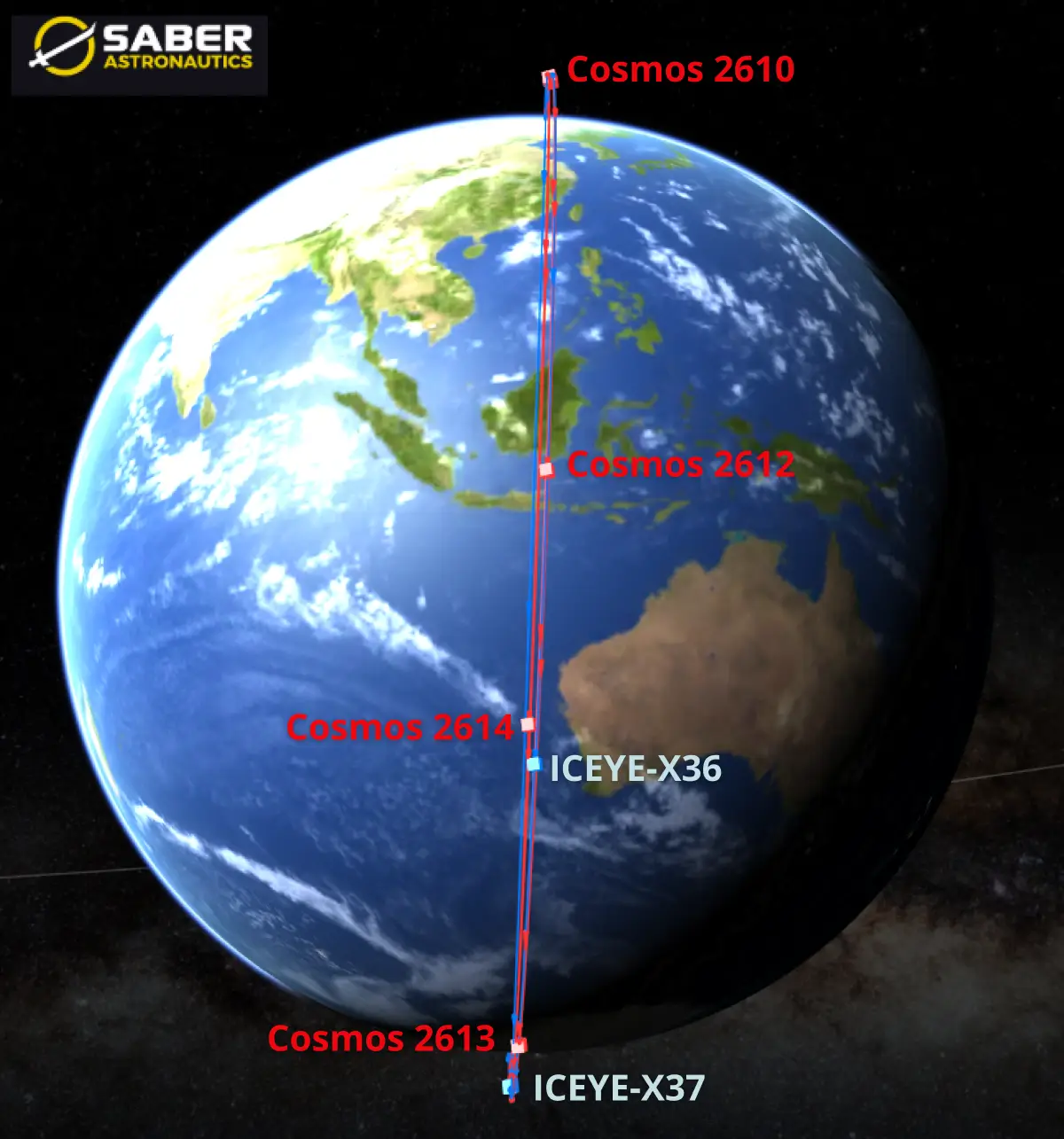
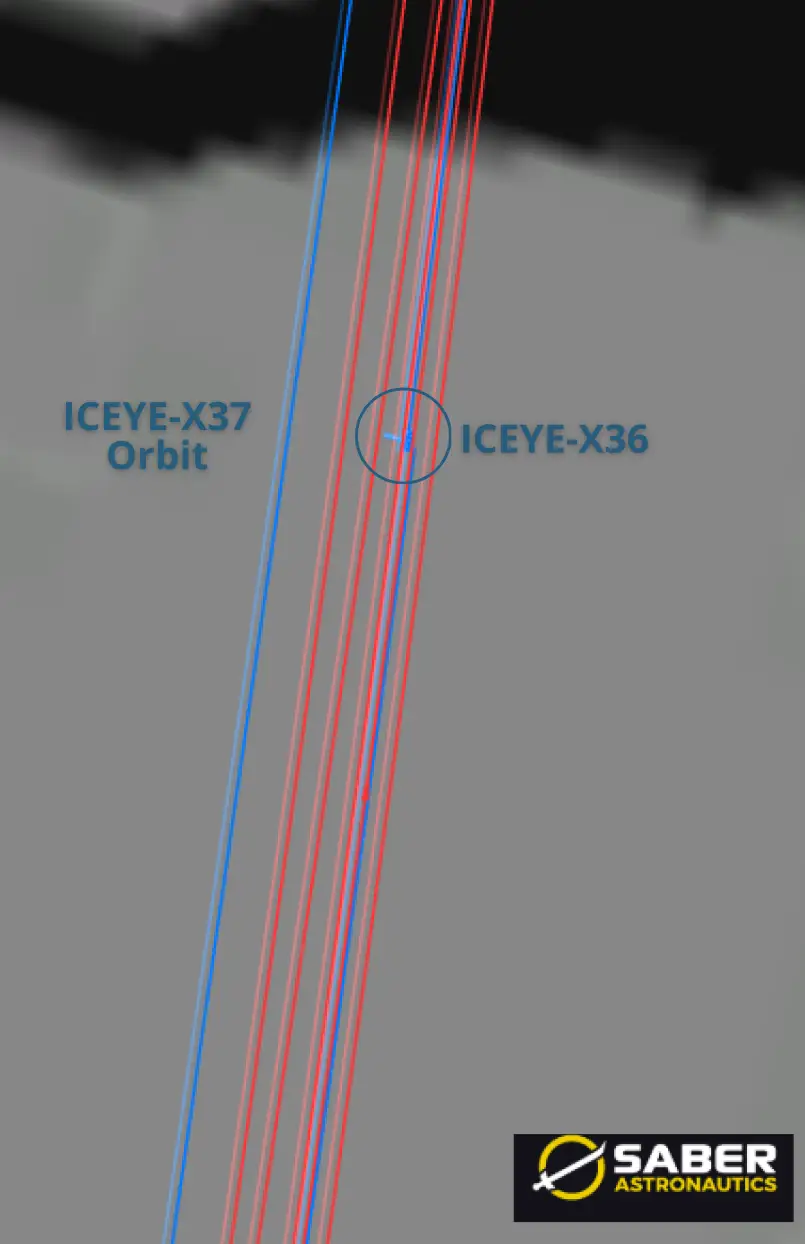
Not by Accident: Russia Has Maneuvered 5 Satellites to be Nearly Co-Planar with ICEYE-X36 (saberastro.com)
What’s Happening Now?
As of 29 May, Cosmos 2614 is in the closest proximity with X36. On 29 May 2026 ~0805-1035Z Cosmos 2614 and ICEYE-X36 had 4 instances where the two satellites were within <20km of one another. Cosmos 2614’s SMA is 3.12km greater than X36 as a result of Russia increasing SMA ~6km on 20 May and is nearly co-planar as discussed above.
During this 2.5hr period the two satellites had 4 instances (48 minutes apart) where their orbital paths crossed:
1) 0809Z total separation of ~13km, lighting conditions which favored Cosmos 2416
2) 0857Z total separation of ~13km, lighting conditions unfavorable for Cosmos 2416
3) 0945Z total separation of ~16km, lighting conditions unfavorable for Cosmos 2416;
4) 1033Z total separation of ~18km, lighting conditions favorable for Cosmos 2416
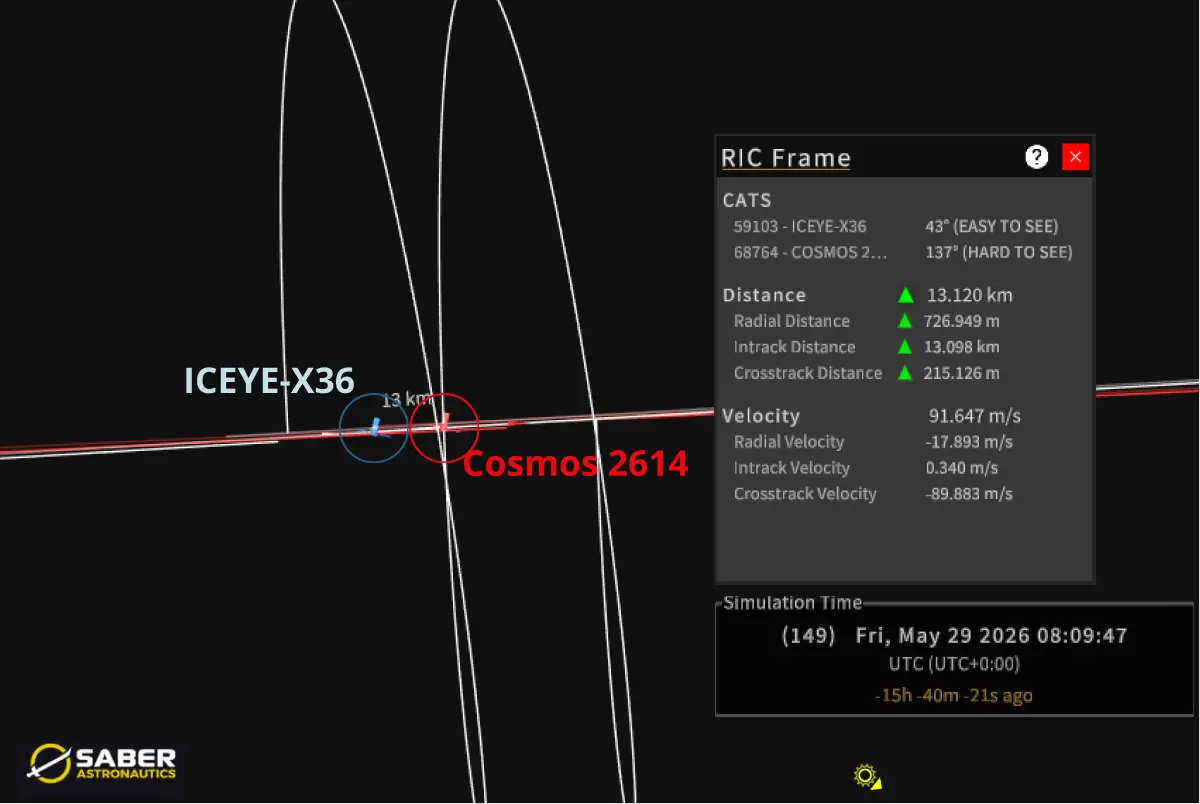
0809Z 29 May 2026: Cosmos 2614 Leads ICEYE-X36 at time of 13km Close Approach. Lighting Conditions Favorable for Cosmos 2614 (saberastro.com)
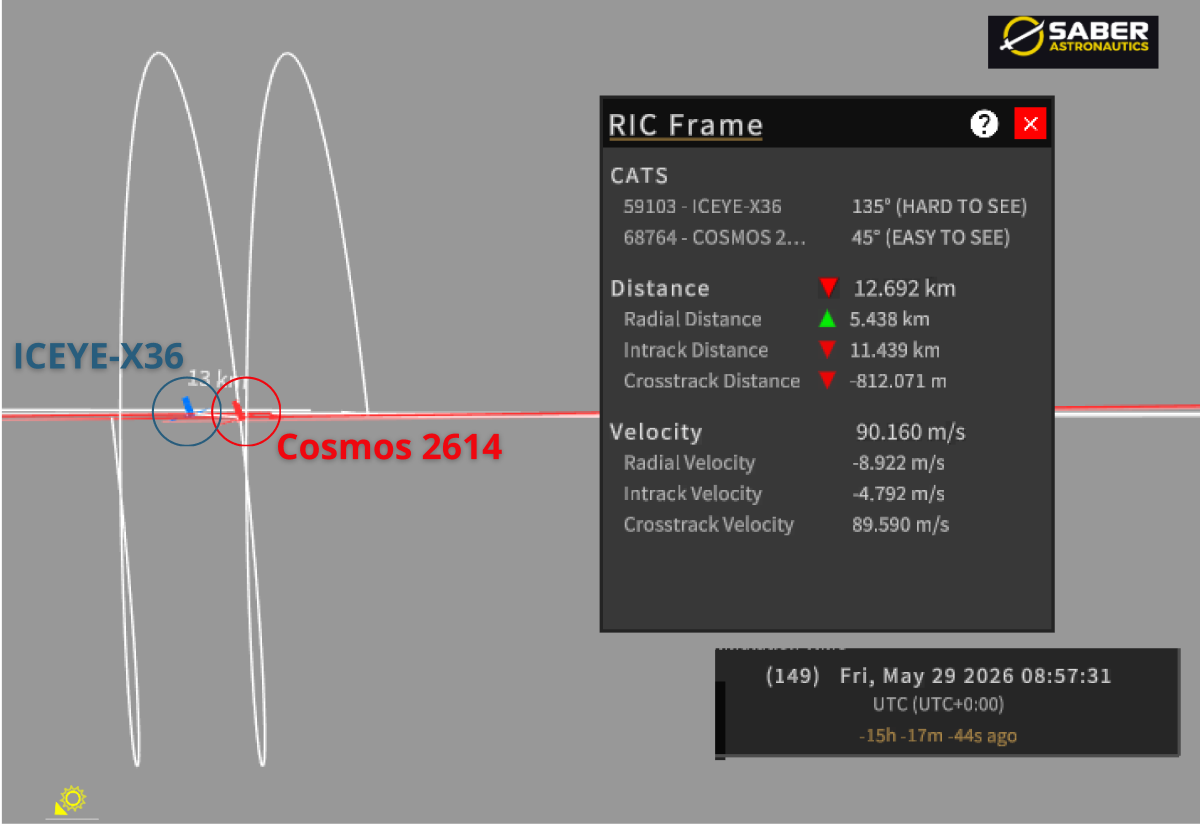
0857Z 29 May 2026: Cosmos 2614 Leads ICEYE-X36 at time of 13km Close Approach. Lighting Conditions Unfavorable for Cosmos 2614 (saberastro.com)
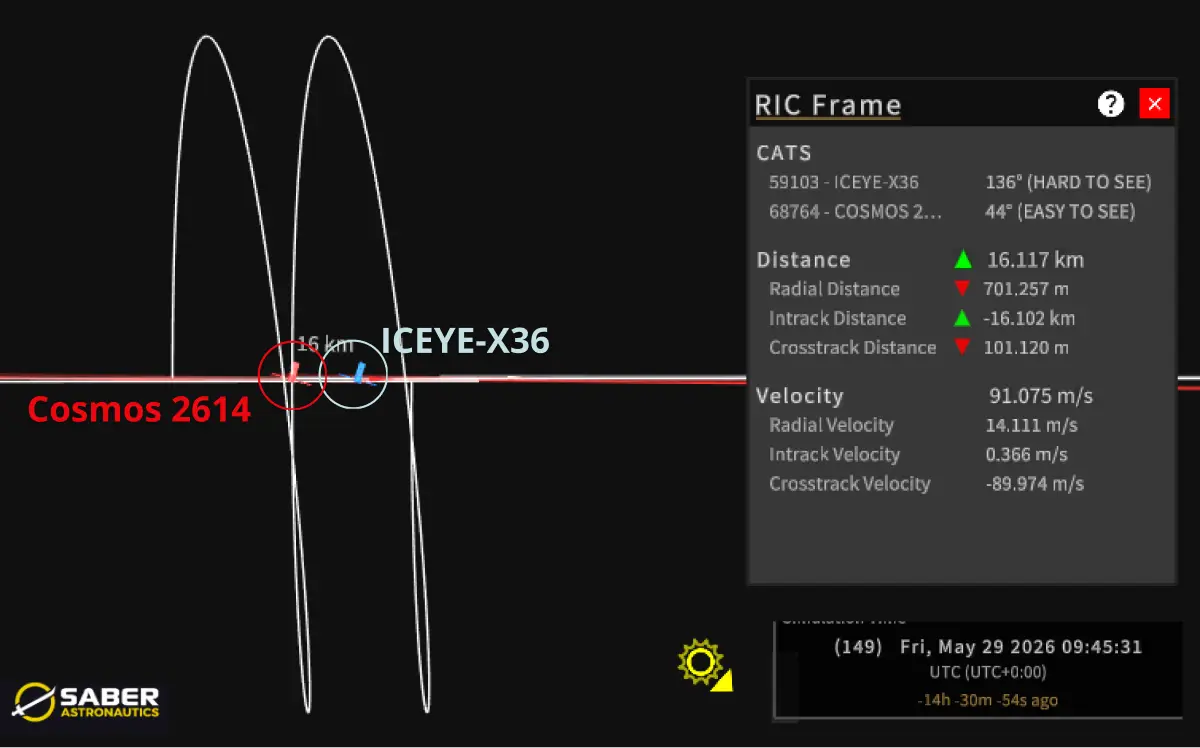
0945Z 29 May 2026: Cosmos 2614 Now Trailing ICEYE-X36 Has 16km Close Approach. Lighting Conditions Unfavorable for Cosmos 2614 (saberastro.com)
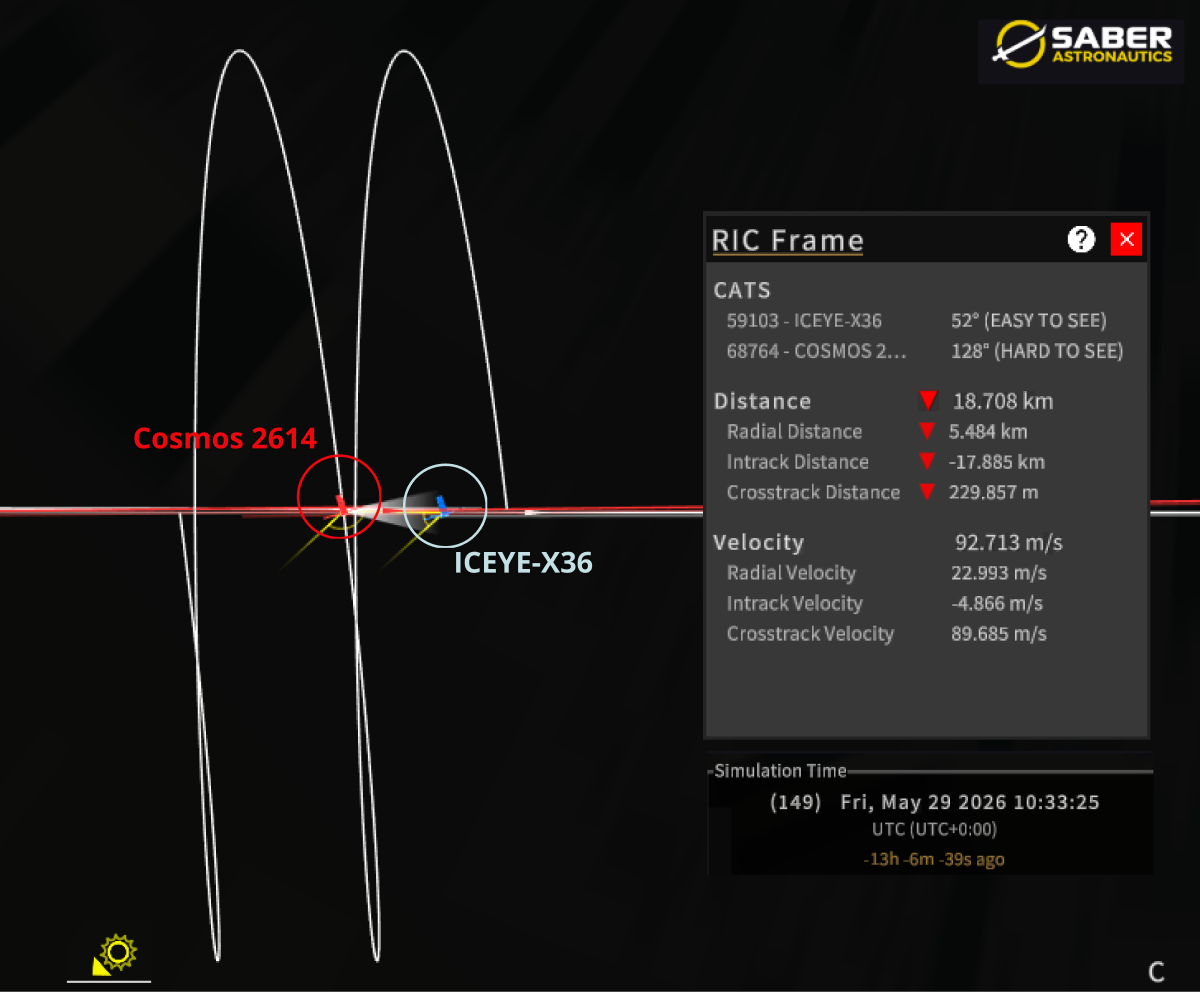
1033Z 29 May 2026: Cosmos 2614 Falls Further Behind ICEYE-X36 Has 19km Close Approach. Lighting Conditions Favorable for Cosmos 2614 (saberastro.com)
Background:
Russia launched Cosmos 2609-2614 on 17 April 2026 using a Soyuz 2.1b with a Volga upper stage. This was the first time Russia had paired the Soyuz 2.1b with the Volga upper stage and the configuration can deliver ~6,000kg to a 550km sun-synchronous orbit. Subtracting dispensers/adapters (typically 5–15% of payload mass, so ~300–900 kg for 6 satellites) this leaves roughly 5,100–5,700 kg for the 6 satellites. However, Russia deployed the satellites into two distinct orbital groups:
- Group 1 (98.25° inclination): Cosmos 2609 — ~495–550 km
- Group 2 (96.95° inclination): Cosmos 2610–2614 — ~547 km
This plane separation required additional Volga fuel requirements, which would further reduce available payload mass. The satellites in the two groups may also be different sizes.
ICEYE-X36 was launched March 4, 2024 from Vandenberg on a SpaceX Falcon 9. It’s registered under ICEYE US, has a mass of ~90 kg and is one node in a 44+ satellite constellation that Ukraine can task. ICEYE resolution can be as good as 0.5 m in spot mode covering a 5x5km area. Other modes offered are as follows: 10x10km spot at 1m resolution; 50x50km strip at 3m resolution; and 100x100km area scan at 15m resolution. In 2022 ICEYE donated one of its satellites, the “People’s Satellite,” to Ukraine, however this was prior to ICEYE-X36’s launch and the earlier ICEYE satellite’s identity remains unknown. On 26 June 2024, Ukraine’s Defense Intelligence Directorate (GUR) said it was making good use of SAR imagery provided by it’s “People’s Satellite.” Specifically Ukraine had used 38% of the nearly 4,200 (as of Jun 2024) images were used to strike Russian targets.
Editor’s Comments: Russia invested significant fuel to maneuver 5 of its satellites into co-planar orbits with ICEYE-X36. I should also note that the maneuvers also decreased the cross-track distance from ICEYE-37 (59102), but not to the same extent as with X36. X36 is a small satellite (90kg) and likely lacks the fuel/maneuverability to respond to any co-orbital threat. X36 last maneuvered over a year ago when it made a slight SMA increase on 11 March 2025.
Russia has warned previously of its intent to target commercial space capabilities assisting Ukraine. On 27 October 2022, Konstantin Vorontsov, deputy director of the Russian foreign ministry’s department for non-proliferation and arms control, spoke at a United Nations meeting on outer space security. He directly criticized Western nations’ use of commercial satellites in military operations and declared that commercial systems serving as “quasi-civilian infrastructure may become a legitimate target for retaliation.” Vorontsov further remarked that the West’s use of commercial satellites was “an extremely dangerous trend that … has become apparent during the latest developments in Ukraine.” These comments added fuel to previous declarations that Russia could target space networks operated by private companies.
Nearly four years after making these statements, Russia is showing signs of carrying out this threat.
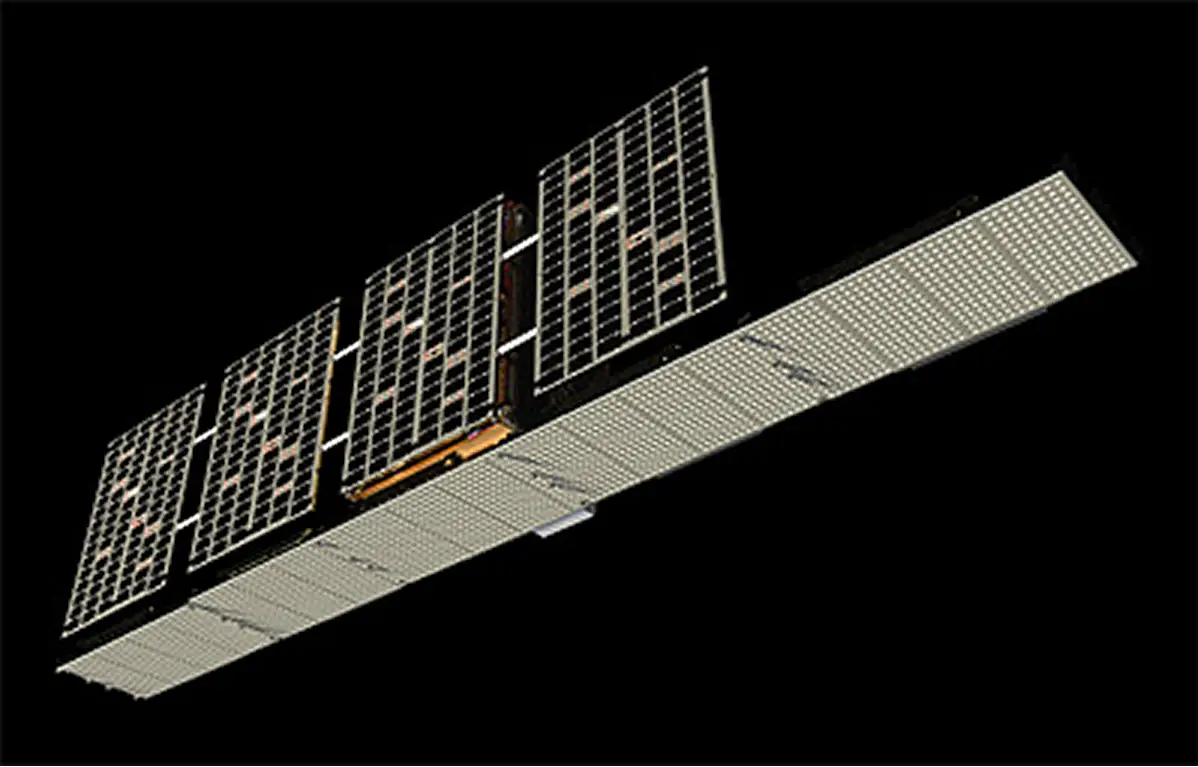
Rendering of ICEYE SAR Satellite (space.skyrocket.de)
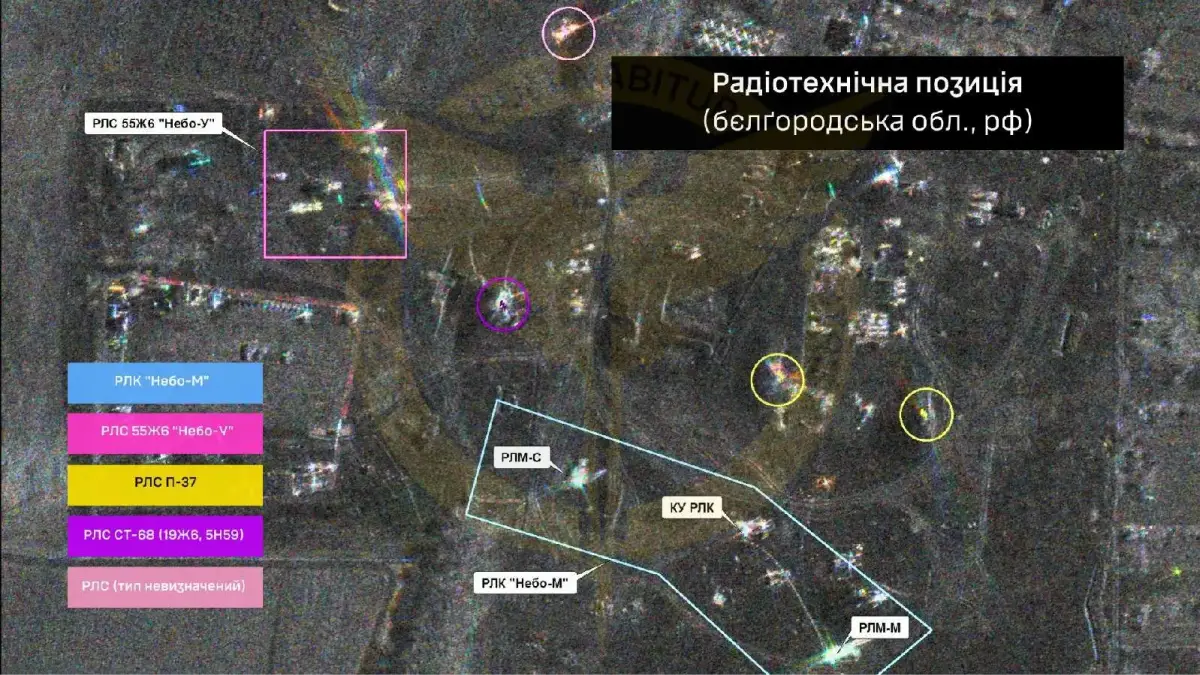
Russian Radar Systems as Seen from ICEYE SAR Imagery (@DI_Ukraine via X)
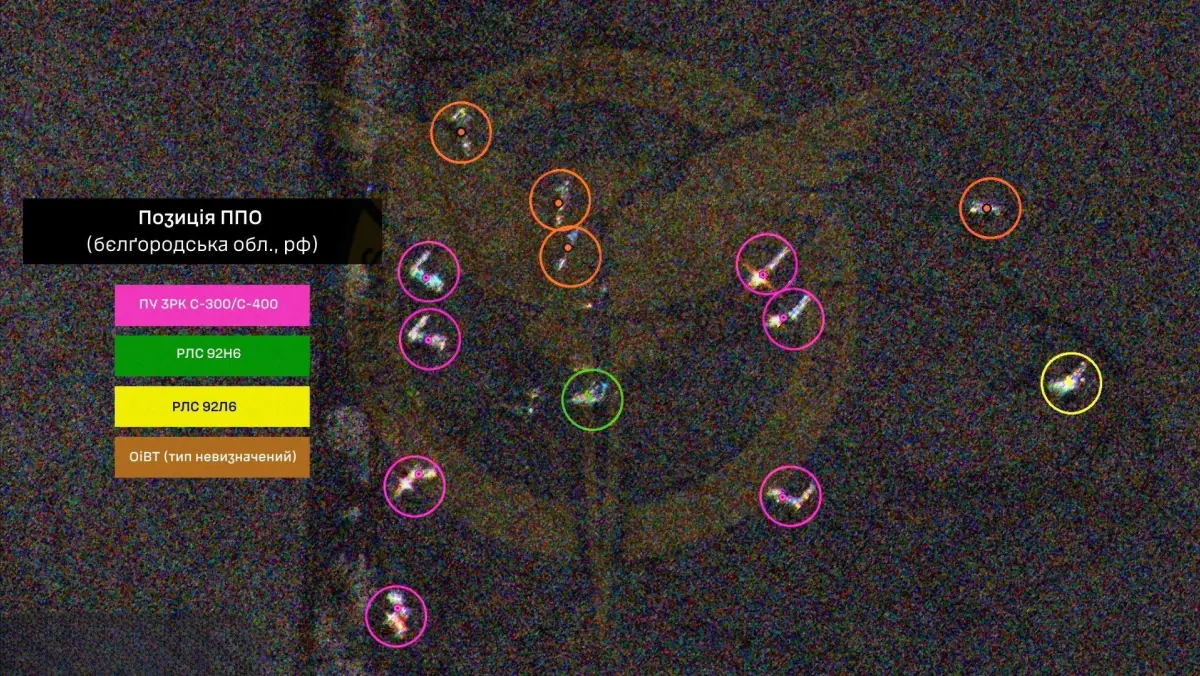
Deployed Russian Equipment as Viewed By ICEYE SAR Imagery (https://gur.gov.ua)
Maneuvering In Space: The Basics
22 May 2026: I thought it might be helpful to do a short review on space maneuvers and their fuel requirements. First a note on why we talk about fuel usage in terms of “change in velocity” or “Delta-v” or simply “Δv” and use the unit “meters per second” (m/sec). M/sec is a universal, spacecraft-agnostic metric that describes how much orbital change you need, completely independent of the spacecraft’s mass, engine type, or propellant. Your Δv tells you what the orbit requires. In the Cosmos 2610-14 examples we described in the previous article, changing inclination by 0.8° at an average altitude of 547km costs ~106 m/sec — that’s true whether the Cosmos Satellites are 50 kg CubeSats or a 5,000 kg reconnaissance satellites. If we knew (we don’t) the mass of the Russian satellites and their propulsion (thruster) type then we could calculate the actual propellant mass required to achieve the desired Δv required for the maneuver. So Δv is the input, and the rocket equation tells you how much propellant you need for your specific vehicle.
For the curious, here is the rocket equation:
Δv=I⋅g⋅ln(m0/mf)
Where:
- I = specific impulse (engine efficiency, in seconds)
- g = 9.80665 m/s² (standard gravity)
- ln stands for the natural logarithm
- m0 = initial mass (spacecraft + fuel)
- mf = final mass (spacecraft after burn)
Think of Δv like pricing a road trip in kilometers rather than liters of gas:
- “It’s 705 km from DC to Boston” is universally true.
- How many liters that takes depends on whether you’re driving a Prius or a Humvee as well as how quickly you need to arrive at your destination.
Similarly, an orbital analyst can say “that maneuver costs 50 m/sec” and every engineer on the team can independently calculate what that means for their specific spacecraft design.
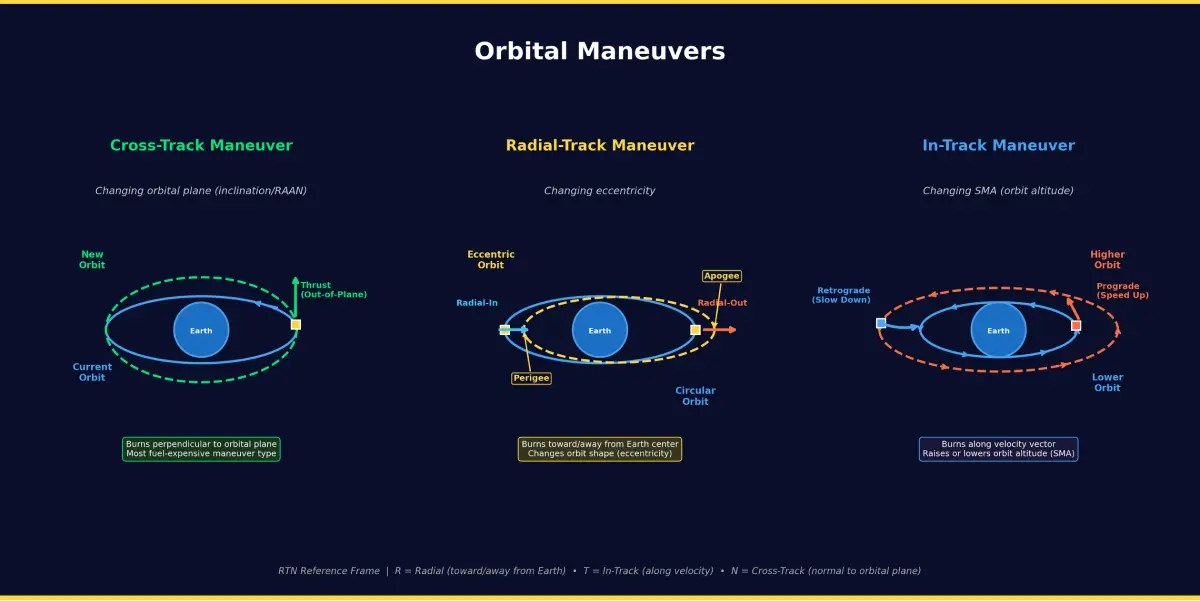
The three fundamental orbital maneuver types: 1) Cross-Track; 2) Radial-Track; 3) In-Track. Of the three, Cross-Track changes are the most fuel-expensive
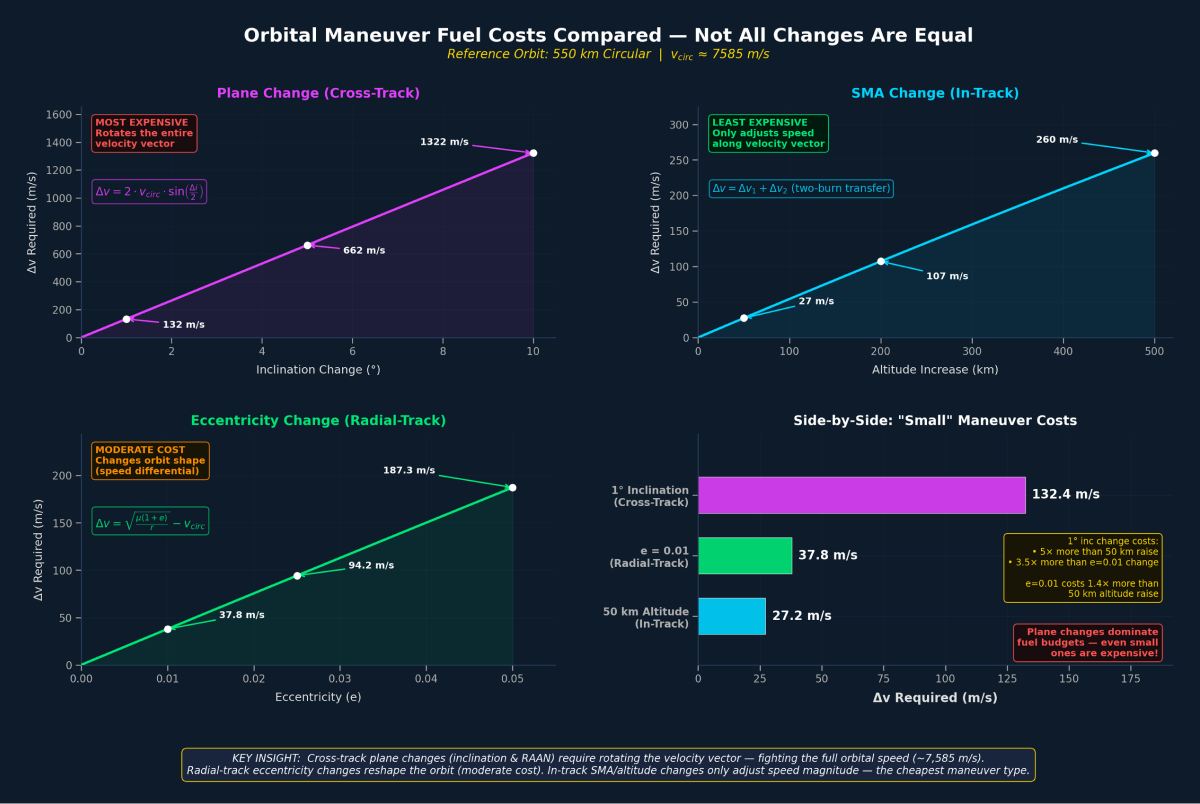
Graphic Comparing Δv Requirements for Cross-Track, In-Track & Radial Track Maneuvers for Circular Orbit with 550km SMA
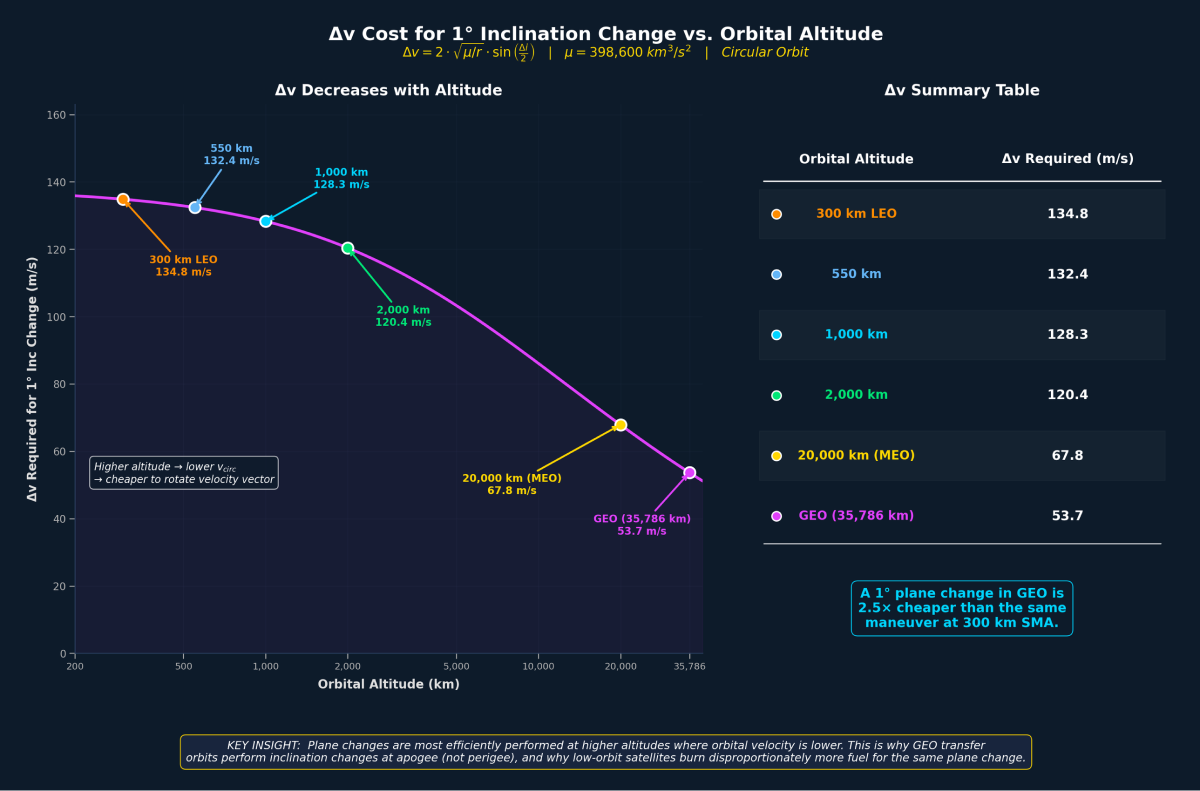
Graphic Comparing Δv Requirements for 1° Inclination Change at Varying SMA Values
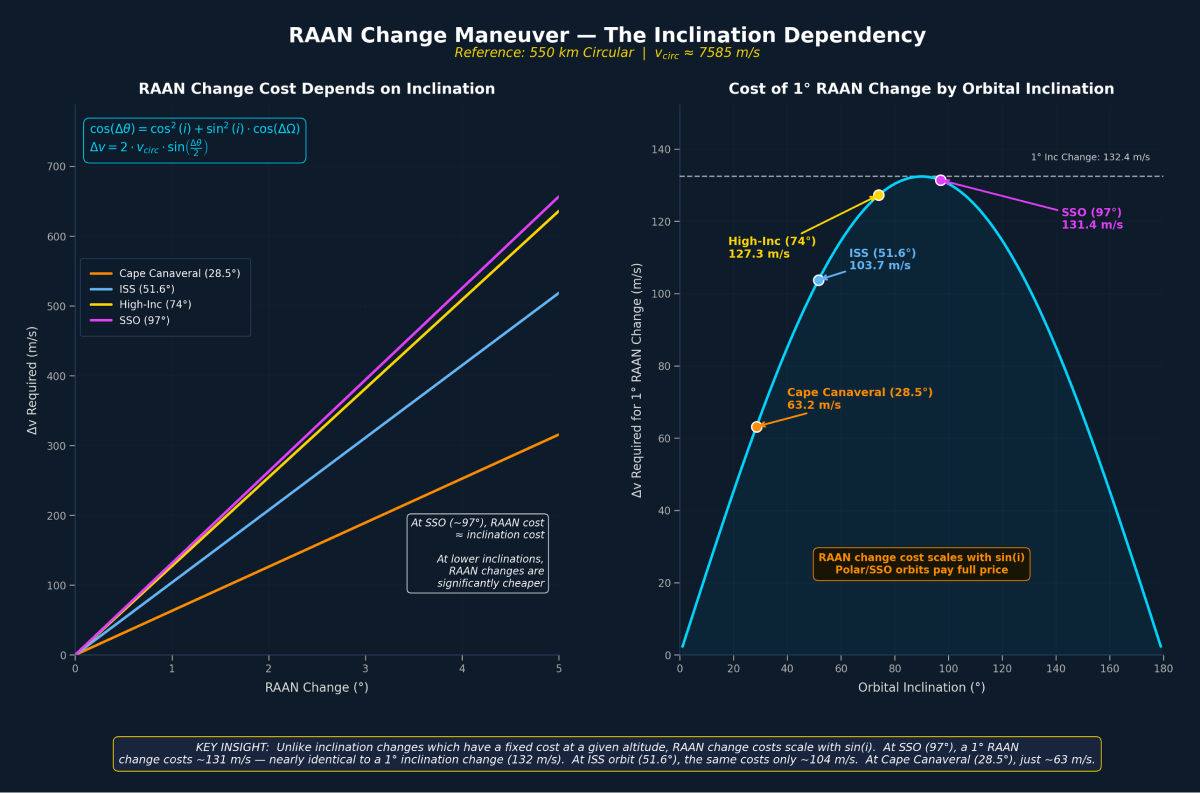
Δv Requirements for RAAN specific maneuvers varies by Orbit Inclination. Cross-Track Maneuvers include both inclination and RAAN.
Here is the math behind the energy requirement calculations specific to a 0.8° inclination change like the ones conducted by Cosmos 2610-14. I assumed Russia performed the plane change at apoapsis (apogee), where the orbital velocity is at its minimum, thus reducing the Δv cost (in this case slightly as the orbit is nearly circular).
- ParameterValues
- Semi-major axis (a) = 6,912 km
- Eccentricity (e) = 0.002
- Perigee radius = 6,898.18 km (~527.2 km altitude)
- Apogee radius = 6,925.82 km (~554.8 km altitude)
With these parameters we can calculate the satellites velocity at apogee using the vis-viva equation:
v = orbital velocity
μ = Standard gravitational parameter (398,600.44 km³/s²)
r = radial distance from the center of the earth. Computing r at apogee = 6,912 x (1 + .002) = 6,925.82km (.002 is orbit eccentricity)
a = semi major axis (in this case 6,912km)
At apogee the orbital velocity = 7,578.76 m/sec
Now we’re ready to calculate Δv cost for changing inclination 0.8° using the pure plane change maneuver formula:
Inclination change (Δi) = 0.8°
v = satellite velocity at apogee = 7,578.76 m/sec
Therefore: Δv = 2 (7578.76) sin (0.8/2) = 105.82 m/s
26 May 2026: China launched a Long March-7A with TJS-24 (69235) from Wenchang. According to official sources, the satellite entered the preset orbit successfully and “will be mainly used for verification of multi-band, high-speed satellite communication technologies”. The satellite is likely heading to GEO and is currently in Geosynchronous Transfer Orbit (GTO). Typically TJS satellites require ~10 days to reach their GEO position (and be reflected in the catalog). Launch Video.
A geosynchronous transfer orbit (GTO) is a highly elliptical Earth orbit used as an intermediate step to place satellites into geosynchronous or geostationary orbit.
- TJS-24 is currently in a highly elliptical orbit (e=.73) with an apogee of 35,858km (about 100km above GEO) and perigee of only 176.7km.
- China will adjust TJS-24’s inclination and perigee when the satellite is apogee—where orbital velocity is lowest.
- While it is perhaps counterintuitive, conducting small prograde (in the direction of travel) ΔV at apogee produces a large perigee raise — doing so adds velocity where it has the greatest geometric leverage on the opposite side of the orbit.
- GTO uses orbital mechanics to reduce the total delta-v required from the launch vehicle while shifting part of the maneuvering burden to the spacecraft itself.
China has described the missions of the following TJS satellites as “mainly used for verification of multi-band, high-speed satellite communication technologies”: 1) TJS-10; 2) TJS-11; 3) TJS-15; 4) TJS-16; 5) TJS-17; 6) TJS-19; 7) TJS-20; 8) TJS-23; and 9) TJS-24.
We will wait to see where China decides to position TJS-24 in the coming weeks. More updates to follow.
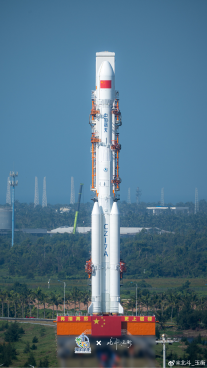


LM-7A Prepares for Lift Off with TJS-24
Launch & Mission Patches
(saberastro.com)
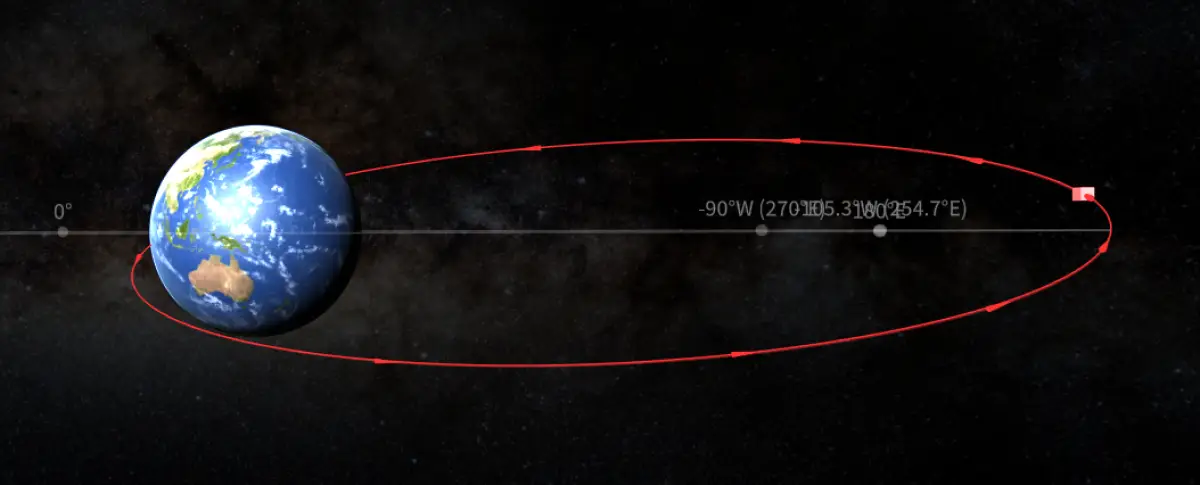
TJS-24 In GTO: Inclination = 19.5° Eccentricity = .73 Apogee = 35,858km Perigee = 176.7km(saberastro.com)

TJS Positions May 2026 (TJS-13/21 in HEO and 24 in GTO not displayed) (spacemap42.com)
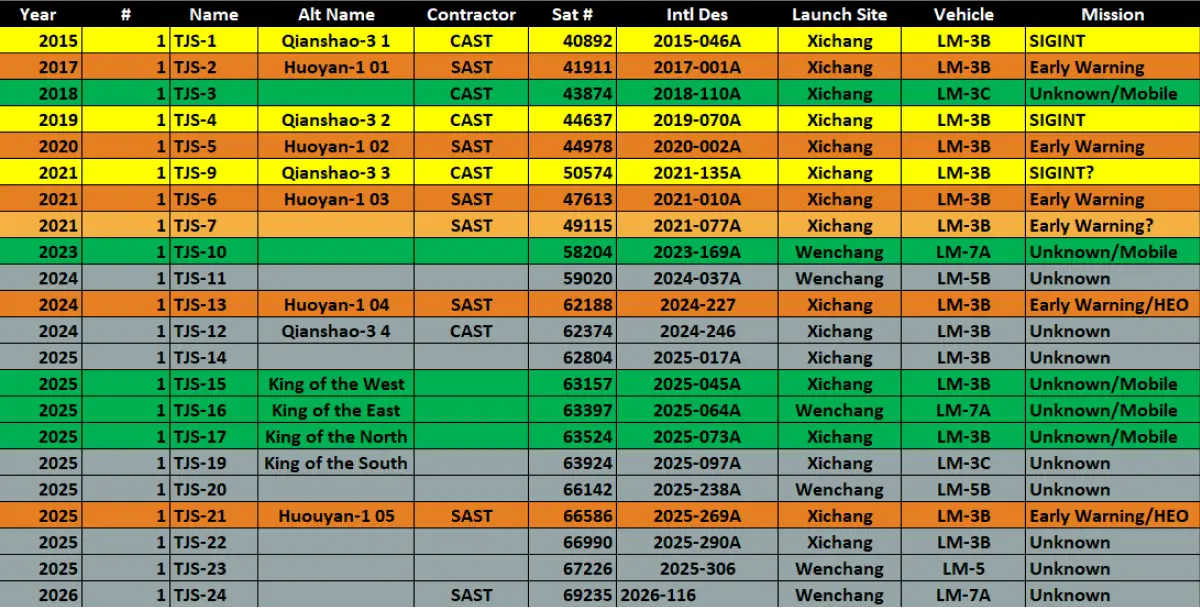
China’s Growing TJS Catalog (13 of 23 Have Publicly Unknown Missions) (Gunther’s Space Page, Celestrak.org)
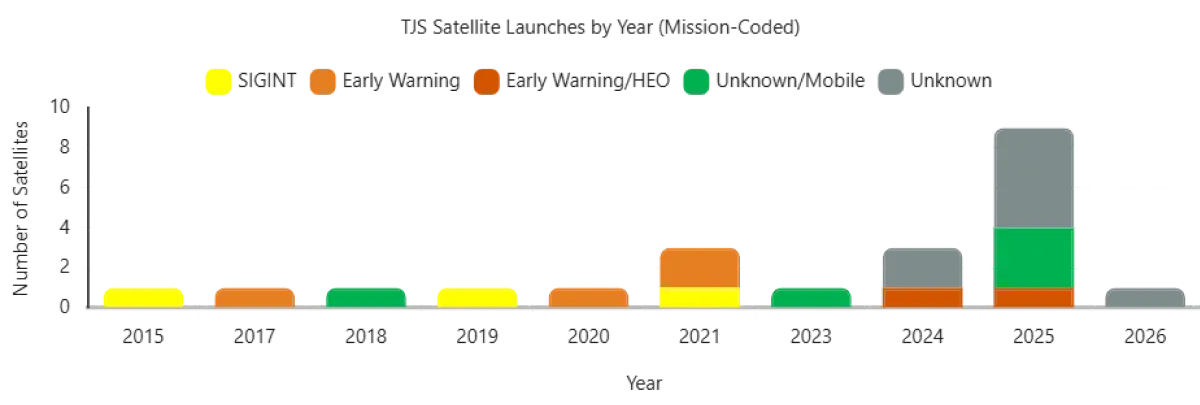
China Added a Record 9 TJS Satellites in 2025(Gunther’s Space Page)
27 Mar 2026: As we reported in the 6 Apr 2026 – Integrity Flash, Shiyan-33 (SY‑33) is a Chinese experimental satellite launched on 27 March 2026 aboard a Long March‑2C with a Yuanzheng‑1S upper stage from Jiuquan, successfully inserting into a sun-synchronous orbit (SSO) of approximately 485 × 505 km at 97.5° inclination. The use of the LM‑2C/YZ‑1S configuration—capable of delivering roughly 2,600 kg to a 500 km SSO—suggested SY‑33 may be a relatively large satellite within the Shiyan program. I asked Darren McKnight of LEOLabs for more specific details. Dr McKnight noted, “From preliminary object characterization measurements from our global radar network, it is clear SY-33 is a moderate-sized (i.e., characteristic length of 1.5 to 2.5 m) spacecraft with an above average effective spacecraft density. This leads us to assess with moderate confidence the mass is likely well less than 1,000 kg; closer to 500 to 600 kg. LeoLabs continues to persistently monitor this satellite and is providing regular updates to USG partners.” So…my hypothesis that SY-33 is a relatively large satellite looks to be incorrect. For comparison, the Russian/Iranian Khayyam imagery satellite (53370) is in this size-range (see image from Gunther’s Space Page).
Dr. McKnight’s assessment places SY‑33 at less than a quarter of the LM‑2C/YZ‑1S’s lift capacity, raising the question of why China selected such an oversized platform. I suspect China’s rationale is based on the LM‑2C’s reliability and the YZ-1S’s precision. The LM-2C has been in service for over 40 years and has had 85 successful missions in 87 flights. By comparison the Long March‑11, while carrying a clean 18-for-18 record, is a solid‑fueled vehicle limited to roughly 350 kg to a 700 km SSO—insufficient margin for SY‑33, particularly given the mass growth common in experimental programs. Commercial options such as Galactic Energy’s Ceres‑1 (~300 kg to SSO) and Landspace’s Zhuque‑2, in addition to being undersized, have both suffered recent launch failures, underscoring their relative immaturity. The YZ‑1S restartable upper stage may be the most critical element as it provides precise, multi-burn orbital insertion that solid‑fueled kick stages cannot replicate—a critical capability if SY‑33’s mission demands a tightly controlled sun‑synchronous orbit. The decision to pair a moderate‑sized experimental satellite with China’s most dependable SSO launch platform—accepting significant excess capacity in exchange for mass flexibility, orbital precision, and near‑certain mission success—strongly suggests China views SY‑33 as a high‑value asset that warrants continued monitoring.
SY-33 has settled into its desired orbit. Chinese space operators last adjusted the satellite’s SMA on ~30 Mar 2026 (three days after launch) to 496.3km. The satellite’s altitude has naturally decreased to 494.6km in the past 2 months. I don’t see any adjustments to the other orbital elements. (see Celestrak.org graph).
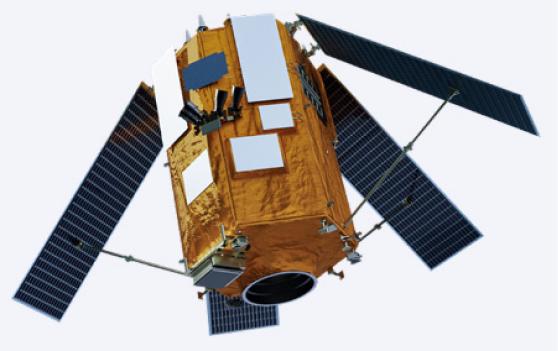
Russian-built/Iranian-operated Khayyam Satellite has similar mass estimate (500-600kg) as SY-33 (https://space.skyrocket.de/)
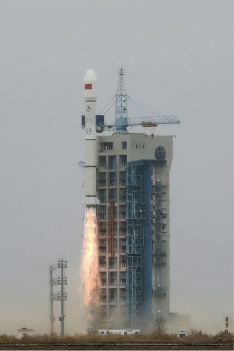
LM-2C/YZ1S Lift Off with SY-33 (nasaspaceflight.com)
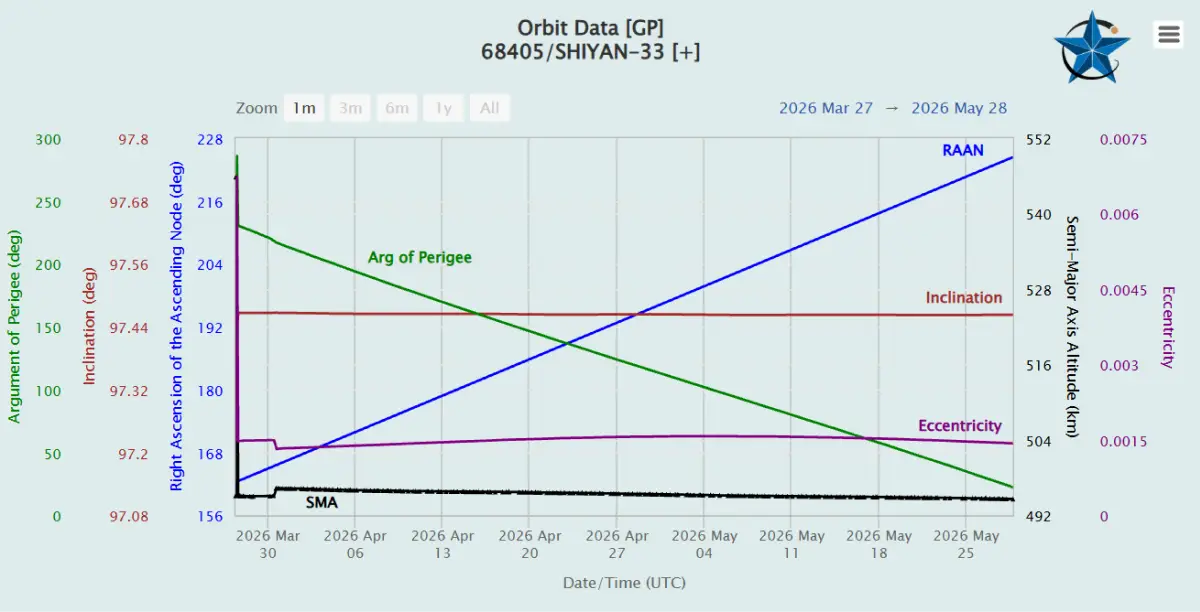
SY-33 Orbit History(celestrak.org)
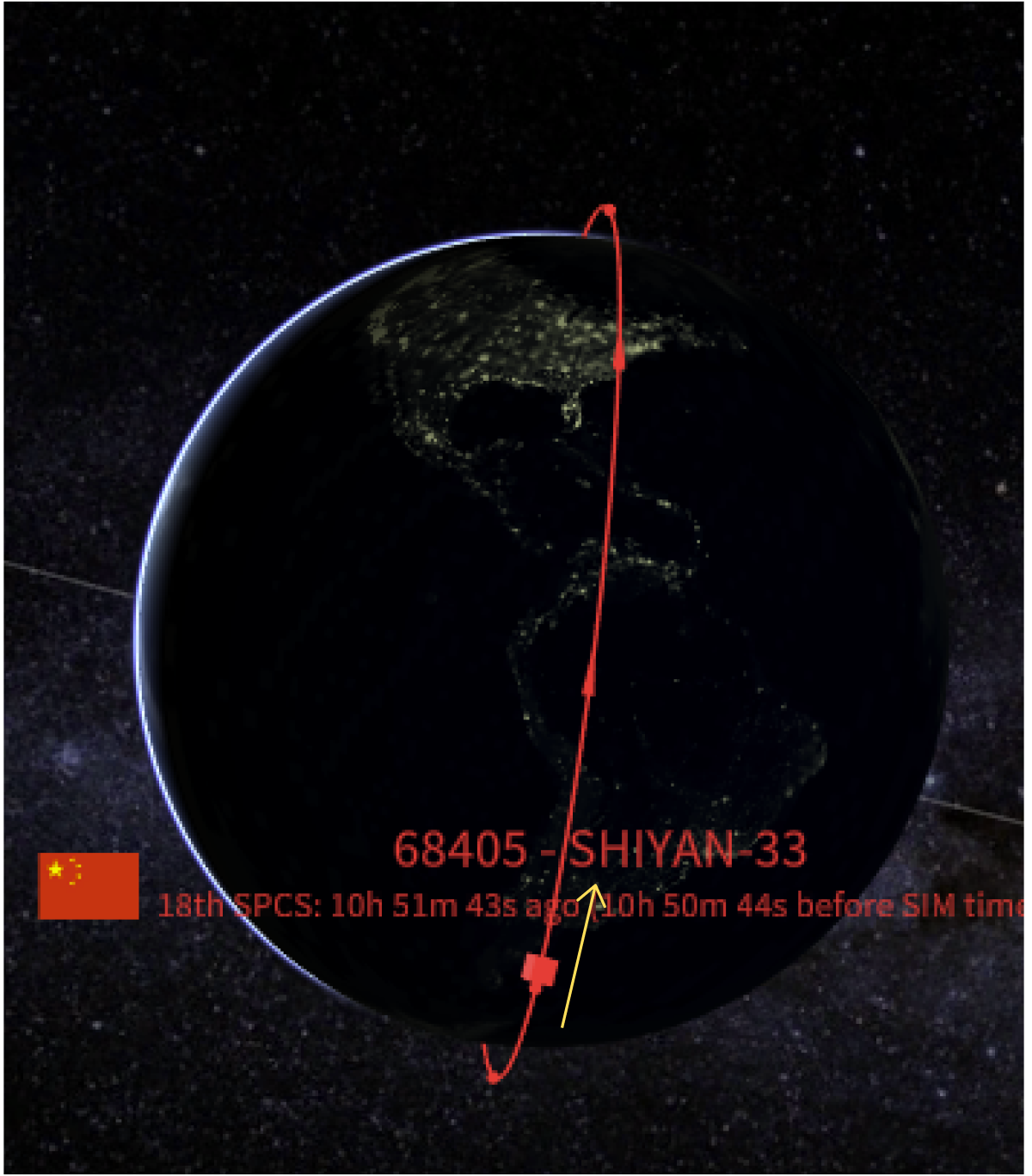
SY-33 Orbit Visualization(saberastro.com)
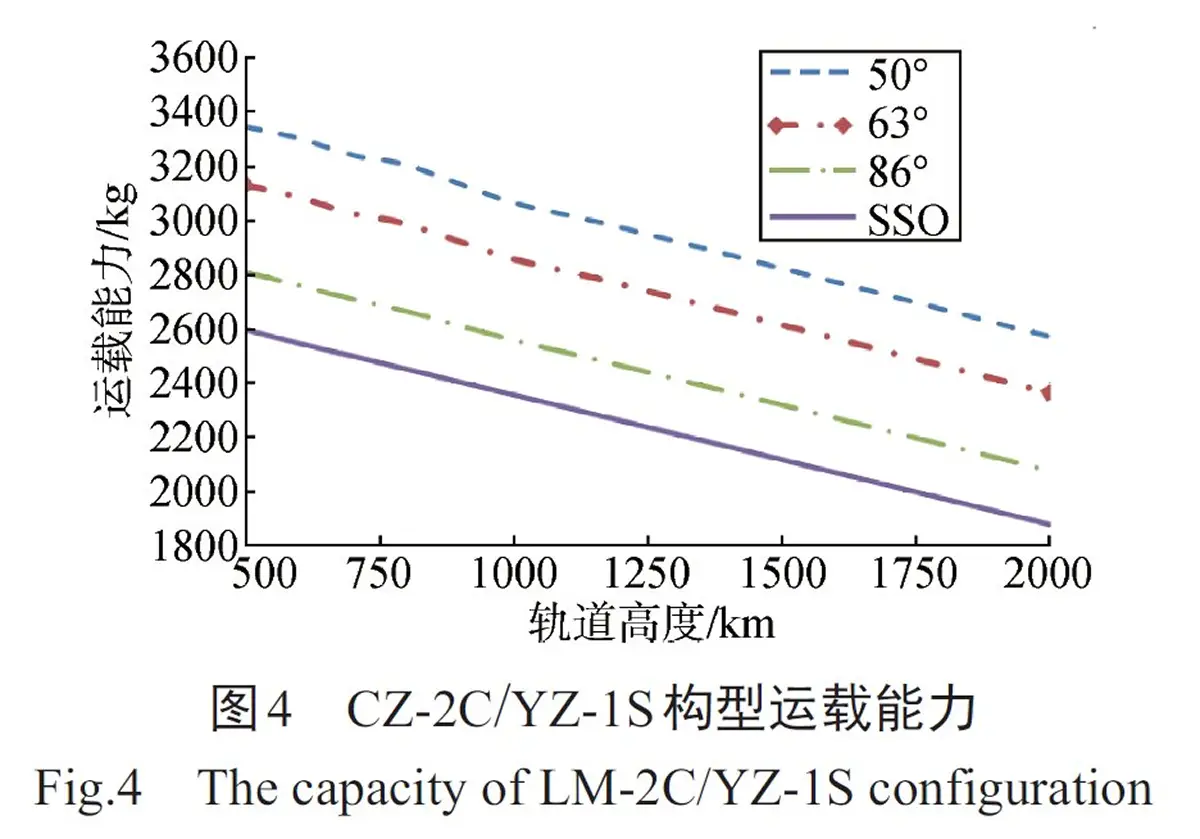
Mass to Orbit Capacity of LM-2C with YZ-1S Upper Stage(@TAbusnardo via X)
17 May 2026: China launched a Long March-8 with 18 SpaceSail satellites (69104-69121) from Hainan (Wenchang). According to official sources, the 18 satellites constitute the ninth batch of the first generation of the SpaceSail Constellation developed by Shanghai SpaceSail Technologies Co., Ltd. to “provide global users with low-latency, high-speed and ultra-reliable satellite broadband internet services”. SpaceSail has yet to launch “Group 8” and labelled this launch “Group 10”. There are now 162 satellites in orbit. Group 10’s launch occurred just 5 days after the previous Qianfan launch on 12 May 2026. Of the 9 launches 6 have used the LM-6A from Taiyuan and 3 have used the LM-8 from Hainan (Wenchang). Launch Video.
– SpaceSail launched its 9th group Qianfan (labelled “Group 10”) satellites into a co-planar orbit with Group 3 (see graphic). This is the first Qianfan launch to be co-planar with another group. All planes are inclined 89° with a 20° of RAAN offset between each plane. With this launch, 8 of the 9 planes are in use. SpaceSail may want to augment Group 2 due to 15 of 18 satellites failing to reach their operational SMA of 1,069km.
Constellation Summary:
– Of 162 Qianfan satellites on orbit, 87 have reached their operational altitudes of 1,069kms.
- Group 1 (60379-60396) (LM-6A launched 6 Aug 2024) : 17 of 18 satellites reached operational SMA. Qianfan 7 (60385) has not maneuvered and may be inoperable.
- Group 2 (61552-61569) (LM-6A launched 15 Oct 2024): Only 3 of 18 satellites (Qianfan 29, 30 & 32) reached their operational SMA.
- Group 3 (62238-62255) (LM-6A launched 5 Dec 2024): 16 of 18 satellites reached their operational SMA. Qianfan 39 (807km) & 42 (810km) likely inoperable. Group 3 is co-planar with Group 10.
- Group 4 (62785-62802)(LM-6A launched 23 Jan 2025) : 18 of 18 satellites reached their operational SMA.
- Group 5 (63159-63176) (LM-8 launched 11 Mar 2025): 16 of 18 satellites reached their operational SMA. Qianfan 77 (904km) & 83 (1,028km) likely inoperable.
- Group 6 (66033-66050) (LM-6A launched 17 Oct 2025): 17 of 18 satellites reached their operational SMA. Qianfan 101 (66043) (800km) likely inoperable.
- Group 7 (68636-68653): (LM-8 launched 7 Apr 2026): All 18 satellites in process of raising their SMA. Range 1,024-1,063km as of 28 May 2026.
- Group 9 (69073-69090): (LM-6 launched 12 May 2026): All 18 satellites in process of raising their SMA. Range 815-830km as of 28 May 2026.
- Group 10 (69104-69121): (LM-8 launched 17 May 2026): All 18 satellites in process of raising their SMA. Initial SMA range is 825-850km. Group 10 is co-planar with Group 3.
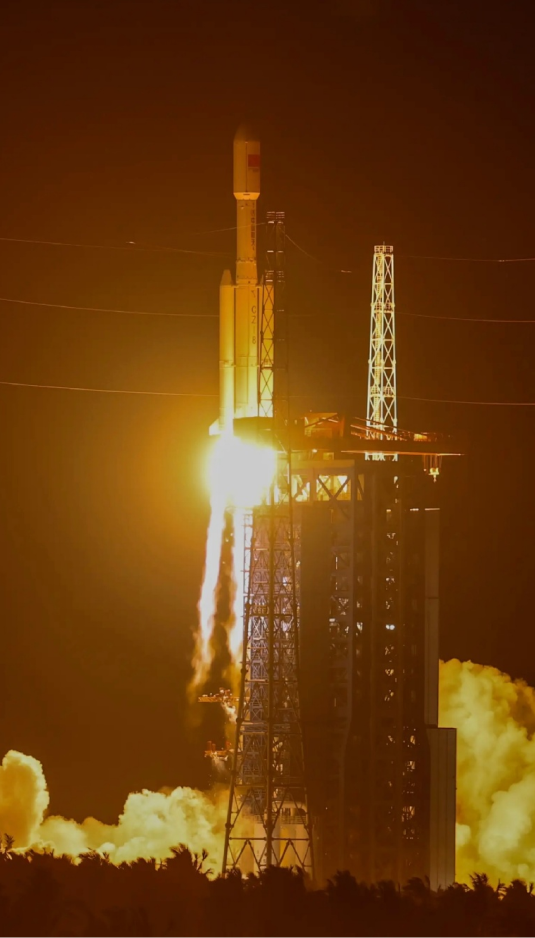
LM-8 with Qianfan Group 10
(nasaspaceflight.com)
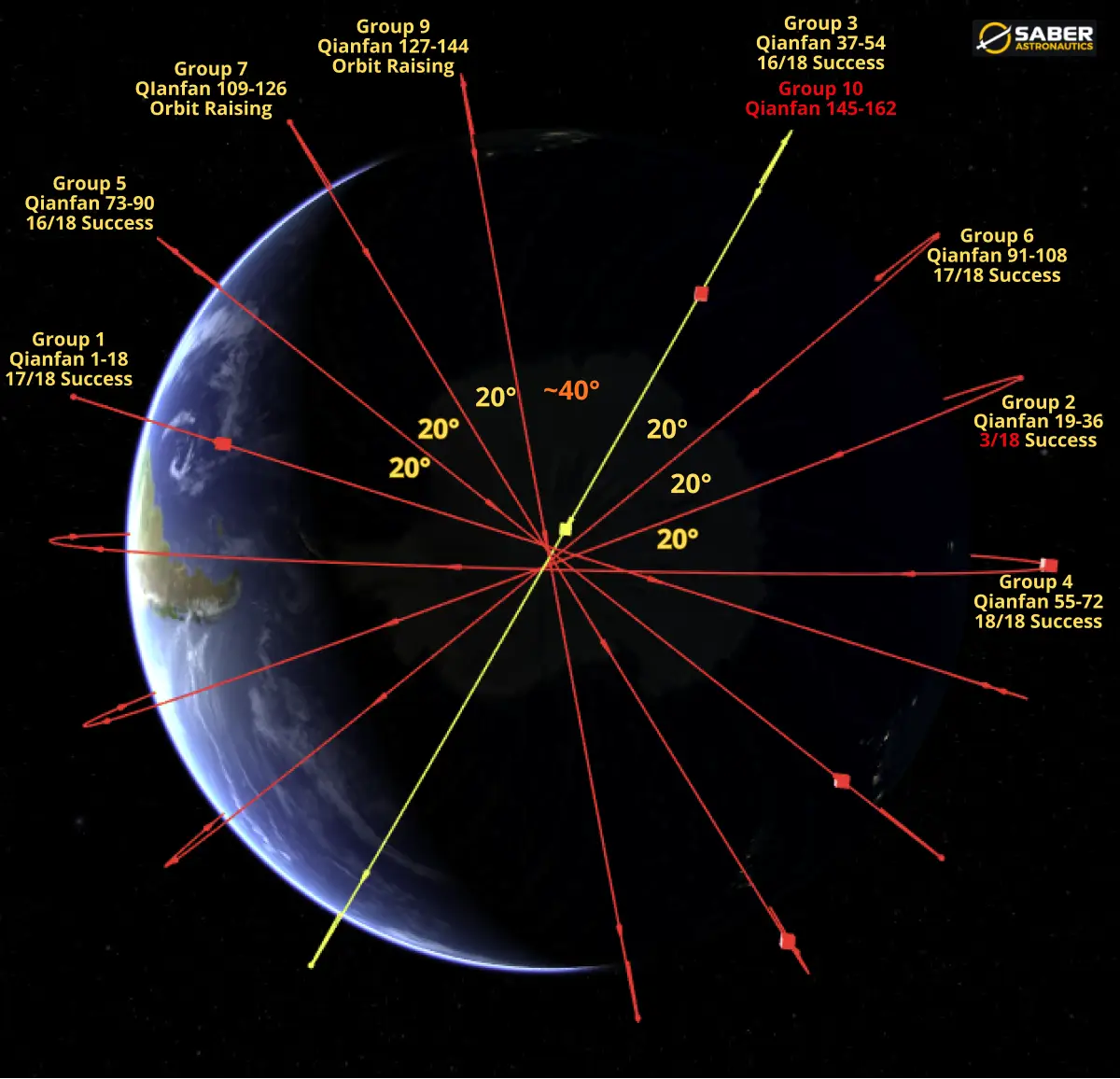
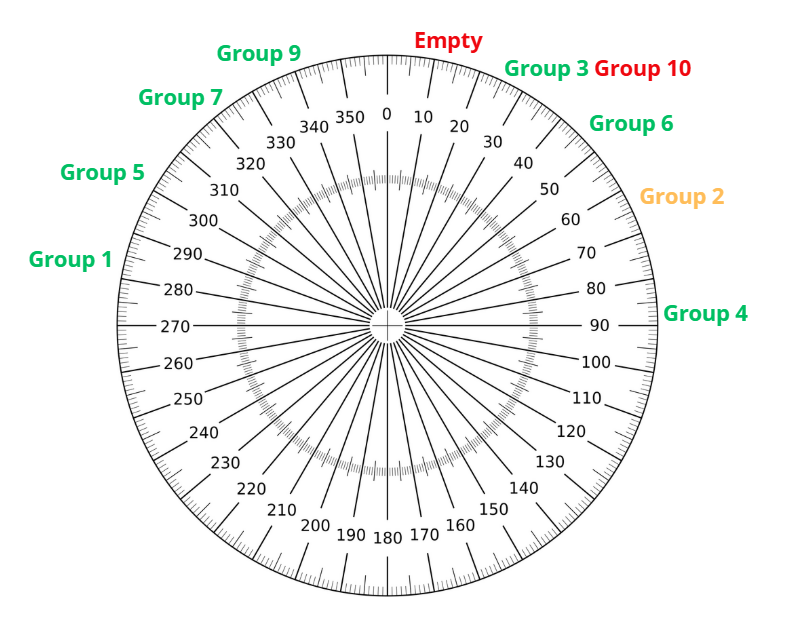
Current Qianfan Constellation consists of 162 satellites operating in 8 orbital planes. Planes are inclined 89° & separated by ~20° RAAN with one plane remaining empty. (saberastro.com)
Pics o’ the Fortnight!
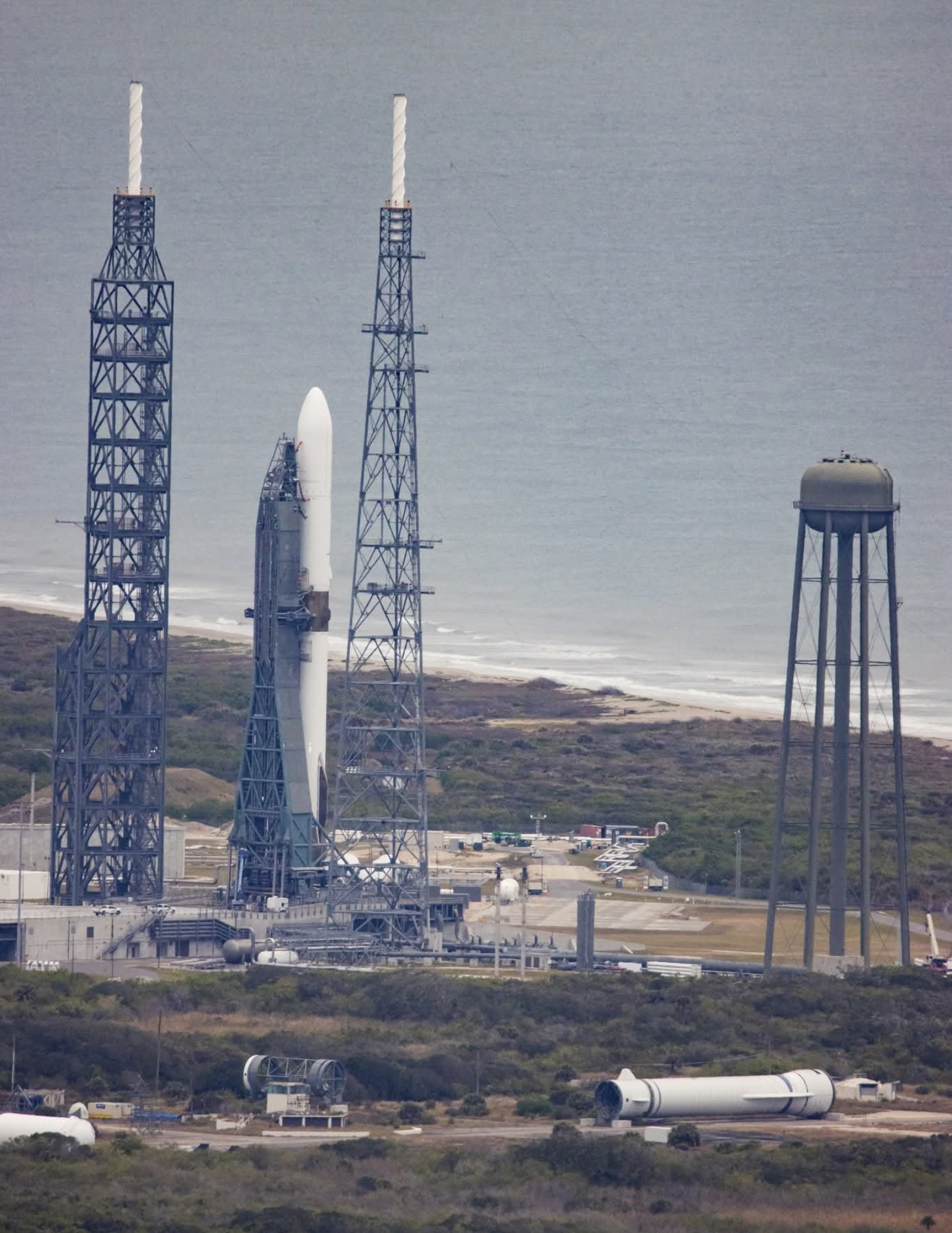
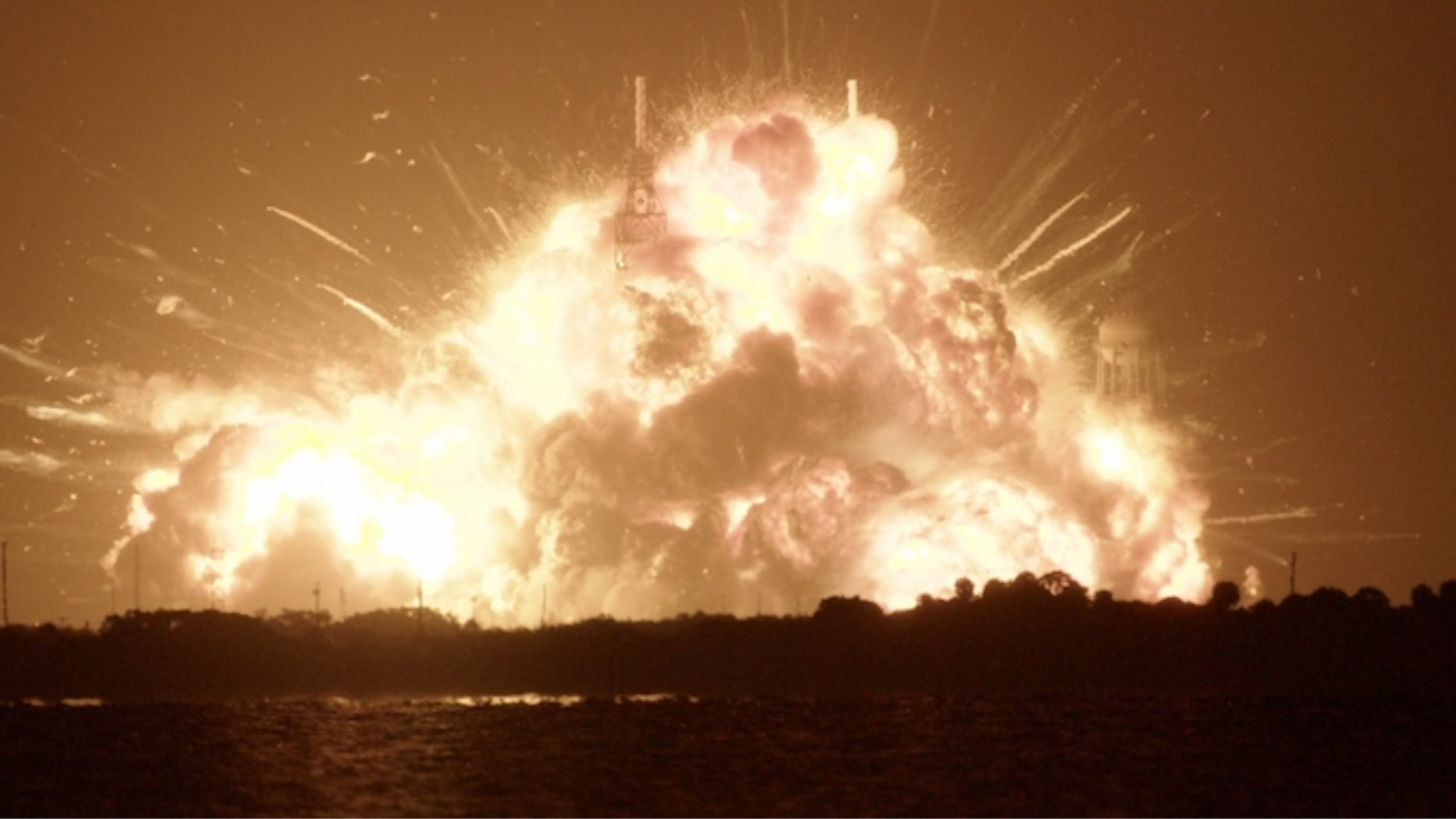
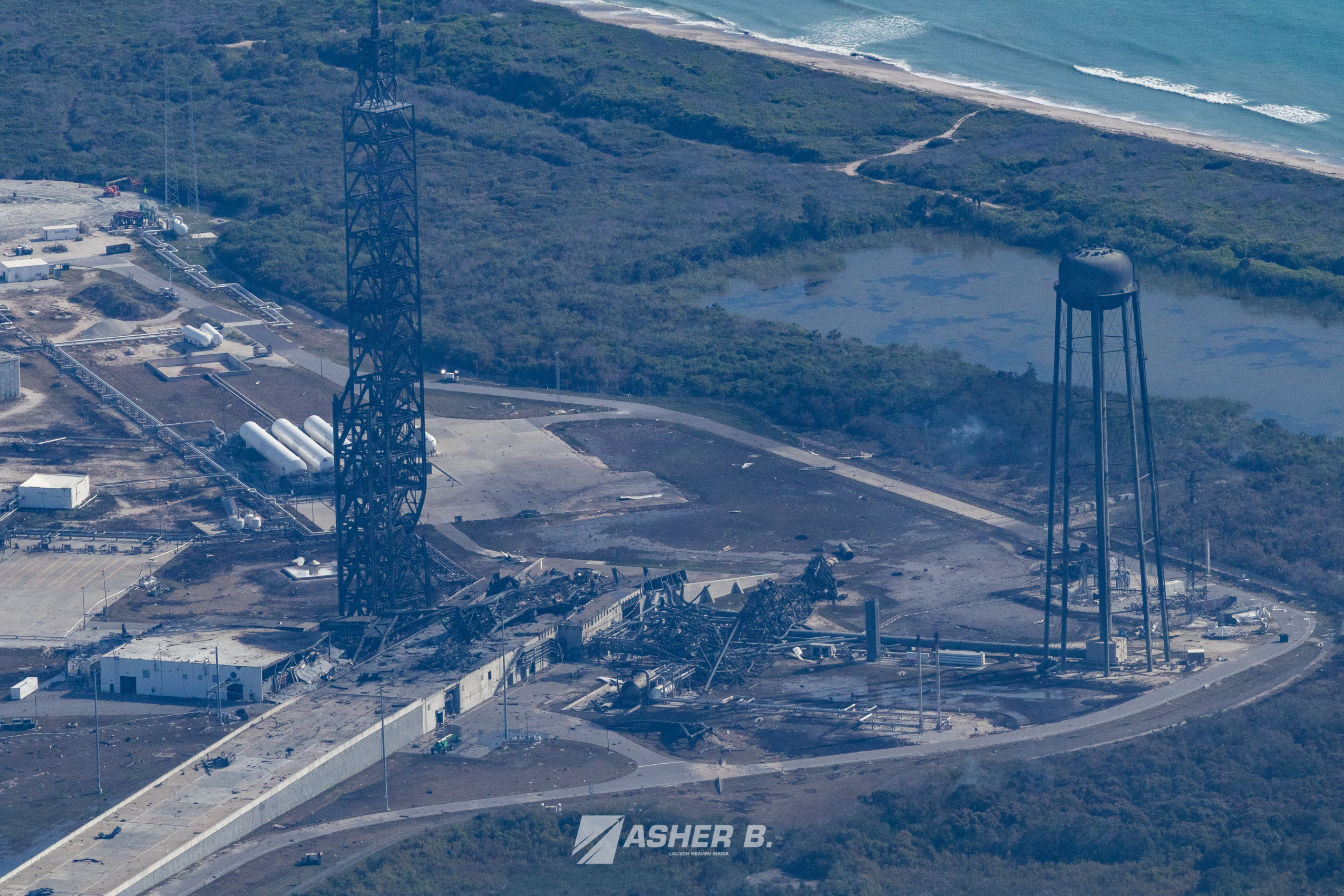
Before, During & After Images of New Glenn Launch Site (@asherbphotos, @LaunchHeavenX, & nasaspaceflight.com)
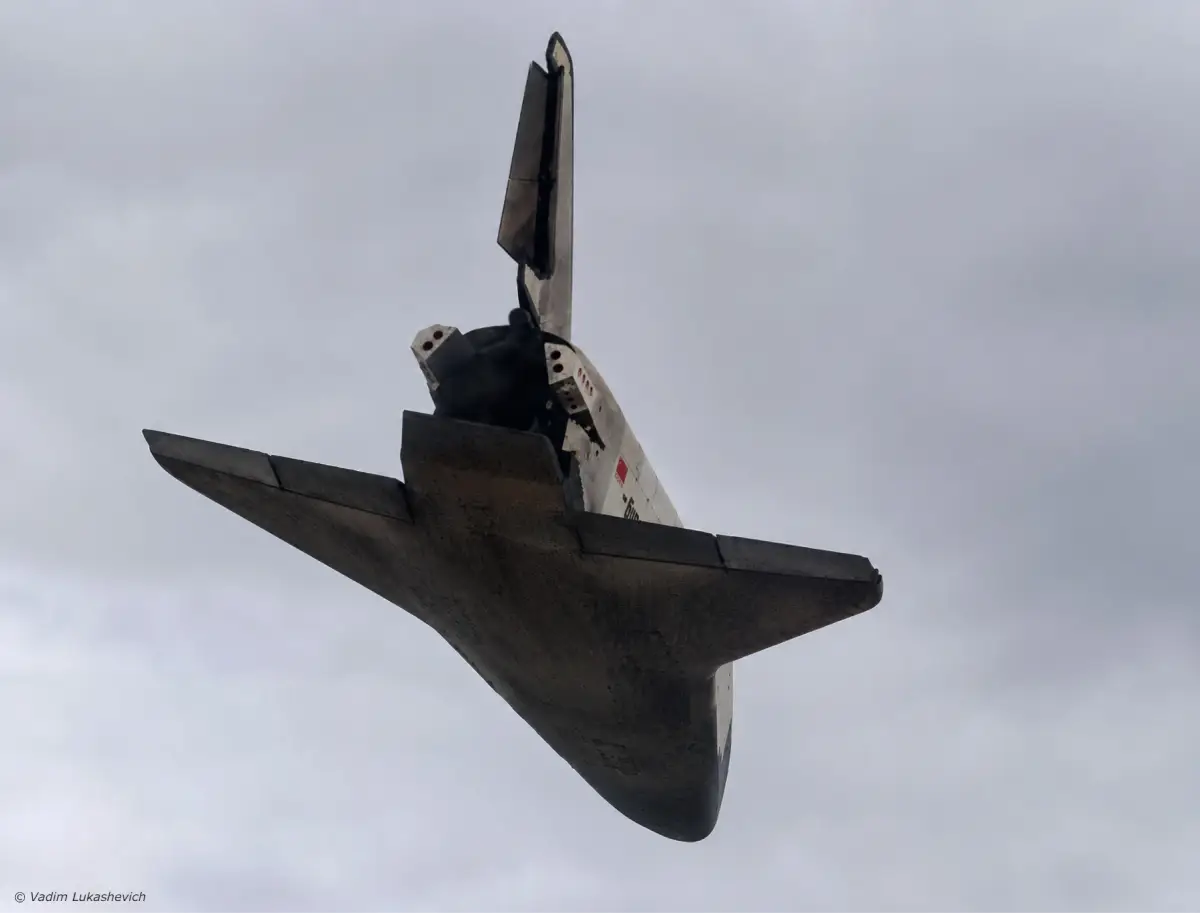
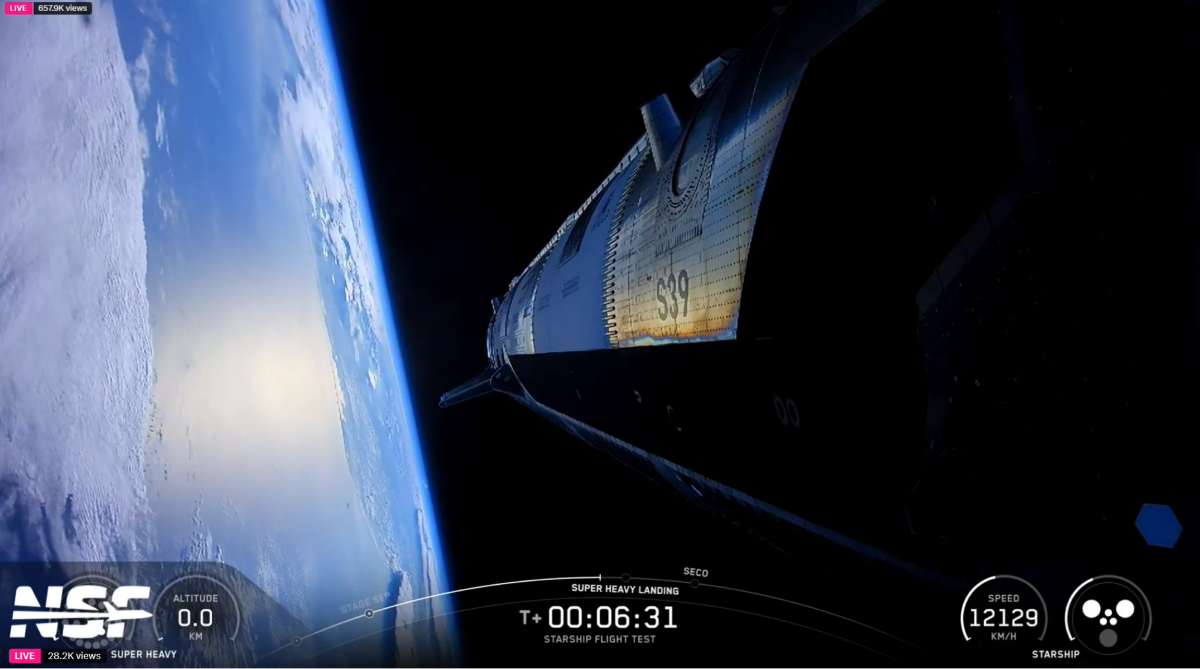
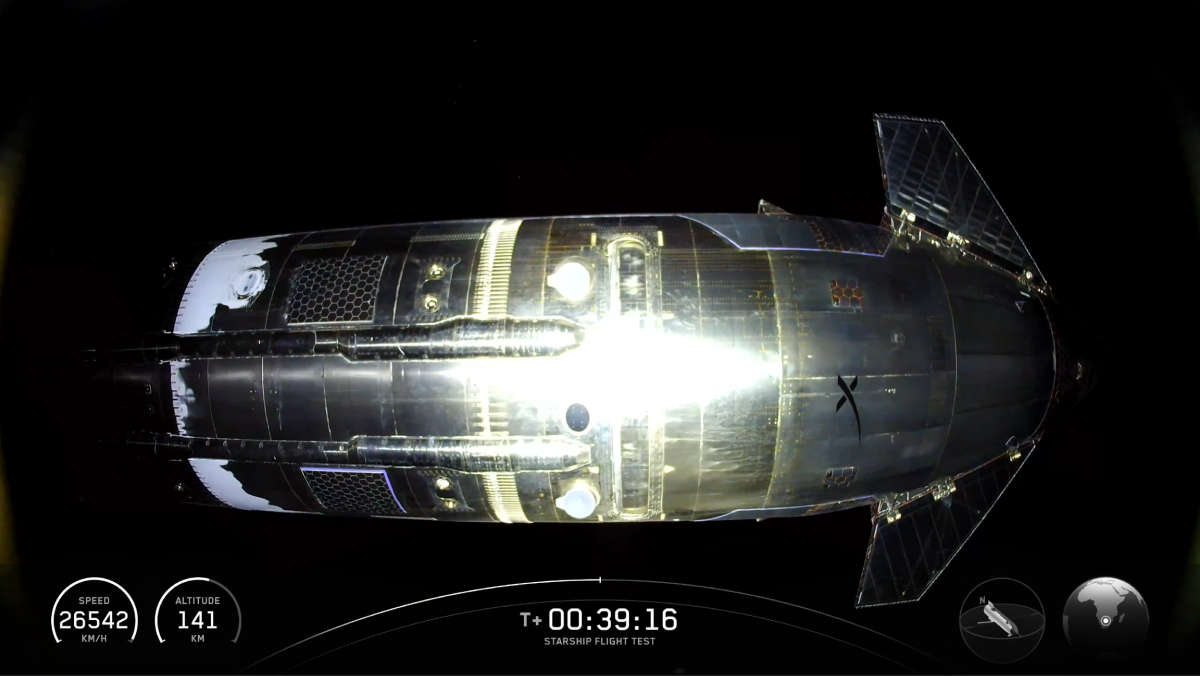
Starship In Space (nasaspaceflight.com & @SpaceX via X)