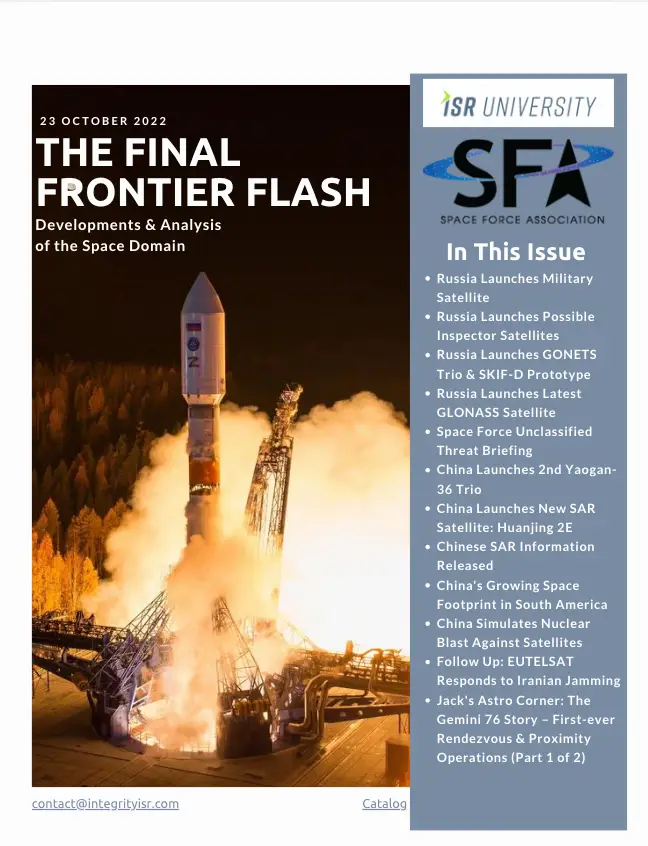
In this issue of Integrity Flash (Edition 59), space militarization and strategic moves intensify:
Russia launches a military satellite, possible inspector satellites, and a new GONETS trio with SKIF-D prototype.
GLONASS expansion continues with the latest Russian navigation satellite.
The U.S. Space Force issues an unclassified threat briefing highlighting emerging risks.
China deploys a second Yaogan-36 triplet and a new SAR satellite, Huanjing 2E.
Chinese SAR intelligence is released, furthering transparency-or disinformation.
China expands its space presence in South America, raising geopolitical concerns.
Simulated nuclear blasts by China underscore potential space warfare scenarios.
EUTELSAT responds to Iranian jamming in a developing interference case.
And Jack’s Astro Corner dives into The Gemini 76 Story-highlighting the first-ever RPO in orbit (Part 1 of 2).
In this issue of Integrity Flash (Edition 63), China’s space ambitions surge forward:
China launches Shiyan-20A & 20B, Shiyan-21, and Shiyan-10(02), bolstering its array of scientific and experimental payloads.
Yaogan-36 Group 4 Triplets continue China’s rapid expansion of remote sensing assets.
Jielong-3 SLV makes its debut, successfully deploying 14 satellites in one go.
China becomes the first nation to launch a Methalox SLV, showcasing next-gen propulsion.
A series of Gaofen launches, including GF-05 (01A) and GF-11, enhance Earth observation capabilities.
KZ-11 achieves a successful mission, while LM-6A debris count rises beyond 300-raising questions about space safety.
Tianxing-1 exhibits strange orbital behavior, stirring speculation.
On the geopolitical front, Maxar gains approval for non-Earth imaging services, and Nigeria and Rwanda join the Artemis Accords.
China continues to deepen space ties with the GCC, while the role of small satellites in modern warfare is explored.
Finally, Jack issues a reader challenge in his Astro Corner.
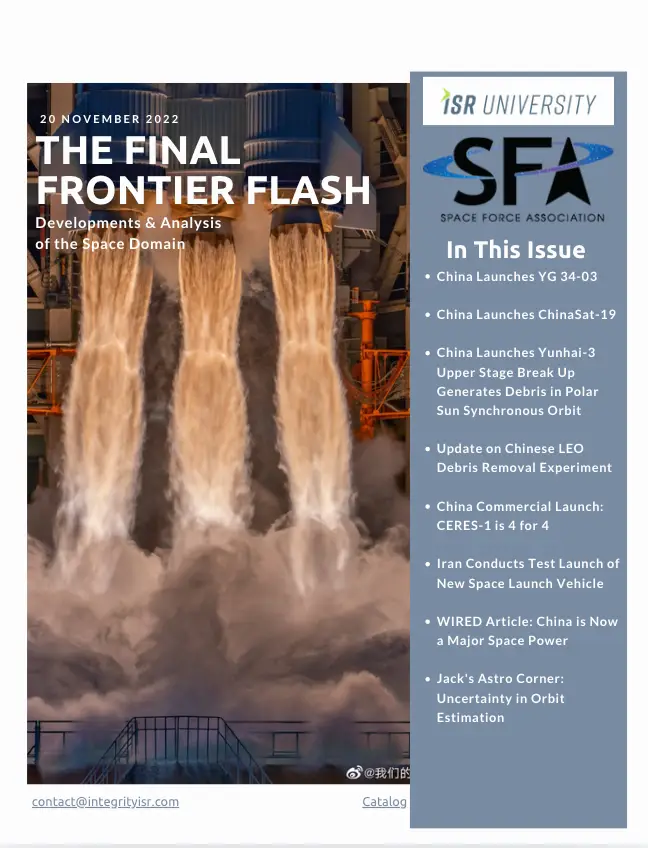
In this issue of Integrity Flash (Edition 61), satellite expansion and space debris threats intensify:
China launches YG 34-03 and ChinaSat-19, growing both military and civilian satellite fleets.
A Yunhai-3 upper stage breakup in polar orbit generates concerning debris, highlighting orbital sustainability risks.
China’s LEO debris removal experiment progresses, signaling a move toward active mitigation solutions.
China’s commercial launch provider CERES-1 achieves a 4-for-4 record, solidifying its reliability.
Iran conducts a test launch of a new space vehicle, suggesting regional competition heating up.
WIRED profiles China’s ascension as a major space power, underscoring geopolitical shifts.
Finally, Jack’s Astro Corner explores the challenge of Uncertainty in Orbit Estimation.
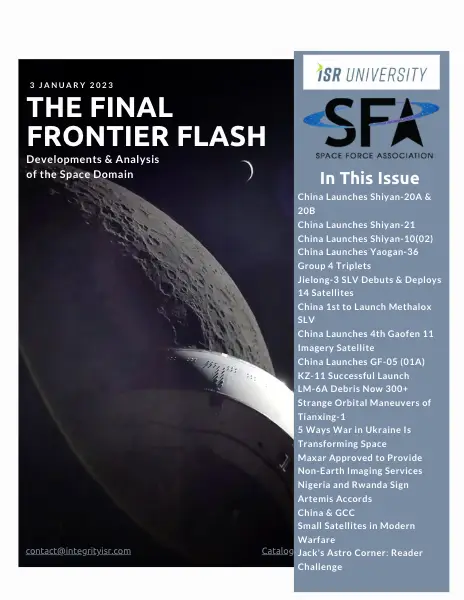
In this issue of Integrity Flash (Edition 62), global space developments accelerate:
China launches YG 36-03, continuing its constellation surge.
A deep-dive analysis, Evaluate, Decide, Commit, examines China’s rapid satellite deployment strategy.
China’s spaceplane enters a new phase in “Play Time!”-hinting at testing or experimental maneuvers.
“To the Moon & Beyond” outlines China’s long-term plans for lunar and deep space exploration.
The U.S. DoD releases its 2022 China Military Power Report, spotlighting space capabilities and threats.
Russia adds another GLONASS-M navigation satellite and a 6th LOTOS-S ELINT satellite to its fleet.
India launches an ocean research satellite and eight accompanying payloads in a show of multi-mission efficiency.
Finally, Jack returns with Astro Corner: Video Edition!
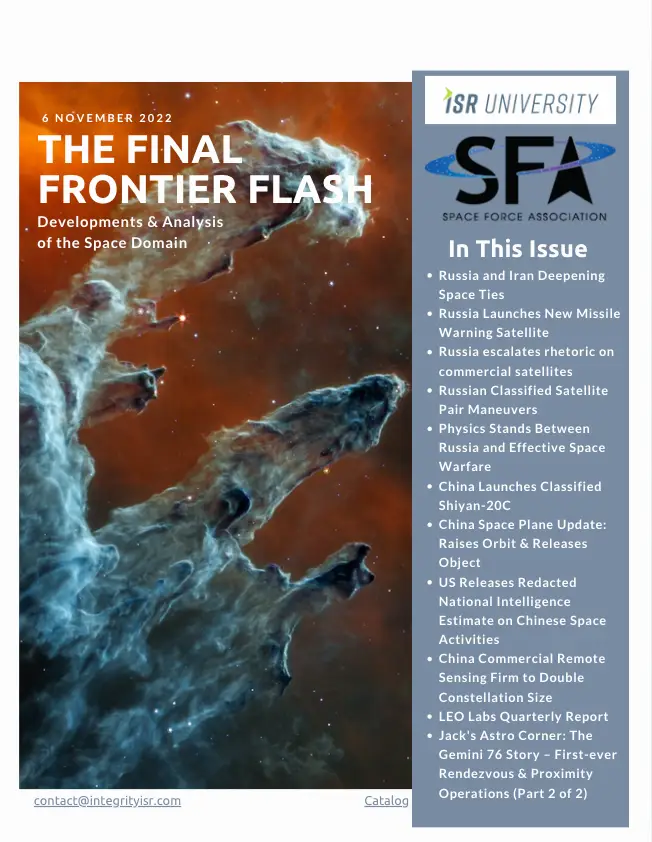
In this issue of Integrity Flash (Edition 63), China’s space ambitions surge forward:
China launches Shiyan-20A & 20B, Shiyan-21, and Shiyan-10(02), bolstering its array of scientific and experimental payloads.
Yaogan-36 Group 4 Triplets continue China’s rapid expansion of remote sensing assets.
Jielong-3 SLV makes its debut, successfully deploying 14 satellites in one go.
China becomes the first nation to launch a Methalox SLV, showcasing next-gen propulsion.
A series of Gaofen launches, including GF-05 (01A) and GF-11, enhance Earth observation capabilities.
KZ-11 achieves a successful mission, while LM-6A debris count rises beyond 300-raising questions about space safety.
Tianxing-1 exhibits strange orbital behavior, stirring speculation.
On the geopolitical front, Maxar gains approval for non-Earth imaging services, and Nigeria and Rwanda join the Artemis Accords.
China continues to deepen space ties with the GCC, while the role of small satellites in modern warfare is explored.
Finally, Jack issues a reader challenge in his Astro Corner.
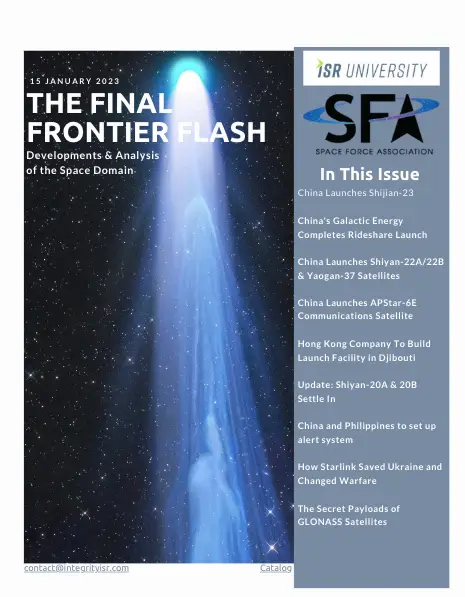
In this issue of Integrity Flash (Edition 64), China expands its satellite presence and international footprint:
China launches Shijian-23, continuing its pattern of experimental satellite missions.
Galactic Energy executes a successful rideshare launch, highlighting the rise of China’s commercial launch sector.
Shiyan-22A/22B and Yaogan-37 are placed into orbit, further reinforcing China’s surveillance and remote sensing constellations.
APStar-6E adds to China’s GEO communications capabilities.
A Hong Kong-based firm announces plans to build a launch facility in Djibouti, signaling China’s extended reach into Africa.
Shiyan-20A & 20B updates confirm the satellites have settled into orbit and are operational.
China and the Philippines pursue cooperation on an alert system, reflecting growing regional space diplomacy.
Meanwhile, Starlink’s influence in modern warfare takes center stage with Ukraine as a case study.
Finally, the secretive payloads onboard GLONASS satellites stir curiosity about Russia’s evolving space capabilities.
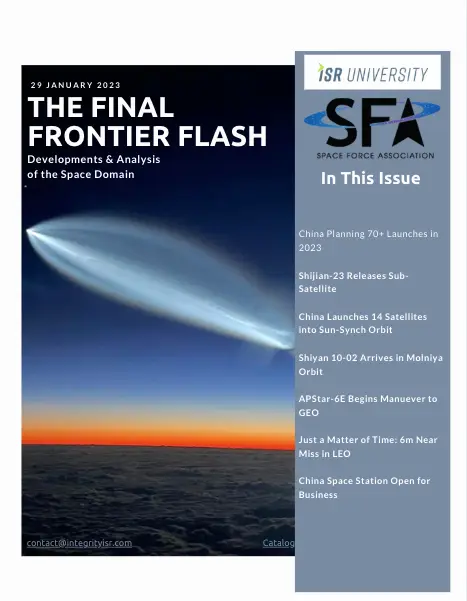
In this issue of Integrity Flash (Edition 65), China’s expanding launch ambitions and orbital activity take center stage:
China announces plans for over 70 launches in 2023, signaling an aggressive pace for its space program.
Shijian-23 releases a sub-satellite, contributing to speculation over its mission purpose and dual-use capabilities.
Fourteen Chinese satellites are deployed into sun-synchronous orbit in a single launch, boosting Earth observation capabilities.
Shiyan 10-02 reaches Molniya orbit, possibly indicating a specialized high-latitude surveillance role.
APStar-6E initiates maneuvering to GEO, underscoring China’s ongoing investment in global communications.
A close shave in LEO raises eyebrows: two objects pass within 6 meters, reminding the community of growing congestion and risk.
Meanwhile, China officially opens its space station for international business, inviting new partnerships-and new scrutiny.
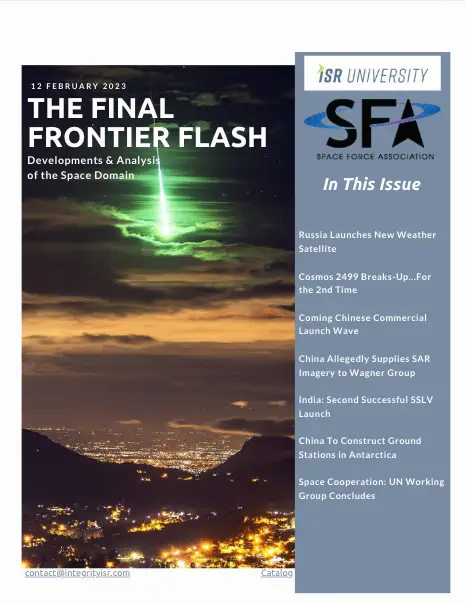
In this issue of Integrity Flash (Edition 66), international developments in weather monitoring, defense imagery, and global cooperation dominate the headlines:
Russia launches a new weather satellite, maintaining its capabilities in orbital meteorological data collection.
Cosmos 2499 suffers a second breakup, raising debris concerns and highlighting the challenges of satellite aging or design flaws.
China prepares for a wave of commercial launches, signaling a push to expand its private sector space activity.
Allegations surface that China supplied SAR imagery to the Wagner Group, fueling geopolitical tensions.
India achieves its second successful SSLV launch, solidifying its progress in small satellite delivery systems.
China announces plans to construct ground stations in Antarctica, expanding its global space infrastructure reach.
Meanwhile, the UN Working Group on Space Cooperation concludes its latest round of discussions, offering cautious optimism for multilateral alignment.
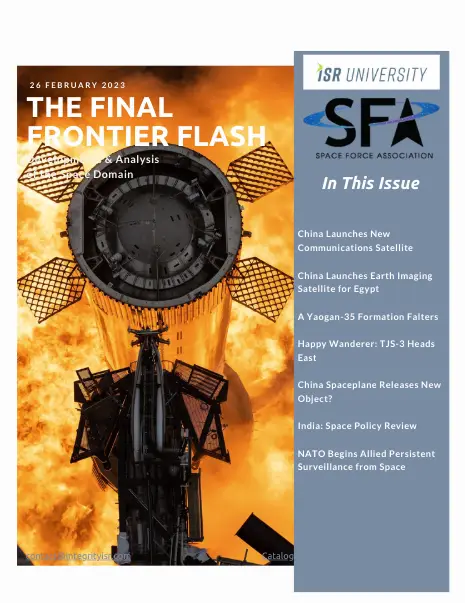
In this issue of Integrity Flash (Edition 67), global surveillance and satellite maneuvers drive headlines:
China launches a new communications satellite and an Earth imaging satellite for Egypt, strengthening bilateral space ties.
One of the Yaogan-35 formations falters, raising questions about orbital stability or mission setbacks.
TJS-3, nicknamed the “Happy Wanderer,” makes a notable eastward maneuver.
Uncertainty surrounds the Chinese spaceplane as it appears to release a new object into orbit.
India reviews its national space policy, outlining future goals and potential reforms.
Meanwhile, NATO initiates Allied Persistent Surveillance from space, marking a major step in multilateral orbital intelligence efforts.

You must be logged in to post a comment.