
Author: lostartistry
Issue 130
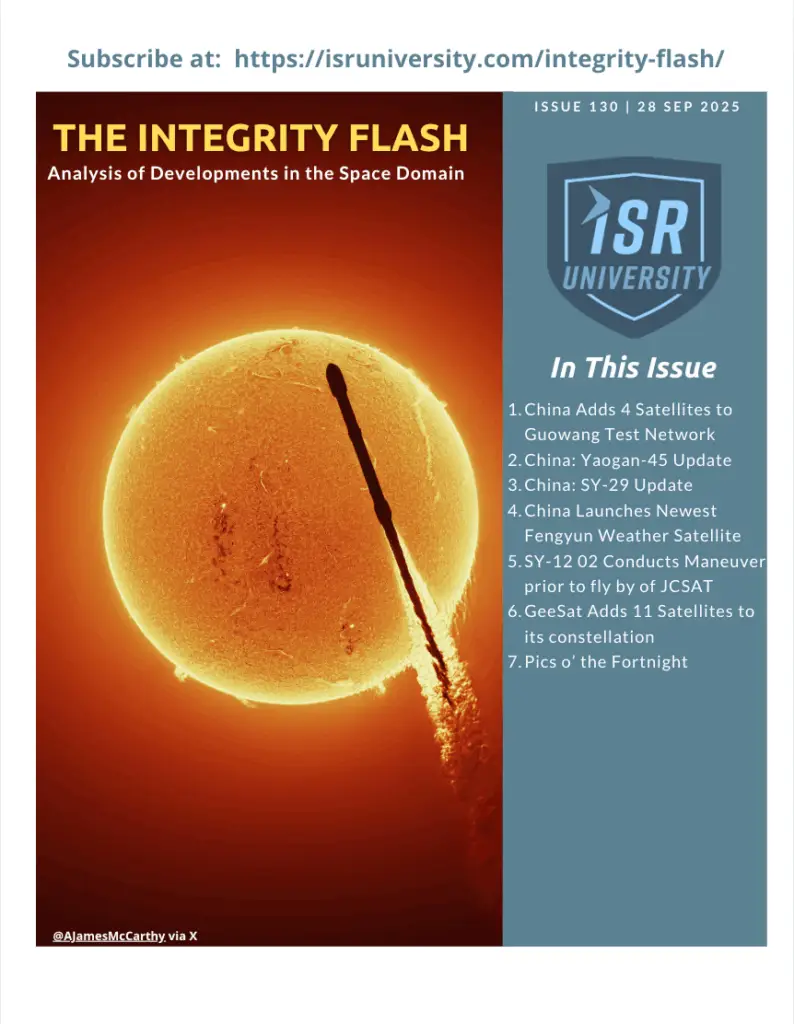
In this issue of Integrity Flash (Edition 129), China and its orbital allies continue pushing boundaries across weather, communications, and strategic positioning:
• China adds 4 satellites to its Guowang Test Network, advancing its planned broadband megaconstellation.
• Yaogan-45 receives an update, providing further clarity on this classified remote sensing satellite’s role and orbital behavior.
• A new update on SY-29 indicates shifts in its mission profile and positioning within GEO.
• China launches a new Fengyun weather satellite, reinforcing its Earth observation infrastructure and global meteorological coverage.
• SY-12 02 executes a maneuver ahead of a flyby near commercial satellite JCSAT, raising questions about intentions and tracking capabilities.
• GeeSat boosts its constellation with 11 additional satellites, solidifying its commercial presence in orbit.
• And of course, don’t miss this edition’s “Pics o’ the Fortnight”, capturing the latest movement and maneuvers from orbit.
Issue 129
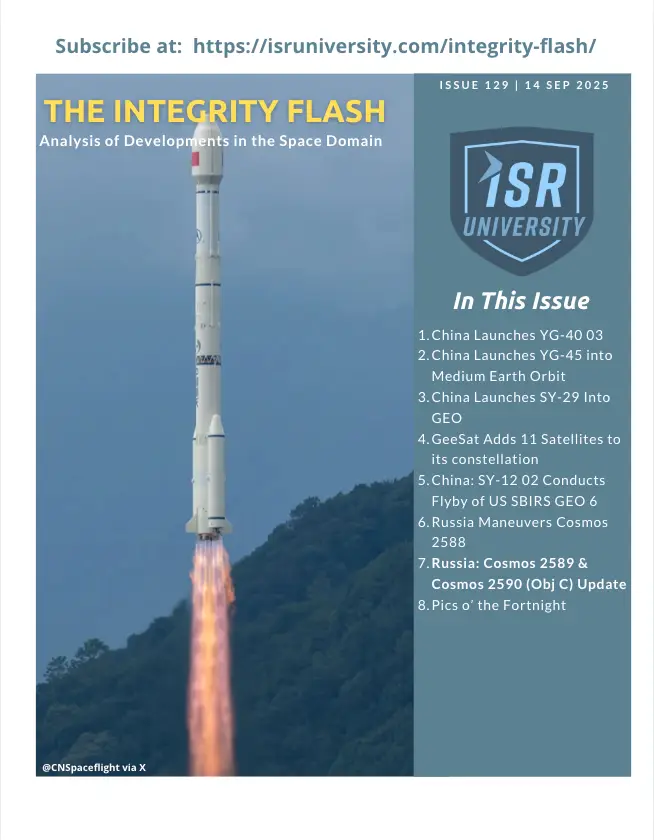
In this issue of Integrity Flash (Edition 129), maneuvering satellites and Chinese launch momentum continue to shape the orbital narrative:
China’s satellites SJ-21/SJ-25 conduct a coordinated plane change maneuver, showcasing impressive orbital agility.
A deeper dive into the fuel math behind these movements is featured in “Doing the Math,” estimating the complex requirements for SJ-21/25 maneuvering.
China maintains launch tempo with 2 new Guowang deployments, adding 19 satellites to the expanding constellation.
SatNet ambitions enter the spotlight in “Higher Level Support?”, exploring China’s growing GEO infrastructure.
GEESAT adds another 11 satellites, intensifying its presence in orbit.
Russia resurfaces with a detailed Cosmos 2589 and Object C update, keeping tabs on proximity dynamics.
In Jack’s Astro Corner, rendezvous operations get technical with XSS-11 and its daring proximity ops—Part 3 of 3 in this RPO deep dive.
And of course, Pics o’ the Fortnight rounds it out with visuals from across LEO, MEO, and GEO.
issue 128
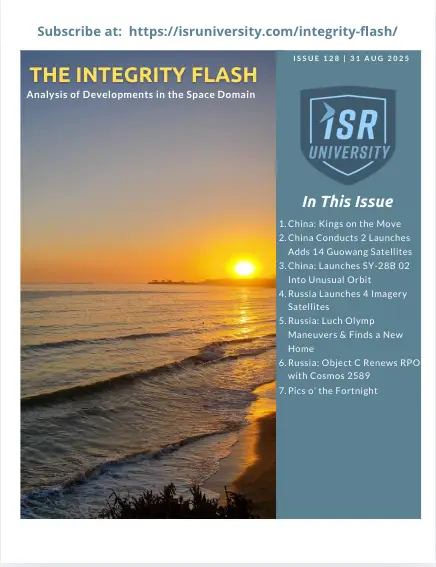
In this issue of Integrity Flash (Edition 128), satellite dynamics and international maneuvers take the spotlight:
China’s “Kings on the Move” initiative captures attention with a notable step in strategic mobility.
Two Chinese launches boost the Guowang satellite network by 14, expanding national coverage.
China’s SY-28B 02 enters an unusual orbit, raising curiosity among analysts.
Russia adds 4 new imagery satellites, sharpening its Earth observation capabilities.
Luch Olymp repositions to a new orbital slot, extending its influence.
Cosmos 2589 welcomes back Object C, renewing RPO activity.
“Pics o’ the Fortnight” wraps the issue with curated visual highlights.
issue 56
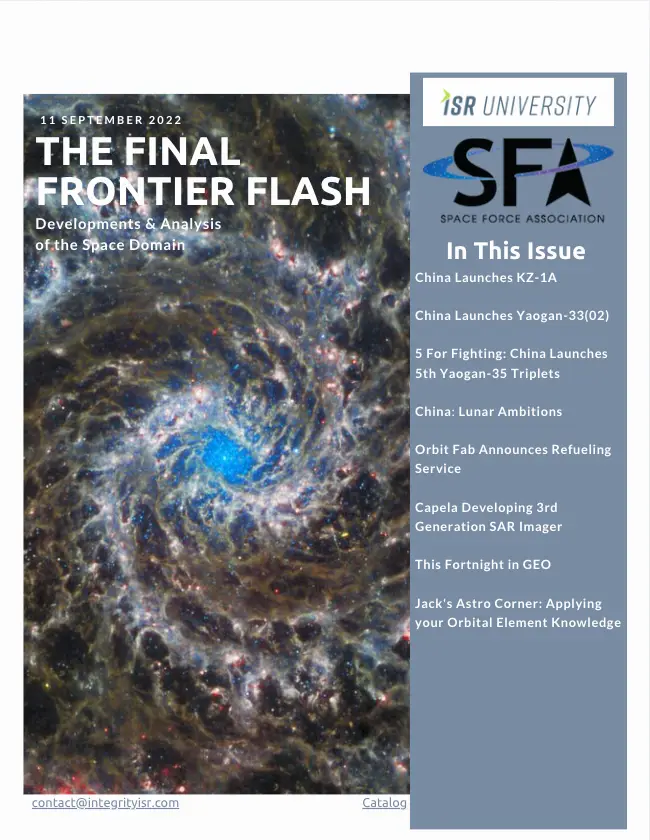
In this issue of Integrity Flash (Edition 56), space ambitions and orbital logistics take center stage:
China launches KZ-1A and Yaogan-33(02), continuing its satellite expansion.
In “5 For Fighting,” China deploys its 5th Yaogan-35 triplet, amplifying reconnaissance capabilities.
Beijing’s lunar ambitions resurface, spotlighting long-term Moon strategy.
Orbit Fab announces a new space refueling service, marking progress in orbital sustainability.
Capela reveals its 3rd generation SAR imager under development.
“This Fortnight in GEO” delivers geostationary updates.
Jack’s Astro Corner walks readers through applying orbital element knowledge like a pro.
issue 127
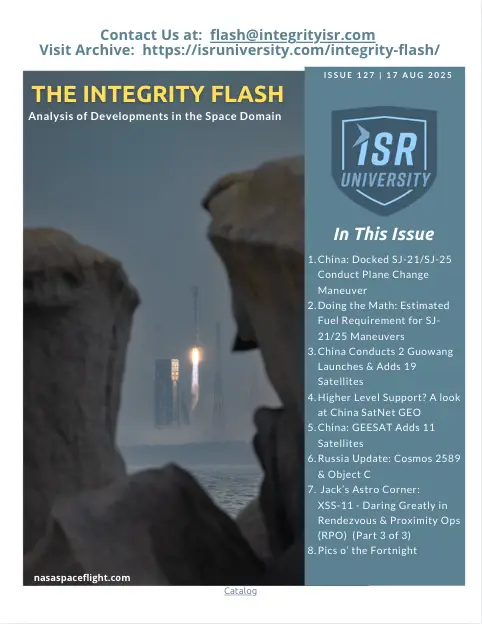
In this issue of Integrity Flash (Edition 127), satellite maneuvering and international space activity dominate the spotlight:
China’s docked SJ-21 and SJ-25 satellites perform a coordinated plane change maneuver, showcasing growing orbital precision.
In a follow-up, fuel requirements for these complex maneuvers are crunched in “Doing the Math,” shedding light on mission planning.
China conducts two major Guowang launches, boosting its broadband constellation with 19 new satellites.
A deeper look at China SatNet’s GEO assets suggests potential for higher-tier global coverage.
Elsewhere, China’s GEESAT constellation adds 11 more satellites to its expanding commercial fleet.
Russia resurfaces with Cosmos 2589 and mysterious Object C, adding intrigue to orbital tracking.
Jack’s Astro Corner concludes its XSS-11 series with a daring deep dive into rendezvous and proximity ops.
And finally, “Pics o’ the Fortnight” captures the celestial moments you don’t want to miss.
issue 56
In this issue of Integrity Flash (Edition 56), space ambitions and orbital logistics take center stage:
China launches KZ-1A and Yaogan-33(02), continuing its satellite expansion.
In “5 For Fighting,” China deploys its 5th Yaogan-35 triplet, amplifying reconnaissance capabilities.
Beijing’s lunar ambitions resurface, spotlighting long-term Moon strategy.
Orbit Fab announces a new space refueling service, marking progress in orbital sustainability.
Capela reveals its 3rd generation SAR imager under development.
“This Fortnight in GEO” delivers geostationary updates.
Jack’s Astro Corner walks readers through applying orbital element knowledge like a pro.
issue 57
In this issue of Integrity Flash (Edition 57), international space policies and partnerships come into focus:
The UN pushes efforts to curb anti-satellite missile tests amid rising orbital tensions.
A Russian official stirs controversy by labeling civilian satellites as potential “legitimate” military targets.
China adds a new military communications satellite to orbit, and launches the Yunhai-1-3 Earth observation satellite.
The UAE partners with China on a lunar rover mission, deepening interplanetary collaboration.
Maxar introduces a new space-monitoring service, enhancing orbital awareness.
“This Fortnight in GEO” captures key geostationary developments.
Jack’s Astro Corner gets tactical with “Launch Windows” – when to GO, and how to go the right way.
issue 58
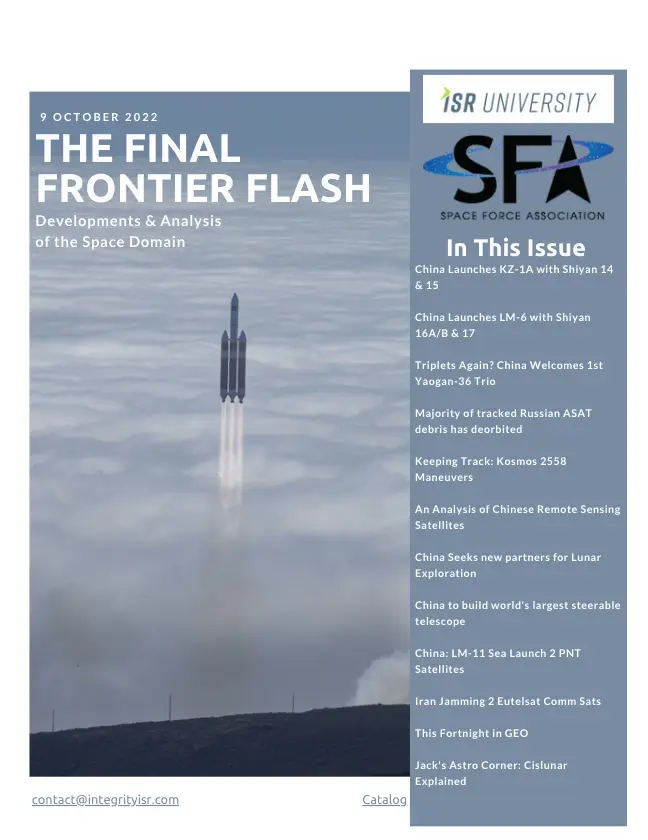
In this issue of Integrity Flash (Edition 58), China dominates launch headlines and space strategy:
China launches KZ-1A with Shiyan 14 & 15, followed by an LM-6 launch carrying Shiyan 16A/B & 17.
A new Yaogan-36 triplet raises questions on China’s constellation expansion.
Tracked Russian ASAT debris mostly deorbits, reducing immediate collision threats.
Kosmos 2558 continues its curious maneuvers, keeping analysts alert.
An analysis of Chinese remote sensing satellites sheds light on strategic capabilities.
China seeks new partners for its lunar exploration ambitions and plans to build the world’s largest steerable telescope.
Sea-based LM-11 launch places two PNT satellites into orbit.
Iran continues comms interference, jamming two Eutelsat satellites.
“This Fortnight in GEO” reviews key geostationary developments.
And in Jack’s Astro Corner, cislunar space finally gets a clear, entertaining explanation.
You must be logged in to post a comment.