ISSUE 138 | 9 FEB 2026

The integrity flash

Analysis of Developments in the Space Domain

in this issue

Welcome Wagon: USA 325 Greets SJ-29A/BinGEO

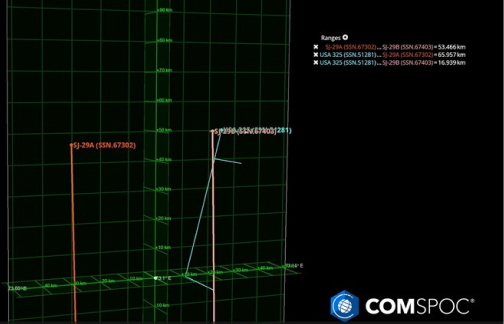
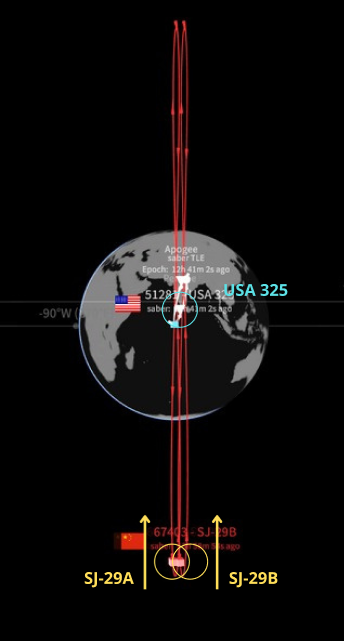
29 Jan 2026: As noted in the 18 Jan 2026 edition of the Flash, China launched Shijian-29A and Shijian-29B satellites (67302 & 67303) to GEO on 30 Dec 2025. We also noted that the SJ-29 pair settled into GEO at 73.0°E longitude with an inclination of 3.1°. What we didn’t know at the time of publishing was that USA 325 (51281), one of the United States’ Geosynchronous Space Situational Awareness Program (GSSAP) satellites, was busy getting into position to characterize the SJ-29 pair. Currently the two SJ-29 satellites are maintaining a separation of Thanks to the 30-70km of one another and occasionally within 100km of USA 325. COMSPOC_OPS team for their insights! Please check out this video! – SJ-29A and 29B remain in a co-planar orbit with an inclination of 3.1° and a RAAN of 98.67°. 

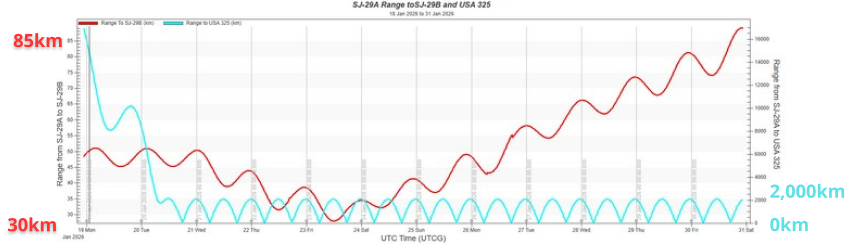
USA 325 is not co- planar and has an inclination of 0.3° and a RAAN of 86.14°. -SJ-29A does not appear to have maneuvered since arrival on orbit. SJ-29B has made minor maneuvers. As a result the two satellites remain within 70km of one another. SJ- 29A is to the west of SJ-29B. -USA 325 remains within 2,000km of both satellites. The difference in inclination is the principal contributor to this separation. -At the point of closest approach USA 325 is <30km of SJ- 29A and B.

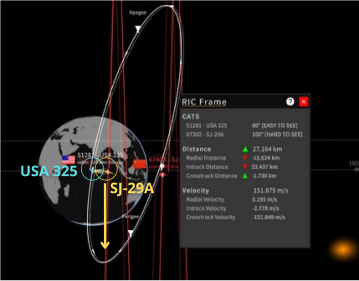
  • As the SJ-29A/B pair move from north to south in their orbit USA 325 is closest to SJ-29A. SJ-29A is <100km Lighting conditions were marginal for both satellites to image one another at point of closest approach. (see graphic)
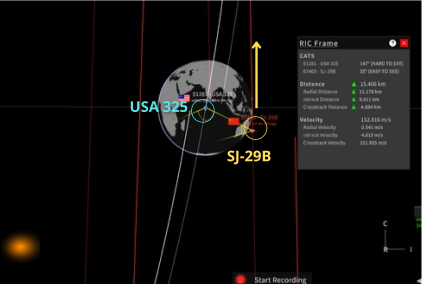
  • As the SJ-29A/B pair orbit from south to north USA 325 is closest with SJ-29B. SJ-29B is <100km from USA 325 for ~22min. Lighting conditions were favorable for USA 325 to image SJ-29B at the point of closest approach. (see graphic)

– Based on their on-orbit operations it appears China is conducting some sort of on-orbit testing between SJ-29A and B…it also appears that USA 325 has positioned itself to observe/characterize both satellites for 45min/day withTransiting to the North, SJ-29B will be varying lighting conditions.

SJ-29A & 29B Make the Turn at the Southern Most Point of their 3.1° Inclined Orbit. USA 325 Awaits to the North in its 0.3° inclined orbit. When closest to USA 325 (saberastro.com)

Graph Showing Distance between SJ-29A & B (Red Line & Scale on Left) & Distance Between SJ-29A to USA 325 (Blue line & Scale on Right) (COMSPOC_OPS)

USA 325 Greets SJ-29A/B in GEO Continued

As SJ-29A/B Transit South SJ-29A has a Close Approach (~27km) with USA 325 with Marginal Lighting Conditions for both Satellites (sbms.saberastro.com)

As SJ-29A/B Transit North SJ-29B has a Close Approach (~16km) with USA 325 with Favorable Lighting Conditions for USA 325 to Image SJ-29B (sbms.saberastro.com)

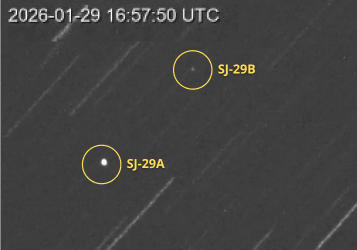
SJ-29B (Pink) & USA 325 (Blue) Point of Closest Approach (17km) while SJ-29A (Orange) Orbits to the West. Watch Video. (@COMSPOC_OPS via X)

Chinese GEO Refueling Update

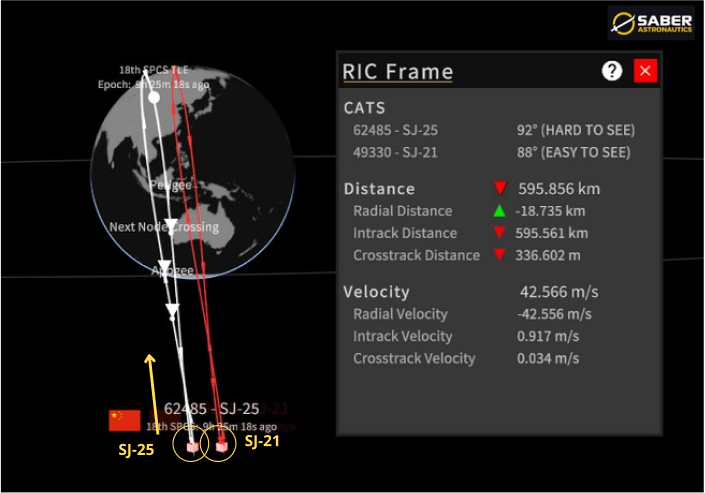
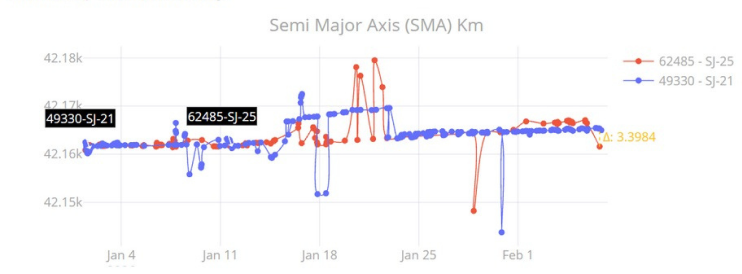
6 Feb 2026: As we noted in the previous flash, SJ-21 (49330) and SJ-25 (62485) exited RPO conditions in mid-January. They are now approximately 600km apart with SJ-21 located to the east of SJ-25. Both satellites have conducted minor “in-track” maneuvers (changes to their SMA) to create the separation. Of note, the two remain co-planar with a radial-track separation of <20km and a cross-track separation of only 300m. A reminder that in-track maneuvers are by far the least expensive in terms of energy (fuel). Should Chine desire to do so they could quickly and cheaply return to RPO conditions between these two satellites.

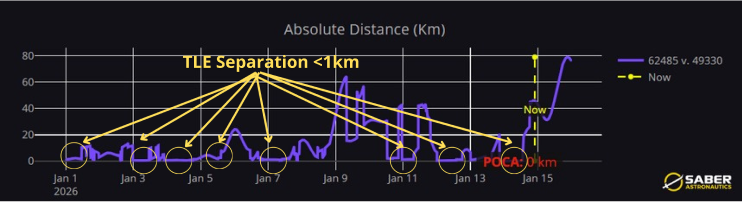
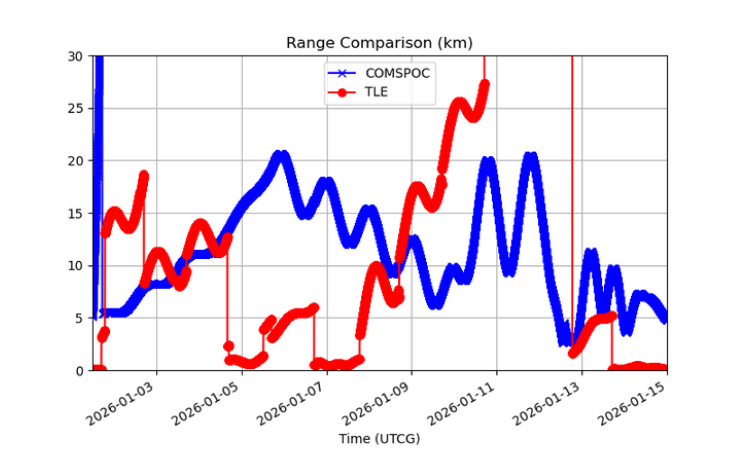
Previously, I pointed out that according to publicly available TLE data, it appeared SJ-21 and SJ-  25 conducted 7-8 extremely close (<1km) Rendezvous Proximity Operations (RPO) with one another between 1-15 January 2026.  As a reminder, TLE data is an average of multiple observations and works great when objects have adequate separation (let’s say >10km). However, once objects near one another the chances for cross-tagging and other errors grows. So, to get a more accurate understanding requires carful analysis of sensor ephemeris data. With this in mind I asked the COMSPOC OPS team to have a look with their sensor data (and to do the painstaking orbital analysis.) Their results differed from the TLE-based analysis. Based on this analysis, COMSPOC found a minimum range of approximately 2.83 km was reached on 13 Jan 2026 and the satellites were often within 5km of one another but did not perform “Zero Prox Ops” as the TLE data suggested. COMSPOC was even nice enough to create a video to show the differences between their ephemeris based analysis and that based on TLE information.

SJ-21 & SJ-25 Visualization 6 Feb 2026 (saberastro.com)

Chinese GEO Refueling Update continued

4 Jan - 6 Feb SMA Comparison (sbms.saberastro.com)

TLE Based SJ-21 & SJ-25 Proximity 1-15 January 2026 (saberastro.com)

COMSPOC vs TLE Comparison (COMSPOC_OPS)

China Launches Guowang Group 19

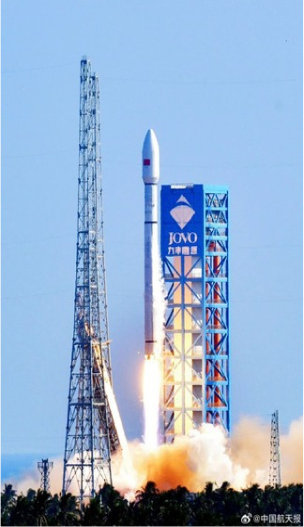
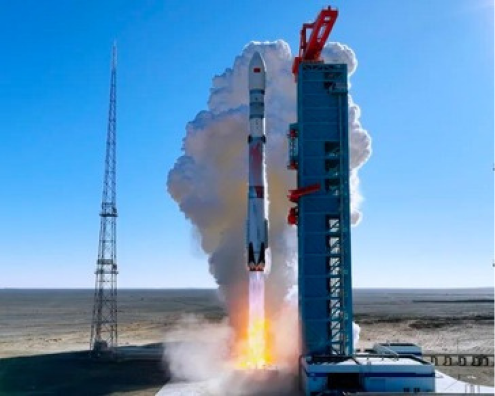
19 Jan 2026: China launched a Long March-12 with Group 19 of the Guowang (SatNet LEO) constellation from Hainan Island (Wenchang). The launch carried 9 satellites (67522-67530) into their 50.0° inclined orbit. Launch Video.

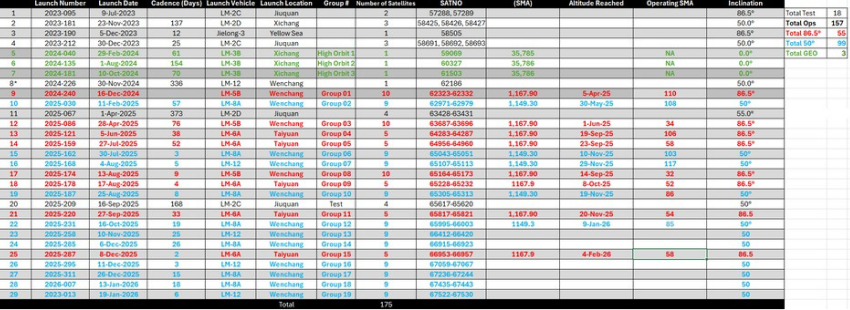
– With Group 19 there are now 154 satellites in the operational LEO Guowang constellation (see graphics & tables). Additionally, there are 3 Guowang satellites in GEO and China has launched 18 Guowang test satellites.

– China is building out the Guowang constellation with orbits inclined either 50.0° or 86.5°. Currently there are 99 satellites in 11x 50.0° orbital planes (9 satellites/plane) and 55 satellites in 6x 86.5° orbital planes (10 satellites/plane with one exception). See Table. Launch Summary + number of days to target SMA…1,167.9km for 86.5° or 1,149.3km for 50.0°

  • Group 1 (16 Dec 2024): 10 sats on LM-5B. 86.5° inclination (110 days)
  • Group 2 (11 Feb 2025): 9 sats on LM-8A. 50.0° inclination (77 days)
  • Group 3 (28 Apr 2025): 10 sats on LM-5B. 86.5° inclination (34 days)
  • Group 4 (5 Jun 2025): 5 sats on LM-6A. 86.5° inclination (with Gp 9) (106 days)
  • Group 5 (27 Jul 2025): 5 sats on LM-6A. 86.5° inclination (with Gp 15) (58 days)
  • Group 6 (30 Jul 2025): 9 sats on LM-8A. 50.0° inclination (103 days)
  • Group 7 (4 Aug 2025): 9 sats on LM-12. 50.0° inclination. (117 days)
  • Group 8 (13 Aug 2025): 10 sats on LM-5B. 86.5° inclination (32 days)
  • Group 9 (17 Aug 2025): 5 sats on LM-6A. 86.5° inclination (with Gp 4) (52 days)
  • Group 10 (25 Aug 2025): 9 sats on LM-8A. 50.0° inclination. (86 days)
  • Group 11 (27 Sep 2025): 5 sats on LM-6A. 86.5° inclination. (54 days)
  • Group 12 (16 Oct 2025): 9 sats on a LM-8A. 50.0° inclination (85 days)
  • Group 13 (10 Nov 2025): 9 sats on a LM-12. 50.0° inclination (TBD)
  • Group 14 (6 Dec 2025): 9 sats on a LM-8A. 50.0° inclination. (TBD)
  • Group 15 (8 Dec 2025): 5 sats on a LM-6A. 86.5° inclination (with Gp 5) (58 days)
  • Group 16 (11 Dec 2025): 9 sats on a LM-12. 50.0° inclination. (TBD)
  • Group 17 (25 Dec 2025): 9 sats on LM-8A. 50.0° inclination. (TBD)
  • Group 18 (13 Jan 2026): 9 sats on LM-8A. 50.0° inclination (TBD)
  • Group 19 (19 Jan 2026): 9 sats on LM-12. 50.0° inclination (TBD)

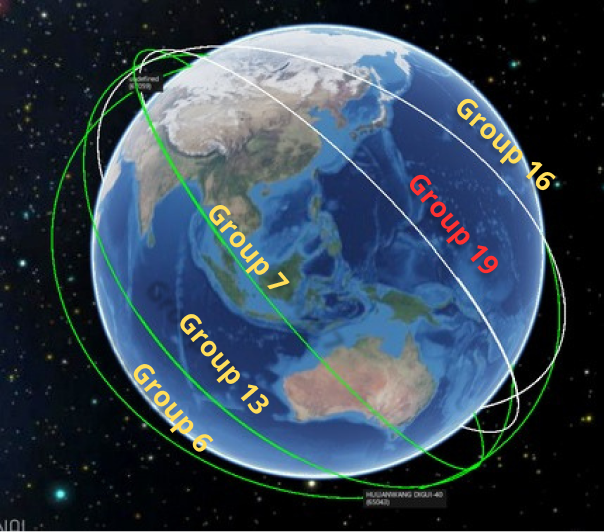
Group 19 and Adjacent Groups in their 50.0° Inclined Planes (spaceaware.io)

LM-12 Launch Carrying 9x Guowang Satellites (nasaspaceflight.com)

Guowang Continued

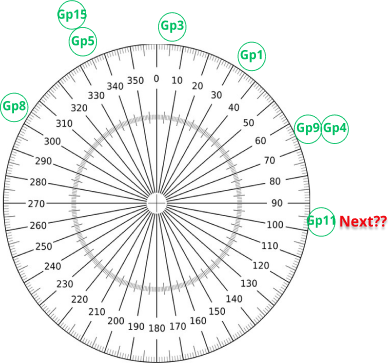
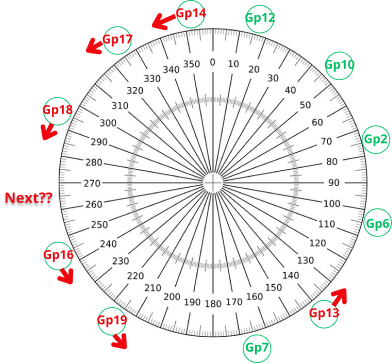
6x 86.5° Inclined Planes 10x Satellites / Plane (Gp 11 only 5 sats) 30° Offset for Satellites at Operational SMA (spaceaware.io & saberastro.com)

11x 50° Inclined Planes 9 Satellites / Plane 30° Offset for Satellites at Operational SMA Red Groups Not at Final SMA (spaceaware.io & saberastro.com)

Guowang Launch Summary: 18 Test and 154 Operational LEO & 3 GEO 29 Total Launches: 7 Test; 19 Operational LEO; & 3 GEO (spaceaware.io & celestrak.org)

Guowang Family Analysis by LeoLabs (as of 23 Jan 26)

By Dr Darren McKnight, LEO Labs Senior Technical Fellow

Dr McKnight at LEO Labs has been doing some comparative analysis of Radar Cross Section (RCS) values across the growing family of Guowang satellites. Below is his report which concludes that China is launching slightly larger satellites into their 86.5° inclined orbits when compared with the satellites heading into their 50.0° inclined orbits. Thank you Dr McKnight!

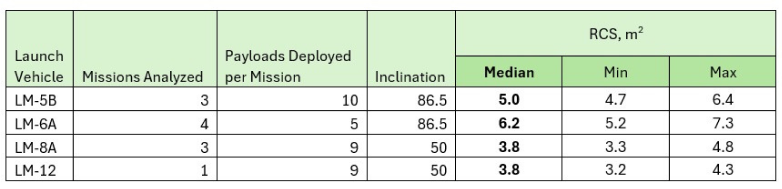
China in Space reported on January 14, 2026, the Guowang satellites launched by the Long March (LM) 5B are larger than the satellites launched by the LM-12 or LM-6A. It was interesting that they did not mention Long March 8A even though there have been more Guowang launches using a LM-8A than any other variant (i.e., seven by LM-8A, six by LM-6A, four by LM-12, and three by LM-5B). An examination of the first 11 of the 19 batches of Guowang satellites does indeed show a differentiation in size of spacecraft but it does not exactly align with public statements. The table below summarizes radar cross-section (RCS) values for 86 of the on-orbit Guowang spacecraft during 2025. This RCS data is an aggregation of over 30,000 RCS measurements taken by LeoLabs.

Consistent with the public statement, spacecraft deployed by the LM-5B appear to be consistently larger (by about 30%) than the spacecraft deployed by the LM-12. There is also strong correlation between objects launched by LM-8A missions with those deployed by LM-12. However, the spacecraft deployed by LM-6A appear to be similar in size to the ones launched by the LM-5B. The difference is not large enough to be statistically significant, especially since the ranges (i.e., minimum to maximum) of RCS values have significant overlap between LM-5B and LM-6A missions.

In examining the table above, the stronger correlative factor does not appear to be the launch vehicle used but rather the inclination of the batch deployed; the payloads populating the 86.5° inclination planes are generally larger than the ones going to a 50.0° inclination.

While there has been speculation that Guowang has three vendors manufacturing Guowang satellites, if that is indeed the case, it makes sense that there might be two of the “high inclination” systems, however, we have only moderate in confidence in assessing two different types of satellites being launched into the planes with an inclination of 86.5°.

We have high confidence that the lower inclination deployments are currently using slightly smaller spacecraft than for the higher inclination planes and that LM-8A and LM-12 missions are deploying the same spacecraft.

SY-32 02 and SY-32 03 Close Approach

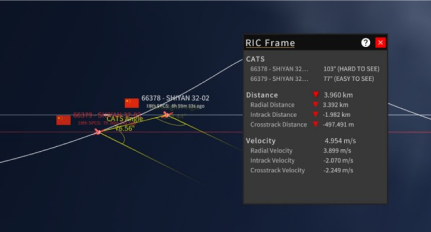
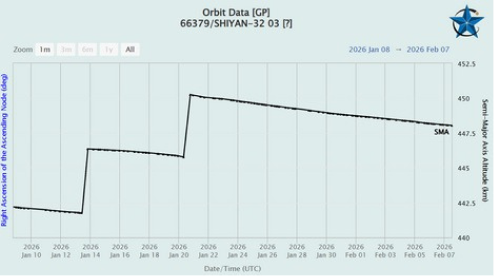
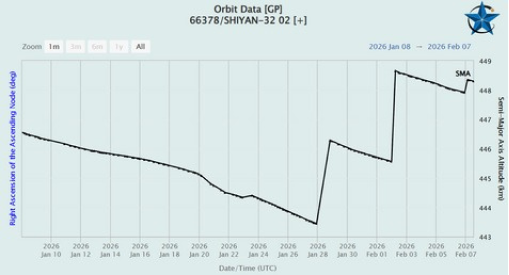
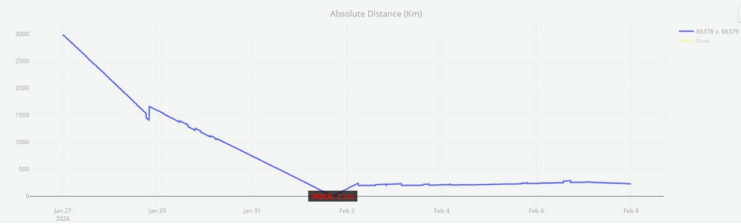
7 Feb 2026: China appears tohave conducted a closeapproach between Shiyan-32 02 (66378) and Shiyan-32 03 (66379). From 13-20 Jan, Chinese space operators conducted 3 in-track maneuvers and increased SY-32 03’s SMA 8.5km to 450.1km. About a week later, from 28 Jan – 7 Feb, Chinese space operators conducted 3 in-track maneuvers and increased SY-32 02’s SMA ~4.8km. On 1 Feb ~1700UTC SY-32 02 passed SY-32 03 and had a point of closest approach of ~2-5km. At the time of closest approach solar conditions favored SY-32 02 to image SY-32 03 (we do not know if either spacecraft has this capability). SY-32 02 maneuvers on 2 Feb and 7 Feb had the effect of matching SY-32 02’s SMA with SY-32 03 and the satellites are now maintaining a separation distance of ~230km with SY-32 02 in lead position. Of note, SY-32 01 (66376) appears to have suffered some anomaly. It has not maneuvered since its arrival on orbit and its SMA has decreased to 430km or 20km lower than SY-32 02 & 03.

We first mentioned the SY-32 triplets when they launched into a near co-planar orbit with hundreds of Starlink and a few Amazon LEO satellites.

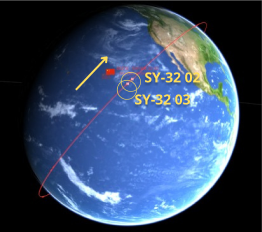
Point of Closest Approach Between SY-32 02 & 03 on 1 Feb (left) Visualization of SY-32 02 and 03 Co-Planar Orbits at 53.0° Inclination (and matched RAAN) (sbms.saberastro.com)

8 Jan – 7 Feb 2026: SY-32 03 Increases SMA 13-20 Jan (top left) SY-32 02 Increases SMA 28 Jan – 7 Feb (top right) Absolute Distances Between 02 & 03 Decrease as 02 Passes 03 on 1 Feb Then Stabilize at ~230km (celestrak.org & sbms.saberastro.com)

Nov 2025: Next month China will approve its 15th Five-Year plan in which it identifies its developmental focus areas for 2026-2030. The new plan states that establishing China as a “major space player” by 2030 is a national objective. This new objective is a logical follow up to China’s 14th 5 year plan (2021-2025) that focused on strengthening satellite development, space infrastructure and researching heavy-lift and reusability.

– From Andrew Jones at SpaceNews

  • In preparation for the release of the 15th Five-year plan, “China the country’s state-owned main space contractor, outlined plans for space tourism, digital infrastructure, resource development and space traffic management.”
  • “CASC calls for feasibility studies for a proposed “Tiangong Kaiwu” major initiative, referring to an earlier-proposed, multi-decade roadmap for solar system-wide resource utilization. It will also seek breakthroughs for technology needed for celestial small body resource prospecting, autonomous extraction technologies and low-cost transport and on-orbit processing.” computing cloud-edge-terminal architecture in orbit. Concepts include space data processed in space and joint space-ground computing. This aligns with Chinese interests in reducing reliance on downlink bandwidth, autonomous satellite operations and space-based AI and data processing.
  • “CASC is also outlining planned development of suborbital and orbital space tourism vehicles, including uncrewed and crewed verification flights and establishing an operational framework for space tourism.”
  • “Another area of focus is space traffic management, with plans for research on key technologies for space debris monitoring, early warning systems and debris removal technologies. It sees these formulations of international rules for space traffic management and providing a guarantee for the safe operation of space infrastructure.”
  • “The areas of interest were framed as ‘space+,’ a concept that treats space systems less as a separate, standalone sector and more as enabling infrastructure to be integrated with other economic and strategic domains and national priorities.”
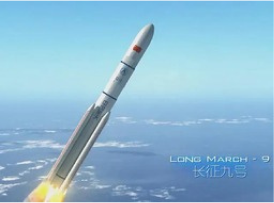
  • “CASC plans indicate that it aims to achieve reusable 20-ton to low Earth orbit (LEO) and 100-ton to LEO launch capabilities—likely referring to the Long March 9 project—while also constructing new commercial launch pads or launch sites at Jiuquan, Hainan and the eastern coastal areas.”

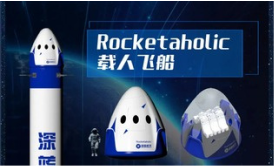
A Few Artist Renderings of China’s Ambitions for 2026- 2030 (and beyond) spacenews.com, popsci.com)

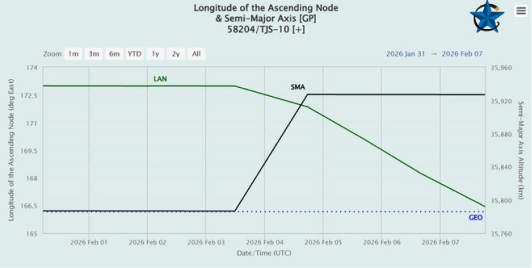
TJS-10 Maneuvers Now Heading West

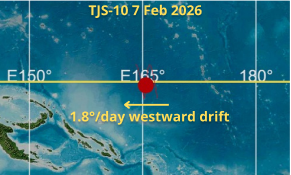
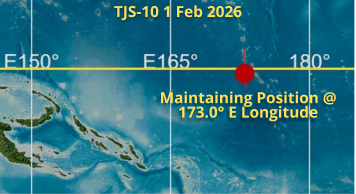
7 Feb 2026: On 3 Feb 2026 Chinesespace operators increased the SMA of TJS-10 (58204)​~140km and initiated a 1.8°/day westward drift. TJS-10 had been at 173.0° E longitude for the past 10 months (April 2025) and has been within 171-173.5°E since arriving on orbit in November 2023. Readers may recall TJS-10 had a visitor in the form of TJS-3 for its first year on orbit. TJS-3 loitered to the West of TJS-10 for the first 6 months (Nov 2023-May 2024) and then both spacecraft maneuvered to place TJS-3 to the East of TJS-10 for another 6 months (May-Nov 2024). With the experiment apparently completed, TJS-3 then headed west. As of 7 February, TJS-10 is at 166.4° East longitude, the furthest west it has ever been.

1-7 Feb Orbital History of TJS-10 Showing +141km SMA Increase 3-4 Feb (Top) TJS-10 Location on 1 Feb (left) & Location on 7 Feb (right) (celestrak.org & spacemap42.com)

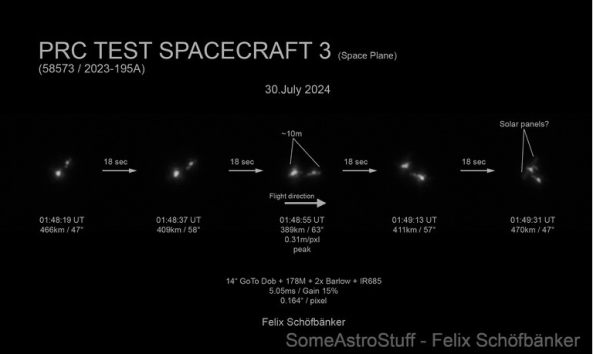
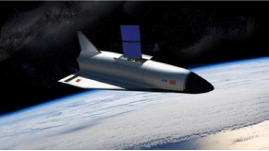
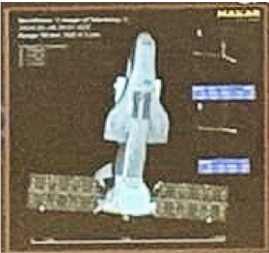
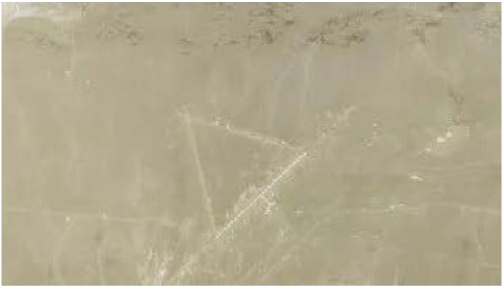
7 Feb 2026: Chinalaunched a Long March-2F carrying an unmanned space plane (likely the Shenlong) to Low Earth Orbit. This is the 4th time China has launched a re-usable satellite, China also launched its space plane in September 2020 (2-day duration), Aug 2022-May 2023 (276-day duration) and then Dec 2023-Sep 2024 (266-day duaration). In previous missions the spaceplane has released smaller objects on orbit and then conducted RPO with those objects. Chinese official media noted, “The experimental spacecraft will conduct technical verification of reusable spacecraft as planned, providing technical support for the peaceful use of outer space.” Very few details are known about the Shenlong spacecraft. However, German astronomer Felix Schöfbänker captured some amazing images and even video of the Shenlong in 2024 during its third mission. Maxar also collected an image of the spaceplane while in orbit. In spite of the secrecy surrounding the program, China made a point to prominently display the launch fairing and other launch articles. They even made a TikTok Video!
Compilation of Telescope Images of China’s Spaceplane Taken During its 3rd Mission in 2024 (app.astrobin.com/)

Notional Rendering of Shenlong Space Plane (space.com)

Modified Fairing Used For 2 Mission (https://pbs.twimg.com)

Lop Nur has been the landing site for all previous spaceplane missions. (spacenews.com)

CHINA: Quest for Reusable Rocket Technology

By Dr. Larissa Beavers

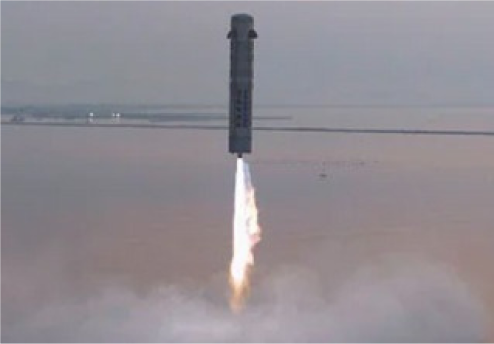
26 Jan 2026: China is accelerating efforts to master reusable rocket technology, a capability critical to lowering launch costs and increasing mission tempo. According to a Space Daily report by Riko Seibo, China is completing an offshore platform at Oriental Aerospace Port in Haiyang to support testing, launches, and recovery of reusable liquid- propellant rockets, with trial operations expected in early February 2026. Additional reporting by the Global Times indicates this push spans both state and commercial sectors, with early reusable launches, recovery infrastructure, and engine development signaling a broader shift away from expendable systems and toward competitiveness with global leaders in reusable launch.

Previous reporting on China’s ambitions for reusable rocket technology:

  • Early recovery demonstrations — Startups such as Space Epoch have achieved controlled ocean soft landings of rocket boosters in June 2025.
  • Strategic competition — 2025 Defense One reporting suggests China’s reusable launch efforts are part of a broader strategic push to close the gap with established reusable launch leaders and capture more of the commercial launch and satellite constellation markets. 
  • Offshore reuse infrastructure — The Haiyang platform enables liquid rocket launch and recovery testing. 
  • First orbital reuse attempt — LandSpace’s Zhuque-3 marked China’s first orbital flight of a reusable liquid rocket, drawing substantial global attention. 
  • Recovery network expansion — A Hangzhou offshore base will support booster inspection and reuse. 
  • Commercial momentum — National aerospace exhibitions highlight rapid progress in reusable launch systems. 
  • PH-1 suborbital test flight — On 13 Jan 26, CAS Space advances its reusable spacecraft ambitions by carrying out the PH-1 maiden suborbital flight.
  • Reusable booster development — On 19 Jan 2026, Long March 12B testing shows continued investment in first-stage reuse. 
  • Beyond satellites — China Daily report, Zhao Lei states that successful reusable system development supports ambitions beyond satellite launches, including suborbital spaceflight, signaling a diversified trajectory for the space economy.

Russia: Checking in on the Nivelirs

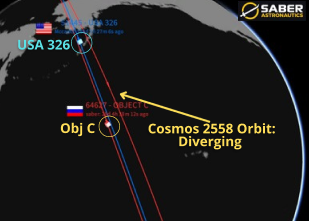
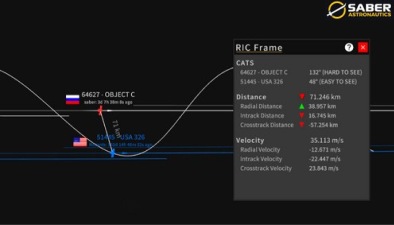
5 Feb 2026: I thought it was about time to check in on the Russian satellites operating in near-coplanar orbits with high-value US satellites. Thanks again to the SaberAstro crew for their fantastic SBMS application! Important note: Orbital data for the USA satellites courtesy of the McCants catalog. This is the best data I have access to, but it can be out of date. However, significant changes to the orbital planes (their Inclination or RAAN values) of any of the satellites in question is unlikely due to the fuel requirements to do so. With this limitation, please consider the points of closest approach as theoretical.

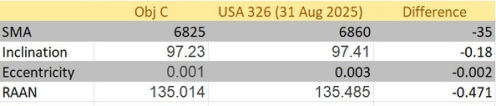
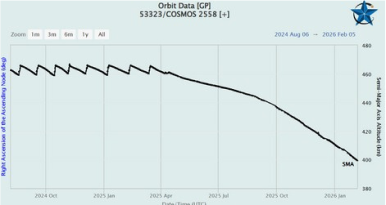
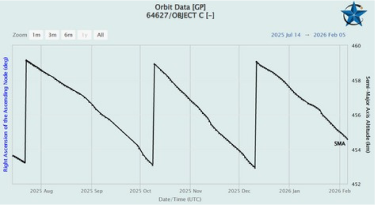
– Cosmos 2558 (53323)/Obj C (64627) vs USA 326: Many will recall that Cosmos 2558 began to suffer some difficulties in April 2025 (began missing regular orbital maintenance maneuvers). In June 2025 Cosmos 2558 released its sub-satellite (likely inspector satellite associated with the Nivelir system). Since that time Obj C has conducted maneuvers to maintain its orbit (and remain co-planar with USA 326). For its part, Cosmos 2558 has lost 60km in altitude (SMA) and is no longer co-planar with either Obj C or USA 326.

Russia: Checking in on the Nivelirs Continued

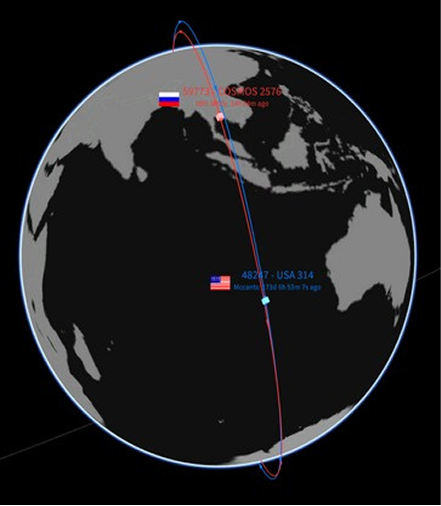
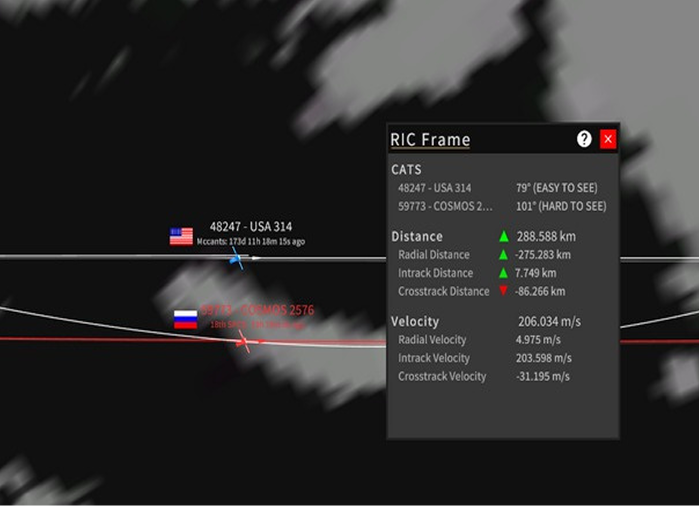
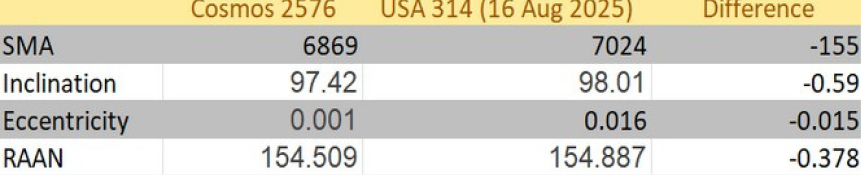
Cosmos 2576 (59773) vs USA 314: After its launch in May 2024, Cosmos 2576 gradually​increased its altitude (SMA) from 440kmto ~485km. Cosmos 2576remains nearly co-planar with USA 314. Cosmos 2576 is signficantly lower (155km) than its target (at least for the last TLE we received for USA 314 back in August 2025).

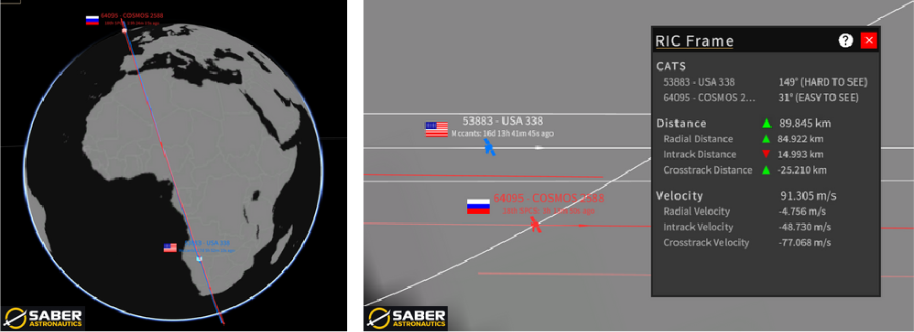
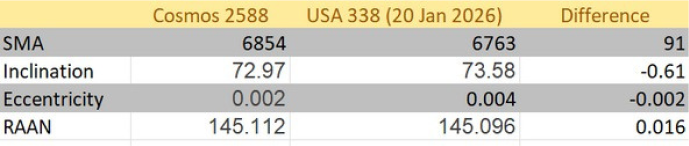
Cosmos 2588 (64095) vs USA 338: Perhaps indicating at new tactic, the latest of Russia’s Nivelir satellites, Cosmos 2588, is maintaining a higher orbit (+91km) than its target, USA 338. We have a fairly updated TLE for USA 338 (20 Jan 2026).

(sbms.saberastro.com)

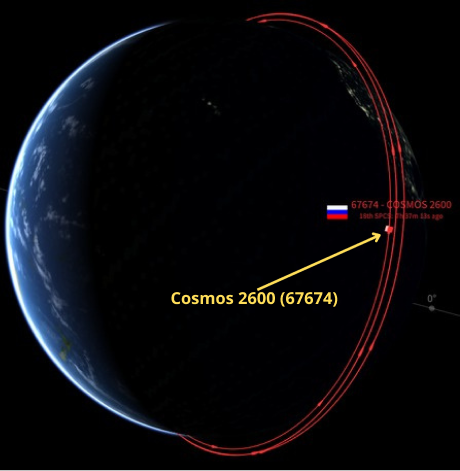
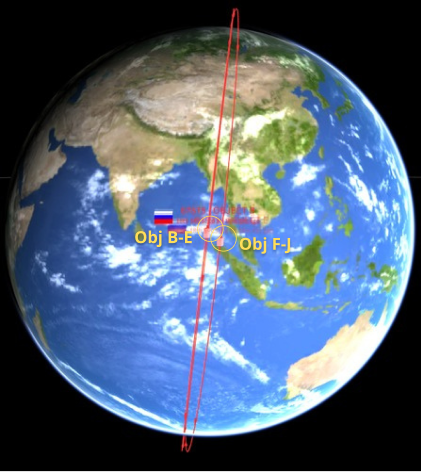
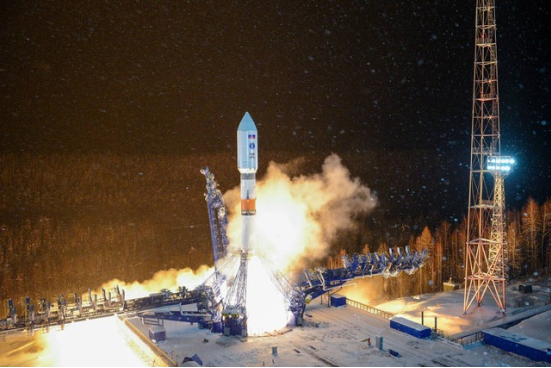
5 Feb 2026: Russialaunched a Soyuz 2.1B from Plesetsk carrying 9 payloads (67674-67682) to​ Earth Orbit (LEO). Russia announced only that the satellites were for the Ministry of Defense. Per Orbital Focus, the objects were released into different orbits. The first, and assumed primary, payload was released into a 326x329km orbit with an inclination of 96.65deg. The Fregat upper stage then maneuvered and released the remaining objects in a 500km orbit with the same inclination. Orbital Focus noted the Fregat released the 8 satellites in 2 batches. The first contained 4 objects, then the Fregat maneuvered to change RAAN 2.5° east and then released the remaining 4 satellites. Satellite mission and payload remain unknown, however the orbital parameters (and operational requirements) suggests imagery satellites.

Russia Released 1 Object (Cosmos 2600) at 327km. (sbms.saberastro.com)

Russia Released 4 Objects at ~500km SMA then Released Additional 4 Objects at Same Altitude & RAAN Differential of 2.5° east. (sbms.saberastro.com)

Soyuz 2.1b Lift Off From Plesetsk with Cosmos 2600 and Others (nasaspaceflight.com)

Key Russian Counterspace Capabilities

By Dr. Larissa Beavers

The SpaceReview released an article,The Successful Development of Russia’s Counterspace Activities in LEO and GEO” by Matthew Mowthorpe and Markos Trichas which analyzes Russia’s expanding counterspace capabilities, highlighting recent advances that showcase Moscow’s ability to develop and operationalize anti-satellite (ASAT) systems in both low Earth orbit (LEO) and geosynchronous orbit (GEO). These developments—some conducted under the cover of experimental space systems—reflect Russia’s strategic intent to challenge U.S. and allied space assets through co-orbital interceptors, ground-based ASAT missiles, and other offensive technologies.

Summarized insights from Mowthorpe and Trichas SpaceReview article:

  • GEO Nivelir ASAT deployment – Russia has successfully developed and begun fielding Nivelir co-orbital anti-satellite systems in geosynchronous orbit. 
  • Co-orbital ASAT operations in LEO – Multiple Cosmos satellites have conducted rendezvous, proximity operations, and inspection maneuvers indicative of kinetic interceptor roles. 
  • Ground-based direct-ascent ASAT (Nudol) – The Nudol system has been tested repeatedly and is likely operational, capable of intercepting LEO satellites up to ~850 km. 
  • Historical ASAT development expertise – Soviet and Russian programs have long experience with multiple orbital ASAT system classes, underpinning current efforts. 
  • Satellite proximity maneuvers – Recent missions show frequent orbit modifications and close approaches to foreign satellites, raising counterspace concerns. 
  • Dual-use experimental designation – Some systems are publicly framed as experimental or observational while testing counterspace functions. 
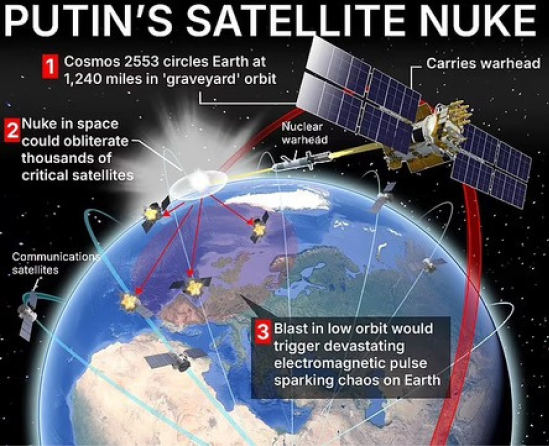
  • Potential nuclear ASAT research – There are indications Russia has explored or pursued orbital nuclear counterspace weapons as part of its threat set. 
  • Integrated offensive suite – Russia’s counterspace posture includes both space-based co-orbital systems and ground-based direct-ascent interceptors, offering layered offensive options.

Timeline: Russian Counterspace Capabilities

By Dr. Larissa Beavers

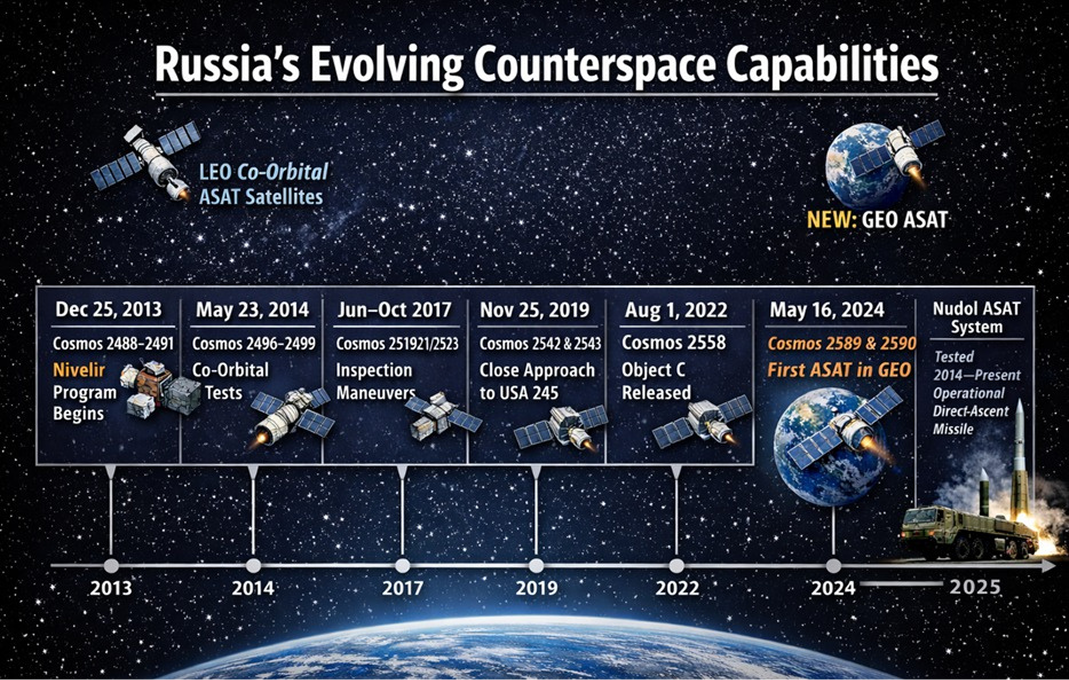
The following graphic provides a concise visual timeline of Russia’s steady progression from early co-orbital satellite experiments to an integrated, multi-layered counterspace posture, based on The SpaceReview article highlighted above. This timeline identifies key milestones that demonstrate Moscow’s ability to threaten space systems across orbital regimes—from low Earth orbit inspection and interceptor satellites to the emergence of a geosynchronous orbit ASAT capability and the fielding of the Nudol direct-ascent missile.

Space Review summary timeline highlights include:

  • Cosmos 2488–2491 (2013): Initial Nivelir co-orbital ASAT satellites; demonstrated rendezvous
  • and inspection in LEO.
  • Cosmos 2496–2499 (2014): Follow-on Nivelir launch conducting covert proximity and
  • maneuver tests.
  • Cosmos 2519/2521/2523 (2017): Expanded Nivelir program; deployed subsatellite performed
  • interceptor-like maneuvers.
  • Cosmos 2542/2543 (2019): Released subsatellite that conducted close approach to U.S.
  • satellite USA-245.
  • Cosmos 2558 (2022): Placed near U.S. USA-326 orbit; later released maneuvering subsatellite
  • (Object C).
  • Cosmos 2576 (2024): Continued co-orbital ASAT testing supporting Nivelir development.
  • Cosmos 2589/2590 (2025): Co-orbital ASATs in HEO, with one projected to reach GEO—first
  • Russian ASAT presence in GEO.
  • Nudol ASAT (2014–present): Mobile direct-ascent missile; demonstrated kinetic kill and
  • assessed operational against LEO targets.

This is Richard Carrington, the first person to document solar flares on the Sun & suggest their influence on aurora at Earth. The largest solar storm on record, the Carrington Event, bares his name. But, there has been no photograph available of Carrington – until now! Read About the Carrington Event.(@RyanJFrench via X)

All content is considered Integrity ISR Proprietary Information and may not be copied or distributed without written consent from Integrity ISR, LLC.