ISSUE 145 | 18 may 2026
The integrity flash
Analysis of Developments in the Space Domain
In This Issue
China: TJS-3 Checking Out Gaofen-13 02
China: SJ-23 Reverses Course & Likely Observes WGS-7
China Launches 8th Group of 18 Qianfan Satellites
Bad Actor: China’s Dangerous Rocket Body Relics
COMSPOC Analysis of Pakistani Space-Based ISR
China Starts Playing “Positionless Hockey” in GEO
China and the Fight for Orbital Dominance
Pics o’ the Fortnight

China: TJS-3 Checking Out Gaofen-13 02
13 May 2026: China maneuvered TJS-3 (43874) into position to observe one of its GEO-based imagery satellites, Gaofen-13 02 (55912). Thank you for the heads up Nathan Parrot! – Chinese space operators decreased TJS-3’s SMA ~121km on 3-5 April 2026, increasing TJS-3’s eastward drift rate from 0.252°/day to 1.8°/day. From early-April through early-May, TJS-3 transited from 95.5°E to 148.2°E. From 4-6 May, Chinese space operators increased TJS-3’s SMA 136.1km to place the satellite within 1km of GEO (35,786km). The maneuvers placed TJS-3 in the vicinity of Gaofen-13 02 at 148.2°E.
For its part, Gaofen-13 02 has not deviated from its pattern of life and has conducted station-keeping maneuvers every 1-1.5 months and is maintaining its location at 148.2°E.
TJS-3 and Gaofen-13 02 are not plane-matched with differing inclination and RAAN values. As a result, the two satellites briefly cross paths every 12 hours. In their current orbits, the two satellites’ time of closest approach is ~0530Z and ~1730Z. During the evening, the satellites are within <20km of one another, with lighting conditions (sun angle) favoring GF-13 02 observing TJS-3 (the sun is behind GF-13 02 and in the face of TJS-3). During the morning pass, there is <75km separation with lighting conditions favoring TJS-3 to observe GF-13 02. (see graphics)
TJS-3’s proximity to GF-13 02 is most certainly purposeful. TJS-3 likely has satellite inspection capabilities and has been noted in the vicinity of other satellites and frequently changes its location. While GF-13 02 has continued to maintain its orbit, the arrival of TJS-3 may signal an anomaly with the satellite. Inspecting the satellite may assist Chinese troubleshooting efforts. We can also not rule out that there may be an issue with TJS-3, and China maneuvered the satellite to take advantage of GF-13 02 imaging capabilities. I suspect this is unlikely, GF-13 02 is used for collecting 15-20m resolution of the Earth, and likely not optimized for satellite-to-satellite imaging. If there is a problem with TJS-3, China would more likely use one of its other GEO test satellites (SJ-17, SJ-21, SJ-23, SJ-25, or SY-12 01/02) to support. Finally, both satellites may be operating nominally, and TJS-3’s relocation is in support of Chinese training and tactics development.

1-3 Apr 2026: TJS-3 Located at 95.5deg E & GF-13 02 at 148.2deg E
(saberastro.com)
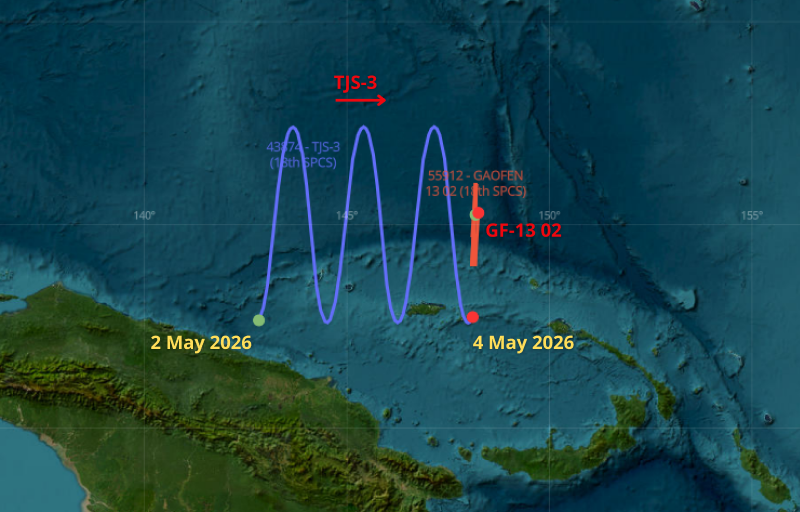
2-4 May 2026: TJS-3 Arrives at GF-13 02’s Position at 148.2deg E
(saberastro.com)
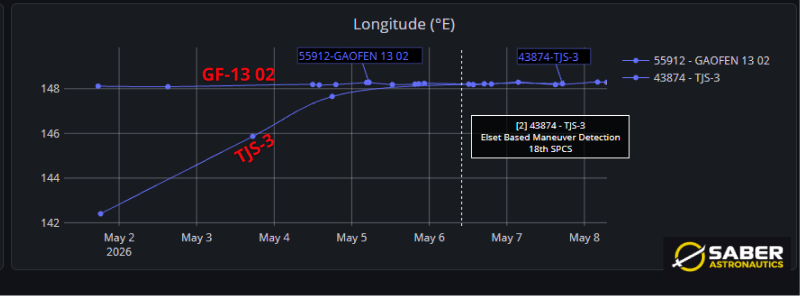
2-8 May 2026: TJS-3 Arrives at GF-13 02’s Position at 148.2°E
(saberastro.com)
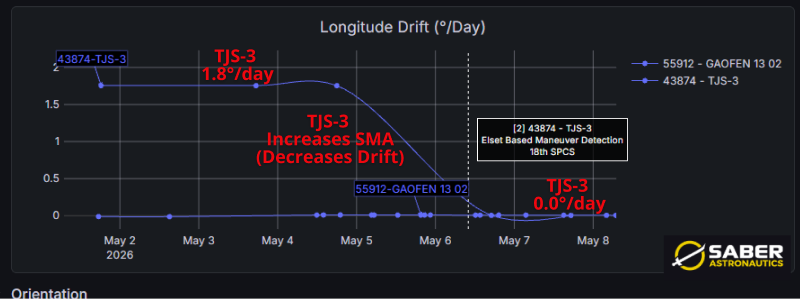
2-8 May 2026: TJS-3 Raises SMA 136km & Stops Eastward Drift
(saberastro.com)
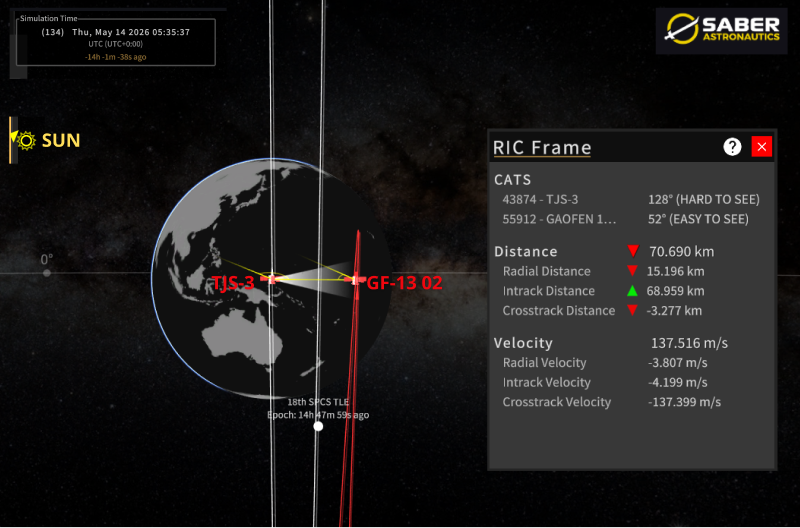
Morning View (0530Z): TJS-3 Favorable Lighting Conditions for Observing GF-13 02 Range: <75km
(saberastro.com)
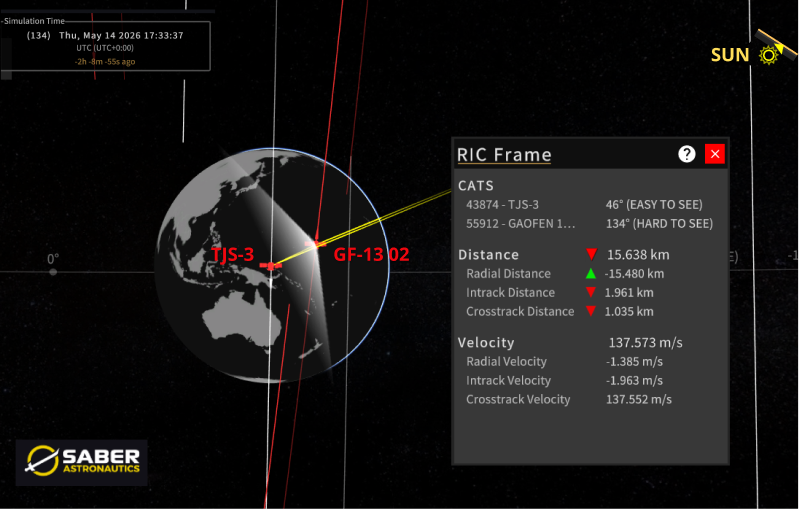
Evening View (1730Z): GF-13 02 Favorable Lighting Conditions for
Observing TJS-3 Range: <20km
(celestrak.org)
China: SJ-23 Reverses Course & Likely Observes WGS-7
7 May 2026: Chinese space operators increased the average altitude of SJ-23 (55131) ~105km to reverse its eastward drift. The maneuvers occurred as the satellite approached 175°E Longitude, and the satellite is now heading west 0.65°/day.
This is SJ-23’s third time raising its orbit to head west. On average, SJ-23 covers 20°E to 175°E in Longitude, with each leg of the journey taking ~221 days.
The Joint Commercial Operations Cell (JCO) noted that SJ-23 had a subsequent close approach to the US military communications satellite WGS-7 (40756) on 7 May 2026. The two satellites came within 70km of one another at ~0230-0240Z with solar conditions favoring SJ-23’s ability to observe WGS-7.
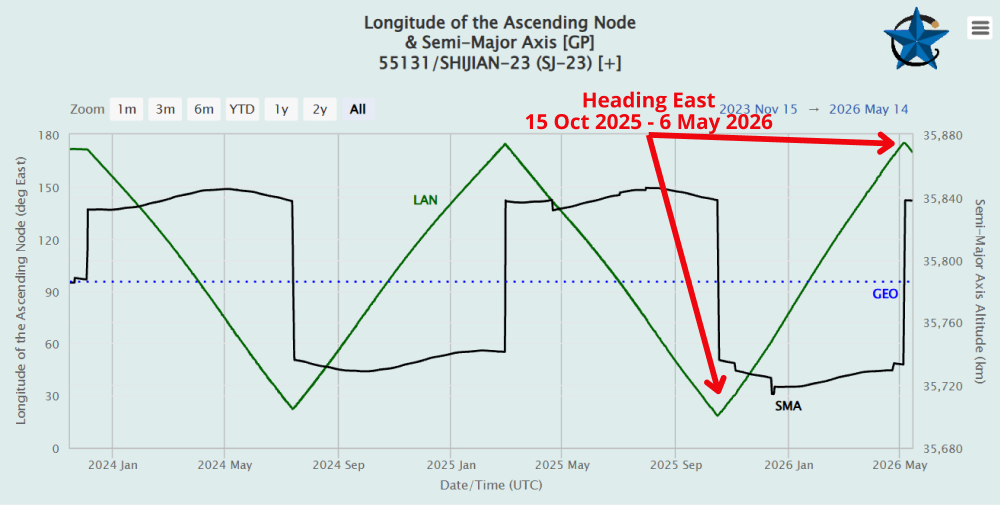
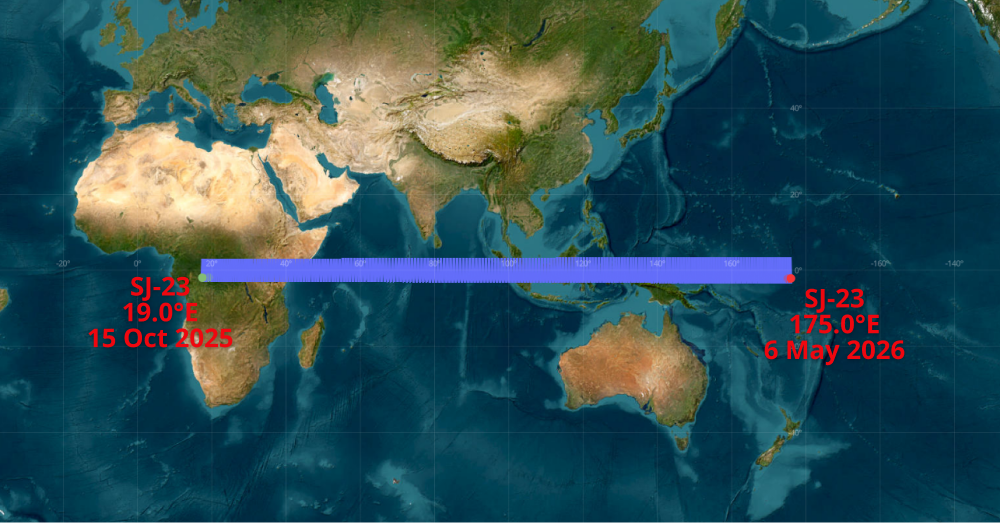
Happy Wanderer: Graph Showing SJ-23 SMA and Longitude Jan 2024 – May 2026 (top) and 2D Visualization of Latest Eastward Leg (below)
(celestrak.org & saberastro.com)
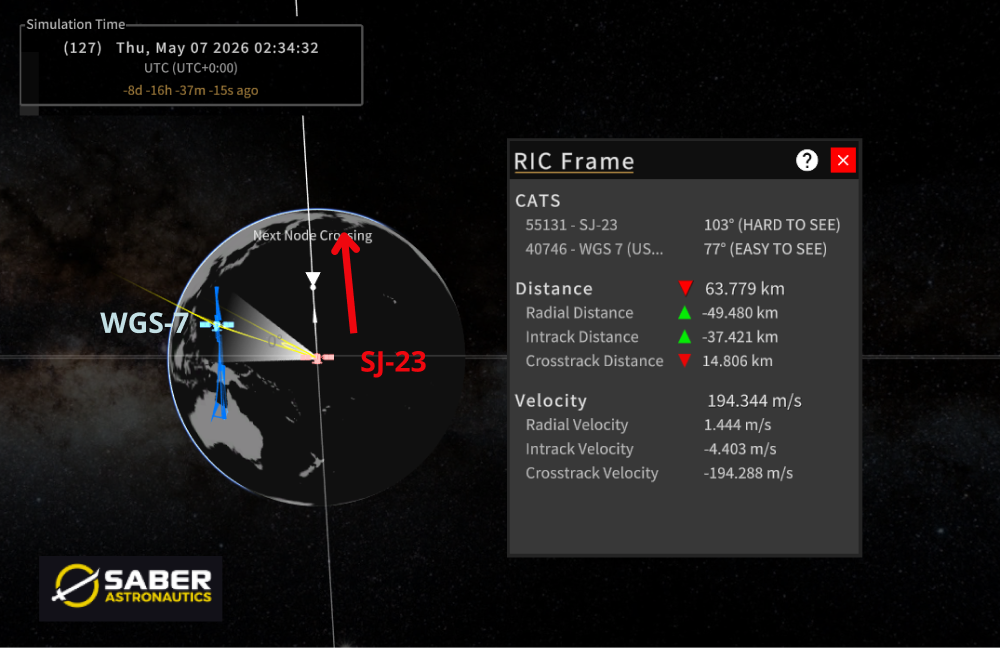

7 May 2026: SJ-23 is <100km absolute distance from WGS-7 (0228-0243Z) with Marginal to Favorable Lighting Conditions (top)
Absolute Distance Graph Showing Separation Distance between SJ-23 and WGS-7 from 5-9 May (below)
(saberastro.com)
12 May 2026: China launched a Long March-6A with 18 SpaceSail satellites (2026-104A-R, SATNOS not assigned yet) from Taiyuan. According to official sources, the 18 satellites constitute the eighth batch of the first generation of the SpaceSail Constellation developed by Shanghai SpaceSail Technologies Co., Ltd. to “provide global users with low-latency, high-speed and ultra-reliable satellite broadband internet services”. Despite being the 8th Qianfan launch, SpaceSail has labeled this launch as “Group 9” with Group 8 scheduled to launch NET 17 May 2026. With this launch, there are now 144 satellites in orbit. Group 9’s launch occurred just 35 days after the previous Qianfan launch on 7 April 2026 and may signal an increased launch cadence (there were 193 days between Groups 6 & 7 and 220 days between Groups 5 & 6). Of the 8 launches, 6 have used the LM-6A from Taiyuan, and 2 have used the LM-8 from Hainan (Wenchang). Launch Video.
– SpaceSail launched its 8th group Qianfan (labelled “Group 9”) satellites into the orbital plane between groups 3 & 7 (see graphic). All planes are inclined 89° with a 20° of RAAN offset between each plane. With this launch, 8 of the 9 planes are in use. SpaceSail may want to augment Group 2 due to 15 of 18 satellites failing to reach their operational SMA of 1,069km.
Constellation Summary:
– Of 144 Qianfan satellites on orbit, 87 have reached their operational altitudes of 1,069kms.
- Group 1 (60379-60396) (LM-6A launched 6 Aug 2024): 17 of 18 satellites reached operational SMA. Qianfan 7 (60385) has not maneuvered and may be inoperable.
- Group 2 (61552-61569) (LM-6A launched 15 Oct 2024): Only 3 of 18 satellites (Qianfan 29, 30 & 32) reached their operational SMA.
- Group 3 (62238-62255) (LM-6A launched 5 Dec 2024): 16 of 18 satellites reached their operational SMA. Qianfan 39 (807km) & 42 (810km) appear to be struggling.
- Group 4 (62785-62802)(LM-6A launched 23 Jan 2025) : 18 of 18 satellites reached their operational SMA.
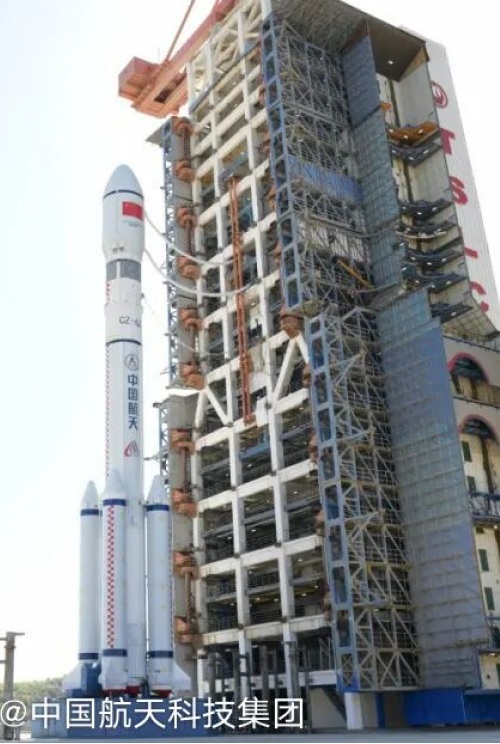
LM-6A with Qianfan Group 9
(nasaspaceflight.com)
- Group 5 (63159-63176) (LM-8 launched 11 Mar 2025): 16 of 18 satellites reached their operational SMA. Qianfan 77 (904km) & 83 (1,028km) appear to be struggling.
- Group 6 (66033-66050) (LM-6A launched 17 Oct 2025): 17 of 18 satellites reached their operational SMA. Qianfan 101 (66043) remains at 800km.
- Group 7 (68636-68653): (LM-8 launched 7 Apr 2026): All 18 satellites in process of raising their SMA. Range 914-940km as of 13 May 2026.
- Group 9: (LM-6 launched 12 May 2026): satellites have not been added to catalog yet.
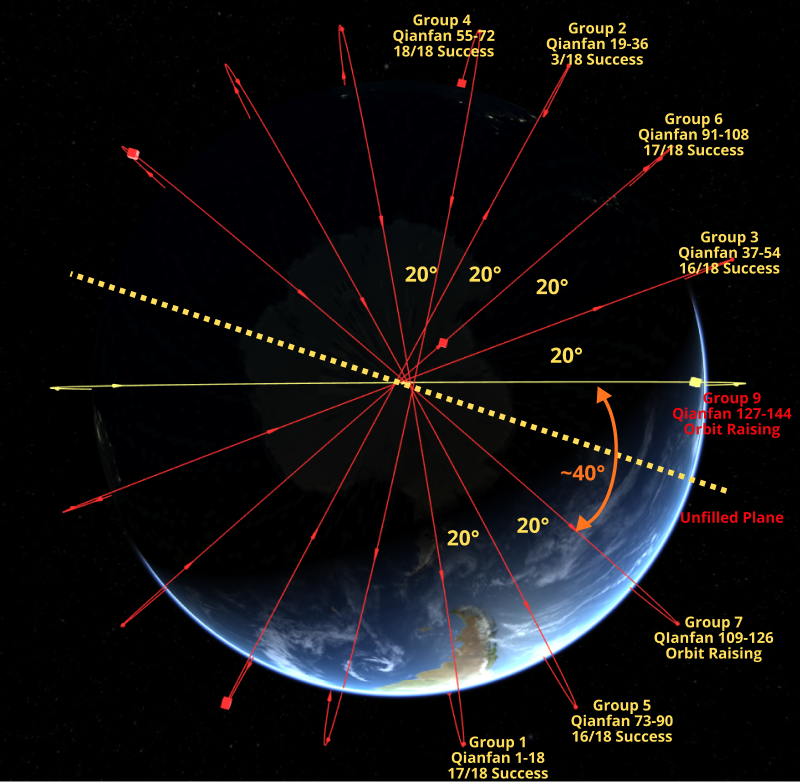
Current Qianfan Constellation consists of 144 satellites operating in 9 orbital planes. Planes are inclined 89° & separated by ~20° RAAN. (saberastro.com)
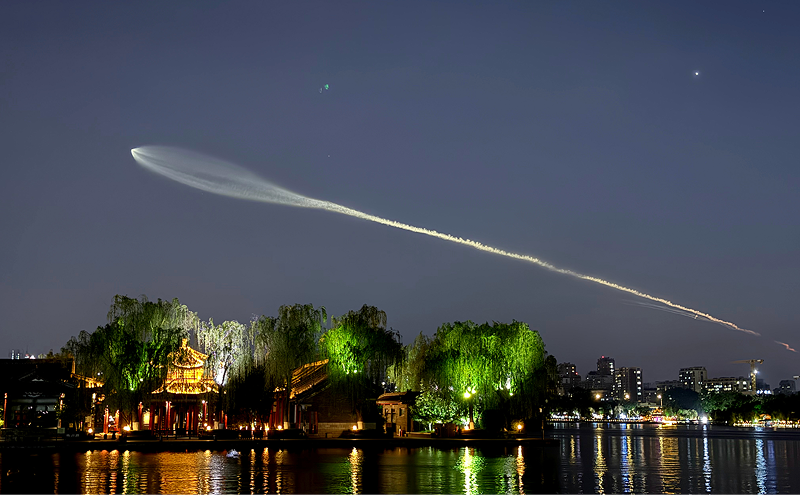
Qianfan Group 9 Heads to Orbit
(nasaspaceflight.com)
14 May 2026: Frequent Flash readers are no doubt tracking China’s ongoing efforts to deploy proliferated Low Earth Orbit (pLEO) constellations. Chinese civilian and military leadership have taken note of the military utility provided by SpaceX’s Starlink constellation in the Russia-Ukraine conflict and have made PLEO deployment a national priority. The Guowang and Qianfan constellations are at the forefront of Chinese pLEO efforts. Both constellations are in the initial deployment stages: Guowang has 168 satellites on orbit (just over 1% of the planned 13,000 satellite constellation); Qianfan has 144 satellites on orbit (just under 1% of the planned 15,000 satellite constellation)
Unlike Starlink, which has satellites orbiting ~450km above the Earth, the Guowang and Qianfan satellites are more than 2x higher. Guowang satellites’ operational SMA is 1,149-1,168km, and Qianfan’s desired SMA is 1,069km. China is using a combination of LM-6A, LM-8, LM-12A, and others to deploy Guowang and Qianfan. In order to minimize the need for the satellites to use their fuel for orbit raising, China is utilizing the upper stages of these launch vehicles to drop off their payloads at 800-900km. As a result these massive upper stages are left in orbits which will not decay for 25-100+ years, representing a growing threat to the sustainability of Low Earth Orbit. The LM-6A (also abbreviated CZ-6A) is of particular concern as its upper-stage has shown a propensity to rapidly disassemble while on orbit creating a large number of dangerous non-maneuvering objects which need to be tracked/avoided.
Dr. Darren McKnight of LEO Labs has been sounding the alarm regarding these derelict objects for at least the past 18 months. Thankfully (for me) Dr McKnight is a friend of the Flash and returns my emails! Please see below for his analysis of the unfolding situation. Thank you, Darren!
Per Dr. McKnight:
- Big Picture: China’s “abandonment of 37 rocket bodies amounting to over 150,000 kg in the last two years, primarily to support the initial deployments of the Guowang and Qianfan constellations, is concerning. This is the same number of rocket bodies and three times the mass than the rest of the world combined has left in the last 15 years in long-lived orbits (i.e. above 650 km which leads to orbital lifetimes of well over 25 years)…if you look at the last 15 years the Chinese have left 90 rocket bodies above 650 km comprising over 300,000 kg while the rest of the world combined has left 33 rocket bodies comprising ~52,000 kg (1/6 of China’s derelict mass “contribution”). That ~300,000 kg from China is 25% of the total abandoned rocket body mass in long-lived orbits of the total population abandoned over the space age.”
- LM-6A R/B Specifics: “There are currently 23 LM-6A R/Bs in orbit as of 23 Apr 2026, comprising ~133,000 kg of abandoned mass. 20 of these R/Bs (i.e., ~120,000 kg) are stranded in orbits with average altitudes over 650 km, meaning they will remain in orbit for more than 25 years; 10 are above 800 km, meaning they will orbit for over 100 years. Since two of the top four fragmentation clouds in LEO (as measured by current on-orbit number of fragments) are the result of CZ-6A R/B explosions that have occurred in the last four years, this deposition is of extra concern to the spacefaring community.”
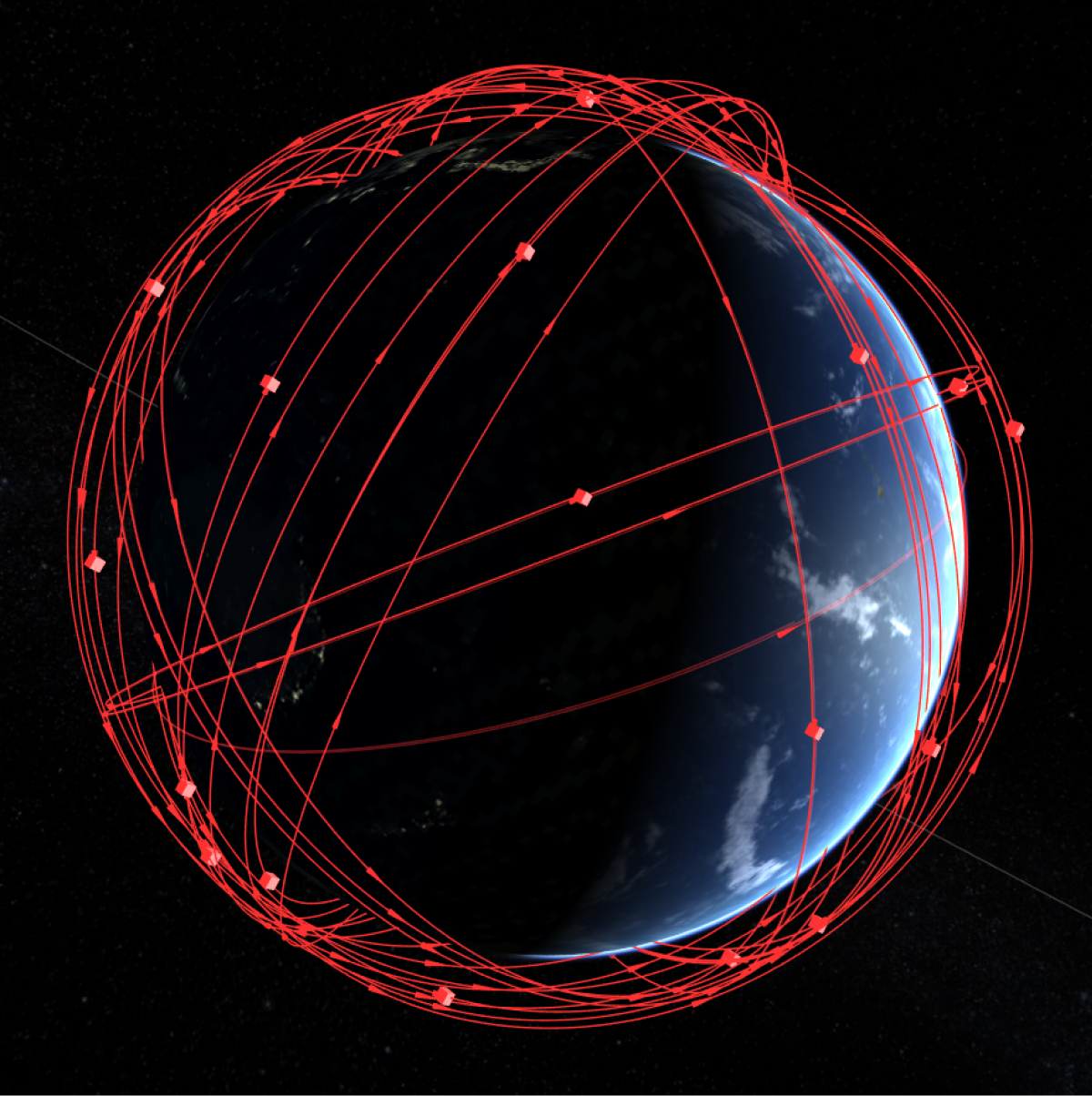
Orbit Visualization of Chinese Rocket Bodies in Orbits with SMA > 650km. These Objects will remain on orbit 25-100+ years
(Darren McKnight & saberastro.com)
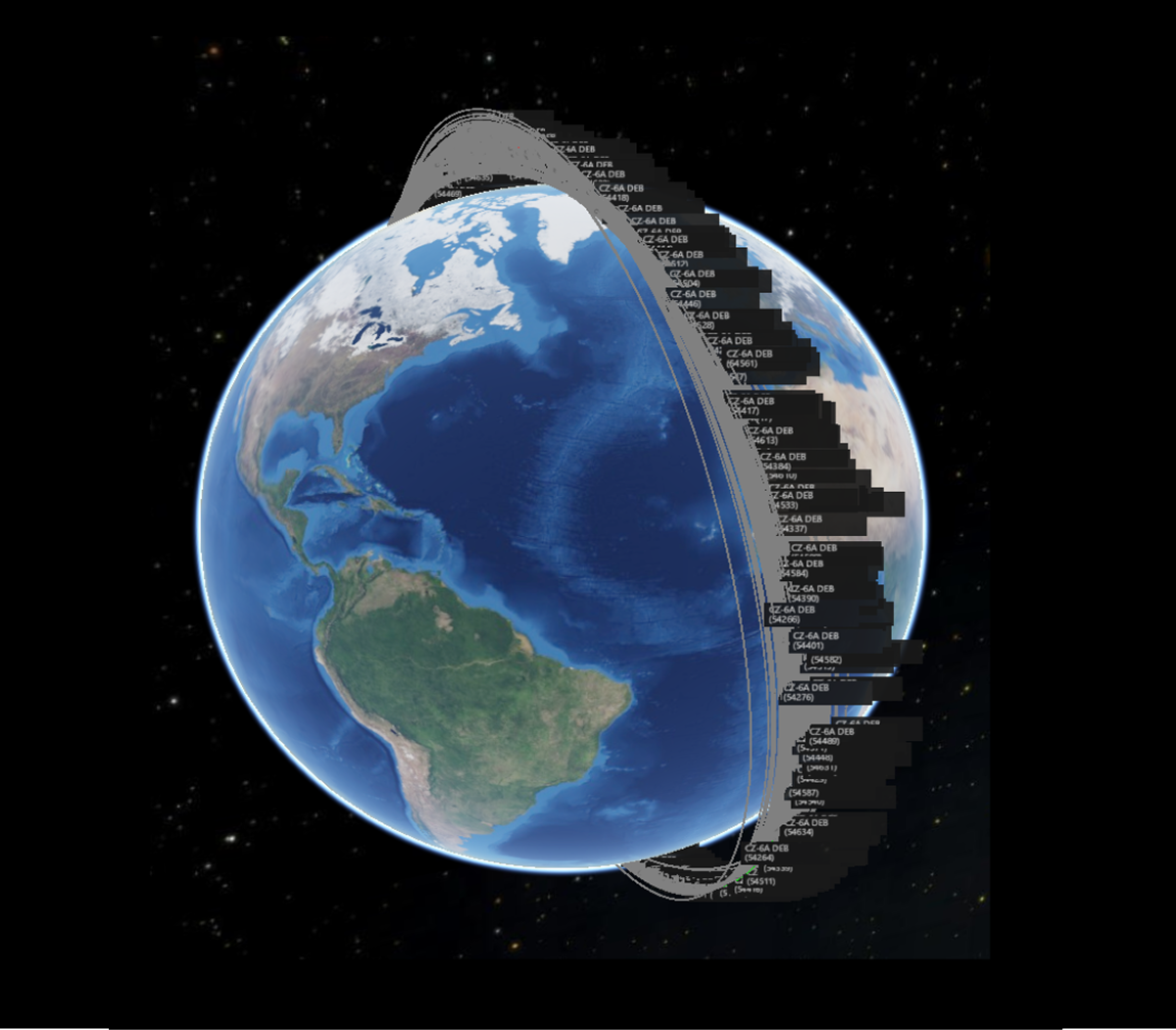
Tracking information from Dec 2022 showing 350 pieces of debris associated with the LM-6A upper stage break up event. China Launched the LM-6A on 12 Nov 2022 with the Yunhai-3 Satellite. Debris perigee ranges from 320 to 844km.
(spaceaware.io)
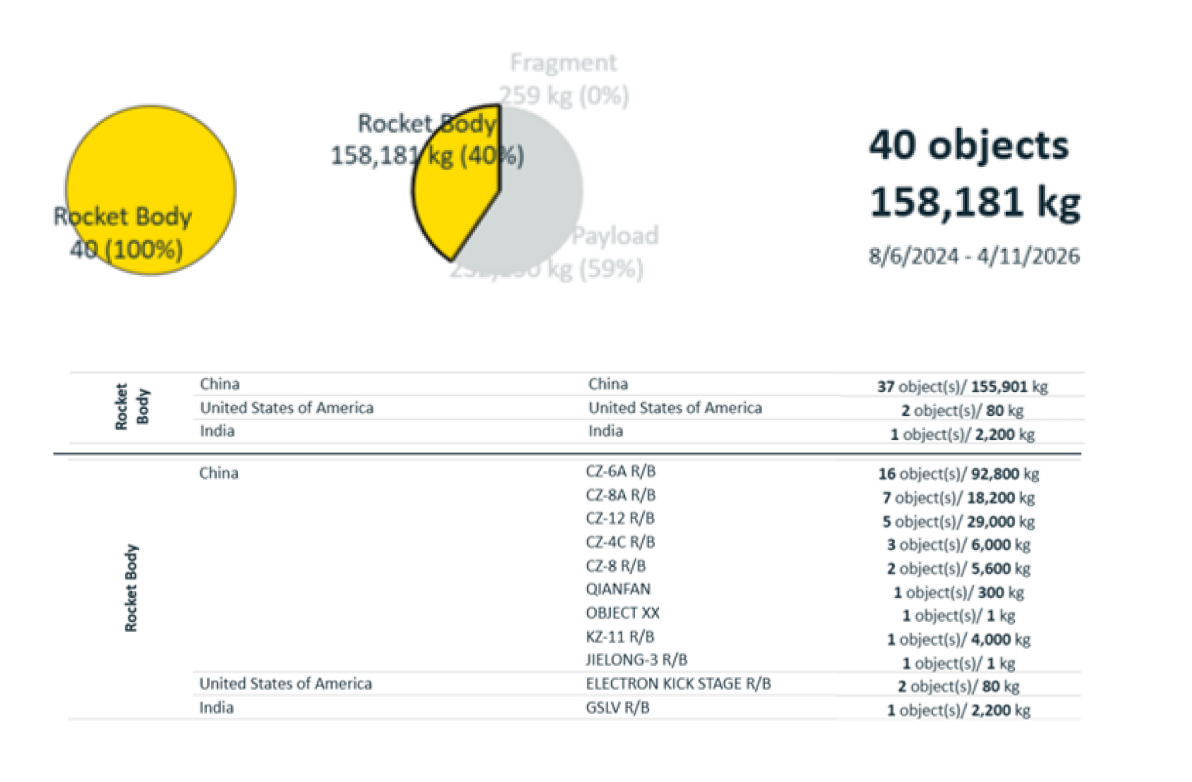
China accounts for over~98% of Abandoned Mass Over the Past 2 Years 12 LM-6A R/Bs comprise nearly 93,000 kg (59%)
(Dr Darren McKnight/LEO Labs)
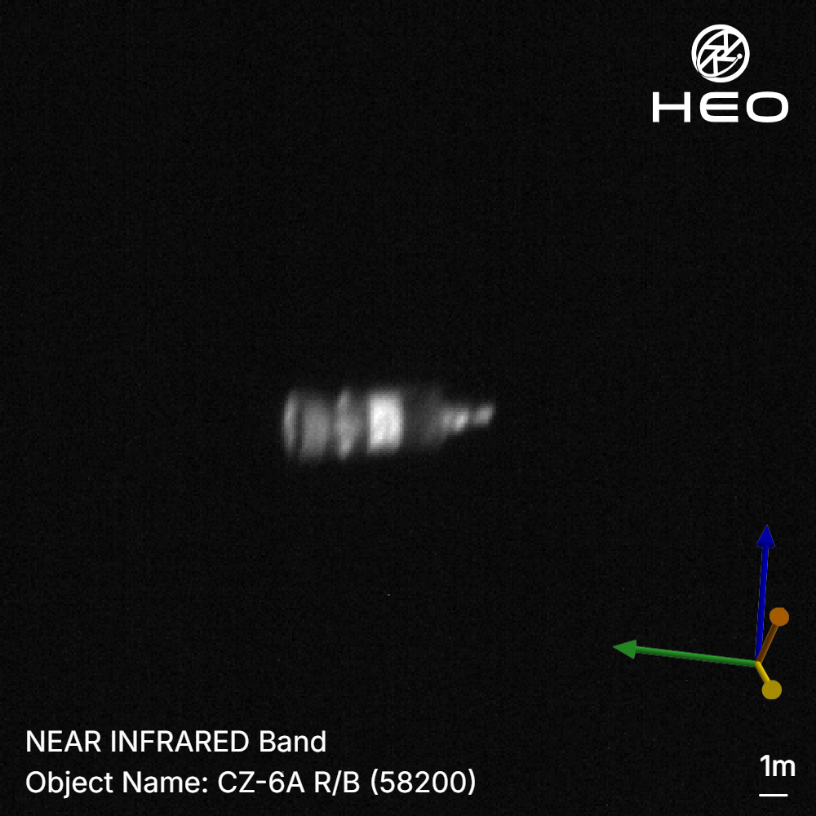
LM-6A Rocket Body in Orbit from October 31, 2023 launch of the Tianhui 5A and 5B satellites. Apogee = 558.9km Perigee = 472.8km
(HEO)
7 May 2026: The COMSPOC_OPS team posted a very interesting analytical product on X. The post detailed Pakistan’s growing space-based ISR constellation, focusing on the orbits of the recently launched PRSC-E03 (launched 25 Apr 2026) electro-optical imagery satellite and PRSC-S1, a radar imagery satellite. I thought the COMSPOC team did a very nice job explaining the orbital relationships between the two satellites and how each orbit played to the varying sensor capabilities. Here’s the video they published to go along with their analysis. Below is the unedited verbiage and graphics from the post. Thanks, team COMSPOC!
“Pakistan’s PRSC-EO3: an unusual orbit for an optical satellite
Radar tracking via @LeoLabs. Processed via COMSPOC SSA.
“PRSC-EO3 (visualized in cyan) launched April 25, 2026 on a Long March 6. It’s an optical imager — but its orbit is curious. Most optical LEO satellites use sun-synchronous orbits (~97-105° inclination), which provide consistent lighting for imaging. PRSC-EO3 is in a 38° inclined orbit instead. This sacrifices global coverage and consistent lighting, but increases revisit rates over a specific latitude band: 20-40°N. That’s India, Kashmir, and Pakistan.
Now consider PRSC-S1 (visualized in pink), Pakistan’s SAR satellite launched
July 2025, sitting in a 41° orbit. Similar
inclination, similar altitude — but their RAANs are ~175° out of phase. When one passes over South Asia in daylight, the other passes in darkness.
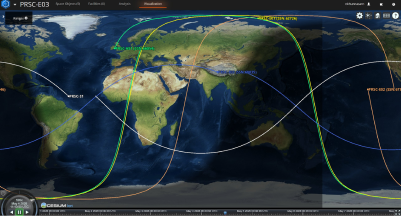
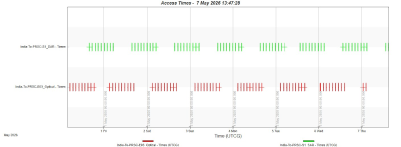
Orbit Visualization for PRSC-E03, S1 & HS1 (top)
South Asia Sensor Coverage SAR (green) and EO (Red)
(@COMSPOC_OPS via X)
SAR works day and night. Optical needs sunlight. The geometry appears to allow complementary coverage. We ran the access analysis. The SAR sensor (unconstrained) and optical sensor (daytime-constrained) together provide repeatable revisit across day and night. The gaps left by one are filled by the other.
Then there’s PRSC-HS1 — a hyperspectral satellite in SSO, capable of detecting camouflage and identifying materials from orbit.
Optical shows you the picture. SAR shows you the picture at night and through the weather. Hyperspectral tells you what you’re looking at. Five remote sensing satellites in 16 months. All were launched by China. All with orbits favoring South Asian coverage. The stated missions are civilian. The orbital architecture appears consistent with a multi-modal ISR constellation.”
China Starts Playing “Positionless Hockey” in GEO
by Alison Sayer
A 2026 CSIS report argues China is changing the way it operates in geosynchronous orbit (GEO), turning what used to look like a quiet parking lot into something much more dynamic and competitive. Instead of satellites staying planted in one orbital slot for years, a handful of Chinese satellites are now maneuvering around GEO with increasing frequency. In celebration of the NHL play-offs, think more constant line changes and forechecking pressure.
The study looked at 109 Chinese GEO satellites from 2016–2025 and found most still behave traditionally. About 86% remained largely stationary. But a small group of satellites stood out as clear outliers, repeatedly performing long-distance relocations and exhibiting unusual maneuver patterns inconsistent with normal commercial operations.
Importantly, CSIS did not simply identify “interesting” satellite movements by observation alone. The study used quantitative thresholds for movement frequency and relocation magnitude to identify statistically unusual behavior across the broader Chinese GEO architecture. In other words, this was less about spotting one questionable play and more about reviewing season-long player-tracking data and realizing that a few teams are skating a completely different system.
CSIS identified roughly 75 unusual maneuvers conducted by eight satellites over the nine-year period:
- SJ-17
- SJ-20
- SJ-21
- SJ-23
- TJS-3
- SY-12-01
- SY-12-02
- CHINASAT-20A
The report breaks the activity into four behavioral categories:
- “Larks” — satellites periodically repositioning across GEO, likely for communications coverage or mission flexibility.
- “Skyliners” — satellites making repeated step-by-step relocations between orbital slots, a behavior that could support SIGINT collection or proximity operations near other spacecraft. CSIS notes similarities to prior Russian “space stalker” style operations.
- “Drifters” — satellites slowly sweeping longitude bands over time with no obvious commercial justification.
- “Ink Spots” — localized clustering and rendezvous-style activity that may support inspection, servicing, or future counterspace missions.
The report stops short of calling the activity overtly hostile, which actually strengthens the assessment. Rather than claiming malicious intent, CSIS argues that the scale, repetition, and consistency of the maneuver patterns suggest that China is deliberately operationalizing mobility in GEO rather than treating maneuvering as an occasional anomaly.
That distinction matters because GEO has historically operated under very different norms. For decades, GEO functioned with:
- assigned orbital slots,
- predictable behavior,
- minimal movement,
- and stable separation between spacecraft.
The report argues China is increasingly normalizing:
- persistent maneuvering,
- dynamic repositioning,
- proximity operations,
- and greater operational ambiguity in GEO.
Another subtle but important point is fuel expenditure. GEO satellites traditionally conserve propellant aggressively because fuel directly determines operational lifespan. Operators usually protect station-keeping reserves carefully and avoid unnecessary movement. Repeated relocations, therefore, suggest maneuverability itself is becoming part of the mission value. GEO operators normally guard fuel like a coach protecting a one-goal lead late in the third period. Burning propellant for repeated repositioning implies these satellites are being tasked to move with purpose, not simply maintain orbital real estate.
A major concern highlighted throughout the report is strategic ambiguity. Many of the capabilities required for legitimate servicing, refueling, inspection, or debris removal missions are inherently dual-use. The same satellite capable of approaching another spacecraft for maintenance could theoretically interfere with, manipulate, or disable it. In orbit, capability and intent are often difficult to separate cleanly.
The larger takeaway is not that China has suddenly weaponized GEO overnight. It is that Beijing appears to be building the operational repetitions, tactical familiarity, and institutional confidence required to normalize a far more dynamic style of behavior in an orbital regime that was historically defined by stability, predictability, and relatively passive norms.
China and the Fight for Orbital Dominance
by Alison Sayer
The growing competition in space between the United States and China is no longer theoretical or confined to science fiction. The recent Financial Times interactive report “Space Weapons” does a particularly good job packaging together many of the trends those of us in the space community have been watching for years. While there is not much in the article that will surprise regular readers of The Flash, it provides a solid overview of where the modern counterspace environment is heading. The article draws from Chinese military textbooks, research papers tied to the People’s Liberation Army (PLA), and U.S. military assessments and explains how the major powers are preparing for warfare in space and why satellites have become critical strategic targets.
The report highlights how China continues investing heavily in counterspace-related capabilities including anti-satellite weapons, electronic warfare, cyber operations, robotic servicing satellites, and advanced surveillance systems. Particularly concerning are capabilities tied to targeting, tracking, and persistent observation in the Indo-Pacific region. The article also touches on China’s growing interest in secure communications technologies, such as quantum communications, an area that Beijing continues to pursue aggressively.
One of the more interesting parts of the report is how openly some PLA-affiliated writings discuss potential wartime actions in space. The article walks through a range of options that Chinese strategists have considered, including cyberattacks against satellite networks, jamming communications, dazzling or damaging systems with lasers, physically capturing satellites, deploying orbital “blockades,” and even using debris itself as a weapon. Some writings reportedly discuss targeting launch infrastructure, interfering with command-and-control nodes, or disrupting the information systems that modern militaries rely on to function. The overall theme is less about dramatic Hollywood-style destruction and more about paralyzing an opponent’s ability to collect, move, and act on information.
At the same time, both China and the United States are racing to build more resilient space architectures. Rather than relying on a small number of expensive satellites, there is a growing shift toward large constellations in low Earth orbit designed to complicate targeting and improve survivability. This is one reason systems like SpaceX’s Starlink have drawn so much attention from military planners around the world.
Overall, the article paints a picture of a rapidly intensifying competition in orbit driven by vulnerability, technological advancement, and growing distrust between major powers. Space is increasingly viewed not as a sanctuary, but as critical terrain that could shape the outcome of future conflicts long before forces ever engage directly on Earth. More importantly, the report highlights how thin the line has become between routine space operations and activities that could quickly be interpreted as hostile escalation.
Pics o’ the Fortnight!
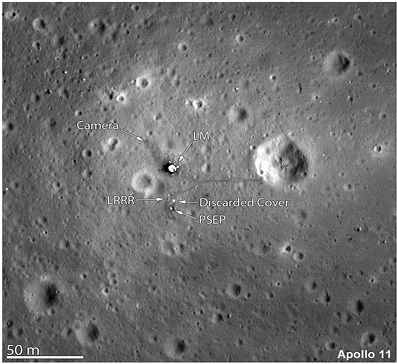
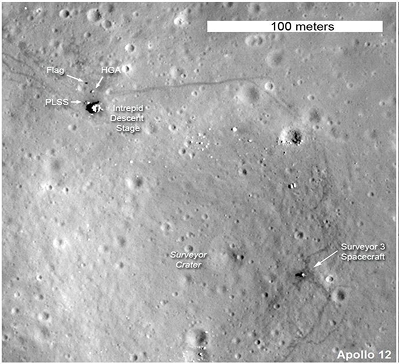
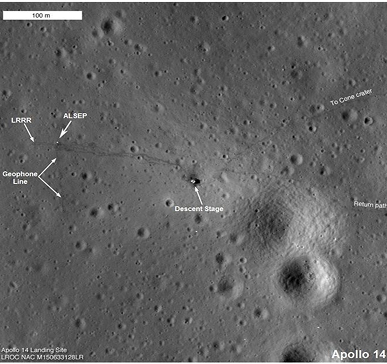
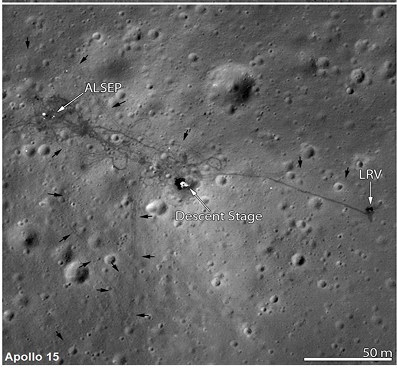
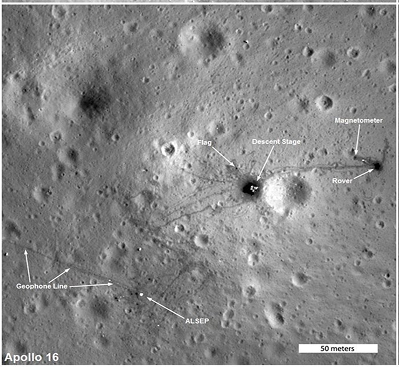
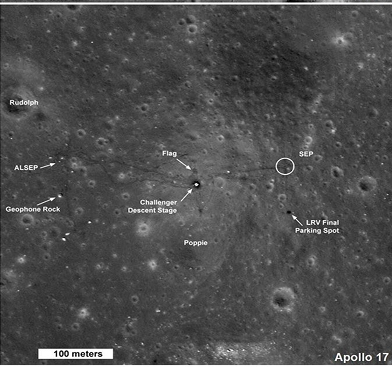
6 Apollo landing spots Imaged By the NASA lunar probe, Indian Chandrayaan II
(@IsaNini7 via X)
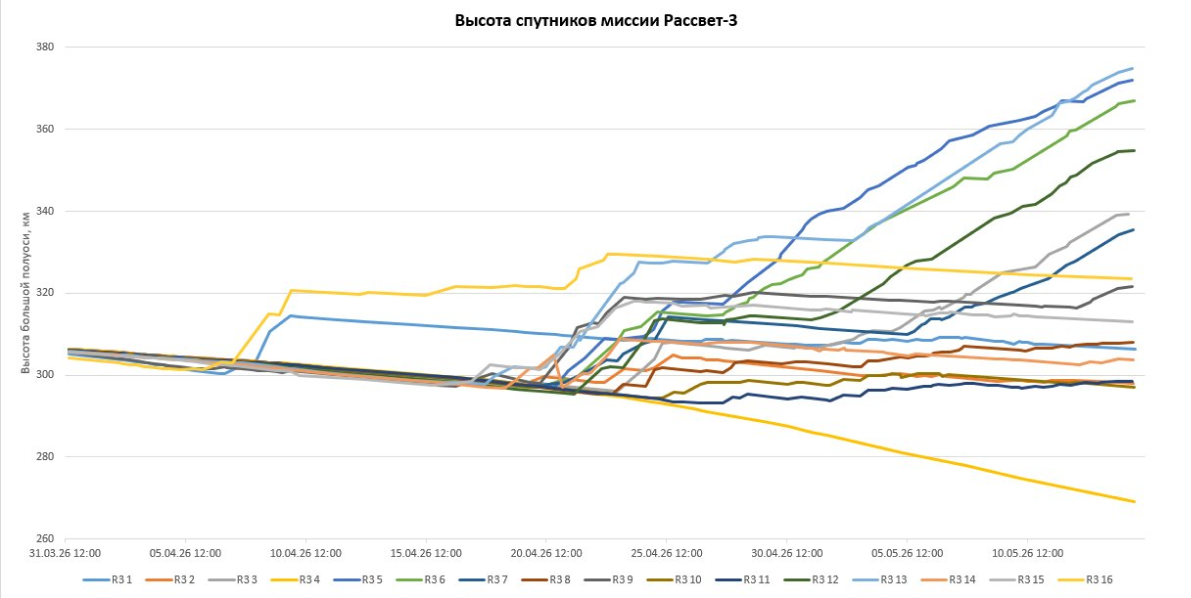
“Graph of semi-major axis altitude of all 16 Rassvet satellites The majority started raising their orbits almost a month after the launch…One satellite remains inactive, possibly lost.”
(@robert_savitsky via X)
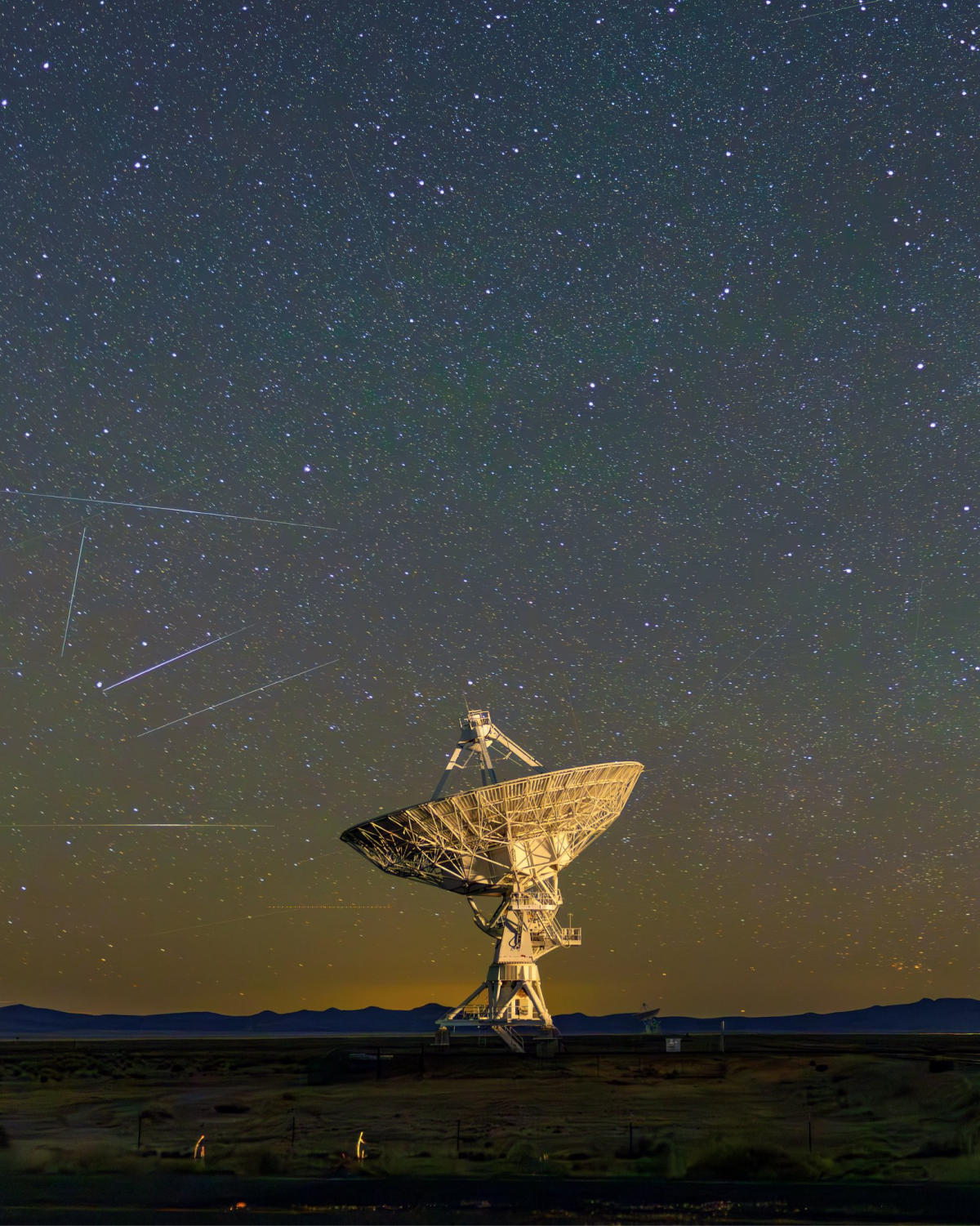
“Very Large Array (VLA) in New Mexico…Massive radio telescopes work hard through the night to bring us data from the stars.”
(@AJamesMcCarthy via X)