
ISSUE 150 | July 26, 2026
The integrity flash
Analysis of Developments in the Space Domain

Exit Stage Right: Cosmos 2589 Heads East
20 – 24 Jul 2026: Russian space operators reduced Cosmos 2589’s (64467) average altitude by at least 33km. The maneuvers have generated a 0.4°/day eastward drift. Observations on 25-26 July show that the satellite had levelled out and continues to drift eastward. This is the first significant maneuver from Cosmos 2589 since it arrived at 98.0°E in April 2025. Recall Russia launched Cosmos 2589 in June 2025 into a Geosynchronous & Highly Elliptical orbit back in June 2025. The satellite released a sub-satellite, Cosmos 2590 (64527) two-weeks later and for the next 5 months the sub-satellite conducted several RPOs against its parent satellite. From Nov 2025 through April 2026 Russian space operators methodically circularized Cosmos 2589’s orbit and it eventually parked at 98.0°E where it was joined by USA 325 (51281) for several weeks. USA 325 departed the area in early July and was replaced by USA 271 (41745) (see next article.)
Now we wait to see where Russia decides to park Cosmos 2589. Even more importantly observers will also be keen to identify the release of any additional sub-satellites which may be on board Cosmos 2589. Cosmos 2589 is of particular interest due to its potential GEO inspector mission. As noted in the 22 June 2025 Flash, excellent research from Bart Hendrickx links Cosmos 2589 with the CNIIHM Insitute which has, in-turn, been linked to Russian inspection/anti-satellite programs.
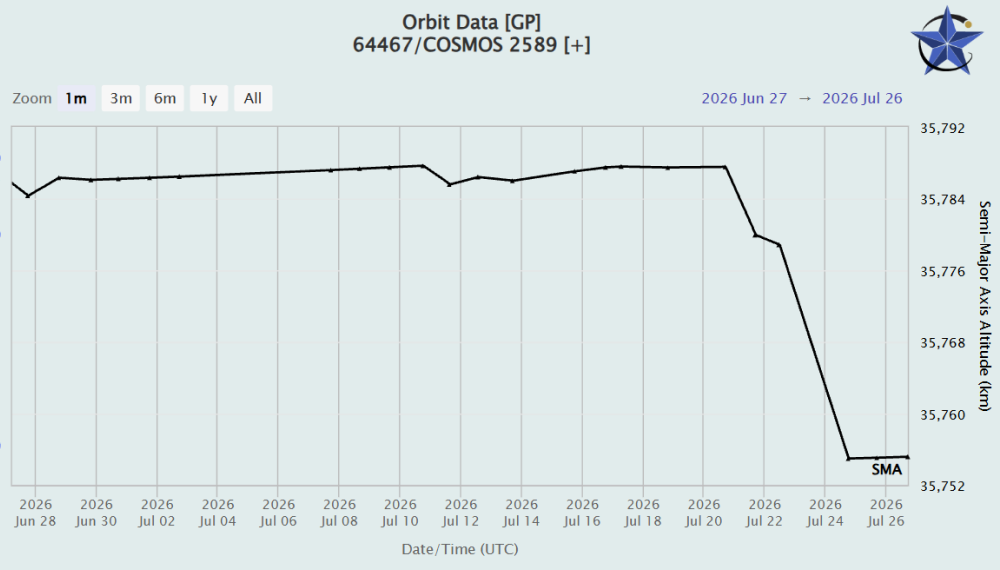
21-24 July 2026: Cosmos 2589 Decreases SMA at least 33km Initiating Eastward Drift Departing its 98.0°E location where it had resided Apr-Jul 2026.
(celestrak.org)
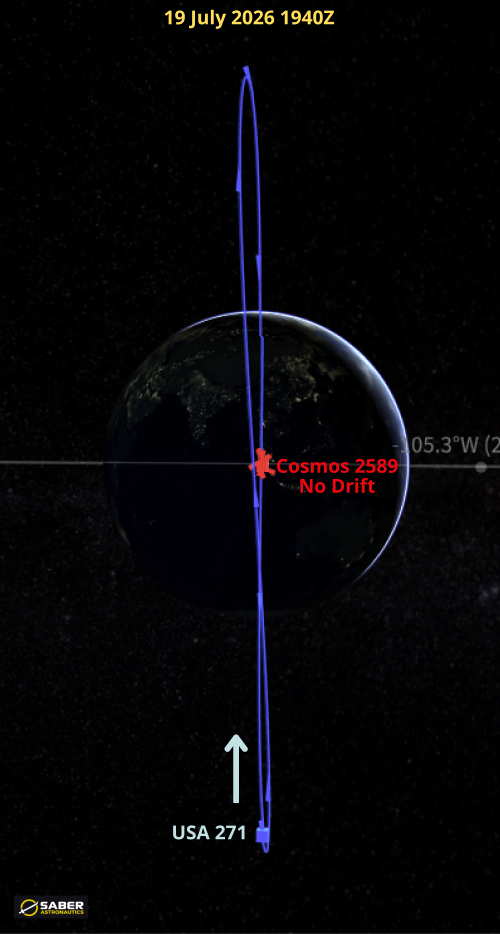
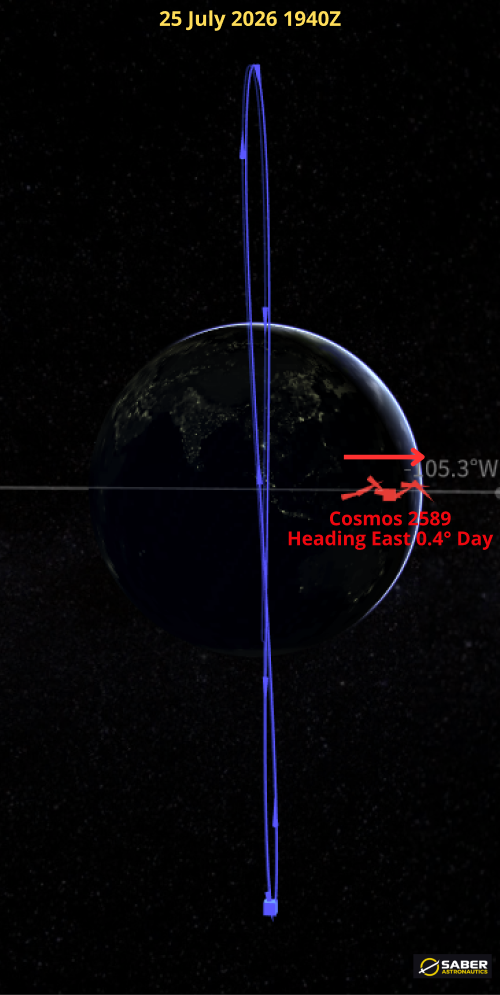
25 July 2026: Skipping Town. Cosmos 2589 Now Moving Eastward at 0.4°/Day
Per Available Observation Data USA 271 Has Not Responded
(saberastro.com)
Ever Vigilant: US GSSAP Monitoring of Cosmos 2589
4 – 16 Jul 2026: As we discussed in the Flash edition 148, the US has maintained a close watch over Cosmos 2589 since it arrived in the GEO belt in early May 2026. From May through early-July USA 325 (51281, GSSAP 6 launched in Jan 2022) remained in vicinity of Cosmos 2589 at 98.0°E longitude. USA 325 decreased its average altitude nearly 250km 3-4 July resulting in a 3.17° eastward drift. As USA 325 was conducting its maneuver, USA 271 (41745, GSSAP 4 launched in Aug 2016) arrived at 98.0°E. From its new location USA 271 appears to have taken over responsibility for monitoring Cosmos 2589 as USA 325 heads east toward its next mission. <NOTE: we’re waiting to see if USA 271 responds to Cosmos 2589 maneuvers 20-24 July>
There are some important differences between USA 271 and 325. USA 271 hasn’t conducted a North/South Stationkeeping maneuver since late-2021 and over the last 5+ years its inclination has increased from 0° to 4.27°. By comparison USA 325 has an inclination of 0.678° while Cosmos 2589 is inclined 0.034°. USA 271, like USA 325 had 2 close approaches/day with Cosmos 2589, however with the large inclination difference US space operators will need to contend with a differential velocity at time of closest approach of ~228m/sec or 7.6x greater than the ~30m/sec for USA 325. (For reference a 9mm bullet travels at ~330m/sec as it leaves the barrel).
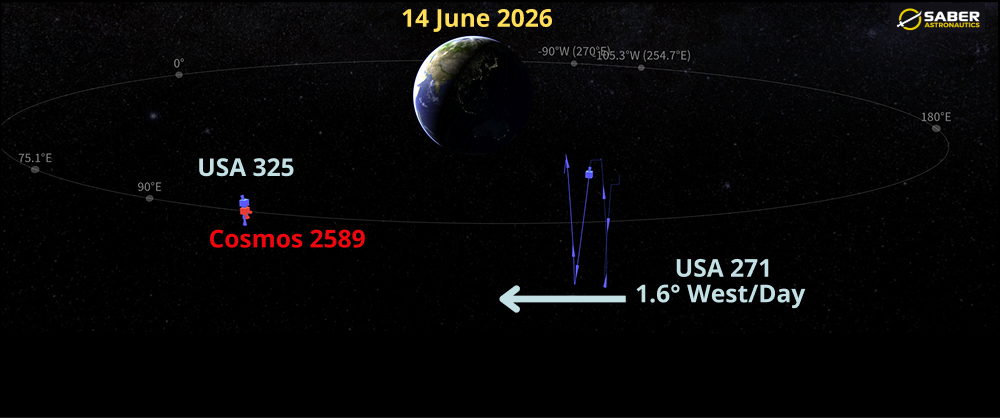
14 June 2026: USA 271 Has Initiated Westward Drift at 122.6°E and Is Heading Toward Cosmos 2589 & USA 325 at 98.0°E
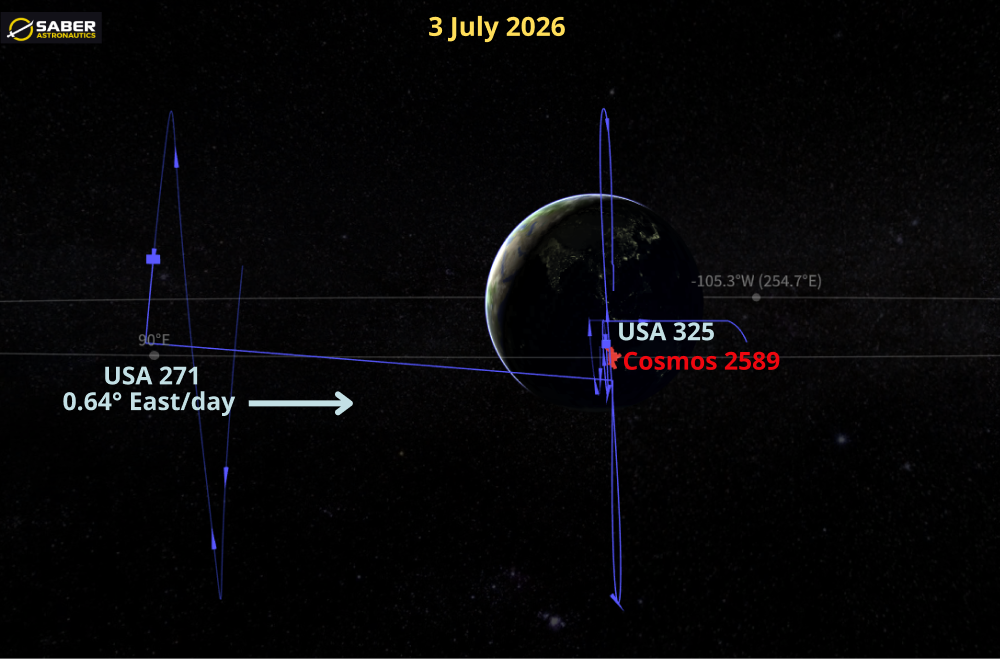
3 July 2026: Per Publicly Available TLE Data USA 271 Drifted to the West of Cosmos 2589 25 Jun – 3 Jul. On 3 July USA 271 Decreased its SMA & Headed East toward Cosmos 2589. USA 325 Remains On Station at this time.
(saberastro.com & celestrak.org)
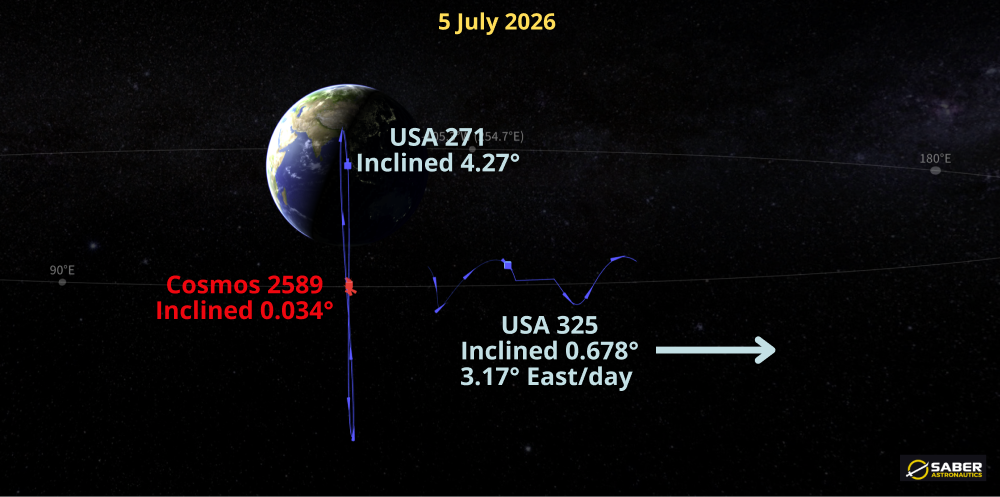
5 July 2026: USA 271 Arrives at 98.0°E & Increases SMA to Join GEO.
Begins Inspection Operations of Cosmos 2589.
USA 325 Reduced SMA ~250km & Is Now Heading East at 3.17°/Day.
(saberastro.com & celestrak.org)
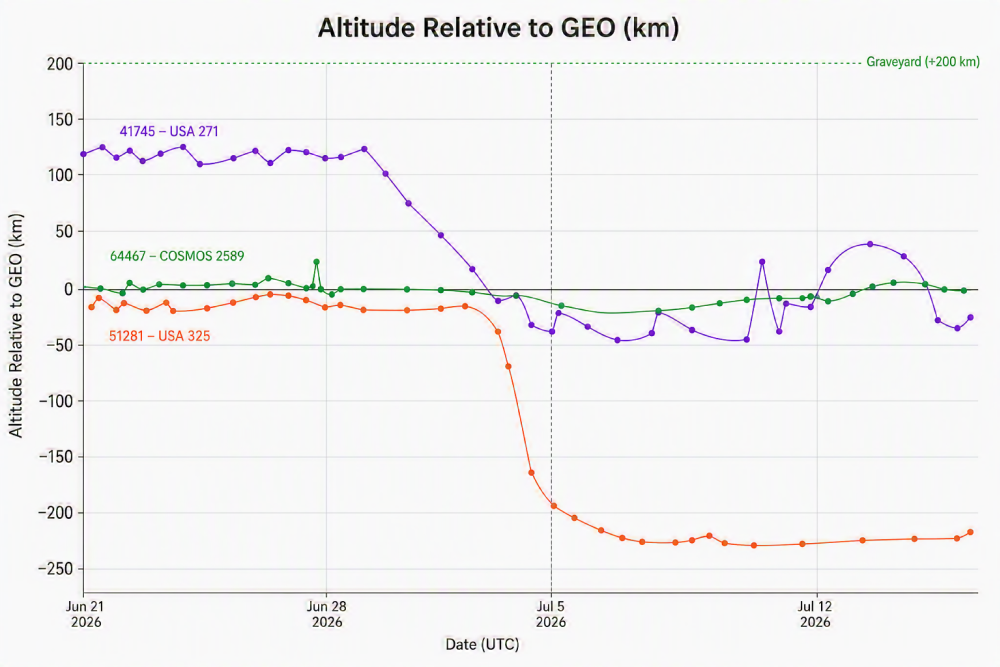
21 June – 16 Jul 2026: Graph Showing USA 271 Over GEO Belt (westward drift) Until 4 July.
As USA 217 Re-Joins GEO, USA 325 Decreases SMA and Heads East.
Cosmos 2589 Remains Virtually Unchanged During Encounter
(based on data from saberastro.com)
POCA Analysis: For 12-15 July the best imaging opportunities occurred as USA 271 passed Cosmos 2589 when traveling from North to South. At ~1500Z the range between the two satellites was 40-80km with favorable lighting conditions for USA 271. 12 hours later as USA 271 passed Cosmos 2589 as it traveled from South to North the range is 70-100km with marginal lighting conditions. <NOTE: again this is prior to Cosmos 2589’s maneuvers 20-24 July.>
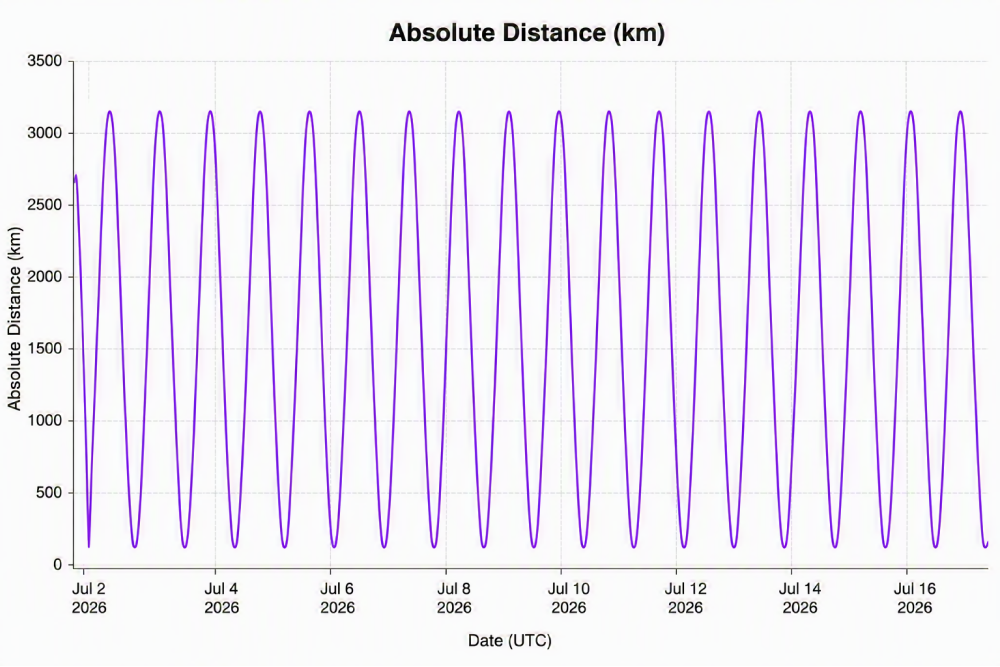
2-16 Jul 2026: Graph Showing Absolute Distance Between USA 271 & Cosmos 2589.
Due to Large Inclination Difference Range Varies from less than 50km to over 3,000km.
(based on data from saberastro.com)
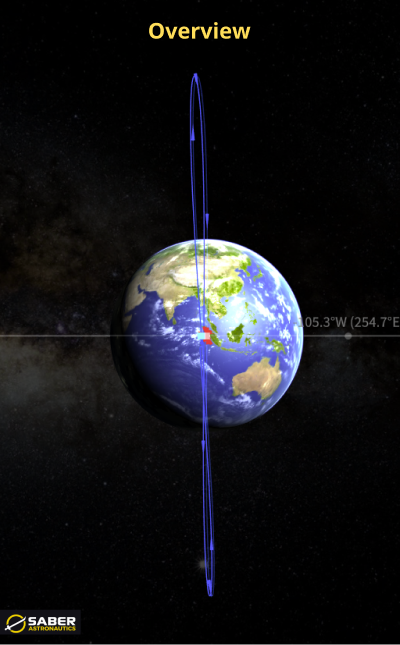
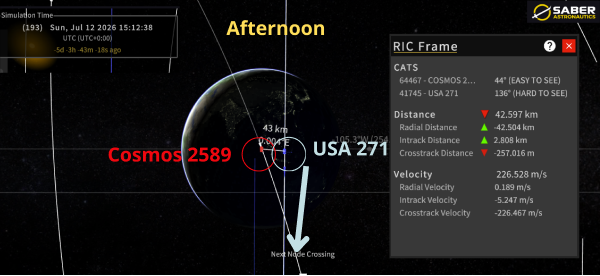
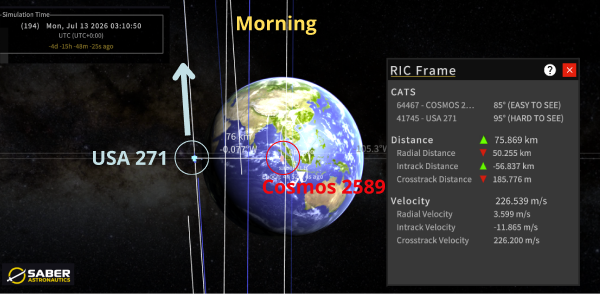
12-13 Jul 2026: USA 271 has 2 Passes/Day (~0300 & 1500Z) of Cosmos 2589.
Afternoon Pass Provides Closer Range & Favorable Lighting Conditions
All Passes Must Contend with High Differential Velocity
(saberastro.com)
Final Thoughts: US Space Operators likely faced an interesting choice with USA 271 from 2021-2023…whether to use their remaining fuel to conduct North/South Stationkeeping which requires ~50m/sec every year, or conserve their fuel and be able to respond to evolving mission requirements such as Cosmos 2589. By not conducting N/S stationkeeping operators now must mission plan to image a target that has 1/125th of USA 271’s inclination which generates a differential velocity of ~228m/sec at time of closest approach. Of course, if operators had conducted N/S stationkeeping for the past 5 years (about 250m/sec total) they may have completely used up their propellant and been taken out of mission months or years ago.
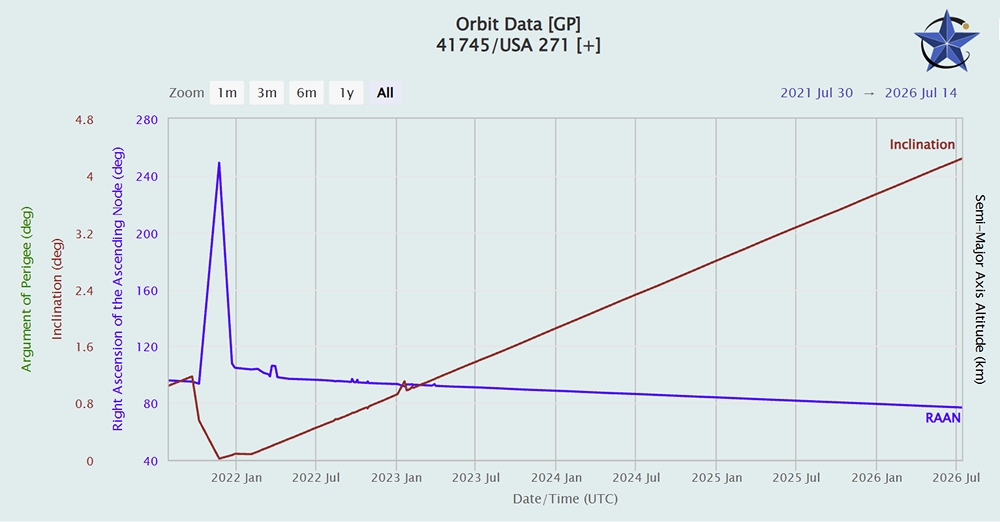
USA 271 Inclination/RAAN Values 2021-2026. Last North/South Stationkeeping Manuever Occurred in Late 2021. Inclination Has Since Grown from 0 to 4.27°
(celestrak.org)
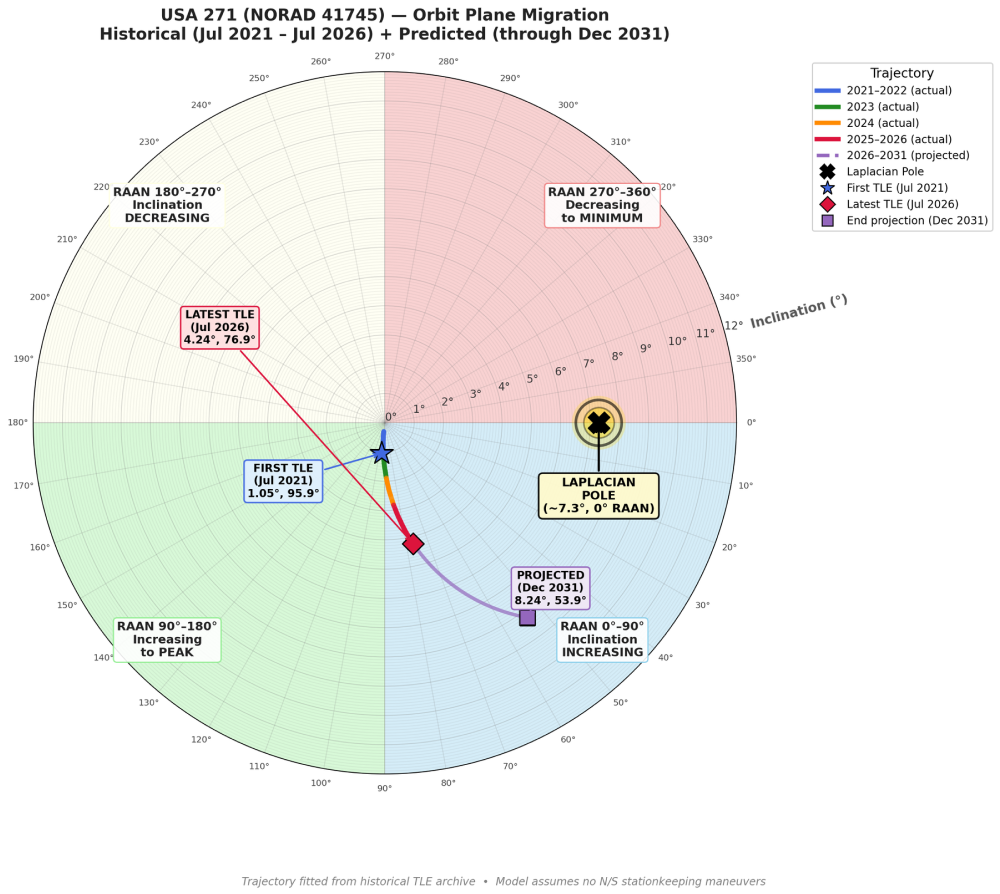
USA 271 Inclination/RAAN Values 2021-2026. Last North/South Stationkeeping Manuever Occurred in Late 2021. Inclination Has Since Grown from 0 to 4.27° & Will Reach 8.24° In the Next 5 Years
(based on data from celestrak.org)
China Mid-Year Review: 2026
by Ron Lerch
So far in 2026, China has continued to further develop its proliferated constellations, pursue reusable capabilities, and launch classified satellites to LEO and GEO offering minimal information about their exact mission. China has conducted slightly more launches compared to this timeframe last year. Recent research has been focused on space-to-ground laser comms and countering proliferated constellations. As for its lunar ambitions, China continues to progress with the critical hardware required for supporting a 2030 mission. The next high visibility event will be later this summer when a lander attempts to survey the moon’s south pole.
As of 23 June, China has conducted 43 launches, 13 of which were performed by commercial providers. CAS Space is the current front runner in the commercial market, regularly providing launches in support of China’s Jilin commercial remote sensing constellation. Chinese media has highlighted over the past year that the company’s Kinetica-1 solid rocket offers a very competitive, low-cost per kg ($3-5K) option to access space. On the other hand, there have been 3x failed launches across China’s launch enterprise. A notable failure occurred on 16 Jan, which resulted in the loss of a Shijian-32 satellite due to a failure with the government-owned Long March 3. Multiple companies continue to chase reusability as well. Landspace’s Zhuque-3, which is expected to launch in July, and Space Pioneer’s Tianlong-3 are the closest commercial contenders, with the former serving as the only rocket that has attempted (but failed) orbital recovery. The government-owned Long March 10B is also expected to launch in July and recover at sea via a wire-network catch on a barge. However, this rocket will not be as efficient in terms of reusability compared to the Zhuque-3 as the Long March 10B uses traditional aerospace alloys, kerolox for its first-stage, and does not have landing legs. Launch tempo will likely increase as historically China conducts more launches in 2nd half of the year, partially due to better weather. The fall and winter months bring much more stable, dry, and clear atmospheric conditions across northern and western China.
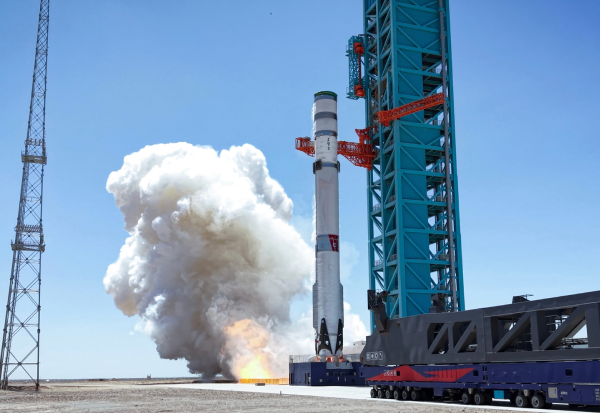
Zhuque-3 Static Fire Test (Landspace)

Barge for Long March 10B (Hainan Daily)
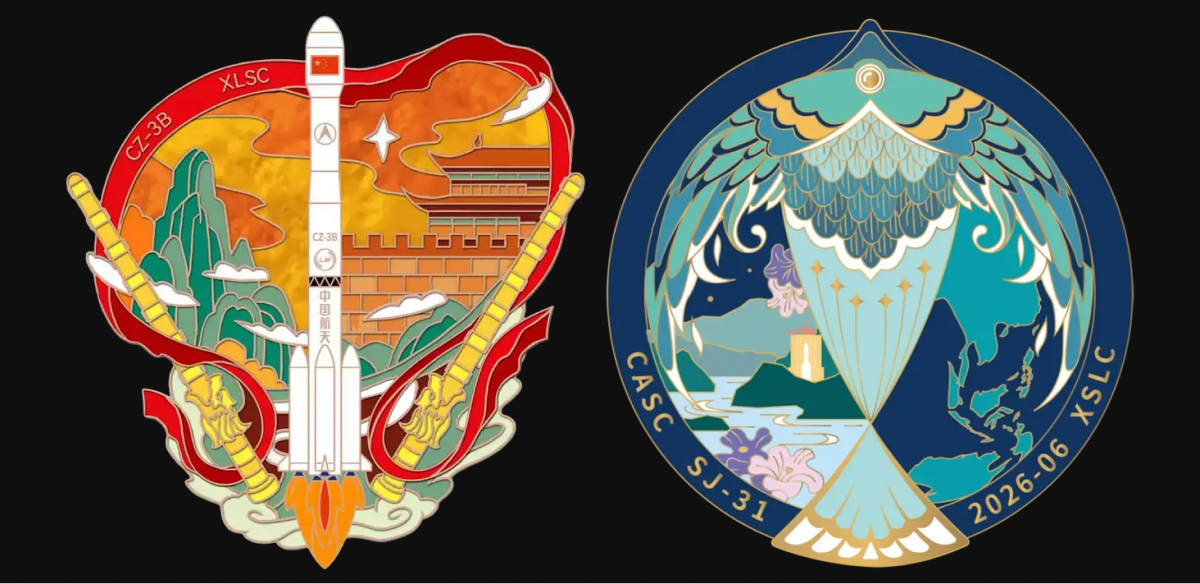
2026 has continued to affirm China’s commitment towards mirroring U.S. efforts to leverage proliferated architectures. As of 23 June, the two proliferated constellations, SatNet and SpaceSail, are now comprised of over 400x satellites in total. The Government’s SatNet has seen the addition of Groups 18-22 with typically 9x spacecraft per group. The commercial offering, SpaceSail, has surged since April by adding Groups 8-12 with typically 18x spacecraft per group. The difference in group size suggests SatNet satellites are heavier than their commercial counterparts, likely due to additional, non-advertised capabilities. China has also continued to add additional TJS-series spacecraft. These “experimental communication satellites” are notorious for moving around the GEO-belt in ways that indicate a greater mission than simply SATCOM. TJS-24,25, and 26A have joined so far this year, with the latter’s naming convention suggesting it will be part of a forthcoming pair. On 6 Feb, China launched its secretive Shenlong spaceplane for its fourth mission. Recent commercial analysis indicates the spaceplane released an object, possibly to test rendezvous & proximity operations. The Shijian-31 and Shiyan-33, launched in June and March respectively, are other high interest satellites added this year. Notably, Shijian-31 is in a highly eccentric orbit, which is a first for this family of spacecraft. Shijian, which translates to practice, satellites have in the past demonstrated on-orbit robotics and refueling capabilities, suggesting spacecraft with this nomenclature are more likely to demonstrate “closer to” operational capabilities. Shiyan, which translates to testing, satellites are more secretive and likely in the earlier phases of development.
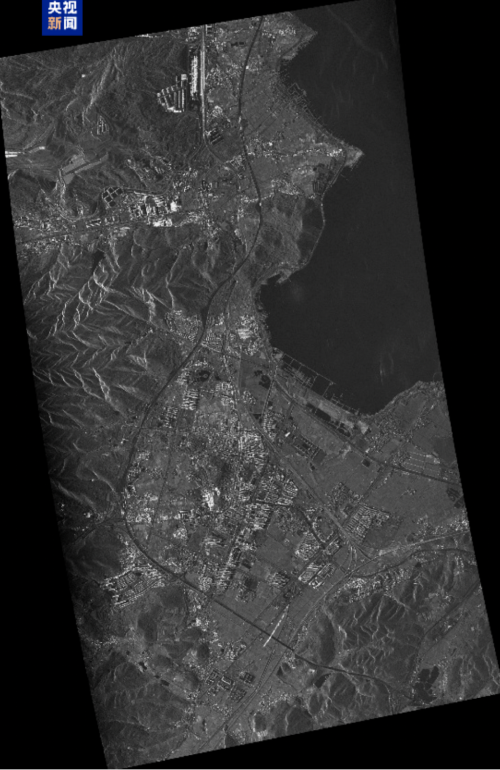
There have been notable technological breakthroughs and research efforts this year. In January, Chinese Academy of Sciences (CAS) reported they had successfully conducted a 120 Gbps space-to-ground laser communications experiment. The milestone topped previous breakthroughs of 10 Gbps in 2023 and 60 Gbps in 2025. During the experiment, a batch of synthetic aperture radar (SAR) images from AIRSAT-02 were passed to a laser ground station in northwest China. Furthermore, researchers noted the maximum continuous communication duration was 108 seconds, during which a total of 12.656 terabits of data were transmitted.
CAS added, “this achievement sets a new domestic record for satellite-to-ground laser communication transmission speed and addresses key challenges associated with ultra-high-speed links, including rapid link establishment, long-duration stable operation, and efficient, reliable data transmission.” A capability like this, once fielded at scale, could afford “high-volume remote sensing data dumps” for commercial and government users.
Separately, in February the Northwest Institute of Nuclear Technology in Xian claimed to have developed a compact, ultra-powerful high power microwave driver designated the TPG1000Cs. Researchers added the 12-ft long, 5-ton device can deliver 20 gigawatts of microwave power for up to 60 seconds and has allegedly completed ~200,000 test pulses thus far. Researchers explicitly described it as a counter-LEO constellation system. South China Morning Post (SCMP) even referred to it as potentially “Starlink’s worst nightmare.” China is clearly concerned with mitigating this type of technology as well. In April, a research paper funded by the China Academy of Spacecraft Technology was published, highlighting the effects of high-power electromagnetic pulse (EMP) interference. Researchers discussed how artificial EMPs can not only affect satellite communication, navigation, and other payload operations, but also easily couple to satellite electrical power systems (EPSs). This could cause problems such as overvoltage or short circuits in the satellite’s EPS seriously endangering the spacecraft’s lifespan and in orbit health condition.

TPG1000Cs High-Power Microwave Driver( SCMP)
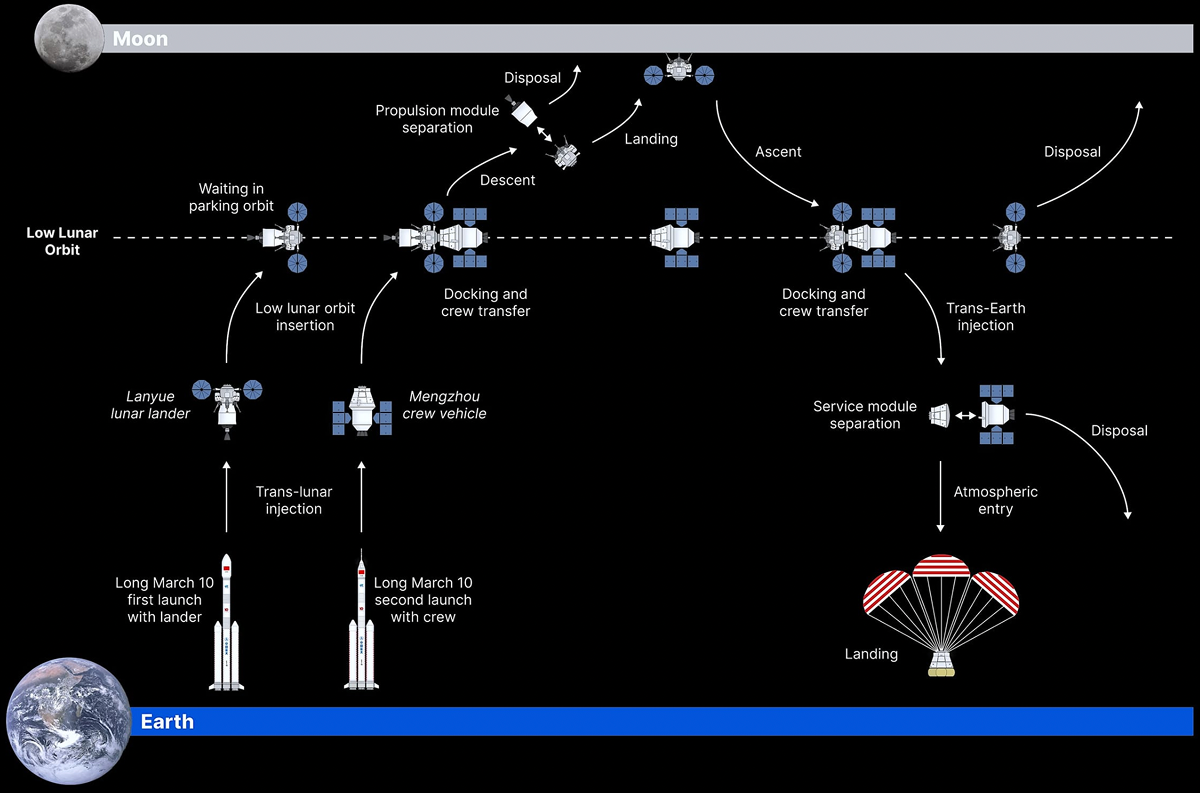
In May, China merged its crewed lunar landing program and the robotic Chang’e program into a single Lunar Exploration Project under China Manned Space Agency. Previously, the Chang’e program was overseen by the China National Space Administration. The merger aims to limit redundant efforts while fully leveraging decades of technical expertise. Several key elements of the future lunar mission have advanced this year. The Chang’e-7 arrived at Wenchang Space Launch Center in April. The spacecraft, which should launch later this summer, intends to survey the lunar south pole and is expected to carry scientific instruments developed by multiple countries. The Long March 10, which is the rocket that will carry the crew for its future lunar mission, has completed ignition testing and low-altitude demonstrations. The Mengzhou crewed spacecraft completed an emergency escape test in February and multiple large-scale ground verifications. The Lanyue lunar lander completed landing and ascent tests. Lastly, the Wangyu EVA spacesuits for the crew are undergoing engineering development. China remains laser focused on accomplishing a crewed lunar landing by 2030. The current plan is for the Long March 10 to launch the Mengzhou and Lanyue separately, dock in lunar orbit, and have 2-3 taikonauts land/stay on the moon for approximately 6 hours.
China: TJS-26A Arrives in GEO
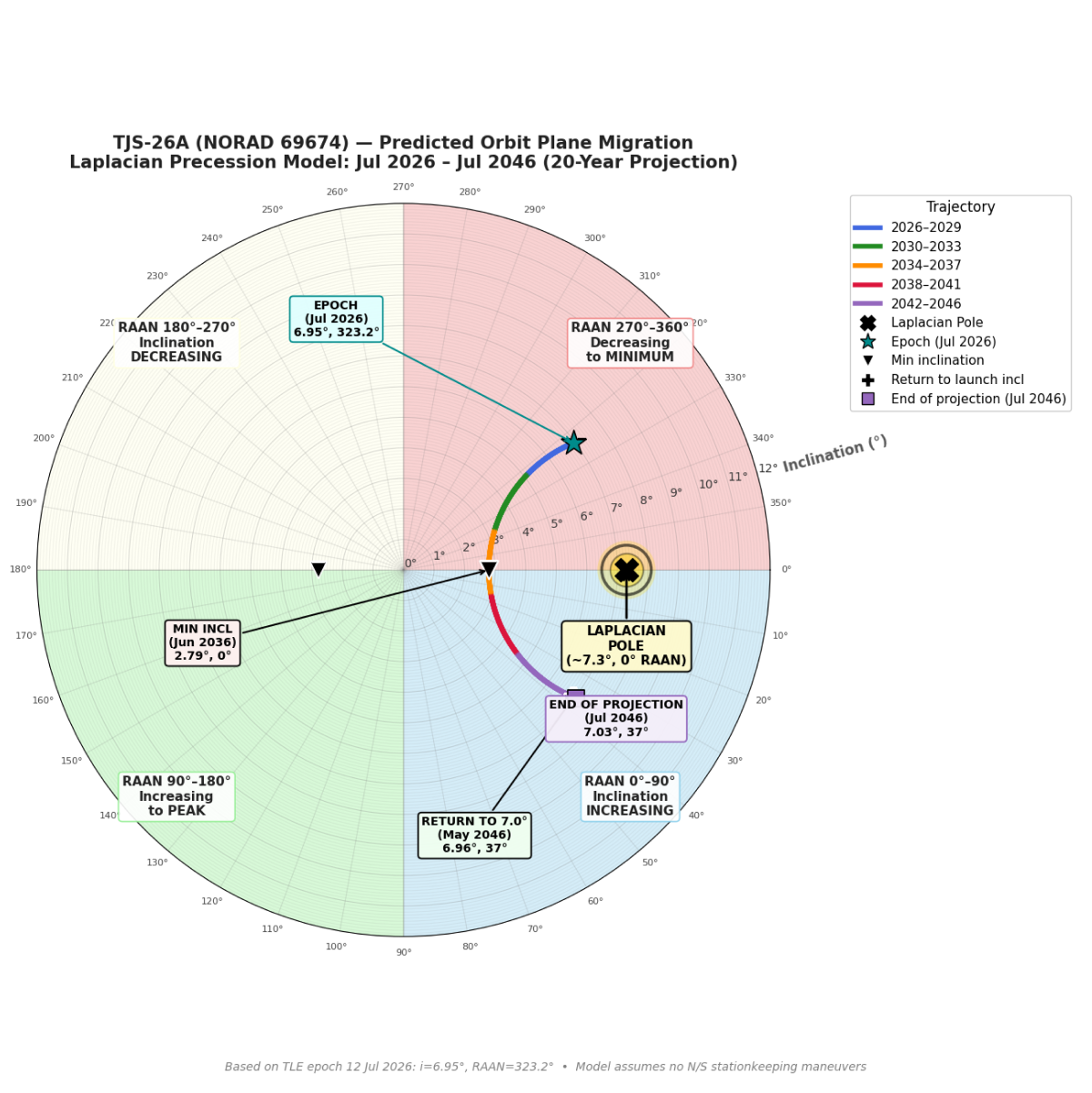
12 Jul 2026: China has parked TJS-26A (69674) in geosynchronous orbit at 107.5°E longitude. As with several recent TJS launched, China has place TJS-26A into an inclined orbit, and at 7° I believe TJS-26A has the highest inclination yet for any TJS satellies (excluding TJS-13 and -21 which are in Molniya orbits). As it did with TJS-11, TJS-20, TJS-23, and TJS-25, China launched TJS-26A into an “inclination biased” orbit plane (RAAN is 323°). For the next 10 years the gravitational pull of the sun and moon will combine to reduce TJS-26A’s inclination down to ~2.8° before it begins to increase again. TJS-26A will remain at or below its current 7° inclination for ~20 years, eliminating the need for fuel expensive North/South stationkeeping maneuvers. Average inclination stationkeeping requires ~50m/sec of energy per year, so this technique will save ~1,000m/sec of fuel over the course of 20 years. Decreasing fuel requirements enables a couple of options: 1) extended lifespan of satellite; or 2) decreased fuel mass allowing for greater mass budget for payload.
China has parked TJS-26A in vicinity of TJS-5 (44978) which is also at 107.5°E. China launched TJS-5 in 2020 and the satellite is believed to be one of China’s Huoyan missile warning satellites. As with the other Huoyan satellites (TJS-2 and TJS-6) China actively maintains TJS-5’s inclination at near 0°. Twice a day TJS-26A passes ~35-65km from TJS-5 with favorable lighting conditions. This may be purely coincidental, the vast majority of the time the satellites are separated by 1,000s of kilometers.
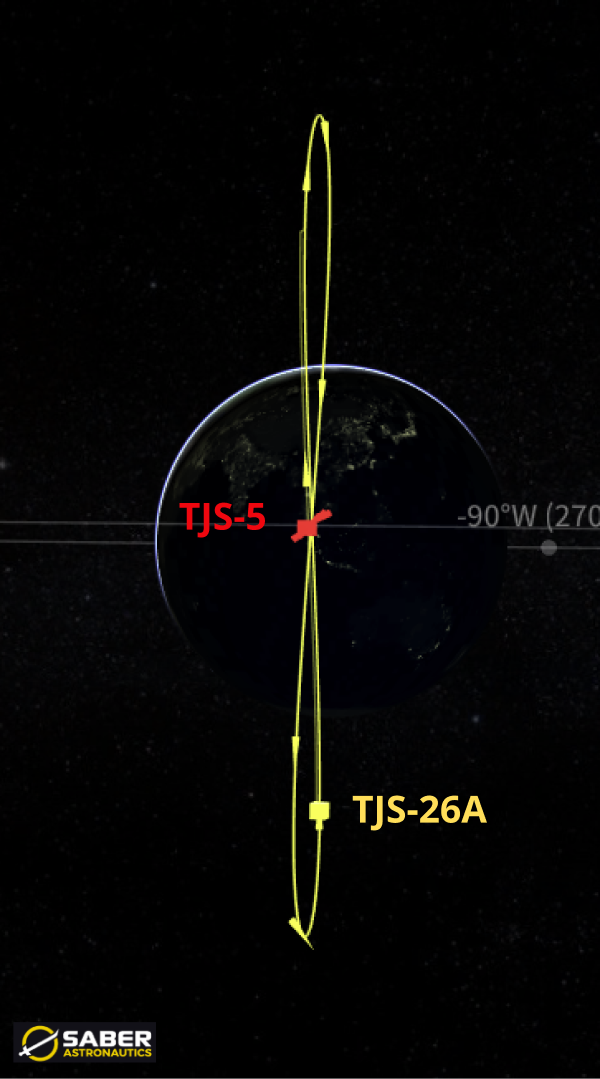
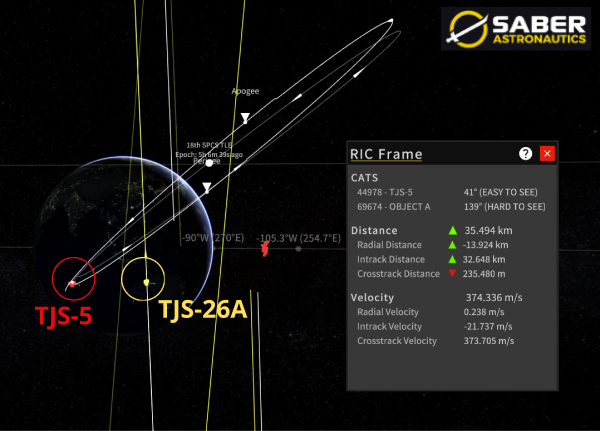
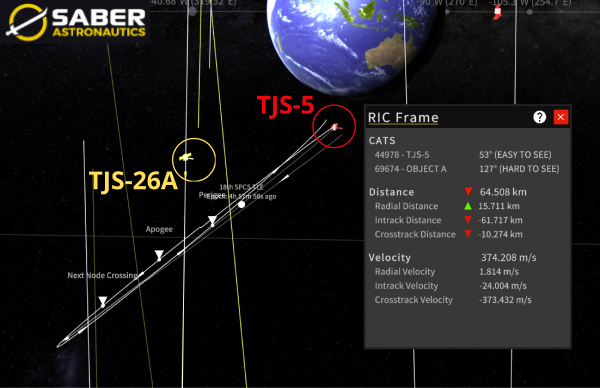
Twice per Day TJS-26A Has a Close Approach
(35-65km) with TJS-5 (saberastro.com)
In the previous Flash I noted China’s mission description for TJS-26A matched that of TJS-14 (62804) and TJS-22 (66990). Chinese official media reported all three satellites “will be mainly used for services such as satellite communications, broadcasting and television, and data transmission, as well as for conducting related technology test verifications.” While their missions descriptions were identical all three satellites are operating in different orbital planes. TJS-14 (launched in 2025) is inclined 0.73° and parked at 18.4°E, TJS-22 (also launched in 2025) is inclined 1.5° and parked at 66.5°E. TJS-14 and -22 both launched on a LM-3B while TJS-26A launched on a LM-7A.
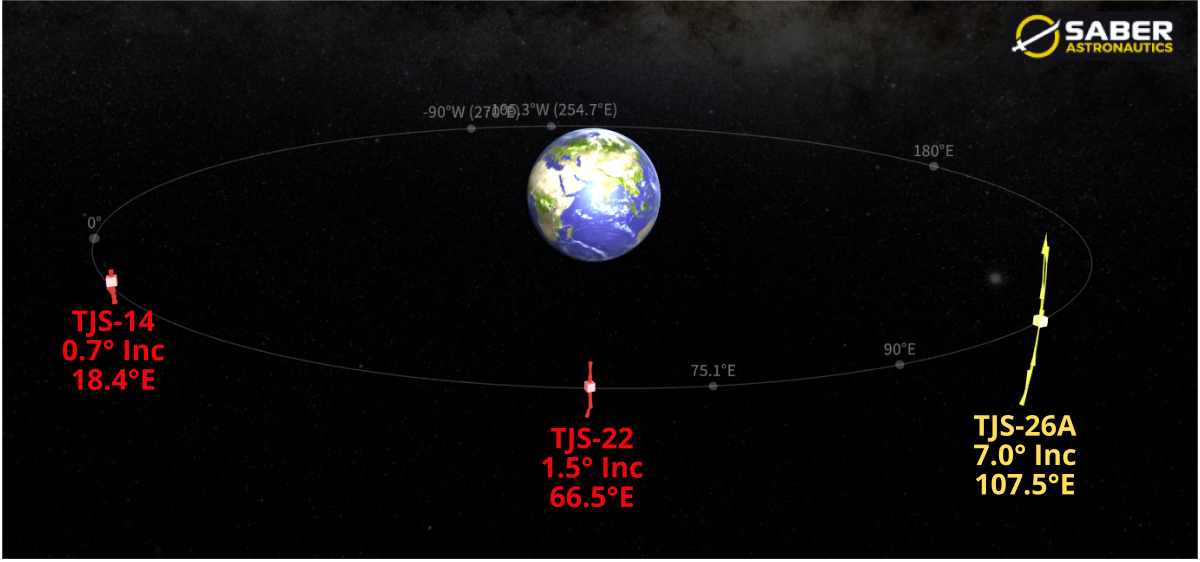
While They Share a Common Mission Description There are No Obvious Orbital Similarities Between TJS-14, 22 & 26A (saberastro.com)
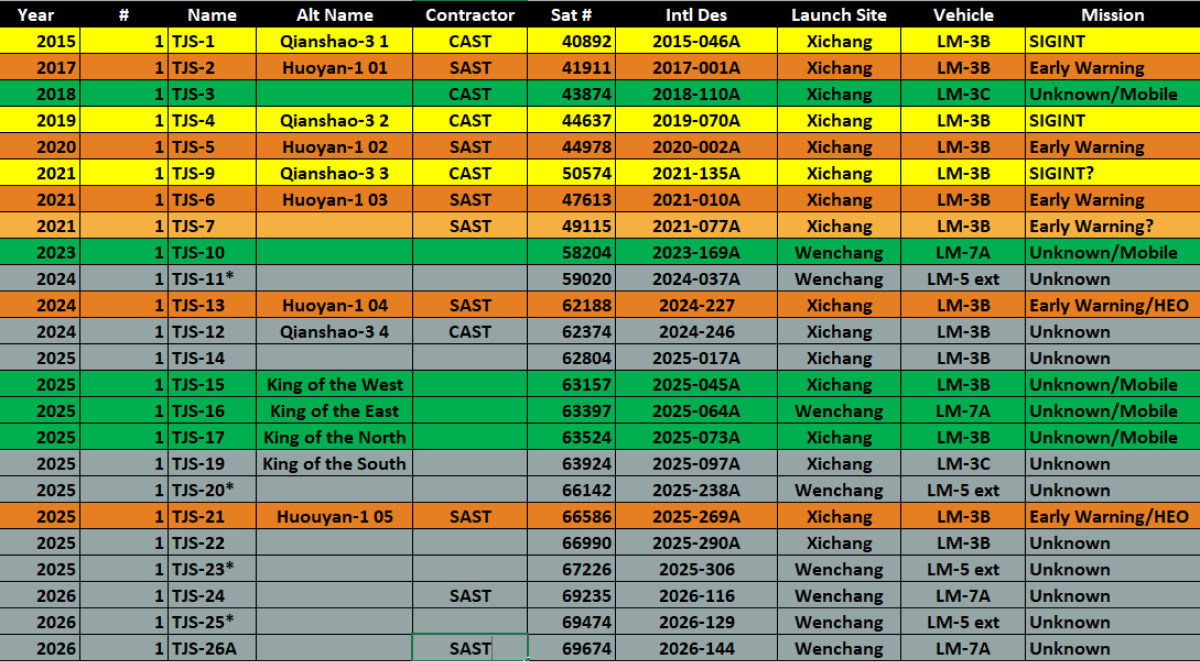
China’s Growing TJS Catalog (15 of 24 Have Publicly Unknown Missions (Gunther’s Space Page, Celestrak.org)
China: SpacePlane Shenanigans!
12 Jul 2026: As I noted in the previous Flash, China’s fourth Shenlong flight (67689) released a sub-satellite, Object H (69673), on ~23 Jun. From 26 Jun – 8 Jul Object H made a series of in-track maneuvers (increasing/decreasing its SMA). On 1 Jul as Object H “passed” Object G, it completed at least 2 Natural Motion Circumnavigation (NMC) revolutions around Object G (59884) at ranges between 10-60km. Watch SaberAstro video. Shortly afterward China increased Object H’s SMA which resulted in Object H falling behind Object G.
Object G is a relic from the third Shenlong mission…China’s spaceplane released Object G on 25 May 2024 and the Object performed RPO missions with China’s SpacePlane in early June 2024. You may recall I did a Flash article based on observations from Dr Marco Langbroek at the time. A recent inquiry to Dr Darren McKnight at Leo Labs revealed that Object G remains stable. Object G has not maneuvered during this time period.
After completing its RPO with Object G, Object H increased its SMA bringing it back towards Shenlong. JCO reporting from 12 July indicates Shenlong may have captured Object H sometime on 12 July.
Timeline:
- 26-30 June: Obj H decreases SMA and closes with Object G
- 30 Jun – 1 Jul: Obj H conducts (at least ) 2 revolution NMC of Obj G. Obj H increases SMA/orbital period falling back to “trail” position.
- 2-3 Jul: Obj H decreases SMA to again approach Obj G. Obj H closes to <10km of Obj G without overtaking
- 4-7 Jul: Obj H increases SMA and begins to fall back toward Shenlong spaceplane
- 7-8 Jul: Obj H decreases SMA to 0.1km of Shenlong (591.3km vs 591.2km respectively).
- 9-12 Jul: Obj H is <10km from Shenlong and slowly moves from lead to trail position. POCA is <1km on 11 Jul. Reporting from JCO indicates Shenlong may have recovered Object H. Last observation of Object H collected on 12 Jul at 0730Z.
- 14 Jul (predicted): Obj G with SMA 0.9km greater than Shenlong moves from lead to trail position. POCA is <2km.
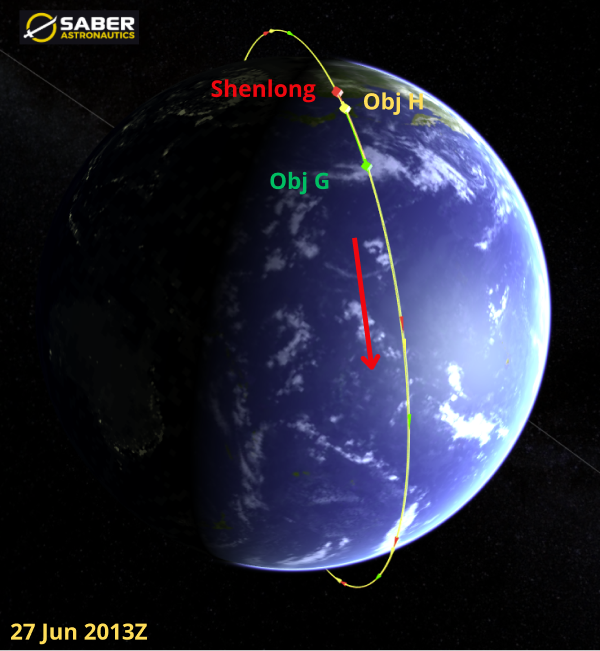
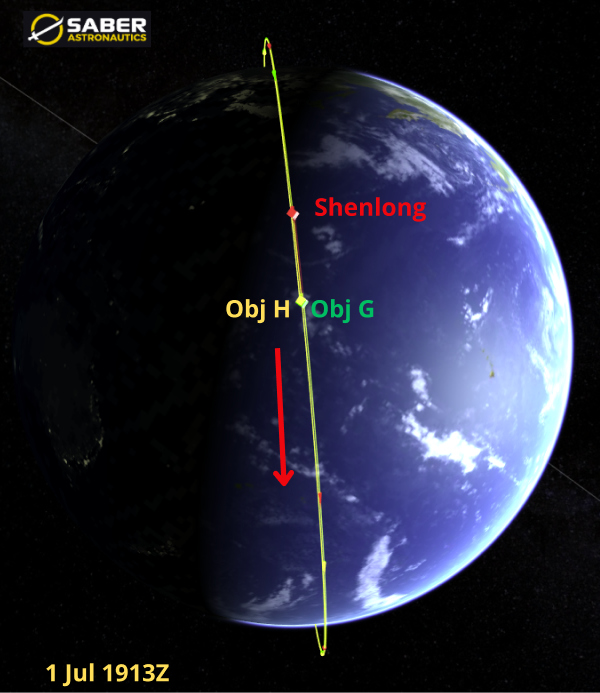
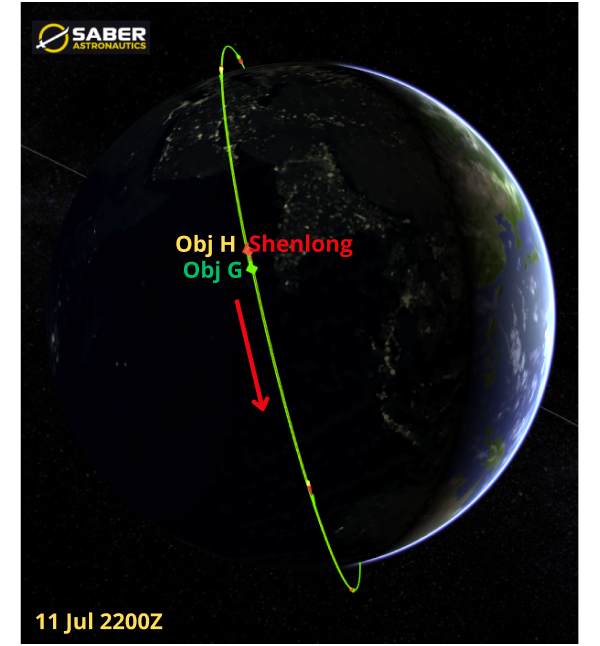
Overview: Shenlong Flight 4 Released Object H which it Released on 23 Jun. Object H then Maneuvered to RPO with Object G.
Object G was Released 2+ years ago during 3rd Shenlong Test Flight
(saberastro.com)
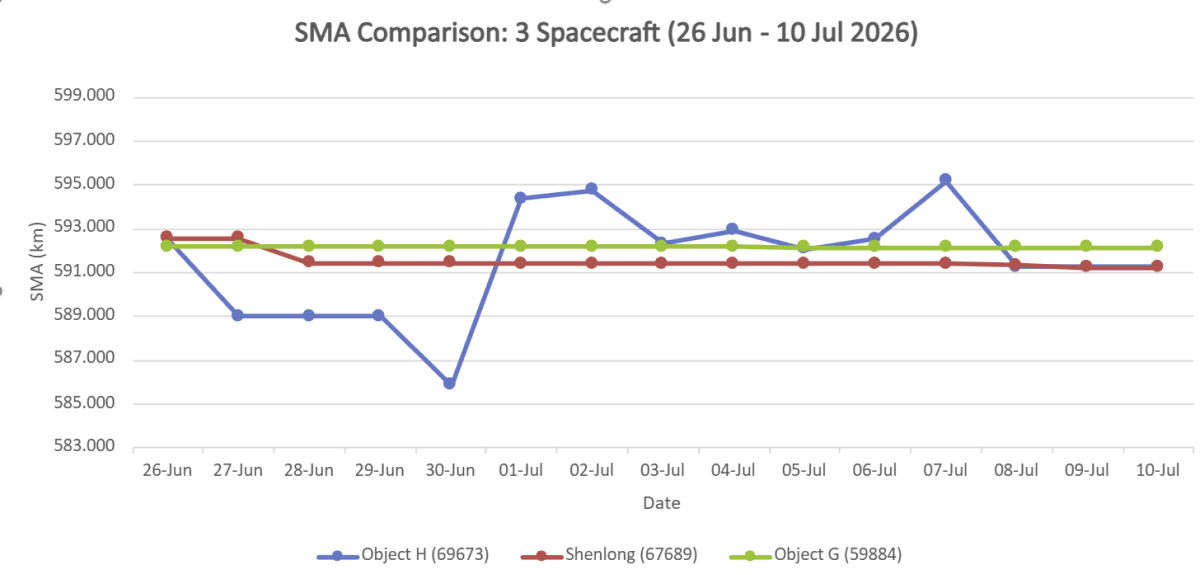
26 Jun – 10 Jul: SMA History of Shenlong, Object H and Object G
(derived from Celestrak data)
Previous Shenlong flights:
1) September 2020 (2-day duration);
2) Aug 2022-May 2023 (276-day duration);
- Shenlong released an object and the two separated ~100km, then Shenlong maneuvered to RPO with the sub-satellite at distances <1km.
- Radar data from private companies like LeoLabs confirmed that the spaceplane performed multiple rendezvous, forced separation, and capture maneuvers with the object before bringing it back to Earth.
3) Dec 2023-Sep 2024 (266-day duaration).
- During this flight it appears Shenlong released 7 objects, 6 soon after launch and”Object G” on 25 May 2024. Object G appears to have maneuvered and tested with Shenlong.
Editor’s Comment: All Shenlong missions have involved releasing a small satellite or object into orbit. All but the first mission included rendezvous and proximity operations (RPO) between Shenlong and its sub-satellite. I believe Flight 4 is the first instance where China has released an object from Shenlong and that sub-satellite has conducted rendezvous-proximity operations (RPO) against a satellite other than Shenlong. As you would expect China is increasing the complexity of its on-orbit testing with Shenlong and its sub-satellites. A logical next step would be to have the sub-satellite perform persistent NMC against a target or even a forced motion circumnavigation.
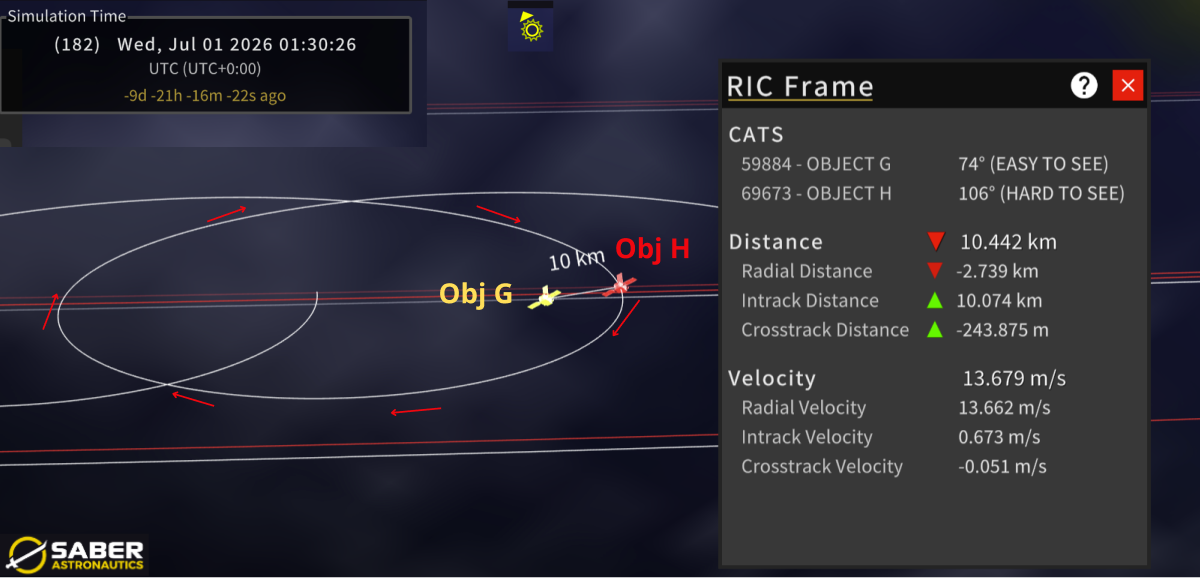
1 July 2026 0111-0236Z: Obj H Completes 1st circumnavigation of Obj G
Range Varied ~10-60km (saberastro.com)
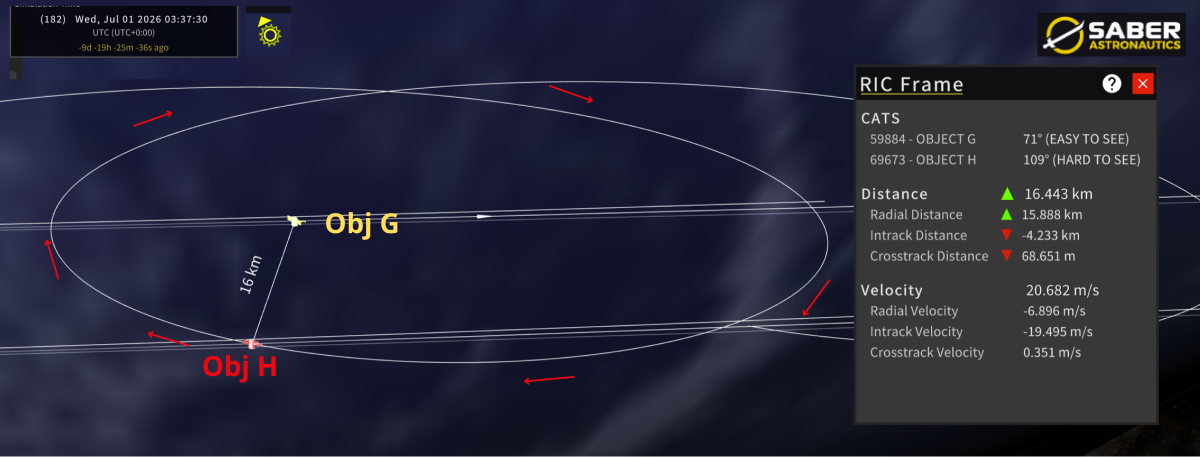
1 July 2026 0236-0411Z: Obj H Completes 2d circumnavigation of Obj G
Range Varied ~16-50km (saberastro.com)
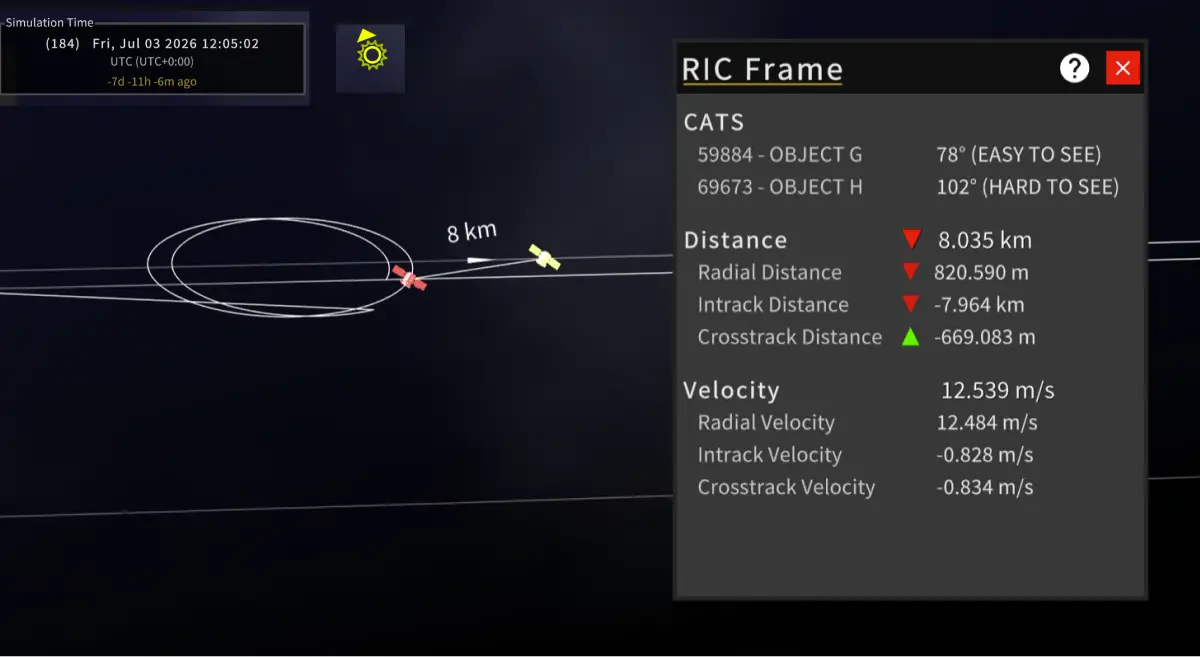
03 Jul 1205Z: Obj H Has 8km Close Approach with Obj G
Low Light Conditions with solar conditions slightly favoring Obj H (saberastro.com)
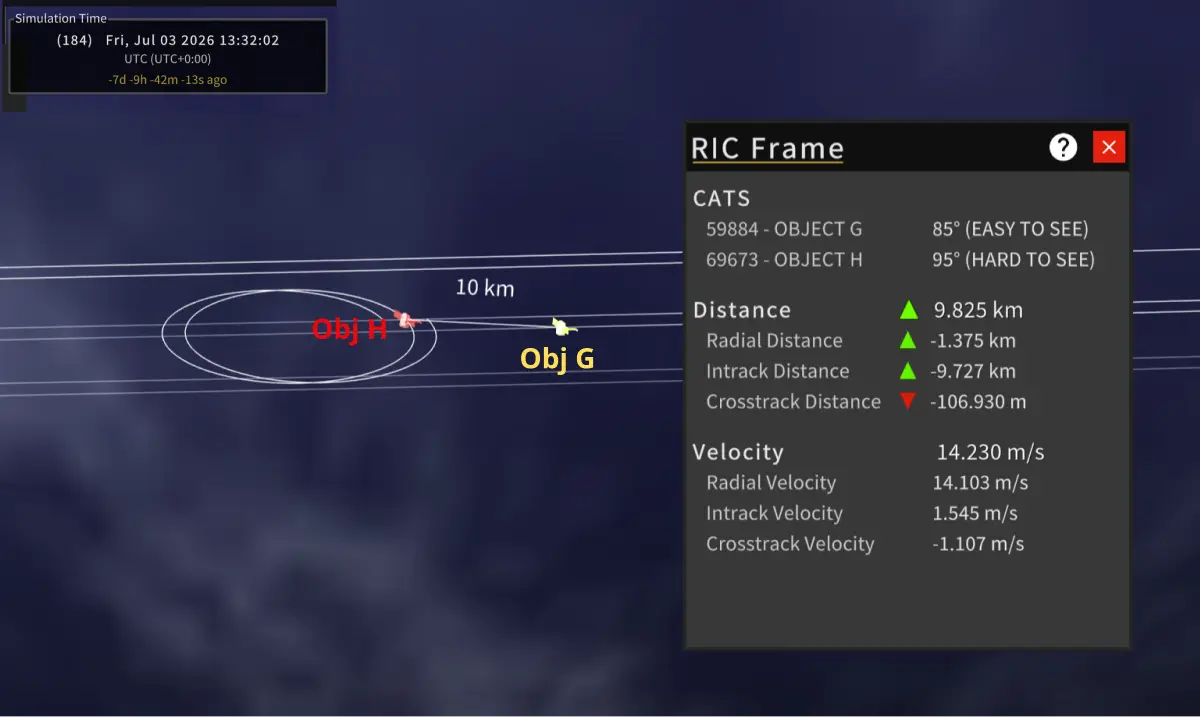
3 Jul 1332Z: As Obj H <10km POCA with Obj G
Low Light Conditions with marginal solar conditions for both satellites (saberastro.com)
China Conducts 2 Qianfan Launches
4 July 2026: China launched a LM-6A with 18 SpaceSail Polar Orbit satellites (Qianfan) from Taiyuan. The launch carried Qianfan’s Group 13 into a near-polar Low Earth Orbit. Launch Video.
5 July 2026: China launched a LM-8A with 20 SpaceSail Polar Orbit satellites (Qianfan) from Wenchang. The launch carried Qianfan’s Group 15 (they skipped Group 14 for now) into a near-polar Low Earth Orbit. This flight marked the debut of the LM-8A following performance upgrades. These upgrades allowed China to launch 20 satellites instead of the typical 18. Unfortunately China did not change its practice of leaving the upper stage in a slow decaying orbit which will need to be tracked for centuries. Launch Video.
There are now 238 Qianfan satellites in orbit. Of the 14 Qianfan launches 8 have used the LM-6A from Taiyuan, 4 have used the LM-8 from Hainan (Wenchang), one has used the LM-8A from Hainan (Wenchang) and one has used the LM-12B from Jiuquan. Orbital information for Groups 13 & 15 was not available as of 12 July 2026. I will update in the next Flash.
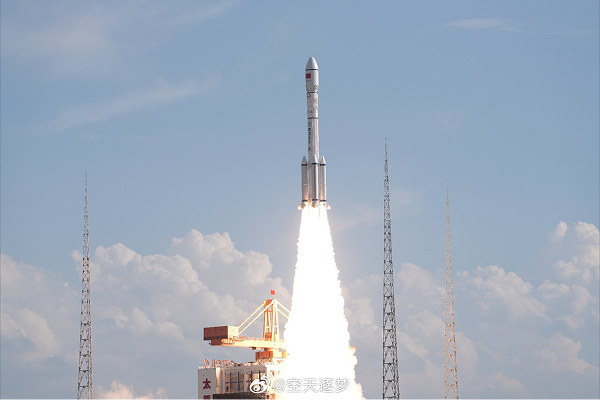
LM-6A Lift off w/ Group 13 (nasaspaceflight.com)
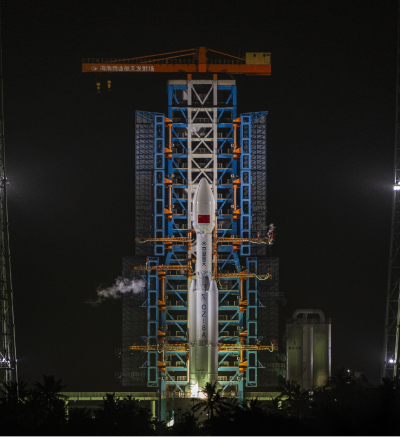
LM-8A Lift off w/ Group 15 (nasaspaceflight.com)
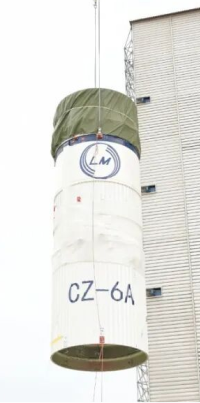
LM-6A Upper Stage which will remain in orbit for centuries (nasaspaceflight.com)
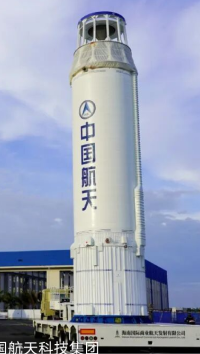
LM-8A Upper Stage which will remain in orbit for centuries (nasaspaceflight.com)
– All Qianfan planes are inclined 89 with a 20° of RAAN offset between each plane. With the Group 11 launch, 9 planes are in use. SpaceSail may augment Group 2 due to 15 of 18 satellites failing to reach their operational SMA of 1,069km.
Constellation Summary:
– Of 200 Qianfan satellites on orbit, 87 have reached their operational altitudes of 1,069kms.
- Group 1 (60379-60396) (LM-6A launched 6 Aug 2024) : 17 of 18 satellites reached operational SMA. Qianfan 7 (60385) has not maneuvered and may be inoperable.
- Group 2 (61552-61569) (LM-6A launched 15 Oct 2024): Only 3 of 18 satellites (Qianfan 29, 30 & 32) reached their operational SMA.
- Group 3 (62238-62255) (LM-6A launched 5 Dec 2024): 16 of 18 satellites reached their operational SMA. Qianfan 39 (807km) & 42 (810km) likely inoperable. Group 3 is co-planar with Group 10.
- Group 4 (62785-62802)(LM-6A launched 23 Jan 2025) : 18 of 18 satellites reached their operational SMA.
- Group 5 (63159-63176) (LM-8 launched 11 Mar 2025): 16 of 18 satellites reached their operational SMA. Qianfan 77 (904km) & 83 (1,028km) likely inoperable. Co-planar w/ Group 8.
- Group 6 (66033-66050) (LM-6A launched 17 Oct 2025): 17 of 18 satellites reached their operational SMA. Qianfan 101 (66043) (800km) likely inoperable.
- Group 7 (68636-68653): (LM-8 launched 7 Apr 2026): All 18 satellites reached their operational SMA.
- Group 9 (69073-69090): (LM-6 launched 12 May 2026): 17 of 18 satellites in process of raising their SMA. Qianfan 137 (69083) lagging. Range 920-960km as of 6 Jul 2026.
- Group 10 (69104-69121): (LM-8 launched 17 May 2026): All 18 satellites in process of raising their SMA. Initial SMA range is 925-980km as of 6 Jul 2026. Co-planar with Gp 3.
- Group 8 (69325-69326): (LM-12B launched 1 Jun 2026): Two satellites launched to 1,034km. Both satellites are in the process of raising their altitudes. Co-planar with Gp 5.
- Group 11 (69382-69399): (LM-6A launched 4 Jun 2026): All 18 satellites in process of raising their SMA. Initial SMA range is 830-860km as of 6 Jul 2026.
- Group 12 (69401-69418): (LM-8 launched 5 Jun 2026): All 18 satellites in process of raising their SMA. Range 850-870km as of 6 Jul 2026. Co-planar with Group 1.
- Group 13 (UNKNOWN): (LM-6A launched 4 Jul 2026): No orbital information available on 18 satellites.
- Group 15 (UNKNOWN): (LM-8A launched 5 Jul 2026): No orbital information available on 20 satellites.
Pics o’ the Fortnight!
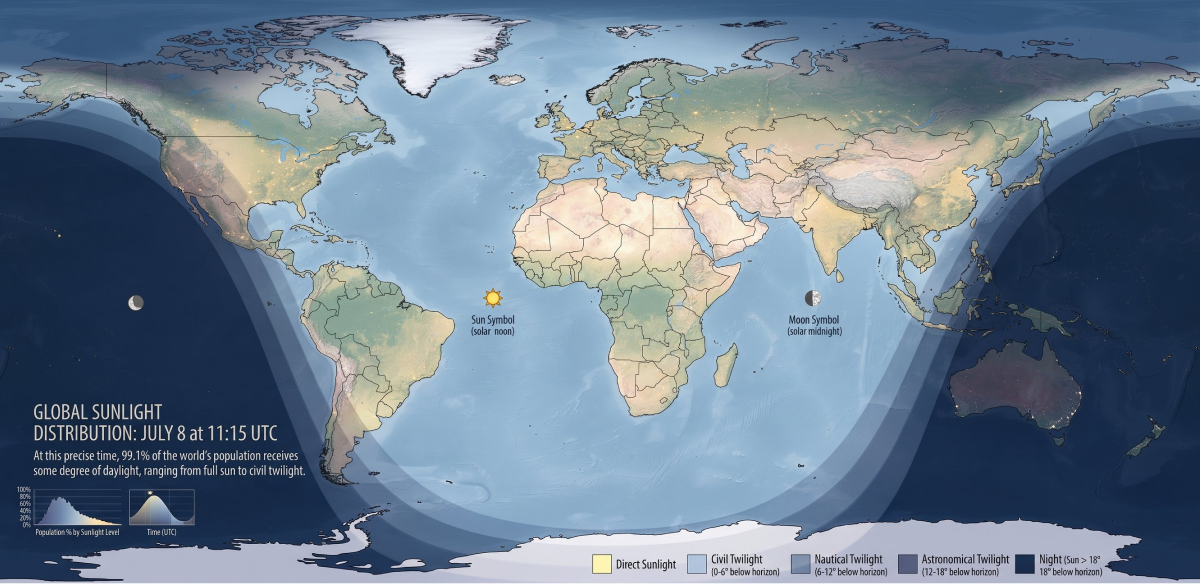
8 July 2026 at 11:15 UTC the sun shined on 99% of the world’s population simultaneously. (@CuriosityonX via X)
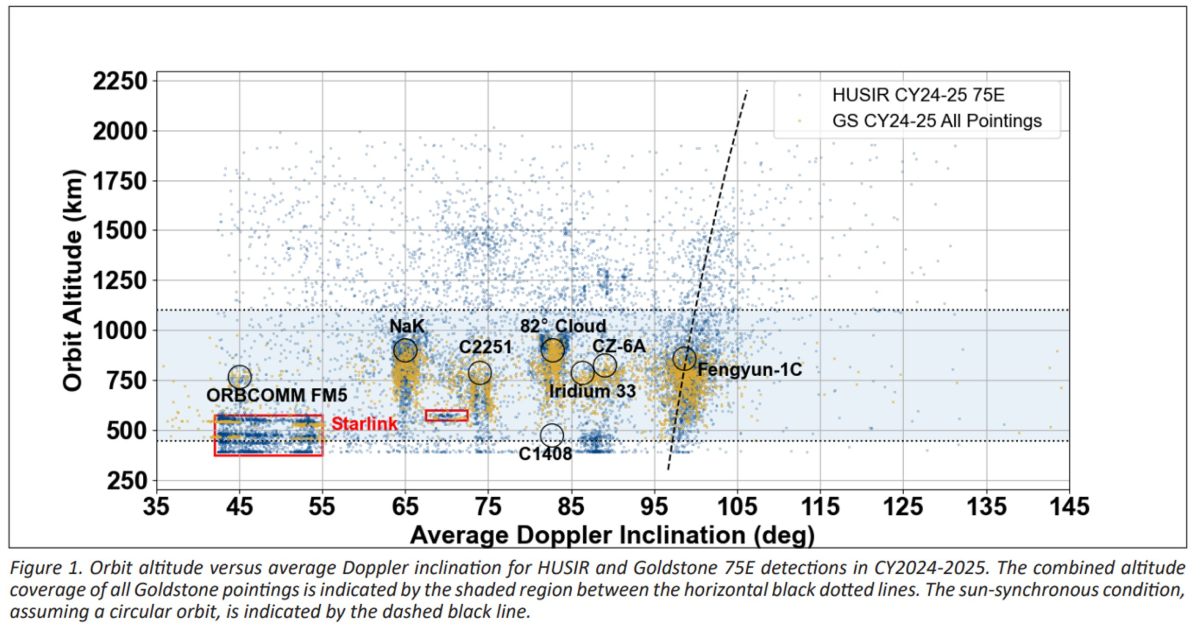
NASA’s “Orbital Debris Quarterly News” (@shell_jim via X)
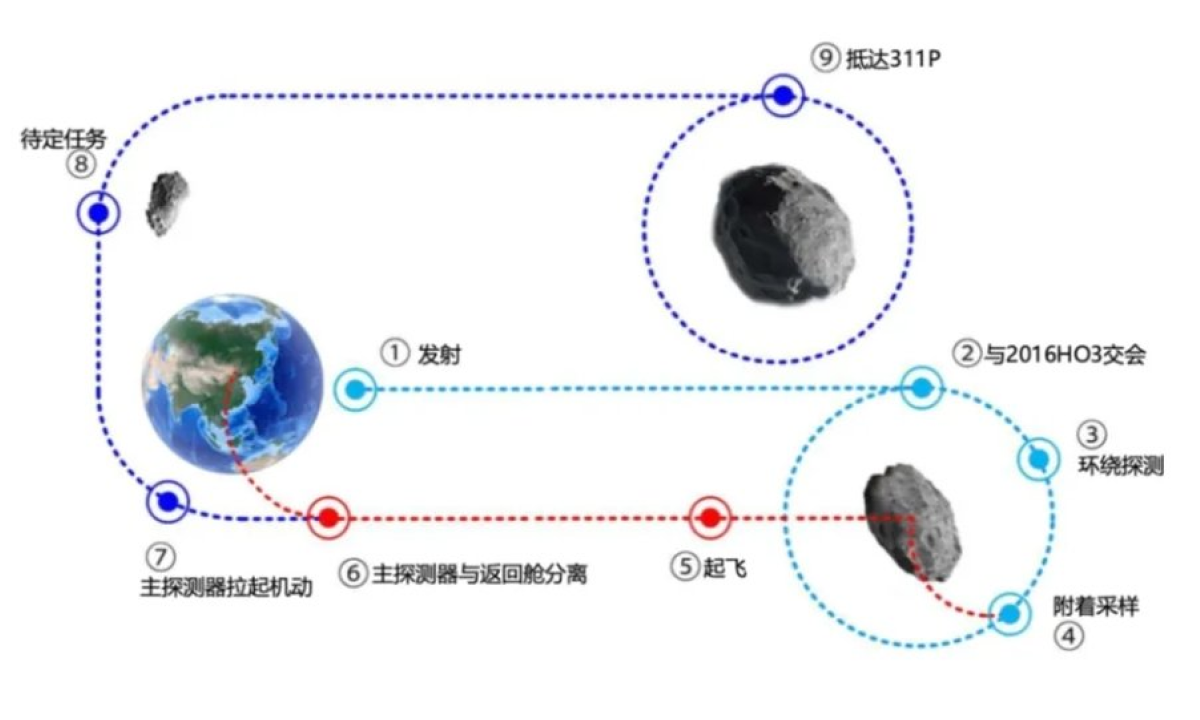
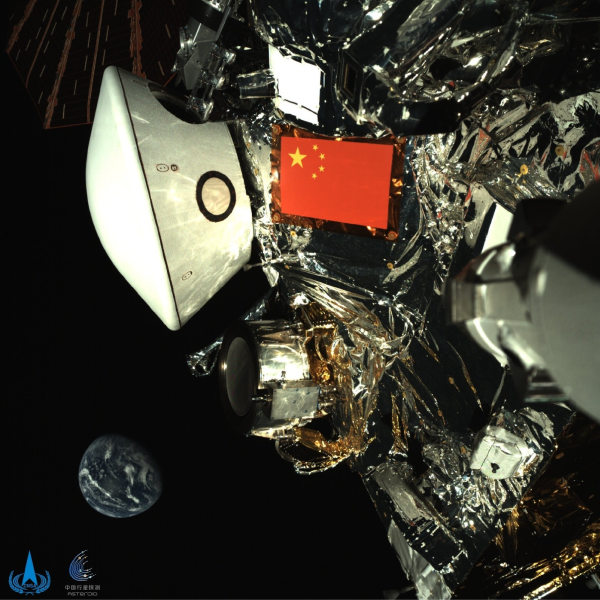
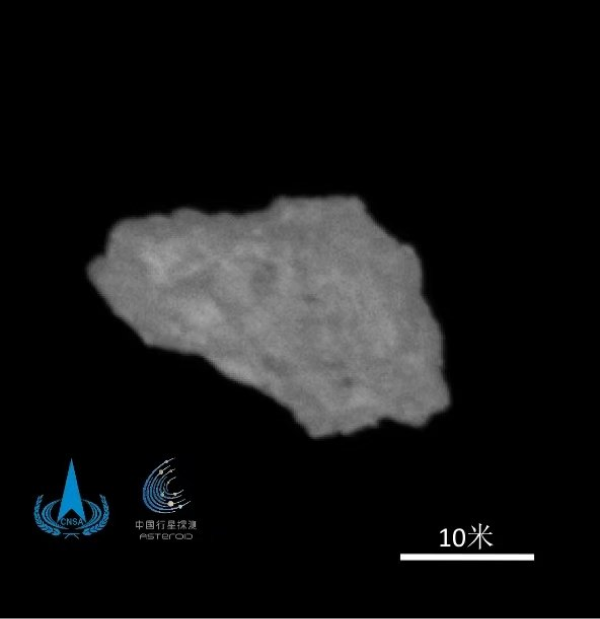
4 Jul 2026: China’s Tianwen-2 sample return mission arrived at the near Earth asteroid Kamo’oalewaat a distance of ~20 km. “Kamo’oalewa was previously thought to be 40-100m in diameter, but this image validates the ~18 metre estimate derived from JWST observations.” (@AJ_FI via X)
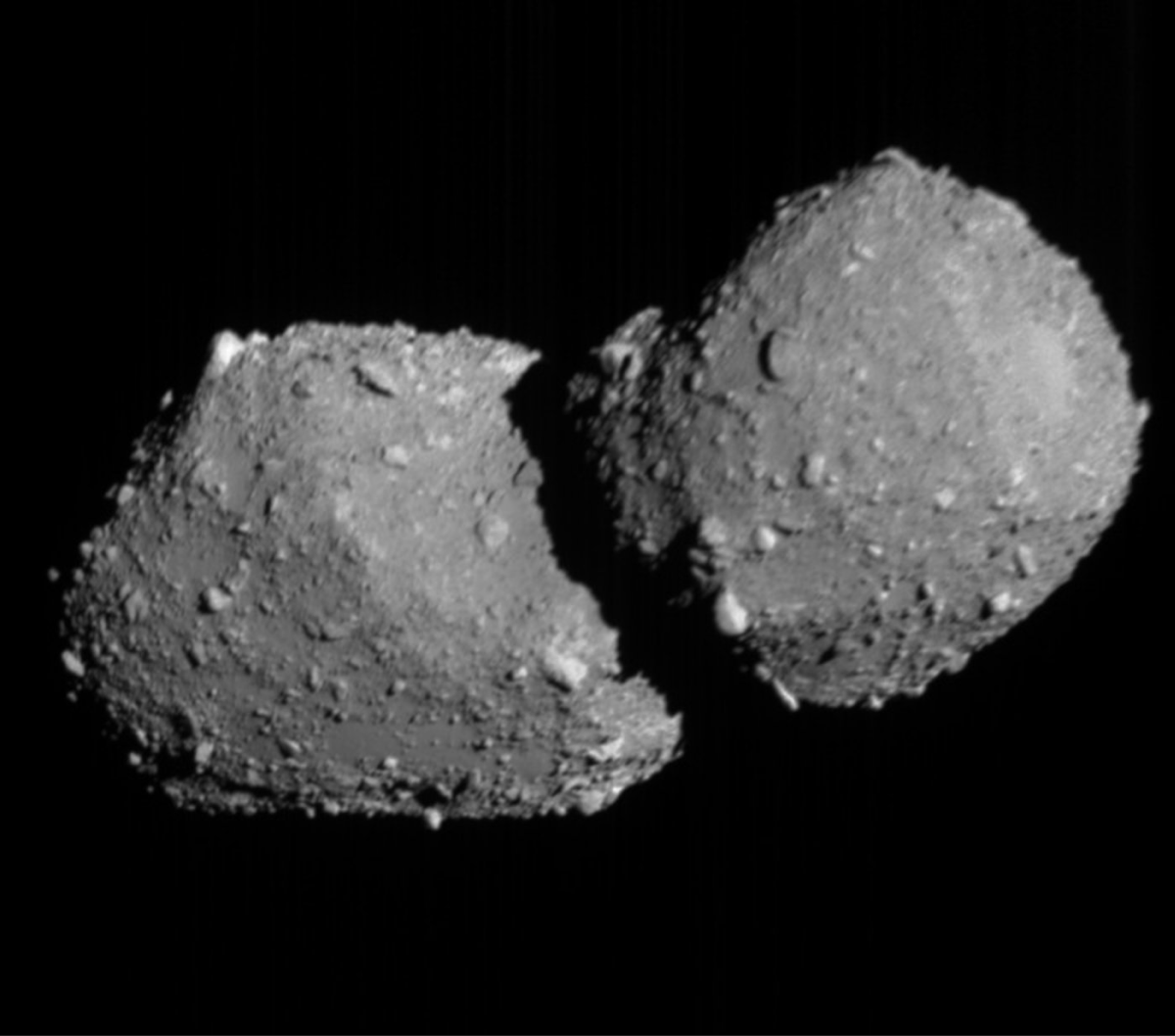
6 Jul 2026: Japan’s Hayabusa 2 Image of Torifune during flyby (@AJ_FI via X)
You must be logged in to post a comment.