
Deep Track 1 | September 10, 2026
the integrity flash deep track
Pattern-of-Life and Orbital Behavior Analysis
China’s GEO-Based Space Domain Awareness Satellites
China’s Quest for Space Domain Awareness in GEO
Geosynchonous orbit, approximately 35,786 kilometers above the equator, is among the most strategically important regions of space. At this altitude objects have an orbital period of just under 24hrs matching the rotation of the Earth. Satellites at this altitude and an inclination of 0° appear fixed over a point on Earth, and are known as Geostationary. Perched high above the Earth gives a GEO object line of sight to approximatley ⅓ of the planet making them ideal for persistent military and commercial communications, missile warning, signals intelligence, weather monitoring, and other missions requiring continuous regional coverage. These spacecraft often provide services that are essential to national command and control, nuclear warning, intelligence collection, and global military operations. Understanding the condition, configuration, and behavior of objects in this orbital regime is therefore a critical element of space-domain awareness.
Monitoring GEO from the ground, however, provides only part of the picture. Optical telescopes can track an object’s location and detect changes in brightness, radars can refine orbital estimates, and terrestrial signals-intelligence systems can characterize some emissions and also assist in identifying an object’s orbit. These sensors remain constrained by distance, atmospheric distortion, weather, viewing geometry, resolution, and signal attenuation. Accurately determining a satellite’s configuration, payloads, condition, and potential threat capabilities requires more than maintaining its orbital track. It requires characterizing the object, a mission best performed by sensors operating in or near GEO that can observe a spacecraft from multiple angles (to view all faces of a satellite) and, when necessary, maneuver into its vicinity. The United States began deploying this capability in July 2014 with the Geosynchronous Space Situational Awareness Program (GSSAP), whose satellites were designed to conduct enhanced surveillance and rendezvous and proximity operations for the characterization of objects of interest.
China followed with a growing group of maneuverable GEO surveillance and inspection satellites. Shijian (SJ)-17 reached orbit in November 2016, followed by TJS-3 in December 2018, the paired Shiyan (SY)-12 01 and SY-12 02 satellites in December 2021, and SJ-23 in January 2023. Although China has disclosed little about their payloads or operational capabilities, their orbital behavior reveals two distinct approaches to monitoring the GEO environment: 1) Focused Patrol; and 2) Neighborhood Watch. This article is an inspection of the orbital behavior of each group.
The first operational mode described in this article is “Focused Patrol” exemplified by SJ-17 and TJS-3. Rather than simply passing objects as they travel through the belt, focused patrollers relocate toward targeted spacecraft, remain in their vicinity for weeks or months, and in some cases conduct fuel expensive cross-track maneuvers to reduce differences in orbital plane and enable rendezvous and proximity operations (RPO). SJ-17 employed this approach during its 2017–2020 inspection campaigns, including an unusually maneuver-intensive response to a
ChinaSat-1C anomaly in 2018. TJS-3 has followed a similar target-focused pattern since 2019. These operations are indicative of a characterization mission in which sustained observation of a particular spacecraft is more important than broad coverage of the belt. They are also comparatively fuel intensive because rapid relocation, plane matching, close station-keeping, and extended loiter operations require considerably more delta-v than periodic fly-by collection.
The second mode, described here as Neighborhood Watch, is represented by SY-12 01, SY-12 02, and SJ-23. These three satellites operate as a coordinated patrol, repeatedly entering drift orbits slightly above or below the GEO belt and moving west or east through the region. Their changing geometry creates recurring opportunities to observe other GEO spacecraft during fly-bys without requiring the patrol satellites to stop near each target (although early in its operational life SJ-23 did alter its SMA to remain in place near other Chinese satellites). Maneuvers have been of the in-track variety only, and the satellites have made no observed attempt to match a target’s orbital plane or even maintain their own inclination through routine north-south stationkeeping. As a result, their cumulative delta-v expenditure is far lower than that of SJ-17 or TJS-3. China appears willing to trade sustained access to a specific target for broad, persistent coverage of the GEO neighborhood, accepting that useful collection opportunities will arise as the patrol formation repeatedly passes other resident space objects. The contrast between focused patrol and neighborhood watch likely reflects differences in spacecraft capability, sensor design, propulsion, collection requirements, and assigned mission.
The Focused Patrol: SJ-17 and TJS-3
Launched 3 Nov 2016 on the maiden flight of the Long March 5 from Wenchang, SJ-17 was the first Chinese satellite to demonstrate RPO in GEO. Unclassified sources note the satellite carried an onboard optical surveillance sensor and a reported signals-collection payload. U.S. Space Command testimony also credited it with a robotic arm assessed as dual-use.
SJ-17 was China’s most maneuver-intensive GEO inspector, conducting rapid relocations, extended loiter operations, and close approaches to other Chinese satellites. Its most significant campaign occurred in 2018, when Chinse space operators used SJ-17 to conduct 2 separate RPOs, the first with Chinasat 20 (28082) and followed by Chinasat 1C (41103).
Chinasat 20 is a decommissioned communications satellite in graveyard orbit drifting west at ~4°/day. China had long since ceased inclination maintenance maneuvers on the satellite and its inclination had naturally increased to 4°. In January 2018, SJ-17 operators increased the satellite’s inclination by approximately 4°, aligning its inclination and RAAN with Chinasat 20 in preparation for RPO. With plane matching complete SJ-17 made several in-track maneuvers end orbited near Chinasat 20 from mid-February through mid-March 2018.
The Chinasat 20 RPO appears to have been planned well in advanced. This does not appear to be the case with SJ-17’s RPO with Chinasat 1C. Chinasat 1C was a new communications satellite launched in December 2015 and likely suffered some sort of anomaly in early April 2018. China again did a large plane change maneuver, dropping 4° to become co-planar with Chinasat 1C and then conducted a 1 month inspection mission. At times the satellites were <1km apart and not distinguishable to ground based telescopes. (see timeline/graphics)
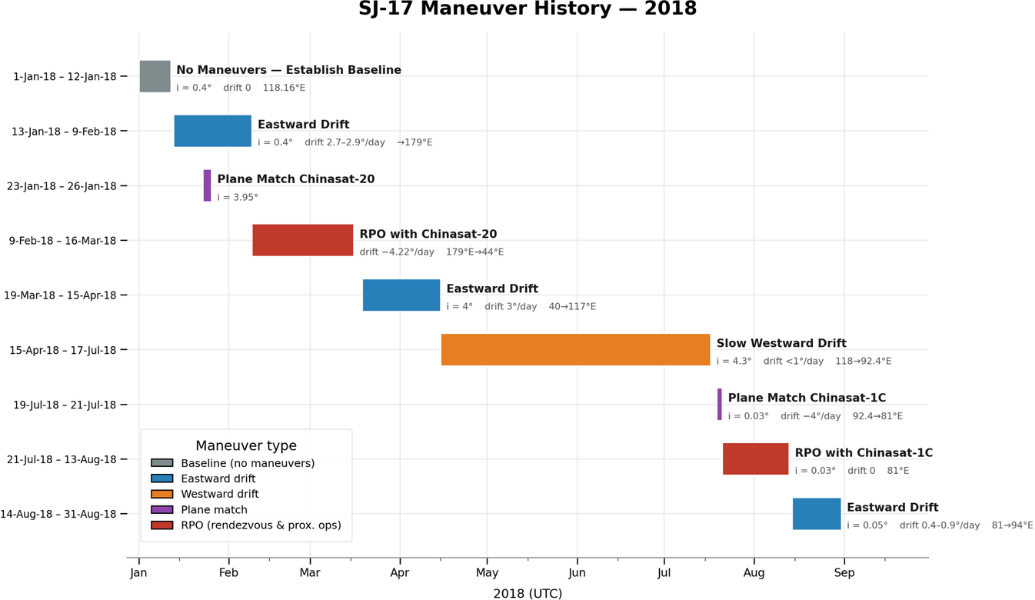
Eventful Year: 2018 Timeline of SJ-17 Maneuvers
Includes 2 Large Plane Change Maneuvers to Support RPO Missions
(based on data from Celestrak.org)
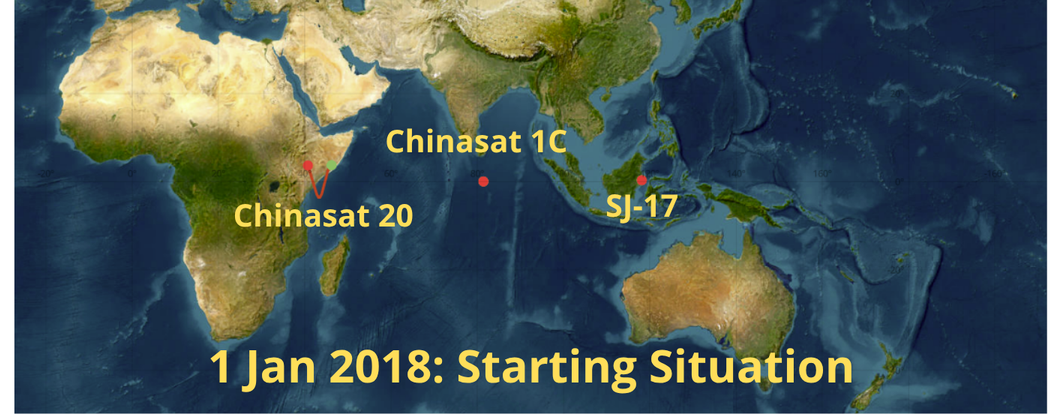
Beginning Status: SJ-17 Has 0° Inclination & Is Holding Position Over Indonesia
(based on data from Celestrak.org & saberastro.com)
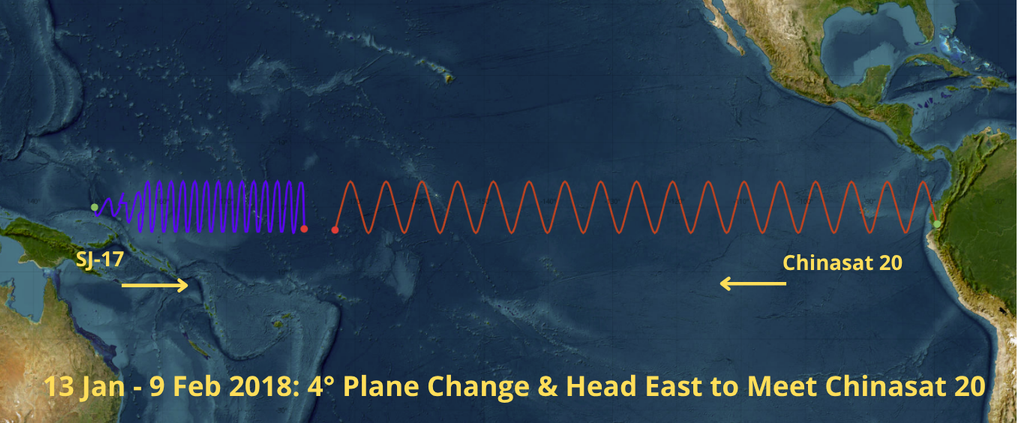
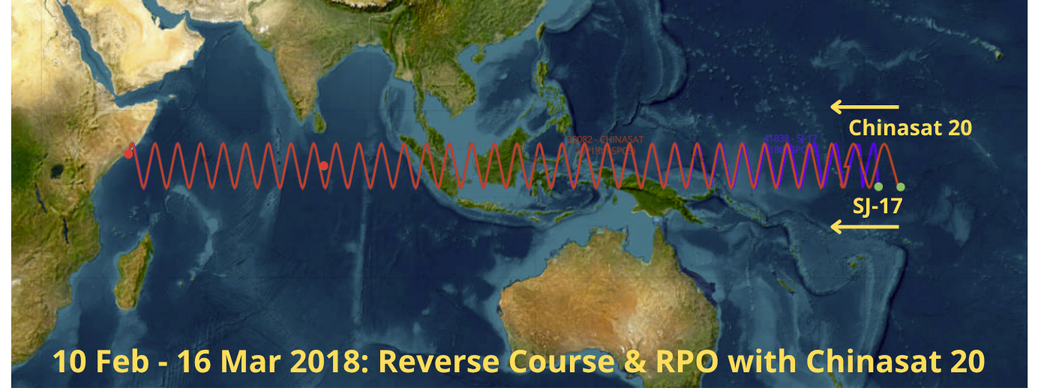
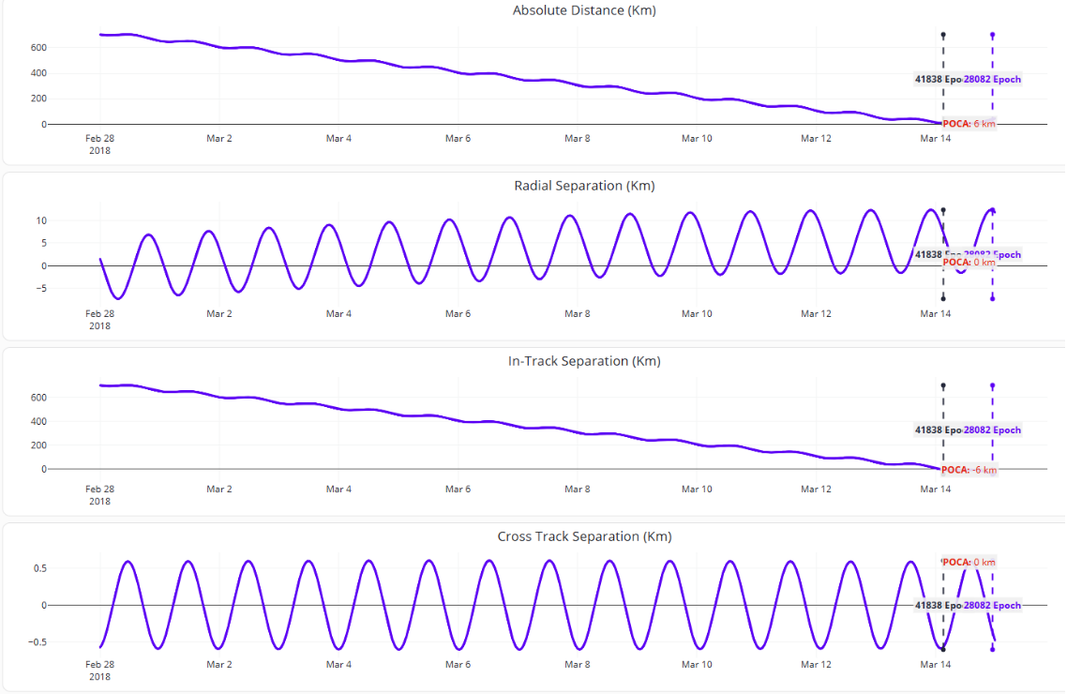
28 Feb – 16 Mar 2018: Distances Separating SJ-17 & Chinasat 20 During Their RPO
Note In-Track Separation Dominates as Objects are Plane Matched (cross-track separation <1km). SJ-17 methodically closes distance with Chinasat 20, Reaches POCA <6km in mid-March 2018
(saberastro.com)
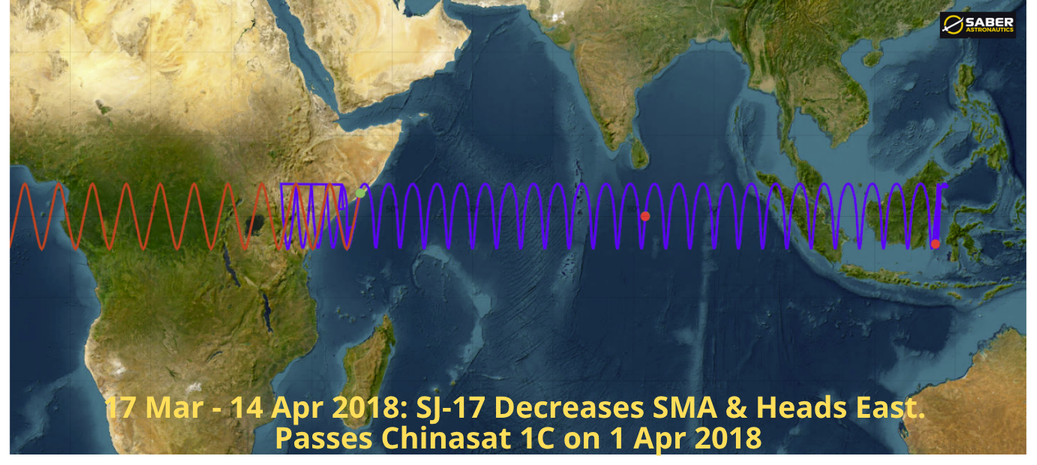
With RPO mission complete SJ-17 Decreases SMA & Leaves Chinasat 20. SJ-17 Inclination Remains 4°. As it Heads East, SJ-17 Passes Chinasat 1C on~ 1 Apr 2018 (saberastro.com)
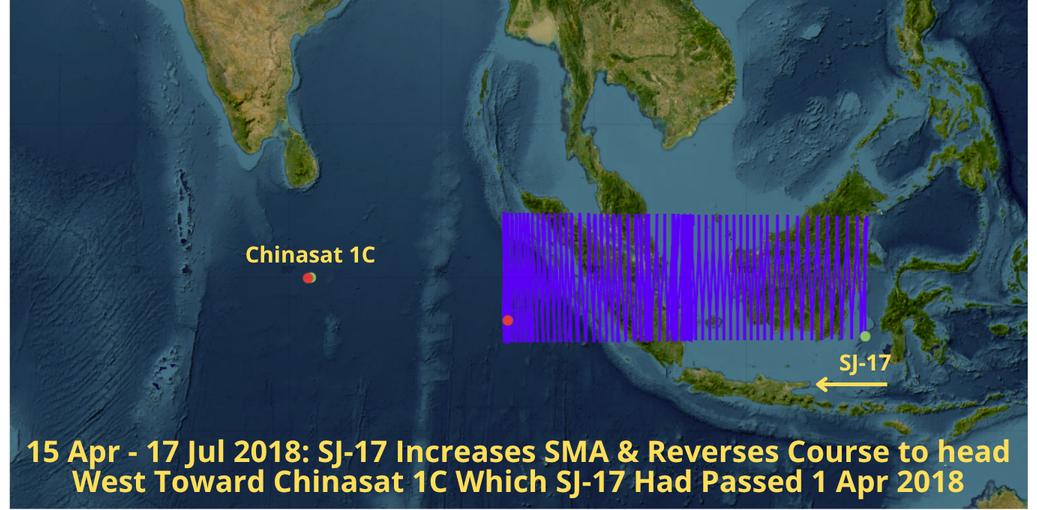
Two Weeks After Passing Chinasat 1C, SJ-17 Reverses Course and Heads West. Inclination Remains 4° (saberastro.com)
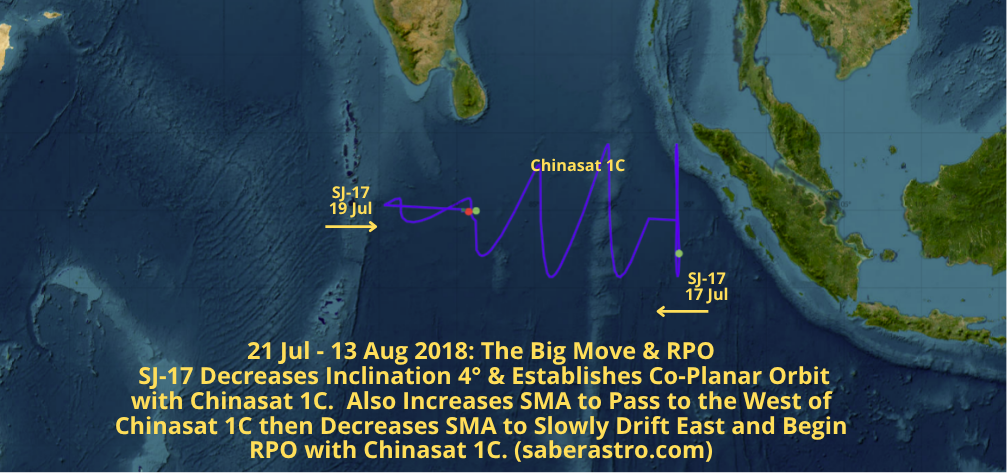
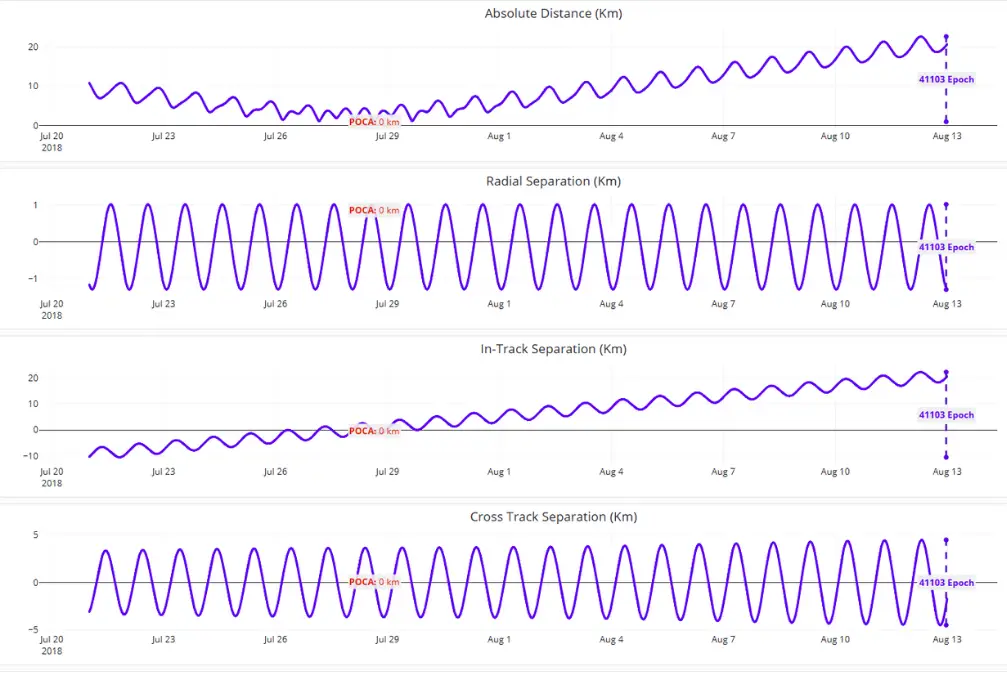
21 Jul – 13 Aug 2018: Distances Separating SJ-17 & Chinasat 1C During Their RPO. From 20 Jul – 1 Aug the 2 Satellites are <10km Apart Making them Indistinguishible to Ground Based Optical Telescopes
(saberastro.com & Celestrak.org)
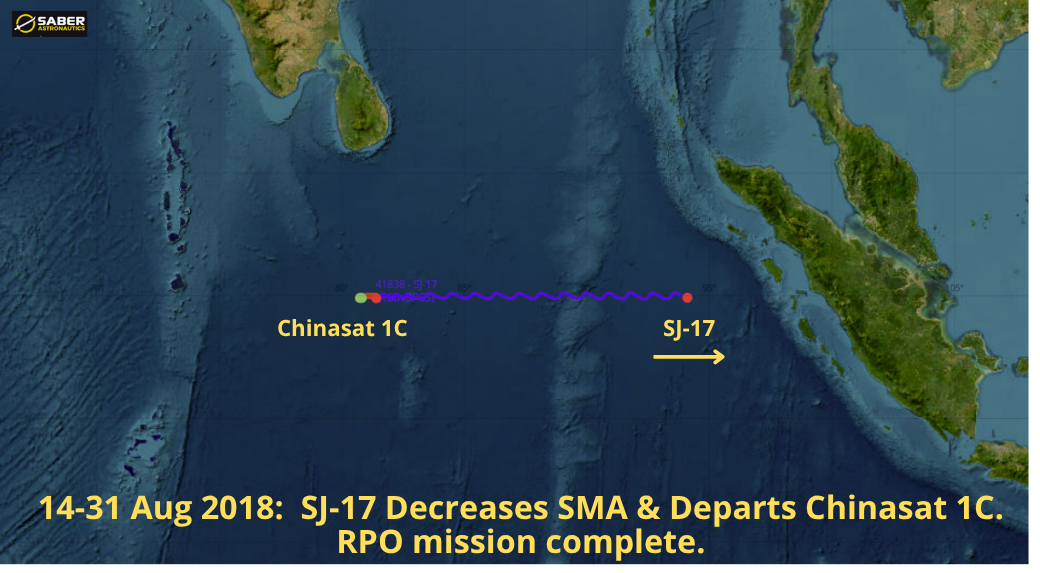
Show’s Over: SJ-17 Completes RPO of Chinasat 1C, Breaks Contact and Heads East.
(saberastro.com & Celestrak.org)
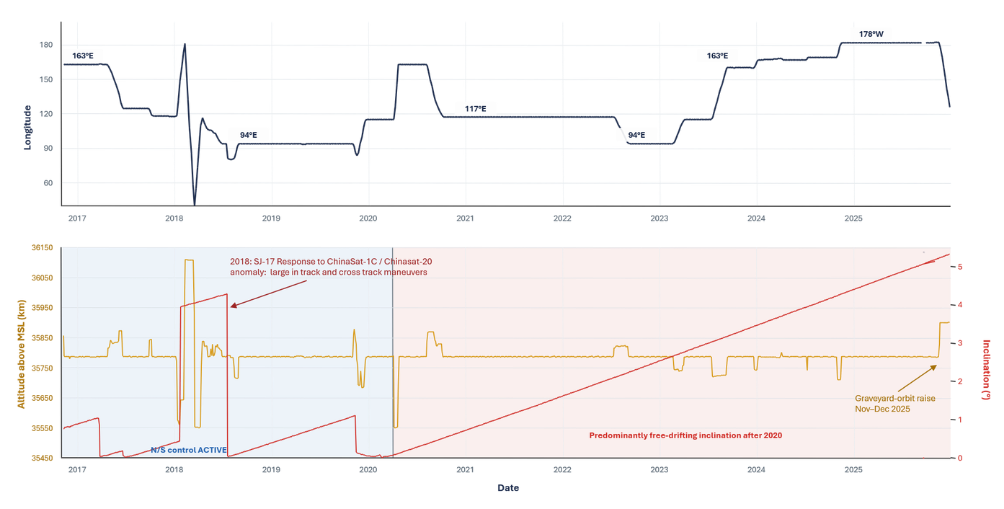
10 Year Overview of SJ-17 Mission. After Eventful 2018 SJ-17 Loitered At Specific Longitudes for Months/Years at a Time.
Final Cross Track Maneuver in 2020. Boost to Graveyard Orbit in Dec 2025
(based on data from Celestrak.org)
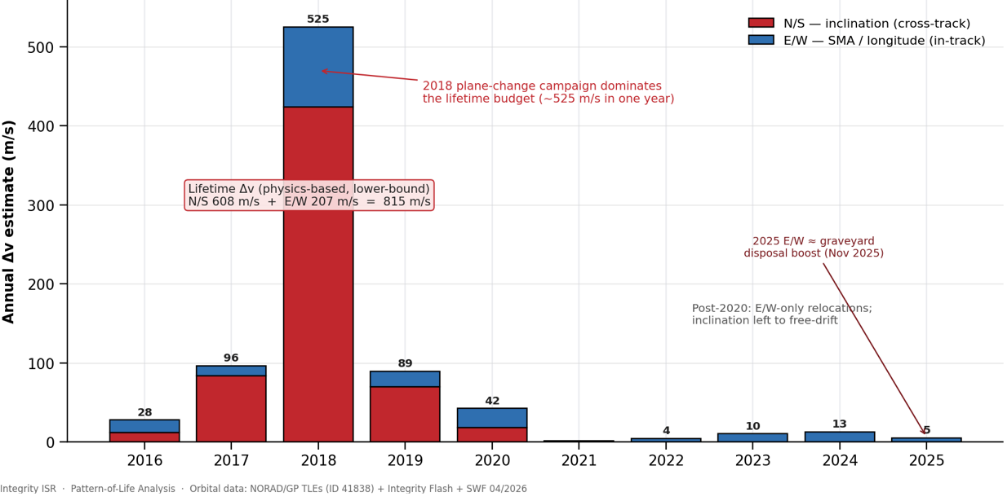
| Year | N/S (incl.) m/s | E/W (SMA) m/s | Total m/s |
|---|---|---|---|
| 2016 | 12 | 15.7 | 27.7 |
| 2017 | 84 | 12.4 | 96.4 |
| 2018 | 424.1 | 101.2 | 525.3 |
| 2019 | 69.6 | 19.6 | 89.2 |
| 2020 | 17.8 | 24.5 | 42.3 |
| 2021 | 0 | 1.7 | 1.7 |
| 2022 | 0 | 4.2 | 4.2 |
| 2023 | 0 | 10.3 | 10.3 |
| 2024 | 0 | 12.7 | 12.7 |
| 2025 | 0 | 4.9 | 4.9 |
| TOTAL | 607.5 | 207.2 | 814.7 |
Estimated SJ-17 Delta-V Use From GEO Arrival to Grave
(based on data from Celestrak.org)
TJS-3 launched from Xichang aboard a Long March 3B on 24 December 2018. Chinese media characterized the satellite as a communications technology demonstrator, while Western analysts have suggested that its mission may include military applications. Whatever its actual mission, TJS-3’s maneuvers were notable from the start. First, when TJS-3 reached GEO China appeared to conduct on-orbit testing with its Apogee Kick Motor (AKM). Normally disposed after releasing their payload, the TJS-3AKM (43917) maneuvered to 59°E and station-kept 100–200 km away from TJS-3, behaving like a subsatellite, not a spent motor (watch COMSPOC Video). Since departing the AKM in May 2019, TJS-3 has sporadically relocated across the eastern GEO belt (50–178°E), pausing near US military COMSATS and Chinese assets such as TJS-10 (58204). TJS-3 maintained its inclination until October 2023. Since that time China has not conducted any North/South stationkeeping maneuvers and allowed its inclination to increase through natural luni-solar drift and signaling a transition to a less fuel-intensive phase of operations. Most recently TJS-3 was in proximity with the GEO imager Gaofen-13 02 (55912). As with SJ-17 these collections were deliberately planned and lasted for extended periods of time. Unlike SJ-17, TJS-3 has not conducted close approach RPO with other satellites. TJS-3 did make some minor inclination adjustments in preparation for its 2023-2024 testing with TJS-10 but we have not witnessed any large plane matching maneuvers as we witnessed with SJ-17.
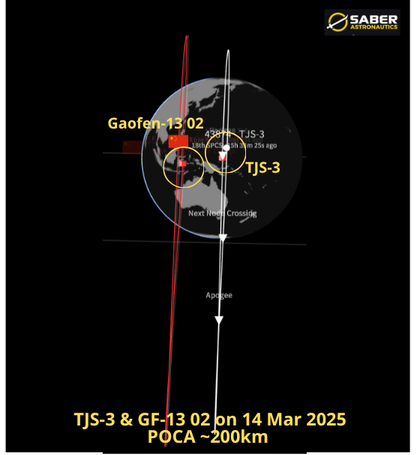
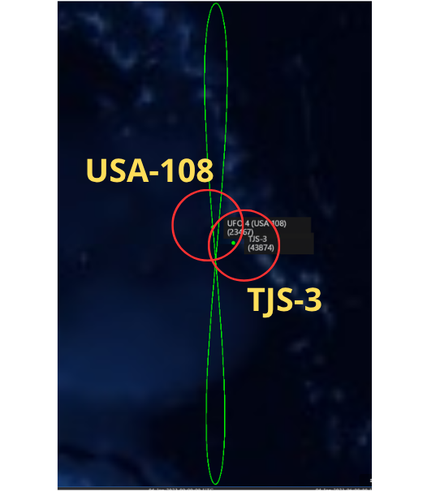
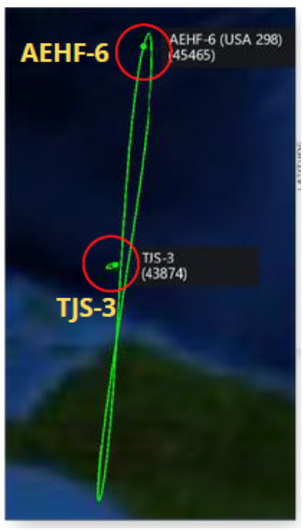
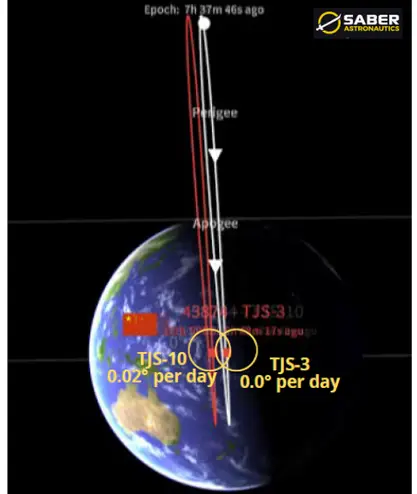
Examples of TJS-3 Operations Near Target Satellites.
(saberastro.com & spaceaware.io)
China will likely continue operating TJS-3 for several more years, but the apparent end of north-south stationkeeping will progressively constrain its collection opportunities. As TJS-3’s inclination grows through natural luni-solar drift, differences between its orbital plane and those of potential targets will increase, reducing the frequency and duration of favorable close-approach geometries. China can partially offset this limitation through careful timing and in-plane maneuvering, but sustained characterization of low-inclination GEO targets will become increasingly difficult unless TJS-3 resumes cross-track maneuvers.
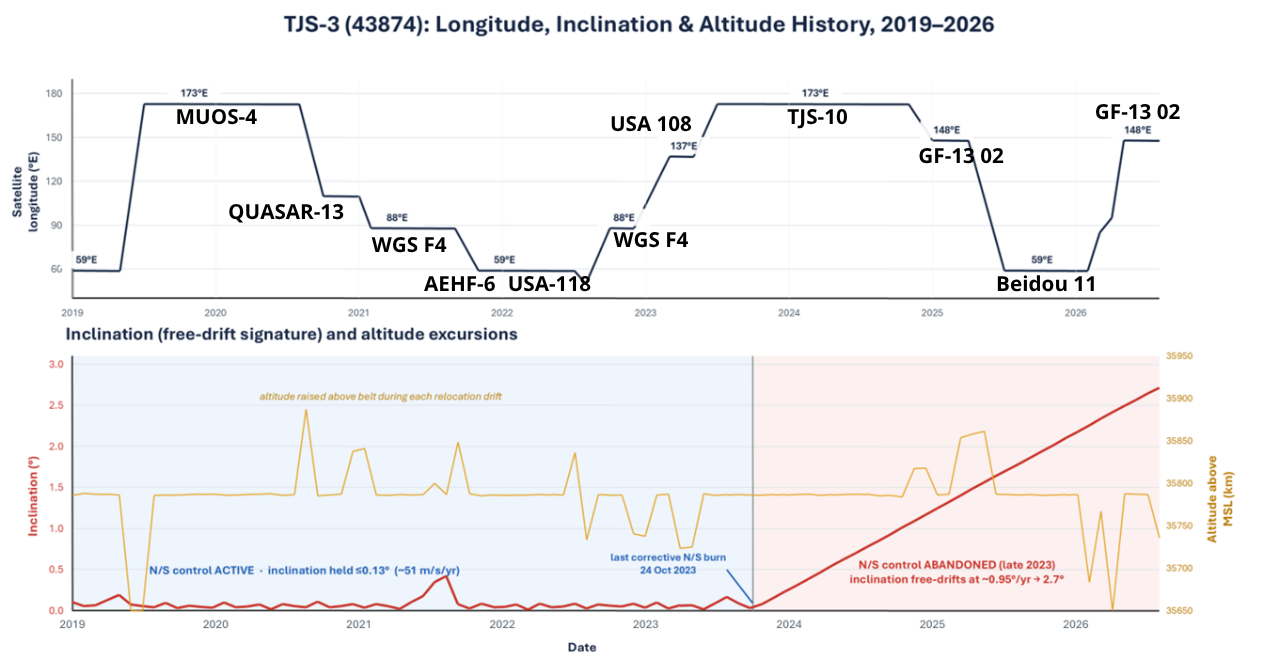
TJS-3 Loitered At Specific Longitudes for Months at a Time (above)
SMA and Inclination Maneuvers (below)
Note Final Cross Track Maneuver in late-2023
(based on data from Celestrak.org)
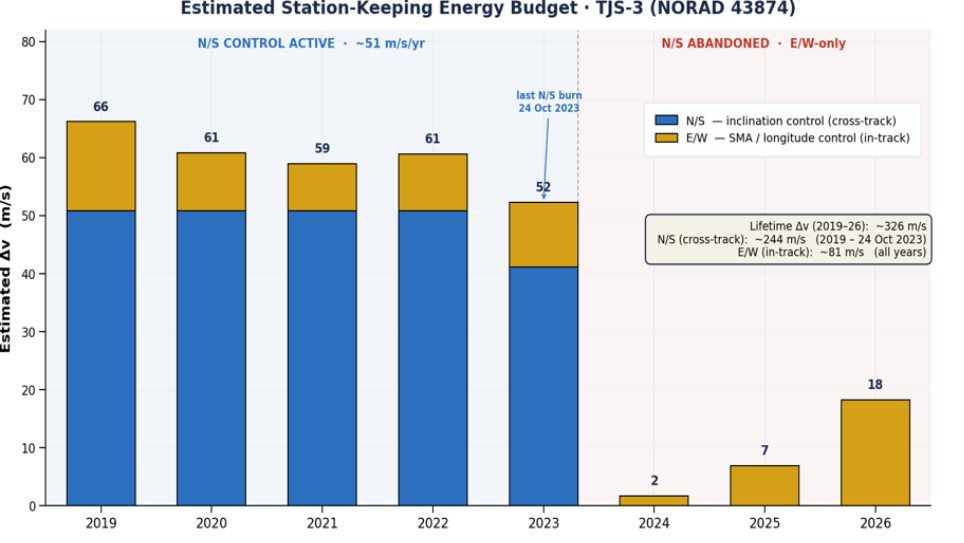
| Year | N/S (incl.) m/s | E/W (SMA) m/s | Total m/s |
|---|---|---|---|
| 2019 | 50.8 | 15.4 | 66.2 |
| 2020 | 50.8 | 10 | 60.8 |
| 2021 | 50.8 | 8.2 | 59 |
| 2022 | 50.8 | 9.8 | 60.6 |
| 2023 | 41.2 | 11.1 | 52.3 |
| 2024 | 0 | 1.7 | 1.7 |
| 2025 | 0 | 6.9 | 6.9 |
| 2026 | 0 | 18.2 | 18.2 |
| TOTAL | 244.4 | 81.3 | 325.7 |
Estimated TJS-3 Delta-V Use by Year and Type in Table View
(based on data from Celestrak.org)
Neighborhood Watch Crew: SY-12 01/02 & SJ-23
The Shiyan-12 pair launched on 23 December 2021 on a LM-7A and reached GEO in early 2022. After circularizing their orbits the pair remained in vicinity of one another and received a visit from USA 270 (41744) (watch COMPSOC video) on ~7 January 2022. In February 2022, SY 12-01 headed east and SY 12-02 headed west to begin their patrols. For their first two years of operations SY 12-01/02 patrolled in antiphase, or out of phase by 180°…two satellites moving through the same cycle at the same rate but offset by exactly half a cycle. During these first 2 years of operations the SY-12 satellites established a patrol area from ~17°E to ~178°E. All maneuvers are in-track to change the drift rate and neither satellite settles in one location. See examples of fly-by collection operations below.
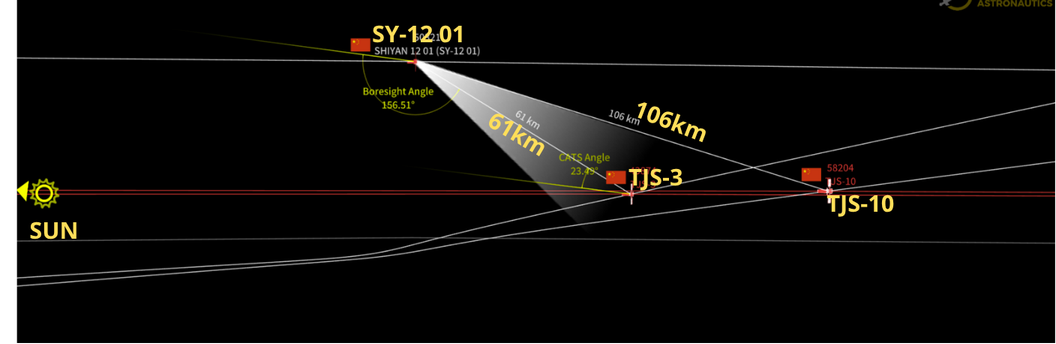
September 2024: SY-12 01 Passed TJS-3 & TJS-10 With Favorable Lighting Conditions
(saberastro.com)
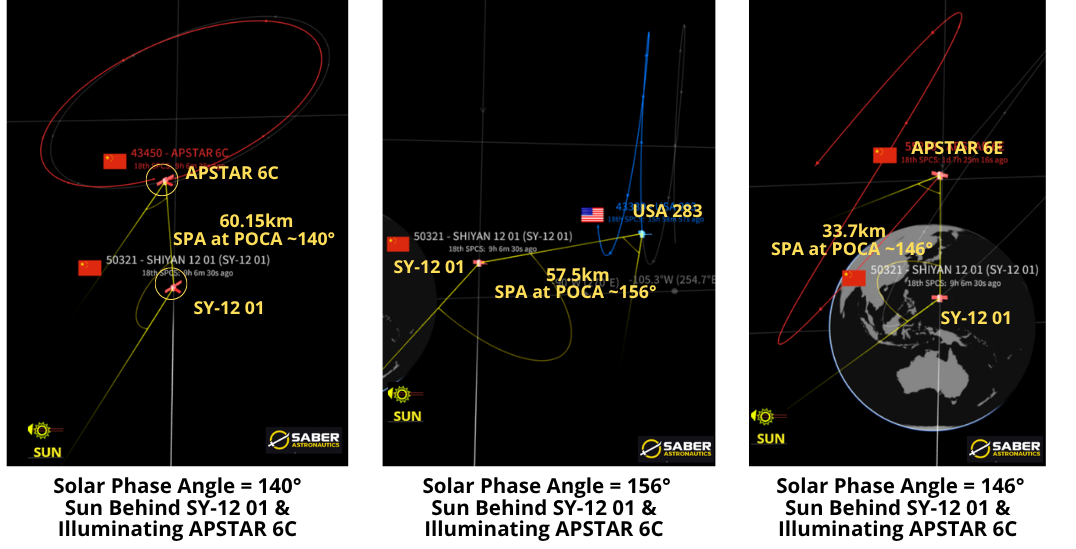
22 November 2024: SY-12 01 Passed by 3 Satellites (APSTAR 6C, USA 283 & APSTAR 6E) With Favorable Lighting Conditions for Observing Target Satellites (saberastro.com)
After launching in January 2023, SJ-23 spent 2 weeks in geosynchronous transfer orbit before circularizing at GEO and beginning a patrol campaign. Its most notable operations involved China’s Tianlian data-relay satellites, including an approach within 4 km of Tianlian-1 03 near the western patrol boundary in March-April 2023 and a series of passes within approximately 30-83 km of Tianlian-2 02 near the eastern boundary from October to December 2023. These appear to be two bookend test events. In both cases Chinese space operators drifted SJ-23 past their intended target then reversed course and methodically closed the distance with the targeted Chinese relay satellite. In these two instances the inspections lasted well over a month. China was likely more aggressive with TL-1 03 due to the satellite nearing the end of its operational lifetime, as China placed TL-1 03 into a graveyard orbit 6 months after SJ-23’s visit. (See graphics below.)
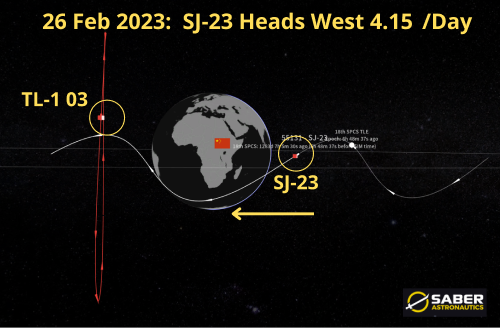
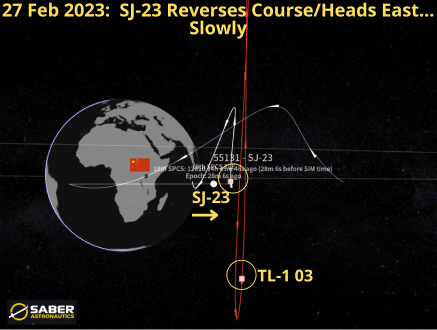
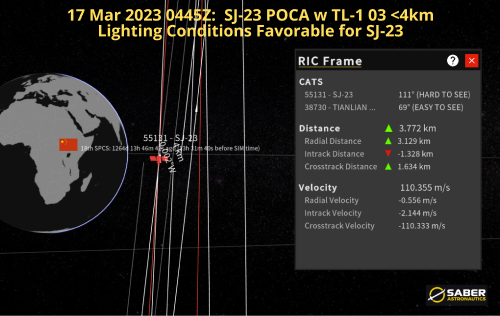
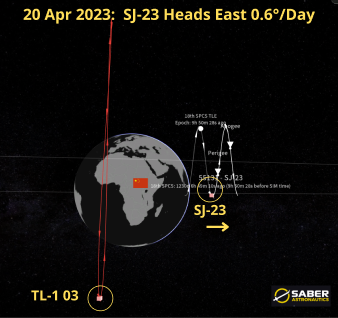
February-Apr 2023: SJ-23 Conducts “RPO” with Tianlian-1 03. Satellites Are Not Plane Matched as SJ-23 Inclination ~0.6° & TL-1 03 Inclination ~2.7° Resulting in Periodic Close Approaches, one of which was <4km on 17 March 2023
(saberastro.com)
China has not used SJ-23 for persistent collection since the end of 2023. Beginning in 2024 SJ-23 has operated in similar fashion with the SY-12 satellites, slowly traversing the GEO belt, presumably conducting collection operations when range and solar conditions align.
As SJ-23 was conducting its test operations, China conducted a series of apparent phasing maneuvers with the SY-12 satellites, likely in anticipation of integrating SJ-23 into a three-satellite formation in which each spacecraft was separated by approximately 120°. This pattern solidified in early 2024 and continues today, with one member of the formation reversing direction at its patrol boundary approximately every 81 days. SY-12 01’s latest turnaround fit this rhythm precisely. From 9 to 10 August 2026, the satellite lowered its average altitude by approximately 62 kilometers to reverse its westward drift as it approached Tianlian-1-05 near 16.7°E. The maneuver marked SY-12 01’s seventh turnaround since its December 2021 launch and demonstrated the continuing coordination of the three-satellite formation.
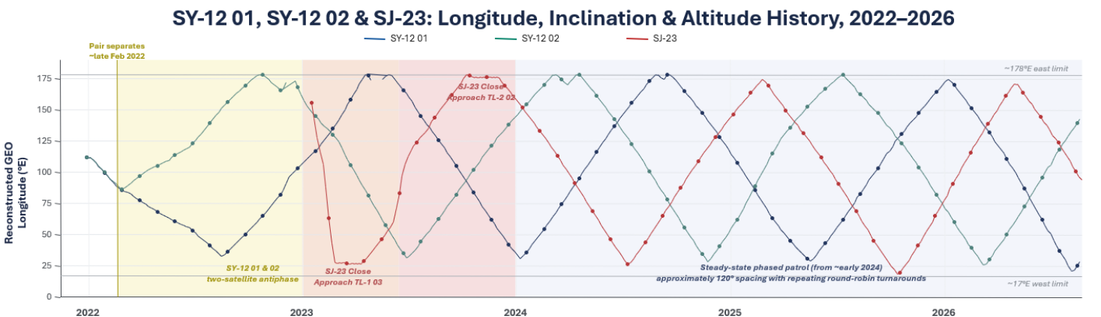
Jan 2022 – Aug 2026: Longitudinal Locations for SY-12 01/02 & SJ-23
Note Synchronization Beginning in 2024 & Continuing through Present.
One Satellite Reverses Course Every 81 Days.
(based on data from Celestrak.org)
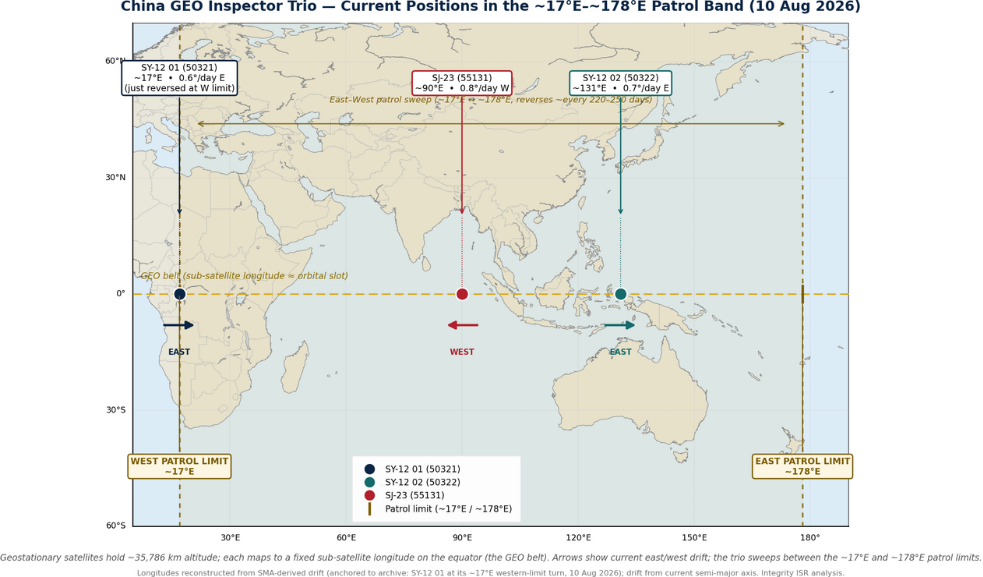
Mid-August 2026: Position of China’s GEO Neighborhood Watch Satellites
(based on data from Celestrak.org)
Energy Efficient & Similarly Inclined
Notably China has NOT conducted fuel expensive North/South stationkeeping maneuvers with any of its GEO neighborhood watch satellites. China launched SY-12 01/02 into an inclination biased orbit in which the sun/moon gravity reduced the inclination for both satellites from 0.5° to near 0.1° before beginning a gradual increase which continues through today (and will continue for the next couple of decades barring any inclination maintenance maneuvers). At the time of SJ-23’s launch the SY-12 01/02 satellites had returned to their original 0.5° inclination. China launched SJ-23 into a plane matched orbit with SY-12 01/02 (nearly identical inclination and RAAN.) As with SY 12 01/02, SJ-23’s inclination is now naturally increasing.
While none of the three satellites have maintained their inclination, all have conducted significant East/West maneuvers. As you all know East/West “stationkeeping” are in-track maneuvers to change the satellite’s SMA and require far less energy in comparison with North/South cross-track maneuvers. We covered this a while back…in GEO it takes about .04 m/sec to change SMA ~1km while you need ~54 m/sec to change inclination a 1°. In limiting their GEO neighborhood watch satellites to in-track maneuvers China has flown very energy efficient profiles. SJ-23’s first year on orbit was an exception with frequent in-track maneuvers. in 2023 when it ran through its testing and conducted staging maneuvers to join the SY-12 01/02 formation. (see graphic)
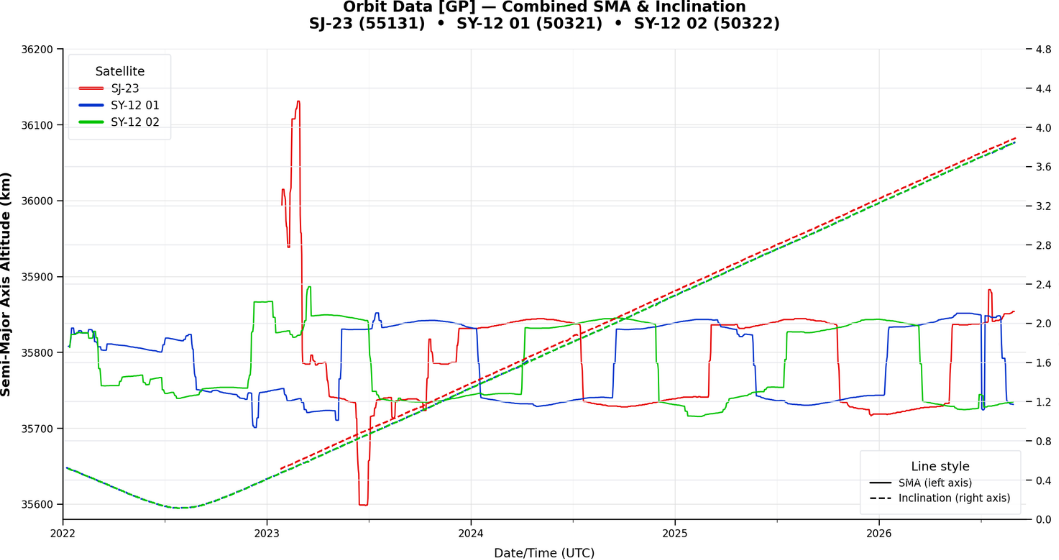
Jan 2022-Aug 2026: SJ-23 is in Plane Matched Orbit with SY-12 01/02 & None Have Conducted Any Cross-Track Maneuvers to Maintain Inclination
All Conduct In-Track Manuevers to Change Drift Rate & Direction
(based on data from Celestrak.org)
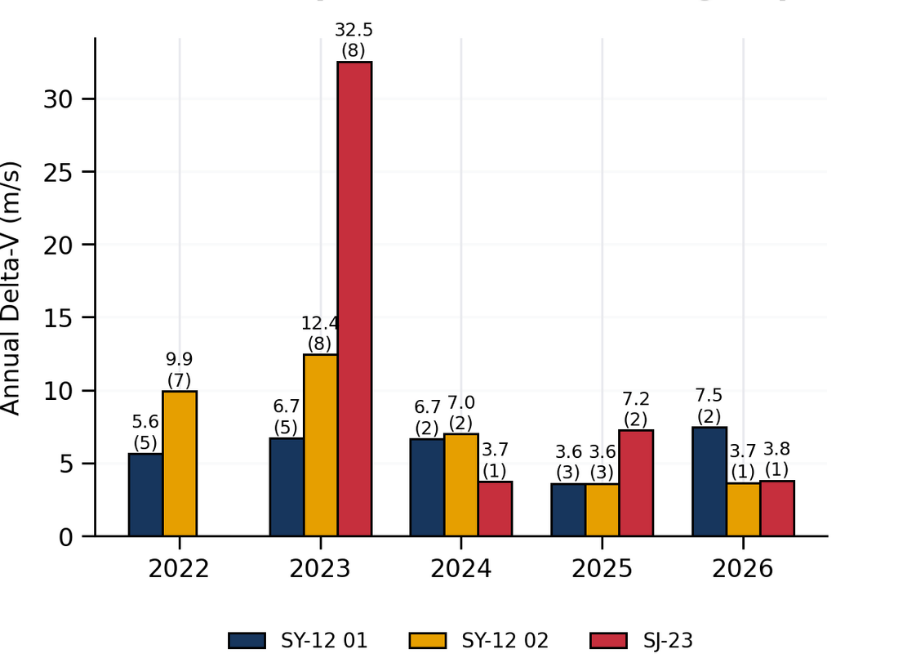
SY 12-01/02 & SJ-23 Maneuver Summary & Energy Estimate
(based on data from Celestrak.org)
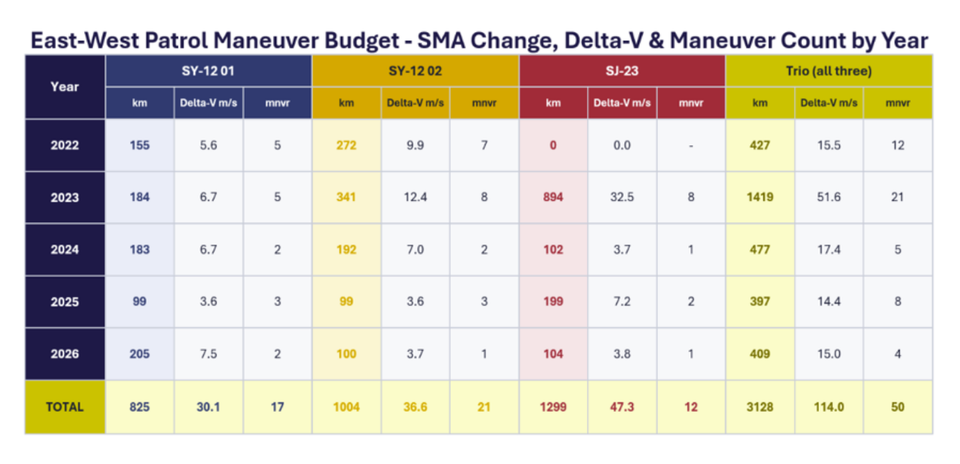
SY 12-01/02 & SJ-23 Maneuver Summary & Energy Estimate Table View
(based on data from Celestrak.org)
The orbital behavior of SY-12 01, SY-12 02, and SJ-23 (after 2023) suggests that China’s Neighborhood Watch architecture is primarily designed for broad, persistent monitoring of the GEO population. Individual Neighborhood Watch satellites occasionally pass within 50 kilometers of other spacecraft with favorable illumination, circumstances that could permit optical sensors to obtain high-resolution images. These opportunities appear incidental to a wider surveillance mission, however. Rather than matching orbital planes or loitering near selected targets, the three satellites repeatedly traverse the belt, potentially collecting lower-resolution imagery, detecting maneuvers, and providing observations that help maintain current cataloged orbit states across the GEO regime.
What’s Next for Neighborhood Watch
All three Neighborhood Watch satellites likely have several productive years of operations remaining. Their primary limitation will probably not be fuel, but a GEO equivalent of orbital decay. In the absence of cross-track maneuvers, natural inclination growth will progressively increase the orbital-plane separation, range, and relative velocity between the patrol satellites and potential collection targets. These changing geometries will reduce the duration and quality of characterization observation opportunities, making high-resolution imagery increasingly difficult and potentially impossible due to range or differential velocity. The satellites should remain useful for maneuver detection, broad-area surveillance, and catalog maintenance. China has undoubtedly gained valuable operational experience from the Shiyan, or “experiment,” and Shijian, or “practice,” satellite programs and will likely incorporate those lessons into future generations of GEO surveillance and characterization spacecraft.
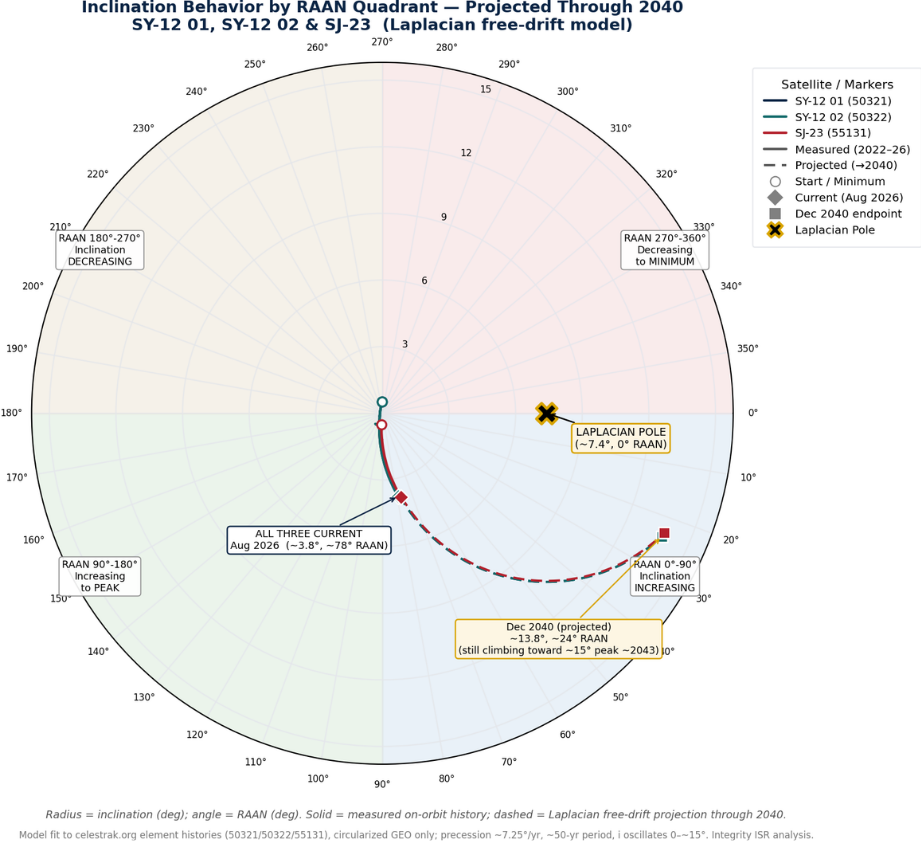
Radial Graph of Predicted SY 12-01/02 & SJ-23 Increasing Inclination Through 2040
(based on data from Celestrak.org)
Conclusion:
China’s GEO patrol architectures demonstrate a clear trade-off between the collection resolution and the propulsion required to achieve it. SJ-17 and TJS-3 expended significantly more delta-v than SY-12 01, SY-12 02, and SJ-23, particularly on cross-track maneuvers needed to alter or maintain their orbital planes. SJ-17’s approximately ±4° plane-change campaign in 2018 consumed an estimated 424 m/s in a single year and contributed to a lifetime cross-track expenditure of roughly 608 m/s, while TJS-3 accumulated approximately 238 m/s before apparently ending north-south stationkeeping in October 2023. That expenditure enabled the two Focused Patrollers to improve observation geometry, remain near selected targets for weeks or months, and conduct sustained characterization missions. The Neighborhood Watch trio made the opposite trade, allowing inclination to grow naturally while relying primarily on lower-cost, in-track maneuvers to create recurring fly-by collection opportunities across the GEO belt. The contrasting profiles indicate that persistent target characterization carries a substantial propulsion cost, while broad surveillance and catalog maintenance can be sustained far longer with a comparatively modest maneuver budget. Ultimately, the two approaches appear complementary: Focused Patrol provides detailed knowledge of selected spacecraft, while Neighborhood Watch provides persistent awareness of activity across the wider GEO population.
A complete GEO space-domain-awareness architecture will likely require two complementary classes of spacecraft: persistent Neighborhood Watch systems optimized for broad surveillance, maneuver detection, and catalog maintenance, and more maneuverable Focused Patrol systems designed to approach selected objects and conduct detailed characterization. Operating both types would allow China and other space powers not only to maintain an accurate account of what is in GEO, but also to understand how those objects evolve, maneuver, and potentially change mission. Detailed characterization could help analysts assess onboard capabilities, infer the roles individual satellites may play in national-security architectures, identify dependencies and vulnerabilities, and develop appropriate defensive, deterrence, and mission-assurance responses.
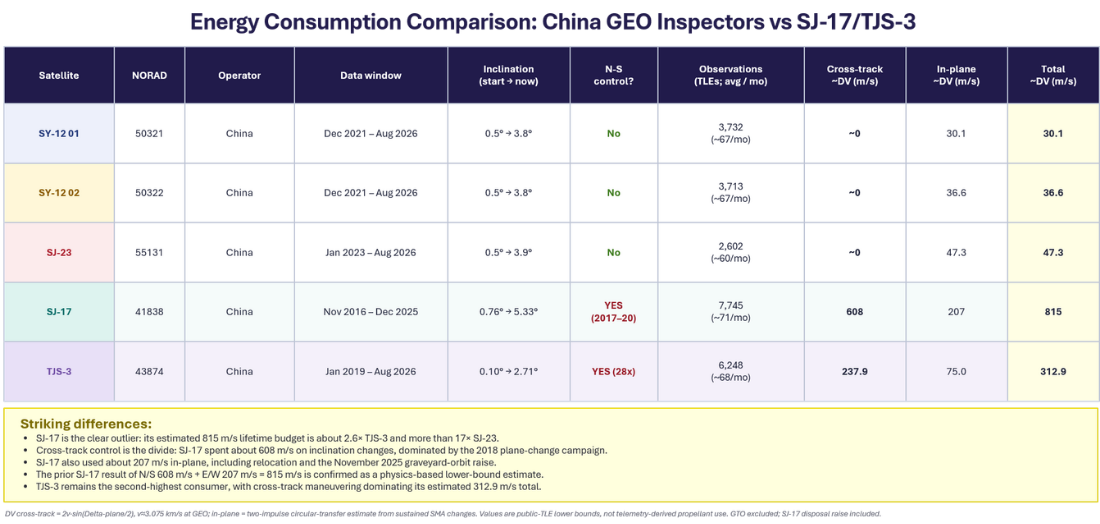
Neighborhood Watch vs Focused Patrol Delta-V Comparison
(based on data from Celestrak.org)

You must be logged in to post a comment.